
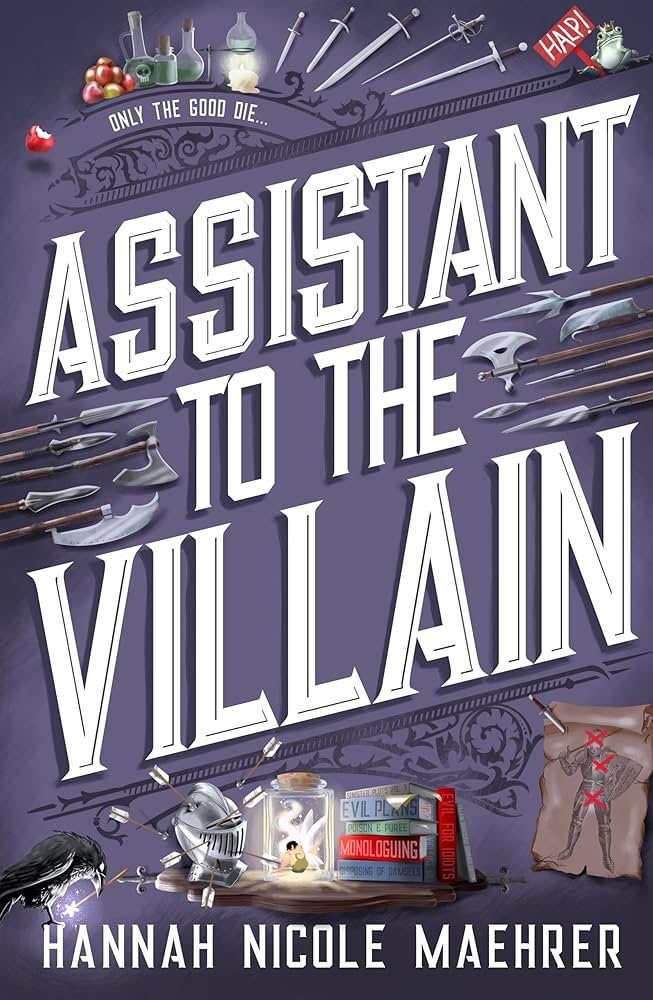
So, let’s talk about Assistant to the Villain by Hannah Nicole Maehrer. Because this book has been hyped as morally grey, villain romance… and that is not quite what it is…
If you expected grit, bite, and genuine menace in the bedroom, you may feel mildly betrayed.
If you expected a whimsical villain in a fantasy office romcom with slow burn tension you’ll probably have a really good time.
On this page, you will find a quick overview, and get a great understanding of whether this book is for you. Anything with major spoilers has been hidden behind a dropdown so you can choose if you want to know.
Takeaways
- Assistant to the Villain is a whimsical fantasy workplace romcom, the darkness is stunted by the humor, but that’s not necessarily a negative.
- It features a slow burn romance with minimal spice in book one.
- Evie is charming, capable, and refreshingly competent. A softer FMC who has a surprising stubbornness.
- Best suited for readers new to romantasy or those wanting light fantasy with yearning.
Overview
- Author: Hannah Nicole Maehrer
- Series: Assistant and the Villain, Book 1
- Publisher: Entangled: Red Tower Books
- Published: August 29, 2023
- Pages: 352
- Genre: Fantasy romcom
- POV: Dual (Evie + Trystan)
Should I read Assistant to the Villain?
Read it if:
- You want a light, whimsical intro to romantasy with a dash of violence.
- You like slow burn yearning with soft villain energy.
- You enjoy workplace romcom dynamics in a fantasy setting.
- You prefer low spice.
- You are here for character vibes over complex plotting.
- You like twists on twists.
Skip it if:
- You want epic romantasy.
- You expect a truly dangerous, morally grey villain.
- You dislike quirky, slightly naive narrators.
- You want heavy political intrigue or dark stakes.
At a glance
- Genre: Fantasy romcom
- Romance: Slow burn
- Spice: Very low in book one
- Tone: Whimsical, light, earnest
Tropes:
- Villain x assistant
- He fell first
- Workplace tension
- Slow burn yearning
- Found family
- Miscommunication
Darkness level: Mild
Ending: Satisfying, sequel ready
The tone? Whimsy first, danger second
This is where expectations matter.
Some of the marketing leans heavily on “morally grey villain.” It depends on where you got your rec. With that said, some readers expected Damon Torrance’s energy. Or something genuinely dangerous.
Instead, the Villain feels more like a moody executive with trauma than a ruthless tyrant. Sure, he murders someone for hurting a duck, but it’s wrapped in humor that removes the dark, evil feel of him. If you want to be slightly afraid of your MMC…I’m not sure this is the book.
The themes and plot points explored are gripping. Things that need true representation. I think the author will explore them in the coming books, and she may drop the whimsy a bit as it has to go deeper into the dark underbelly Hannah has created.
Where did Assistant to the Villain actually come from?
Before it was a novel, it was a TikTok series.
Hannah Nicole Maehrer built the story as serialized content on TikTok with short, punchy, comedic scenes that gathered a following before a publisher came knocking…entangled then picked it up, and the book version landed in August 2023. This matters because it explains a lot about the tone. It really does feel… piecemeal… funny, in a light-hearted, watered-down, for social media way.
When you wonder why the worldbuilding feels a little thin, or why the pacing leans into banter over stakes, that’s the Tik Tok.
The audience that followed it on TikTok got exactly what they signed up for. Readers arriving from the fantasy romance shelf with different expectations may feel confused. Neither experience is wrong. They’re just reading two very different versions of what this book promised them.
What is Evie Like?
Evie works.
And I mean that literally too.
One of the genuinely refreshing things about this book is that she is good at her job. She organizes. She solves problems. She stabilizes everyone around her (so you get to see some great character arcs that she genuinely connects with). She seems how you would imagine a mature young adult might handle people around them if they were parentified.
In romantasy, we often get chosen ones, assassins, and queens in exile. Here? We get admin excellence with a dash of mothering. That’s actually cool because it’s a little different.
She can lean naive because of the way the author handles her voice. Her voice is bright. Slightly whimsical. So, of course, that will divide readers. Some find it endearing. Others find it juvenile.
For me, she lands as charming but not especially layered in book one. I wonder if the author will take this into something a little darker later to balance out the themes, or stick to the fun, romcom, vibes.
What is The Villain Like?
If you expected true menace, evil, brooding, this is where you reconsider this read.
He is a little sulky.
He is traumatised.
He is violent.
He yearns.
He is not terrifying.
The “villain” branding oversells his darkness. He doesn’t scream fractured monster. Think rogue, dark prince, or bard energy. That works for some, obviously, but if you love Damon from The Vampire Diaries, you are getting more of a Stefan.
The chemistry? It’s slow burn. Very slow. But oh, the yearning.
The dual POV: does it work?
Yes. I actually loved it for this story. It was a good structural choice.
You get both Evie’s first-person voice and Trystan’s POV, and they read differently enough that the shift doesn’t feel like the same person wearing two hats. That takes skill to do, so for a debut novel, color me impressed.
Evie’s chapters are bright, slightly chaotic, mothering-the-whole-office energy. Trystan’s are quieter. Slower. You see him noticing things he’s absolutely not going to say out loud, which works really well to create that slow-burn, “you know they want to” energy.
The dual POV also does something useful, as it closes the information gap that makes slow burns frustrating. You’re not sitting there screaming,’ Why won’t he just say something? ‘because you already know why. You’ve been inside his head and get all the answers. It still has a little bit of miscommunication going on, which will be very frustrating for readers sick of that trope.
Plot and worldbuilding
The world is a fairly standard fantasy kingdom backdrop. It exists to support the workplace dynamic, not to rival epic fantasy. This isn’t a world where the author spent years weaving pieces together, but it is fun, which is the exact right word for this story.
The side characters? Some of them have stuck in my mind for ages after; they’re fun, feel real, feel like the right sort of pick for this story. Some feel lightly sketched, but there’s room to explore.
If you want intricate political fantasy, this will not satisfy you.
Does the plot have bite?
More than it seems at first, the real issue is tonal balance.
The whimsy sometimes softens the impact of the darker reveals, making you feel like you’re reading a soft YA for young teens. If the book had leaned harder into tension, those twists would have hit with more force. But that’s not really what this story called for. I think another author eventually will take this idea, run with it, and try a new tone. It’s a smart idea with a lot of leverage.
Is Assistant to the Villain spicy?
No.
This is a slow burn with minimal physical payoff in book one. It’s more tension than heat. If you want explicit open-door spice, this is not that book.

Why are reactions so divided?
If you’ve seen the reviews on Goodreads the split makes sense.
Readers who wanted:
- Dark.
- Morally grey.
- Genuinely dangerous.
- High stakes brutality.
Were disappointed.
Readers who wanted:
- Whimsical fantasy romcom.
- Soft villain.
- Humor.
- Slow burn.
- Light but emotional.
- A villain with a secret purpose.
Had a great time.
Is it actually good?
Here’s the honest answer. It’s not profound. That’s ok, not every book needs to be, and I can see what the author was going for.
I imagine this was planned as a cheerful, fun, quirky, almost Disney-like story, but add a touch of gore.
As an entry point into romantasy for readers who don’t want heavy spice or gross levels of violence, it’s actually a smart gateway book.
Gilt Score: 72 / 100
This is the scoring out of 100. 80 being a top read.
Worldbuilding: 8/15
Plot & Stakes: 11/15
Romance Execution: 14/20
Chemistry: 12/20
Character Depth: 8/15
Prose & Voice: 9/10
Originality: 8/10
Reader Fit Index
This helps you match the book to your needs, with 1 low and 10 high.
New to romantasy: 9/10
Dark romance lovers: 4/10
Spice seekers: 2/10
Workplace romcom fans looking for fantasy: 9/10
Epic fantasy readers: 3/10
Spoilers: What Actually Happens in Assistant to the Villain
Evie’s backstory and her father
Evie’s mother is dead, like most cliche main characters in fantasy stories, it works for a reason, but is also one of those tropes that a lot of readers quickly get sick of.
Her father is sick, too. But if you’re looking for a book with a good representation of chronic illness, you won’t find it here.
I found the ableism here a little…eesh. As someone with a severe chronic illness and children, there were moments I felt the inner monologue wasn’t kind enough, or made Evie a martyr to his illness. It’s great to have representation of the devastation of chronic illness, but at the cost of making the sick look like manipulators, and willing to use their children, it’s a little much. I can’t quote you the exact lines, but I remember the feeling. If you have experience with chronic or progressive illness, go in aware that some of the framing around his limitations may make you wish for better representation, and realize there’s not much.
Because of his illness, money is tight. That’s what pushes Evie into applying for the Villain’s assistant position in the first place.
SPOILER
As the story unfolds, it becomes clear that her father is not just flawed. He is deeply corrupt and involved in trafficking and exploitation. He essentially offered Evie up as leverage. Yey for dead mother evil father trope.
This is where the book unexpectedly sharpens. For all the whimsy and office banter, Evie’s family trauma is dark. It just sits under a bright narrative voice.
The Villain, Trystan, is branded as the kingdom’s great evil. Cape. Reputation. Fear. The whole nine yards…and something about it I didn’t buy from the start. (Of course, it turns out he’s not really the villain and that’s not very surprising.)
Instead of villainry he is actively working against corruption within the kingdom. His “villainy” is partly constructed and partly strategic. He operates in moral grey space, but not in the gleefully sadistic way you might expect from a whimsical villain romcom.
I think something like Alchemised had a darker, grittier, morally grey villain that is more up my street. So do with that info what you will. And I think the Shattered series had a better morally grey villain with savior undertones. But neither beats the yearning Trystan has.
Evie is eventually targeted because of her proximity to the Villain and because of her father’s corruption. The external stakes finally move beyond paperwork and office chaos.
This is where the book shifts from whimsical workplace to legitimate danger. It proves there is plot under the banter. But that plot is dressed in the kidnapping trope common of most romantasy (I personally love it, even when I write my own novels, kidnapping winds up in there somewhere). Trystan’s yearning and all the rest of it really add to the heat of this moment.
This is where Trystan’s mask cracks properly. Where the slow burn yearning finally lands in a way that feels earned, as you can see it’s quite late in the book.
It is not explosive spice. But by this point in the book you know it won’t be.
The restraint up until this point makes that emotional reveal satisfying, especially as he out right refused to kiss her just chapters before. By this point, it’s not a will they won’t they more than it is a why won’t they do it right now.
The final act confirms:
- The corruption runs deeper than assumed.
- Evie is not a passive assistant but a strategic asset.
- The Villain is playing a longer political game.
The ending is not a complete resolution. It is a pivot though, which allows the author to have a sequel (which they do!) if she so chooses. Smart marketing, fun idea.
I actually haven’t picked up the next book yet, mostly because I think this is one of those stories you really need to be in the mood for.
Frequently Asked Questions
Honestly? It depends entirely on what you came for. If you wanted dark, morally dangerous villain energy and high stakes fantasy, you’ll probably feel let down — and that’s a valid read of the marketing. If you wanted a whimsical workplace romcom with slow burn yearning and a soft villain who yearns silently for 300 pages, it absolutely delivers. The divide makes sense. Both camps are right about what they experienced.
No. The novel is completely self-contained and was written to be accessible whether or not you’d seen any of the original content. If you’ve followed Hannah Nicole Maehrer’s TikTok series, you’ll recognise the world and characters and get some extra joy from the translation. If you haven’t, you’re not missing anything that affects the reading experience.
Yes — Apprentice to the Villain picks up where this one leaves off. I haven’t read it yet, mostly because this is one of those stories I need to be in the right mood for, but if the ending left you desperate for more Trystan, it’s there waiting for you.
No. Book one is very low spice — think slow burn tension, yearning, and one emotionally loaded moment rather than explicit open door scenes. If you’re here for heat, this is not your book. If you’re here for the slow accumulation of feelings until Chapter 46 makes you briefly lose your mind, you’re in the right place.
Yes, heavily. It’s the main mechanism keeping the slow burn slow. Trystan withholds, Evie misreads, repeat. Readers who love the agonising accumulation of almost-moments tend to enjoy it. Readers who find miscommunication frustrating will likely feel the gears grinding by the midpoint.
Yes, and that’s worth knowing going in. The consistency of voice and the pacing hold up better than a lot of debuts — but some of the thinner worldbuilding and underdeveloped subplots will probably be further fleshed out in the next books.
It’s published as adult fantasy romance, but the tone reads closer to YA in places — the humor is broad, the voice is bright, and the spice is minimal in book one. If you handed this to a mature teenager they’d probably be fine. If you’re an adult reader expecting adult dark fantasy, that tonal softness is worth knowing about upfront.
Readers new to romantasy who don’t want to wade straight into heavy spice or grimdark stakes. Fans of workplace romcom energy who want a fantasy wrapper. People who are patient with slow burn and enjoy found family dynamics alongside their romance. It’s a gateway book in the best sense — accessible, emotionally satisfying, and low stakes enough to be a genuinely fun read.
Hannah Nicole Maehrer wrote it, and the story actually started as a serialised TikTok series before it was picked up by Entangled Publishing. That origin explains a lot about the tone — content built for social media rewards immediate humour and punchy character moments over slow-building complexity, and you can feel that DNA throughout the novel. It’s not a flaw. It’s just the shape the story grew in.