
The Quicky Answer
This table will give you a quick answer, if that’s what you seek, but if you go on a little scrolling journey, you’ll get all the info only a true reader would catch.
| App | Best For | Key Features |
|---|---|---|
| StoryGraph ↓ | Data-heavy readers | Mood filters, quarter-stars, stats & content warnings |
| Fable ↓ | Social reading & book clubs | Discussion-first, spice ratings, shareable posts |
| Hardcover ↓ | The “new Goodreads” reader | Social + stats + recommendation match score |
| BookWyrm ↓ | Privacy-first readers | Federated, open source, anti-monolith |
| LibraryThing ↓ | Physical library lovers | Barcode scanning, deep metadata, serious cataloging |
| Margins ↓ | Aesthetic & casual trackers | Cover selection, mood search, reading timer |
| Litsy ↓ | Bookstagram readers | Short-form sharing, quote posting, Pick/Pan/Bail |
| Bookworm Reads ↓ | Community-first readers | Playful UI, clubs, message-board style social feed |
| Goodreads | Crowd consensus only | Unbeaten review volume — even if you hate it |
Best Goodreads Alternatives for Book Lovers Reviewed
Goodreads has had the monopoly on where we store our reading conquests for well over a decade, which is why so many choose to use it as their book hub. But once you become a book addict Goodreads starts to show its many flaws.
Add to that the Amazon ownership questions, and the fact we still can’t add even a half-star in our ratings in the year of our book God’s 2026….and it’s little wonder readers always meet the inevitable question of…what’s better out there on the interwebs?
The answer, wonderful reader, is many, other, options. Which Goodreads alternative is actually best for you, though, depends entirely on how you read and what kind of tracking you care about.
On this page, I’ve broken down the best Goodreads alternatives in 2026 by reading style, including the features you’re probably looking for, (and which aren’t always immediately obvious on their landing pages). StoryGraph, Fable, and Hardcover are, of course, mentioned, but I’ve tried to throw in some platforms you might not know about but could be the perfect fit for you.
At a Glance: Goodreads Alternatives Compared
| App | Best For | Biggest Strength | Biggest Downside |
| Goodreads | Maximum review volume + mainstream discovery | Massive community, barcode scanner, reading challenges | Amazon-owned; review bombing concerns; no half-star ratings |
| StoryGraph | Data-driven “is this worth my time?” decisions | Quarter-stars, mood/pace filters, content warnings, buddy reads | Less social polish; non-English catalog can be patchy |
| Fable | Book clubs, social reading, shareable stats | Club-centric design, chapter rooms, spice ratings, social media post generation | Feed can get noisy; had an AI controversy in early 2025 |
| Hardcover | “New Goodreads” with stats + recommendation score | Match-percentage recs, lists, modern UI | Smaller catalog; bugs; still growing |
| BookWyrm | Privacy-first, anti-monolith, small community feel | Federated (ActivityPub), deep privacy controls, imports from everywhere | Smaller review pool; must choose an instance |
| LibraryThing | Cataloging your physical or digital library | ISBN scanning, deep metadata, tens of millions of library records | Catalog-first, not social-first; UI feels traditional |
| Litsy | Bookstagram-meets-book-tracker | Short-form sharing, quote posting, Pick/Pan/Bail ratings | No deep stats or structured recommendation filtering |
| Margins | Aesthetic tracking + mood-based search | Half-stars, cover selection, reading timer, “Stopped Reading” status | Newer platform; catalog gaps being actively addressed |
| Bookworm Reads | Community-forward + fun UI + book clubs | Bright playful identity, clubs, importing, custom shelves | Some users want stronger privacy controls |
Why Are Readers Leaving Goodreads?
Goodreads became the default not because it was particularly good, but because it was first and everywhere, it gave authors a way to set up and see all of their reviews in one place, and readers somewhere to track what they had already finished. For years, there wasn’t a real alternative, so everyone built their reading lives on a platform that — which let’s be kind — hasn’t exactly been in a hurry to evolve.
Amazon vs. Goodreads
Amazon bought it in 2013, and that’s the moment readers started treating Goodreads ratings as a slightly compromised data source. It’s not purely optics — when the platform helping you decide what to buy is owned by the world’s biggest bookseller, questions about neutrality aren’t unreasonable.
Review Bombing and Scammy Tactics
Review bombing is a documented, structural problem, sometimes it’s other authors trying to hurt other authors, sometimes it’s bad marketers selling black hat nonsense, Sometimes it’s just bad luck.
There are well-reported cases of coordinated one-star attacks on authors before their books are even published and Goodreads’ general response has been to tell users to flag suspicious reviews themselves, which they then half the time don’t take down. A website at this scale needs to get their act together.
Stagnant Features
Feature stagnation is real. Goodreads has confirmed in their own support responses that they have no plans to add half-star ratings — in 2026. They are, finally, rolling out a native DNF shelf that just hit, this month (March 2026).
Data Portability
Data portability is the quiet pain point. When you export your Goodreads library as a CSV, the “date started” field isn’t included. If you’ve been logging books for a decade, that’s a significant chunk of your reading history that simply doesn’t exist in any export file. This makes stats-focused alternatives harder to fully populate and makes people reluctant to leave.
None of this means Goodreads is over, and everyone will leave. It still has the biggest review database by a meaningful margin, and for crowd consensus, nothing touches it. But it’s genuinely no longer the only option, and for a lot of serious readers, it’s not the best one either.
What Actually Counts as a Goodreads Alternative?
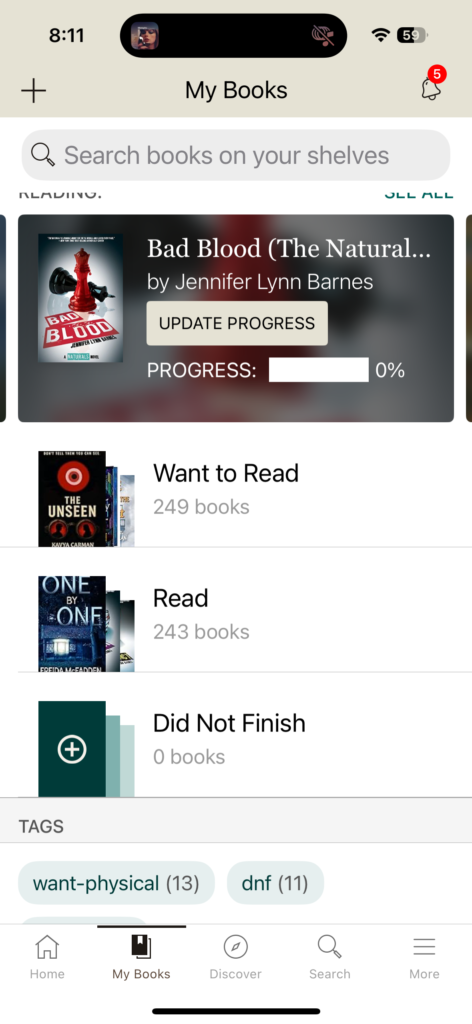
Not every book app is a real replacement for Goodreads as some are better at doing something else. But you may find you actually prefer that.
A real alternative needs to improve at least one of the jobs readers actually use Goodreads for:
- Helping you figure out whether a book is worth your time. This means structured ratings, mood and pacing filters, content warnings, and honest community reviews. StoryGraph is the strongest here; Fable adds explicit spice-level ratings and tags.
- Tracking what you’ve read, what you want to read, and how you actually read. Essentials are TBR/currently reading/read/DNF, but readers increasingly care about stats that reflect how they read, not just what. Multiple alternatives treat DNF as a first-class status rather than a shame shelf, and Goodreads is only now catching up.
- Finding your next book. Goodreads defaults to popularity. StoryGraph uses mood and pacing filters plus machine learning. Hardcover gives recommendations a 0–100 match percentage score you can actually interpret. Fable relies on book clubs where you can meet people who choose what to read together based on themes.
- Reading with other people, in a way that feels like a book club rather than a comment section. Fable and Bookworm Reads are explicitly built around this; BookWyrm takes a quieter, more intentional route with federated small communities. In Fable, it can be hard to find busy clubs, but maybe that will change as time goes on.
For romance and romantasy readers specifically, the decision layer matters most because “is this slow burn?” and “how explicit is this?” are not abstract preferences. They are genuine is this worth my time tonight? questions.
Best Goodreads Alternatives for Data-Driven Readers
Storygraph
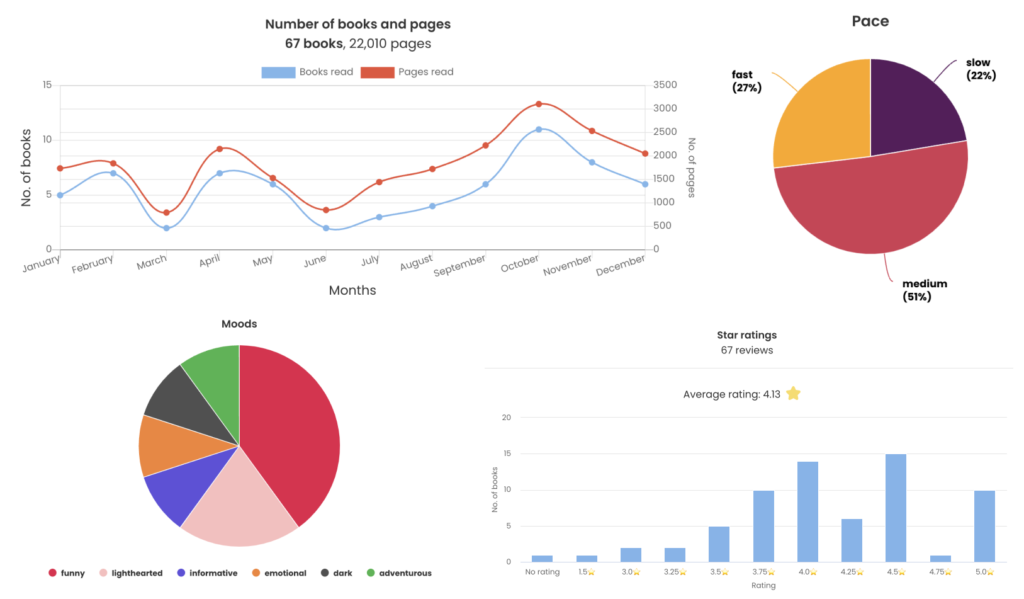
What it feels like: A mood board crossed with a spreadsheet, in the best possible way. StoryGraph centres your entire reading experience around filters and structured data . It asks what pace are you in the mood for. What emotional register? Do the content warnings flag anything you need to know about?
The main loop: Set your reading preferences → log what you’re reading → use mood and pacing filters to choose what’s next → watch your stats charts accumulate.
What makes it worth switching: Quarter-star ratings. Mood and pacing filters. Content warnings built into every book record. Spoiler-protected buddy reads that lock comments until both readers reach the same point. Reading graphs and charts that actually tell you something about how you read, not just what. For anyone using Goodreads primarily as a should I read this? tool, StoryGraph is flatly better at that specific job.
The honest tradeoffs: The social layer is functional but not particularly photogenic. Some users want a more shareable, visual experience — it’s not quite there yet. Non-English catalog coverage and search with special characters can be uneven for some languages.
Use this if you: Make reading decisions based on mood, pacing, and emotional stakes. Care about content warnings. Want structured ratings that actually distinguish between “pretty good” and “great.”
Skip this if you: Want slick social media-ready graphics out of the box, or read primarily in a language other than English.
Hardcover
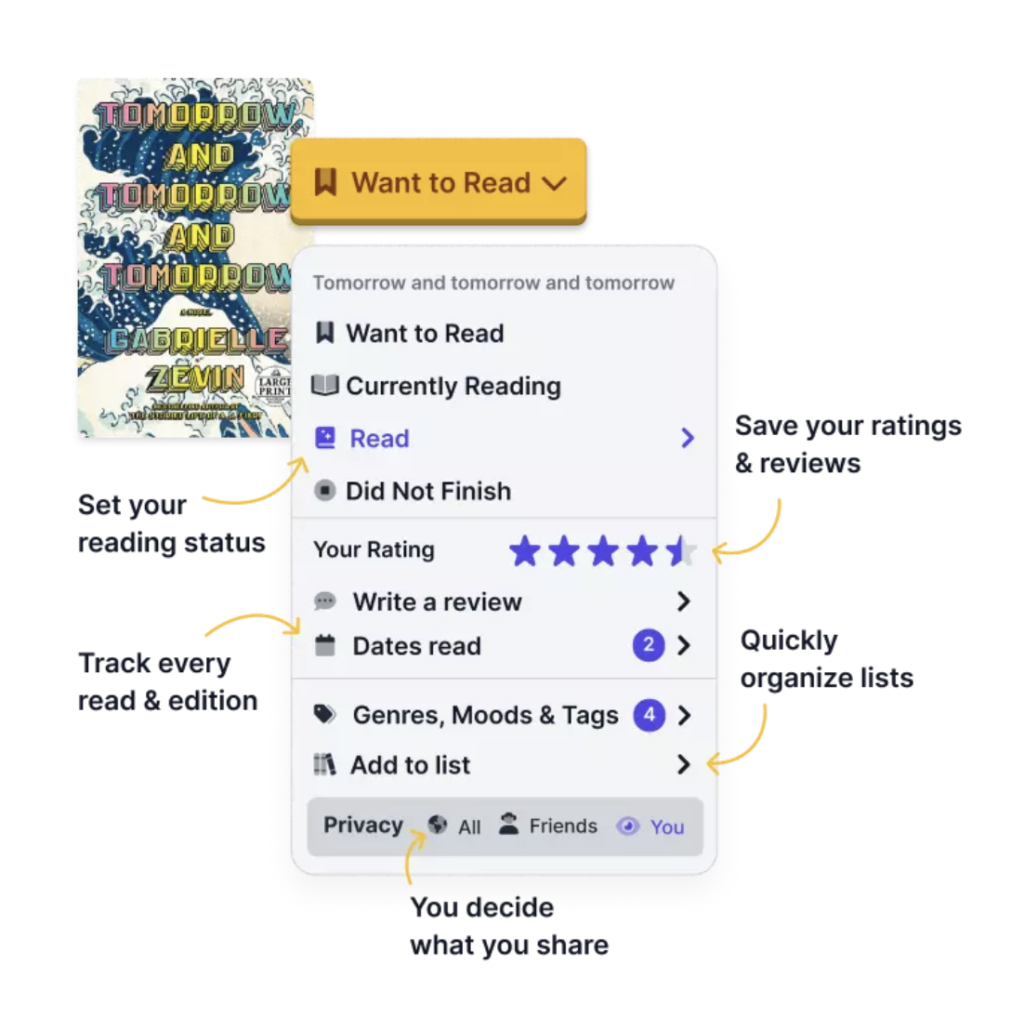
What it feels like: Goodreads rebuilt by someone who’d clearly been watching Letterboxd succeed and decided to apply the same logic to books. Lists, shelves, a clean modern UI, and a recommendation system that gives you a number — Hardcover calls it a “match percentage,” a 0–100 score for how likely you are to enjoy a given book.
The main loop: Find → track → connect → discover, in a structure that feels familiar if you’ve used Goodreads, but considerably more satisfying to scroll.
What makes it worth switching: If you’re a social Goodreads user who wants a newer UX and a more deliberate recommendation engine, Hardcover is the most direct like-for-like upgrade. iOS users describe it as “one of the best looking apps” they’ve used.
The honest tradeoffs: This is still a growing platform, and user reviews are honest about that — crashes, slow loads, occasional missing books, and a smaller catalog than Goodreads or StoryGraph. Trope and spice tagging for romance readers isn’t a core native feature yet; users have actively requested it on Hardcover’s public roadmap.
Use this if you: Want a familiar Goodreads-style social experience with a more contemporary feel, and you’re patient with a platform that’s still building out its feature set.
Skip this if you: Need a complete, reliable catalog from day one, or need spice and trope tags built into your review flow.
Best Apps for Social Reading and Book Clubs
Fable
What it feels like: Goodreads, if it had been designed for the BookTok generation by people who’ve actually been in a book club. The whole app is structured around reading together — clubs, chapter rooms, spoiler-aware discussion spaces — rather than treating community as a bolt-on to a cataloging tool.
The main loop: Pick a book → join or start a related club → read chapter by chapter → see what others had to say chapter by chapter → log TBR/reading/finished/DNF alongside your social reading life → get feedback on what kind of reader you are to make “friends like you”. The main areas (feed, clubs, explore, profile) are kept clearly separated so the app never feels cluttered.
What makes it worth switching: Fable’s review flow is more expressive than Goodreads — half-star ratings, expressive tags, and explicit spice-level ratings built directly into the review process, which matters enormously for romance and romantasy readers who need that information before committing to a book.
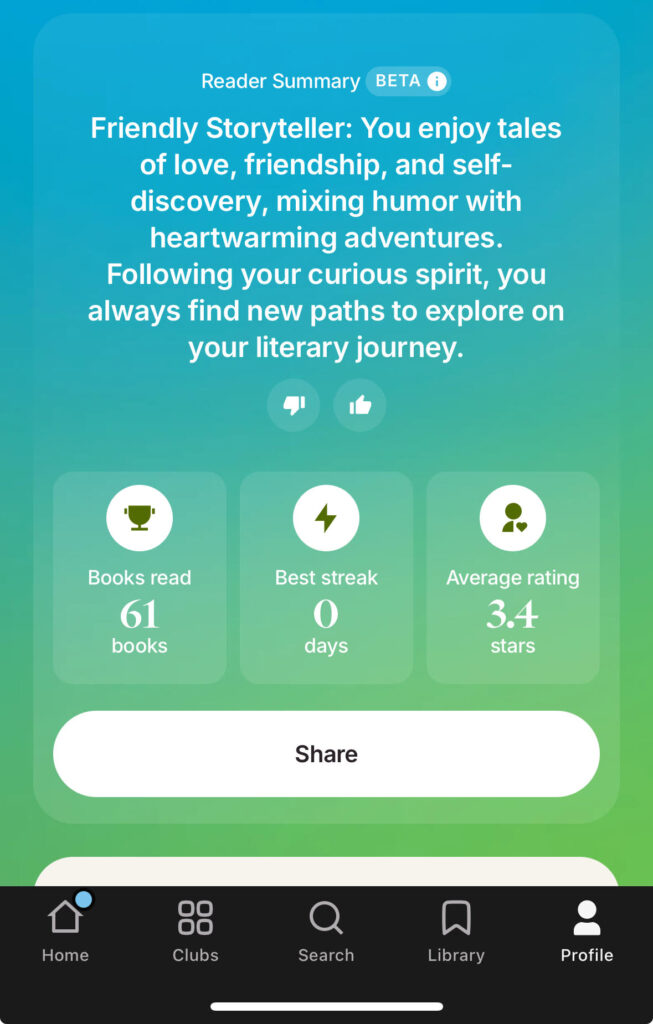
The social media posts feature: This is where Fable does something none of the other apps on this list does properly. Fable generates shareable reading stats cards — think Spotify Wrapped energy — with your reading identity, best streak, goal progress, and average rating, formatted to post directly to Instagram or TikTok. If your reading life and your social media life overlap at all, Fable is the only platform that’s actively built to bridge them.
The honest tradeoffs: A social feed being the core of the app means it can get emotionally noisy. There’s currently no granular “show me less of this” control — you can mute users or mute everything tied to a specific book, but not much in between. Worth flagging for your audience: in early 2025, Fable had a significant public controversy after an AI-powered year-in-reading feature generated offensive content; Fable removed the AI summaries and other AI features after the backlash. The shareable stats cards are not AI-generated.
Use this if you: Want reading to be a genuinely social experience — clubs, discussion, shared reading — and you enjoy having something beautiful to post about your reading habits.
Skip this if you: Read mostly alone, have a low tolerance for social feeds, or are still cautious about Fable’s reputation following the AI controversy.
Bookworm Reads
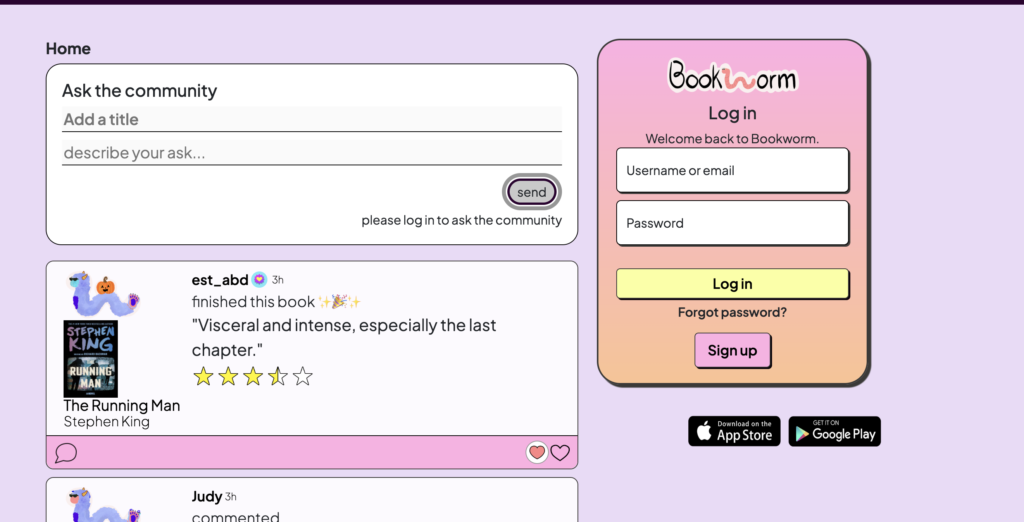
What it feels like: Goodreads with a personality transplant and a significantly more cheerful colour palette. Structurally familiar (shelves, tracking, challenges, clubs), but it has a playful identity — including a customisable “worm” avatar that is exactly as delightful as it sounds.
The main loop: Import from Goodreads, StoryGraph, or Libib → customise your shelves → join clubs → participate in a social feed that behaves more like a message board than a review site, which turns out to be an easier place to actually build community.
What makes it worth switching: The community-first approach makes it genuinely easy to find your people, especially if you’re already in book club spaces. Challenges and custom bookshelves are core features, not afterthoughts.
The honest tradeoffs: Some users want more privacy controls. Bookworm Reads is set up so that your activity surfaces in timelines by default, and there’s limited flexibility around that at the moment.
Use this if you: Want Goodreads’ general structure with a warmer, more playful community feel and a UI that doesn’t take itself too seriously.
Skip this if you: Prioritise privacy controls, or you’re primarily using a tracker for personal stats rather than social engagement.
Best Options for Privacy and Serious Cataloging
BookWyrm
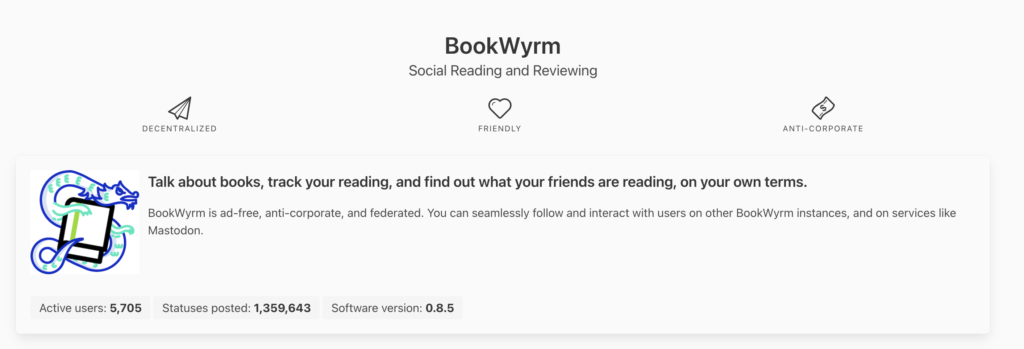
What it feels like: The reading tracker for people who’ve thought seriously about data ownership and don’t want their reading life sitting on a corporate server. BookWyrm is built on ActivityPub, which is the same federation protocol that powers Mastodon — meaning you join a specific server (“instance”) and connect across a wider network, rather than signing into one centralised platform.
The main loop: Choose an instance from the official directory → set up your account → log reading, write reviews, follow people. The experience is quieter and more intentional than most alternatives.
What makes it worth switching: Multiple post privacy levels that go meaningfully deeper than most centralised apps. Official support for importing from Goodreads, StoryGraph, LibraryThing, and more — making it a realistic destination for anyone who wants to migrate their reading history and actually keep it. For readers who are genuinely uncomfortable with Amazon holding their book data, BookWyrm is the most principled exit route available.
The honest tradeoffs: The review pool is smaller and varies depending on which instance you’re on. Setup involves more friction than any other app on this list — choosing an instance is not complicated, but it is an extra step that casual users may find odd.
Also worth knowing: you cannot change a post’s privacy level after it’s published.
Use this if you: Care about data ownership and privacy, want to get off centralised platforms entirely, and like the idea of a smaller and more intentional reading community.
Skip this if you: Need large review volumes, want zero setup friction, or rely on social discovery across a wide network.
LibraryThing
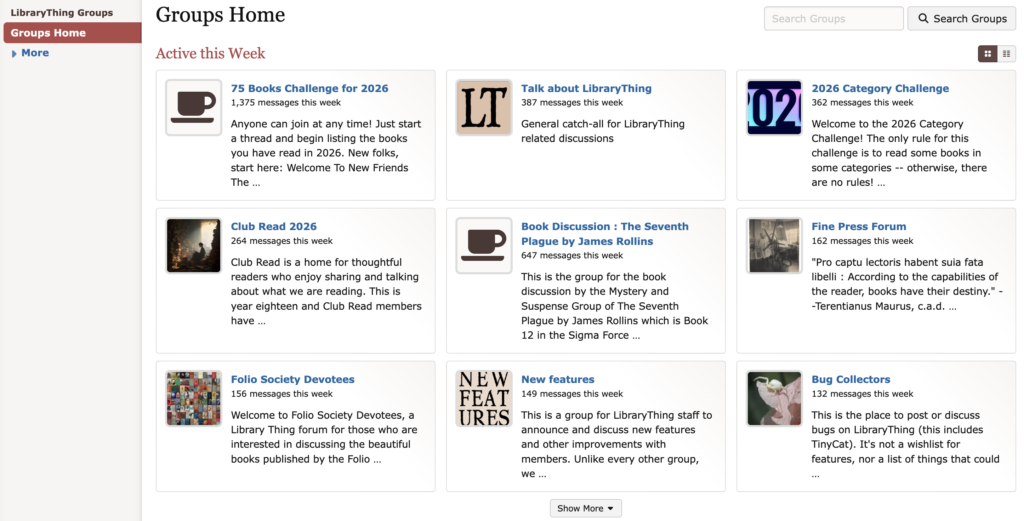
What it feels like: A very serious card catalogue that is also extremely kind to people with physical book collections. If you have a real-world library you want to properly document — not just log books you’ve read, but catalog them with accurate metadata, editions, and cross-referenced library data — LibraryThing is the only app here built specifically for that job.
The main loop: Add books via ISBN scan or search → organise into collections and tags → browse your own library. There are community features and discussion groups, but they’re not the primary hook.
What makes it worth switching: The cataloging depth is unmatched — tens of millions of library records, multiple data sources, and an ISBN scanner that’s been working reliably since before most of these apps existed.
The honest tradeoffs: This is catalog-first and social-second, and the UI reflects that clearly. If you’re migrating from Goodreads for community or recommendation features, LibraryThing will feel like a step back in both areas.
Use this if you: Want to properly document a physical or mixed collection, care about metadata precision, or need multiple library data sources in one place.
Skip this if you: Want social features, reading challenges, or a modern UI as your primary experience.
Best Apps for Aesthetic and Casual Tracking
Margins
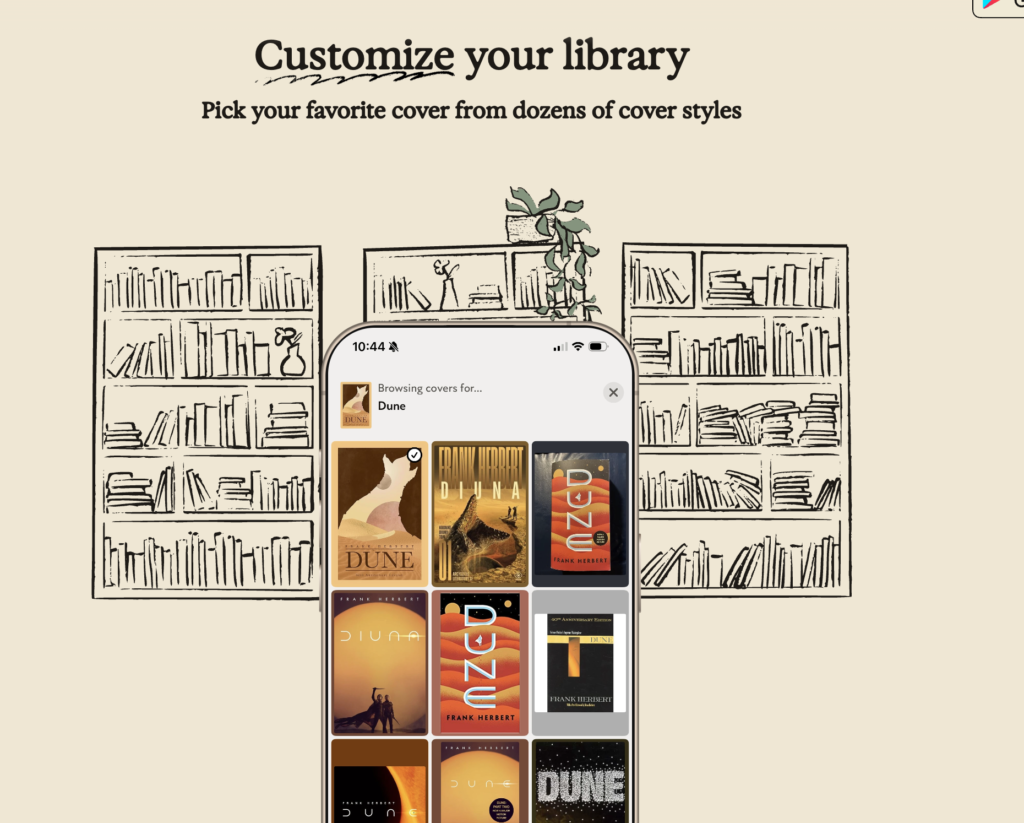
What it feels like: The reading tracker for people who are mildly particular about which cover edition gets to represent a book on their shelves. Margins leans into the feel of reading rather than the data architecture of it — mood-based search prompts (“books that feel like 1920s Paris”), cover selection, a reading timer with distraction blocking, and half-star ratings.
The main loop: Find a book → choose your preferred cover edition → track with half-stars and a reading timer → use “Stopped Reading” (a better framing than DNF) when needed. Fuzzy dates (“sometime in 2024”) are available for people who track retroactively and don’t need to pretend they have perfect records.
What makes it worth switching: The cover-selection feature is a bigger deal than it sounds, Goodreads notoriously defaults to whichever edition it feels like, and multiple Margins users specifically cite this as the reason they made the switch. The mood-based discovery angle is also more useful for romantasy readers than it might initially seem — “books that feel like X” is actually how many readers search.
The honest tradeoffs: Early users complained about not being able to add titles themselves, which is a significant catalog limitation. By March 2026, manual additions via Goodreads links, Amazon links, and ISBNs are now available — active iteration is happening fast.
Use this if you: Care about aesthetics, want cover-display control, like mood-based search, or need a reading timer and focus tools built into your tracker.
Skip this if you: Need maximum catalog depth immediately, or want deep social features and community discussion.
Litsy
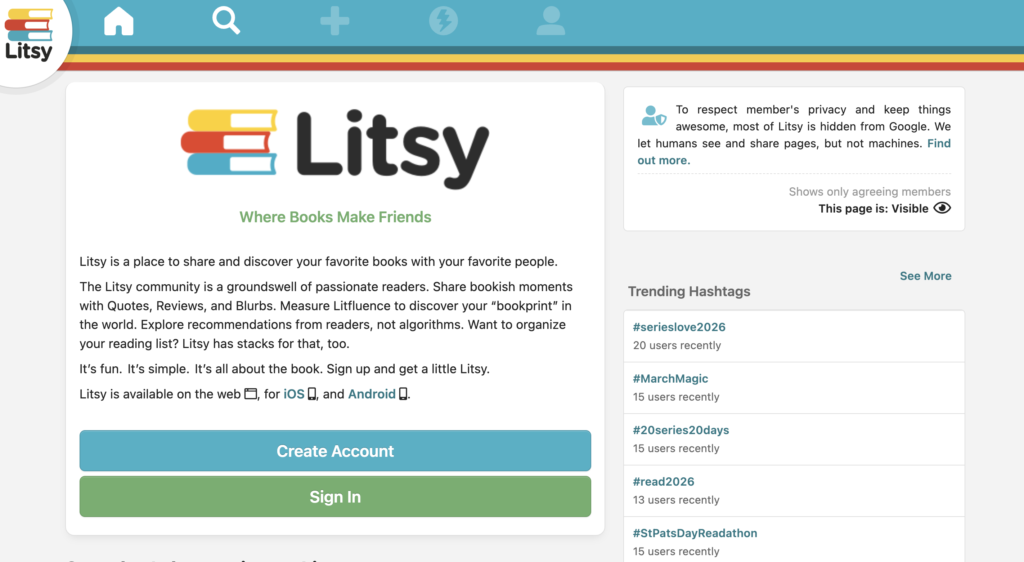
What it feels like: Instagram for books, with a rating system that actively resists scorecard culture. Litsy is built around short-form sharing — quotes, blurbs, reviews, and “stacks” for organising reading lists. The rating system is “Pick / So-So / Pan / Bail” rather than stars, which shifts the whole register from score-tracking to reaction.
The main loop: Post a quote or reaction → browse other readers’ stacks → find your next read by scrolling and exploring rather than filtering and sorting.
What makes it worth switching: If your reading life already lives on Bookstagram and you want a platform built around the content you’re already making, Litsy is the most natural fit. Quote-posting is a core feature.
The honest tradeoffs: Litsy is not a data tool. There are no mood filters, no structured recommendations, no content warnings. If you’re trying to solve Goodreads’ discovery problem, Litsy won’t help you.
Use this if you: Post about books on social media, love quote-sharing, and want community over analytics.
Skip this if you: Make reading decisions based on structured data, need stats, or require content warnings.
A Note on Data Portability and Migration
If you’ve been on Goodreads for years, the real question isn’t which app looks better — it’s how much of your history you can actually bring with you.
The Goodreads CSV export is the backbone of most migrations, but it has known gaps. “Date started” is not included in the export, meaning any stats-focused platform has to ask you to re-enter or approximate that data. Some users also report sporadically missing “date read” entries, which makes people nervous about leaving a platform where their reading record might already be incomplete.
How the main alternatives handle it:
- StoryGraph imports Goodreads shelves and maps custom shelves to tags, but acknowledges that the missing start-date problem originates with Goodreads’ own export. They also allow users to fill in missing metadata themselves — covers, formats, and more.
- Fable imports Goodreads lists and reviews directly from settings and maintains a workflow for flagging missing or incorrect catalog entries.
- Hardcover imports CSV from Goodreads or StoryGraph — user experiences are mixed, with some calling it the only service that successfully transferred their full history, others reporting bugs. They’re also building export functionality, which is an underrated trust signal.
- BookWyrm is arguably the strongest on portability. Official documentation supports imports from Goodreads, StoryGraph, LibraryThing, and more.
- Margins and Bookworm Reads both market migration as a feature, but as newer platforms, catalog completeness is the tradeoff to watch.
The Gilt List Verdict
| If you are… | Use this |
| A data reader who wants structured decision tools | StoryGraph |
| A social reader who wants clubs and conversation to be the whole point | Fable |
| Someone who wants Goodreads but newer and better-looking | Hardcover |
| Someone who wants out of the corporate reading ecosystem entirely | BookWyrm |
| A physical book collector who needs serious cataloging | LibraryThing |
| A Bookstagram person who wants a platform built around sharing | Litsy |
| Particular about aesthetics and mood-based discovery | Margins |
| A community reader who wants warmth and playfulness over data | Bookworm Reads |
| Someone who needs sheer review volume regardless | Keep Goodreads alongside something else |
FAQ: Goodreads Alternatives, Book Tracking Apps, and What’s Actually Worth Your Time
Depends what you’re using Goodreads for. If your main use case is “I want to check what the crowd thinks before I commit two days of my life to a book,” Goodreads still wins on sheer review volume. But if you want a book tracking app that helps you make better decisions — quarter-star ratings, mood and pacing filters, content warnings, real reading stats — StoryGraph is flatly more functional. The honest answer most readers land on is: StoryGraph for decisions, Goodreads for crowd-checking. They’re not mutually exclusive.
StoryGraph has a free tier that covers the core features — tracking, recommendations, mood filters, reading stats — and most readers never need to upgrade. Fable is also free to use for basic tracking and club participation. BookWyrm is entirely free and open source, though you’ll need to pick an instance to join. Hardcover has a free tier, but some of the more advanced stats features have moved behind a paywall in recent updates, which is worth knowing before you migrate.
A few reasons, and they tend to stack. Amazon bought Goodreads in 2013, which hasn’t sat well with readers who want a neutral discovery tool rather than a shopping recommendation engine. The platform has a documented review bombing problem — coordinated one-star attacks on books before they’re even published — and Goodreads’ moderation response has historically been to tell users to flag things themselves. Feature stagnation is the other big one: Goodreads still doesn’t have half-star ratings (by choice, confirmed in their own support responses), and the DNF shelf only became a native feature in March 2026. A lot of readers have simply run out of patience.
Yes to all three. You export your Goodreads library as a CSV (My Books → Tools → Import and Export), then import into whichever platform you’re moving to. The catch is that Goodreads’ own export has gaps — “date started” isn’t included, which affects start-date analytics in any app you move to. StoryGraph handles the import smoothly and maps custom shelves to tags, but it’s working with the same incomplete CSV Goodreads produces. Fable imports lists and reviews directly from settings. Hardcover imports CSV and is also building its own export function, which is a genuinely good sign for long-term data ownership.
Fable, by a comfortable margin. It’s built specifically around club and discussion features — chapter rooms, spoiler-aware discussion spaces, club lobbies — in a way that no other app on this list treats as a core feature rather than a bolt-on. If you want structured group reading with proper spoiler protection and the option to add spice ratings and expressive tags to your reviews, Fable is the obvious answer for that specific use case.
StoryGraph and Fable do the most relevant work here, but for different reasons. StoryGraph foregrounds mood, pacing, and content warnings — which matters enormously when you need to know whether something’s going to emotionally level you before you start. Fable is the better choice if spice level and expressive community discussion are your priority: spice ratings are built directly into the review flow, and the club format is great for romantasy fandoms who want to read and screech together. If you’re primarily choosing between slow burn versus instalove, content warning versus no warning, or cosy versus dark, StoryGraph’s filters are doing more of that work than any other app.
Yes. Amazon acquired Goodreads in 2013, and it has been a subsidiary ever since. The platform announced it was “joining the Amazon family” publicly at the time, which is when a meaningful chunk of readers began questioning whether it could function as a genuinely neutral book discovery engine. That concern hasn’t gone away — it’s now one of the most cited reasons readers give for looking at Goodreads alternatives.
BookWyrm is an open-source, federated book tracking platform — the reading equivalent of Mastodon. It’s built on ActivityPub, meaning you join a specific server (called an “instance”) and connect across a wider network rather than signing up to one centralised platform. It’s worth using if you care about data ownership, privacy, and getting out of the corporate ecosystem entirely. It has multiple post privacy levels, proper import support from Goodreads, StoryGraph, and LibraryThing, and a genuinely cleaner interface than Goodreads. The realistic limitation is that review volume is smaller — you’re in a community, not a crowd — and setup has more friction than a standard app. If that tradeoff works for you, it’s a serious option.
LibraryThing is the answer here. It’s built primarily as a cataloging tool rather than a social reading platform, with ISBN barcode scanning, deep metadata sourcing from tens of millions of library records, and serious tagging and collection organisation. If your goal is documenting a real physical collection with accurate metadata and multiple data sources, LibraryThing does that better than any other app on this list. It’s not the right choice if you want social features, reading challenges, or a modern UI — but for catalog-brain readers, it’s unmatched.
No. Goodreads uses a standard one-to-five-star system with no half-star option, and their own support team has confirmed there are no plans to change this despite years of user requests. This is one of the longest-running and most-cited user frustrations with the platform — and it’s the reason StoryGraph’s quarter-star ratings and Fable’s half-star ratings tend to be the first features people mention when explaining why they switched. For genres where the difference between 3.5 and 4 stars genuinely changes a reading decision, it’s not a minor omission.
Margins is the most interesting newer entrant right now. It leans into aesthetic tracking — you can choose which cover edition gets to represent a book on your shelves, use mood-based search prompts (“books that feel like 1920s Paris”), log fuzzy dates, and use a built-in reading timer with distraction blocking. Early catalog limitations (not being able to add books yourself) have been actively addressed in 2026 updates, with manual additions now available via Goodreads links, Amazon links, and ISBNs. It’s not trying to replace StoryGraph’s data depth or Fable’s social features — it’s doing something slightly different, and for the right reader, it’s exactly right.