
Readers are not usually DNFing your fantasy novel because the writing is bad, or even because you’re bad at crafting a novel. They’re leaving because…psychology. In fantasy, that usually means too much cognitive load, transient transportation, or memory chunks. Intrigued and want to know exactly how to apply it? Let’s get into it.
Why Readers DNF Fantasy
You stayed up until midnight writing it. You revised it four times. Somebody called the prose poetic, which carried you emotionally for at least three business days. And then someone DNF’d it on page eleven. Before the magic system really got going or anyone really did anything profound. Rude.
So, like every determined writer, you go back to the craft advice. Add more tension. Raise the stakes. Make the protagonist more likeable. Start with a stronger hook. Add more danger sooner. Write the perfect opening line.
You rewrite chapter one….Again.
Maybe it helps a little. Maybe the next beta gets to page twenty-three before drifting off into the great beyond of laundry, Netflix, and somebody else’s Kindle sample. Progress! Well, a little.
The problem is the advice you’re following. It’s not meant to be blanket advice, and it’s way harder to apply any of it to fantasy than it is any other genre.
Listen up… Readers don’t leave because your writing is bad. They leave because your book is too much work to get into the obsessiony bits.
Why Readers Stop Reading a Fantasy Novel They Were Excited About
The usual craft advice says readers quit because they were not hooked. The main character was unlikable, and the opening didn’t have enough speed or tension. Sometimes that is true, but there is something happening underneath all of that which writers are not taught to diagnose nearly enough.
Cognitive load.
Cognitive load is the amount of mental effort your reader’s brain has to spend to understand and move through your story. Or, frankly, how many calories their brain is burning just trying to keep up.
Before somebody falls in love with your chapter, their brain has to decide something very basic: Is this easy? If the answer is no, the writing spell breaks.
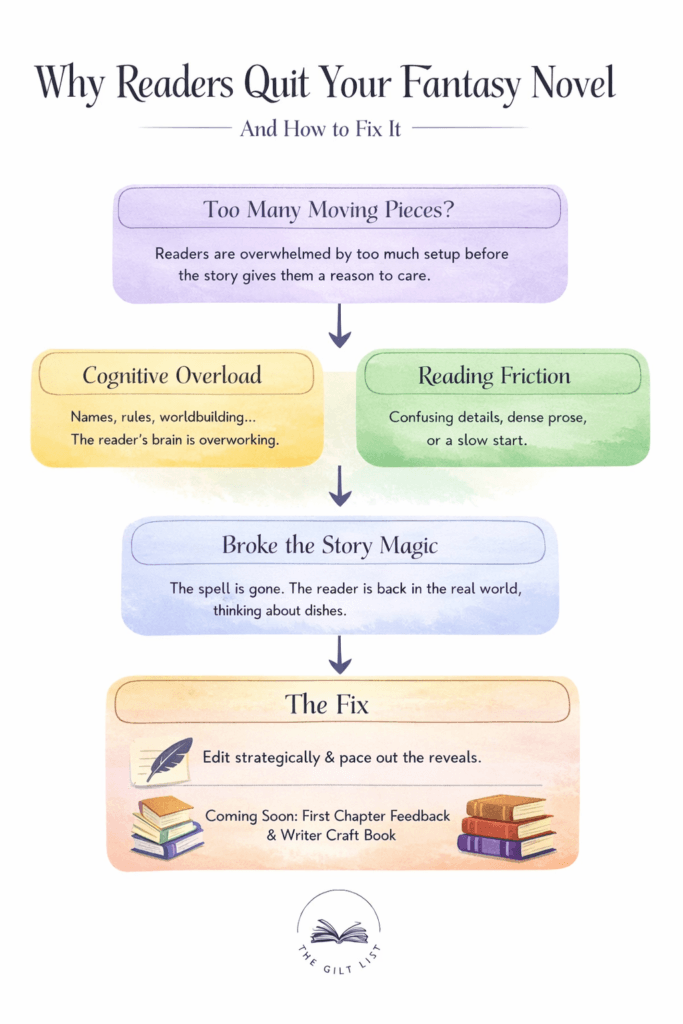
What Happens in the Brain When a Story Stops Working
Psychologists Melanie Green and Timothy Brock studied something called narrative transportation. It’s the state where you are so absorbed in a story that the real world fades out for a while. It’s that feeling where you simply stop existing in the here and now and instead, you’re truly inside of the book, living it alongside the characters. Which is totally the dream for any writer.
But transportation is fragile. It breaks when the reader hits too much friction. When you don’t make the reading easy peasy breezy. It might be a sentence structure, or too many concepts, or it could even be as simple as a completely unbelievable character action. Enough of those moments, and the reader is no longer in the story. They are back in the chair. Looking at the page. Thinking about tea. Thinking about work. Thinking about whether they ever answered that text.
You weaved the magic but lost the voodoo connection for just a moment, the spell gone.
That is often what page eleven is.
Why Fantasy Novels Get DNF’d So Easily
Fantasy has a harder job than most genres, and I say that with all the very best love and fairy-dusted hope.
A contemporary romance can start with a café, a bad date, and a text message, and the reader already understands the operating system; you can’t really overload them, you have what I like to call borrowed engagement, something the reader is already engaged with enough to not need any mental effort to understand it. Fantasy has to build the operating system from scratch.
New names.
New places.
New rules.
New power structures.
New creatures.
New stakes.
Sometimes a map. Lordy help us all.
Which means fantasy writers have far more opportunities to mess it all up. Worse, more data that backs up the last.
Rolf Reber, Norbert Schwarz, and Piotr Winkielman spent years looking at something called processing fluency, which is basically how easy something is for the brain to process. What they found is that ease is not neutral. When something is easier to process, it tends to feel better. When something is harder to process, more craft intense, the brain does not usually go, ah yes, how sophisticated, how literary. It registers friction instead. Something feels off. Something feels very very wrong.
Your book becomes a literal threat. Ouch.
If you want to see what happens when reader expectation and actual reading experience drift apart, you might also like my piece on the Innamorata romantasy backlash.
How Much Can You Introduce in a Fantasy First Chapter?
Here is the annoyingly unsexy answer: treat your first chapter like you are working with a budget. You get maybe three to four major new chunks before friction starts knocking. That does not mean your fantasy world has to be simple. It means your opening has to be strategic.
Pick your most important three or four things and make those count.
Not:
three characters, a kingdom, a prophecy, a magic rule, a political structure, and a creature taxonomy.
More like:
one emotionally legible protagonist, one immediate problem, one world detail that matters right now, and one open question the reader needs answered.
That is how you buy space and don’t turn your reader into an accountant.
Psychologist Nelson Cowan’s work on working memory is a good study to help understand this. And another way is to try it yourself. Go to your first 2 pages. Have you introduced one character, one goal, one setting, one stake? Or two of one, and two of another? And so on.
Go check. Or if you’re at work, bookmark this page and come back to it.
4 isn’t a holy command handed down by some mountain goat, by the way. Not every story needs to or should obey it. But if you really care about engagement, people obsessively consuming your books and being commercial, easy to sell, and easy to love, it’s a good rule to try out. Doing this once will teach you very quickly how little a reader can comfortably hold before friction starts.
So What Should You Fix First?
If your fantasy opening still feels slow, unclear, or hard to connect to, the first fix may not be prettier prose. It may be the structure of the opening itself: what the reader is being asked to hold, how quickly they can attach to the character, and whether the chapter gives them a reason to care before the setup starts piling up.
If that sounds a little too familiar, you can go straight to my first chapter critique service. And if you are still trying to work out whether the issue is pacing, setup, clarity, genre signaling, or reader friction, start with this guide on how to get professional editing help for your fantasy first chapter. If you’re worried the issue is the messy middle a developmental edit or quick manuscript critique might be for you.
I’m also working on a future craft book that digs much deeper into reader engagement, first chapters, story promise, and how to tell when you are fixing the wrong thing. So if this is your sort of rabbit hole, stick around. There is more coming.
Frequently Asked Questions
Readers often DNF fantasy novels early because the first chapter asks them to process too much before the story gives them enough emotional or narrative payoff to stay. In fantasy, that usually means too much setup, too many new concepts, or not enough reason to care yet.
It can be. Fantasy readers expect some setup, but when too many names, rules, places, or systems arrive before they feel grounded in the story, the opening starts to feel like work instead of immersion.
Cognitive load is the amount of mental effort a reader has to spend to understand what is happening. In fantasy, that load rises quickly because the reader is learning a new world while also trying to connect to the protagonist and follow the plot.
There is no perfect number, but fewer is usually better at the start. A strong fantasy first chapter usually introduces one main character, one immediate problem, one or two important world details, and one open question that keeps the reader moving.
They often mean the opening has too much friction, not necessarily that nothing is happening. If readers are confused, overloaded, or still waiting for a reason to care, they will often describe that feeling as slowness.
If the issue is reader friction, worldbuilding overload, or weak early attachment, developmental feedback is usually more useful than more line polishing. A first chapter critique can help you figure out whether the real problem is structure, clarity, hook, or story promise.
Look for where readers get confused, skim, stop highlighting, or say they are “not in it yet.” If multiple people drift at roughly the same point, the opening is probably asking for too much before it gives enough back.