
Fantasy Story-Level Manuscript Editing
Developmental Editing for Fantasy & Romantasy Writers
You finished the book. You’ve reread it so many times you can’t tell what’s working anymore, and you may be considering throwing the whole thing out of the nearest window…at least until you get the itch again. That’s where developmental editing comes in and exactly what it’s designed for. I read the whole manuscript with fresh eyes (a fantasy reader’s eyes and an editor’s, both at once) and tell you the exact moment where readers will drift, where the romance or fantasy promise goes to die, and precisely what to revise first.
I’m a fantasy and romantasy developmental editor working with completed and near-complete manuscripts, with a focus on structure, pacing, character and romance arcs, worldbuilding, and reader engagement.
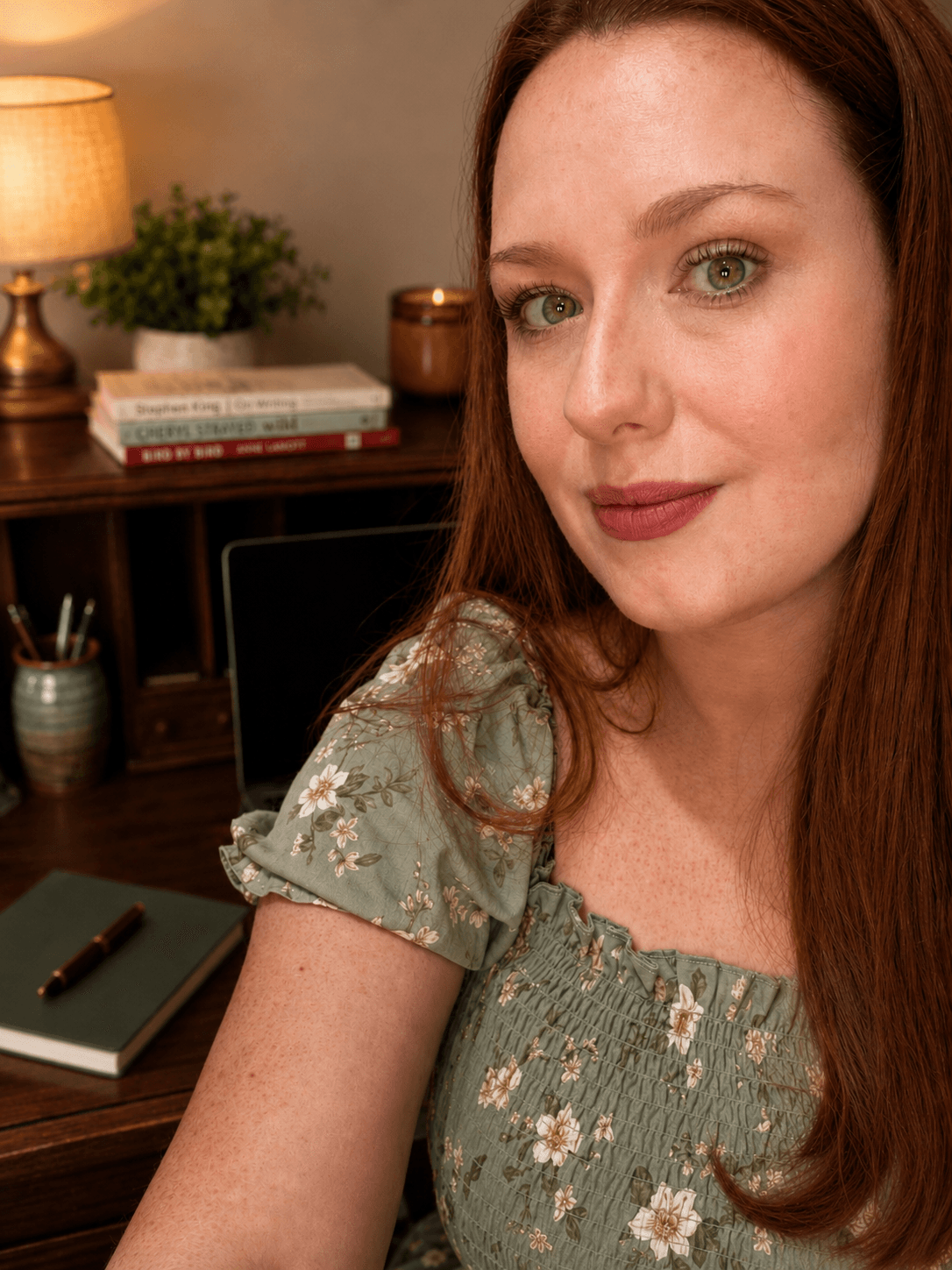
Real editor · real reader lens
Feedback from someone who reads this genre for fun and studies why readers DNF it.
Structure, pacing, character arcs, romance arc, worldbuilding load, emotional payoff, genre promise, reader engagement. I read for all of it in one pass, because in a fantasy or romantasy manuscript these things tangle together. Pull one thread and three others move. Phew.
Two ways to work with me are a Manuscript Diagnostic Review (full read plus an editorial letter, you take it from there) or a Full Developmental Edit (the letter plus chapter notes, inline comments, and a call so you’re never alone with the revision). If you want to start smaller, the First Chapter Critique is the cheaper entry point.
The fantasy developmental editor and romantasy editor behind this manuscript service
Editing track record
Amazon Category Bestseller
I edited a self-published fantasy novel that went on to reach Amazon bestseller status in its category with a four-star reader rating. I’m especially character based when editing (I feel it creates the strongest books), but there are a lot of wheels and cogs turning under a manuscript, and I’ve spent years learning to spot which one is squeaking.
EFA-Trained Developmental Editor
Trained through the Editorial Freelancers Association, Advanced Developmental Editing Certified. My focus is story structure, reader engagement, and manuscript-level revision.
The Gilt List: Genre-First Editorial Platform
I write and edit The Gilt List, a romantasy and genre fiction platform covering reader behavior, book trends, and why some fantasy stories hook.
Reader and Editor in the Same Room
Most editors read as editors. I also read as a fantasy and romantasy expert, so I notice what is structurally wrong AND how genre readers will experience your book against the rest of the market.
Studied Reader Engagement in Fantasy
I have spent a slightly unreasonable amount of time researching why readers quit fantasy novels. Cognitive load, pacing, worldbuilding order, romantasy promise signals, and the beats that cause DNFs in this genre specifically.
Get 50% off for a named testimonial with a link back
This full-manuscript service as it’s named here and posted on this website is new, though the editing behind it isn’t. I’ve helped writers land results like Amazon bestseller status before, just never packaged as a standalone offer like this one from a professional website. To help build a public track record for it, any client who agrees to a named testimonial, with a link back to their site, socials, or Substack, once their edit is delivered gets 50% off: $0.0165/word for a Manuscript Diagnostic Review or $0.025/word for a Full Developmental Edit. One discount per client, and it can’t combine with critique upgrade discounts or other offers.
- 50% off for a named testimonial
- Direct editor access
- No discount stacking
- One discount per client
What Writers Say
Feedback writers actually feel good about
Good editorial feedback should leave you clearer and more encouraged, knowing what is already working in your story. You shouldn’t feel as if you have been shot down on all sides, believe me, every writer and every story has strengths. With that said, these are just a couple reviews from developmental work I’ve done before turning it into a standalone service. I keep names private to protect works still in progress.
Of all the editors I used on this book, you were by far one of the best. You helped improve my passive voice and strengthen my character arcs.
— Past developmental client
You made some great observations. Thank you so much for the excellent crit.
— Past manuscript client
Developmental feedback is a collaborative process
Editorial feedback works best as a middle ground between your goals, your instincts, and what the manuscript needs in order to give readers the experience you’re trying to create. I will not flatten your voice, sand off your weird edges (hello, those are very important), or turn your book into a copy of whatever is trending this week (well, unless you ask). And after delivery, if something in the feedback needs clarifying or a second look, you email me. I’d rather answer ten questions than be unsure.
Sample Feedback
See how I give feedback before you hand over your book baby
A full-manuscript edit is a real investment, and my feedback style needs to be one you can actually work with. When you send your project details, I’ll include a free 2-page sample of feedback with your quote. If my style isn’t your style, no hard feelings, and you’ve lost nothing but the time it took to fill in a form or email me at melissa@thegiltlist.com.
Send your project details and you’ll receive a short sample of real feedback on your pages alongside the quote. See the tone, the depth, and whether we click before committing to anything.
Send Project DetailsWant to see the feedback style this minute? This First Chapter Audit sample shows how I structure a letter. (It’s less in depth than a full edit letter. I don’t have permission to share a client’s full manuscript letter, and I keep that promise.)
View Sample PDFStart with a first chapter critique. It’s a lower-cost way to test the editorial fit, and Tiers 2 and 3 earn a discount on a future developmental edit.
View First Chapter CritiquesFeeling nervous or just want to see if we click? I think that matters a lot for a good edit. Email me at melissa@thegiltlist.com and ask me anything.
Contact MeChoose Your Service
Choose your fantasy developmental editing option
Choose based on how much support you need right now. A lower-cost first chapter entry point, a full-manuscript diagnostic letter, or a deeper developmental edit with chapter/scene notes and selective inline comments. Whichever you request, you’ll get a free 2-page sample of my feedback with your quote, so you can see exactly how I work before any money changes hands.
Start Smaller
First Chapter Critique
For writers who aren’t ready for a full developmental edit but want to know whether the opening is setting up the right book. The top tier includes a brainstorm call and a synopsis review alongside your opening. A great first step if you’ve finished a rough draft and you’re nervous about your first edits.
What’s included
- Lower-cost entry point
- Opening hook and story promise feedback
- Genre-aware reader engagement notes
- Inline markup comments depending on tier
- Tier 2 receives 10% off a future full developmental edit
- Tier 3 receives 15% off a future full developmental edit
- Discounts cannot stack with the testimonial discount
Best if you want to test the editorial fit before committing to a full-manuscript service.
Smaller Starting Point
Discounted rate available for an in-depth testimonial
Option One
Manuscript Diagnostic Review
50% off with a named testimonial
Essentially a normal developmental edit, just without the long calls or step-by-step guidance: here’s everything that isn’t working, here’s how to fix it. Best if you’re a seasoned writer who wants the full picture and is comfortable running with it yourself.
What’s included
- Full manuscript read-through x2
- Editorial letter, 10+ pages
- Structure and pacing feedback
- Character and relationship arc feedback
- Worldbuilding and genre promise notes
- Reader engagement diagnosis
- Revision priorities
- Resources for next steps
- Free 2-page sample with your quote
Best if you want a thorough, honest diagnosis and clear next steps, without calls or hand-holding, and you’re comfortable revising from a letter.
Standard Rate
per word · $0.0165/word with a named testimonial
Example: 85k words = $2,805 standard / $1,402.50 with a named testimonial.
Option Two
Full Developmental Edit
50% off with a named testimonial
The full white-glove edit: a kickoff call, in-manuscript notes, a step-by-step revision plan, and a follow-up call so you’re never guessing what to do next. If you’re ready to invest in yourself and your work and want the most hands-on feedback I offer.
What’s included
- Introductory Zoom call to discuss story and goals
- Full manuscript read-through x2
- Detailed editorial letter, 10+ pages
- In-line chapter/scene notes
- Clarifying inline comments
- Structure, pacing, arc, and stakes feedback
- Romance arc and genre positioning guidance
- Revision priorities
- Step-by-step revision plan
- Synopsis review, checking for gaps between your synopsis and the manuscript
- Follow-up Zoom audio call
- 30 days of availability after delivery for revision questions
- Optional second read-through after revisions at $0.02/word, with a short letter on what’s improved, what could use further tweaking, and what to ask your beta readers
- Free 2-page sample with your quote
Best if you want big-picture diagnosis, hands-on guidance for the revision itself, and support that doesn’t end the day you get the letter.
Standard Rate
per word · $0.025/word with a named testimonial
Example: 85k words = $4,250 standard / $2,125 with a named testimonial.
Not Ready Yet?
Free tools while you finish the draft
If the manuscript isn’t there yet, or the budget isn’t, don’t disappear. I built these for exactly where you are right now, and they’re free. Pop your email in for the PDFs (you’ll also get craft posts, editing offers, and writerly advice as they go out, unsubscribe whenever), and the tools are free to use on the spot.
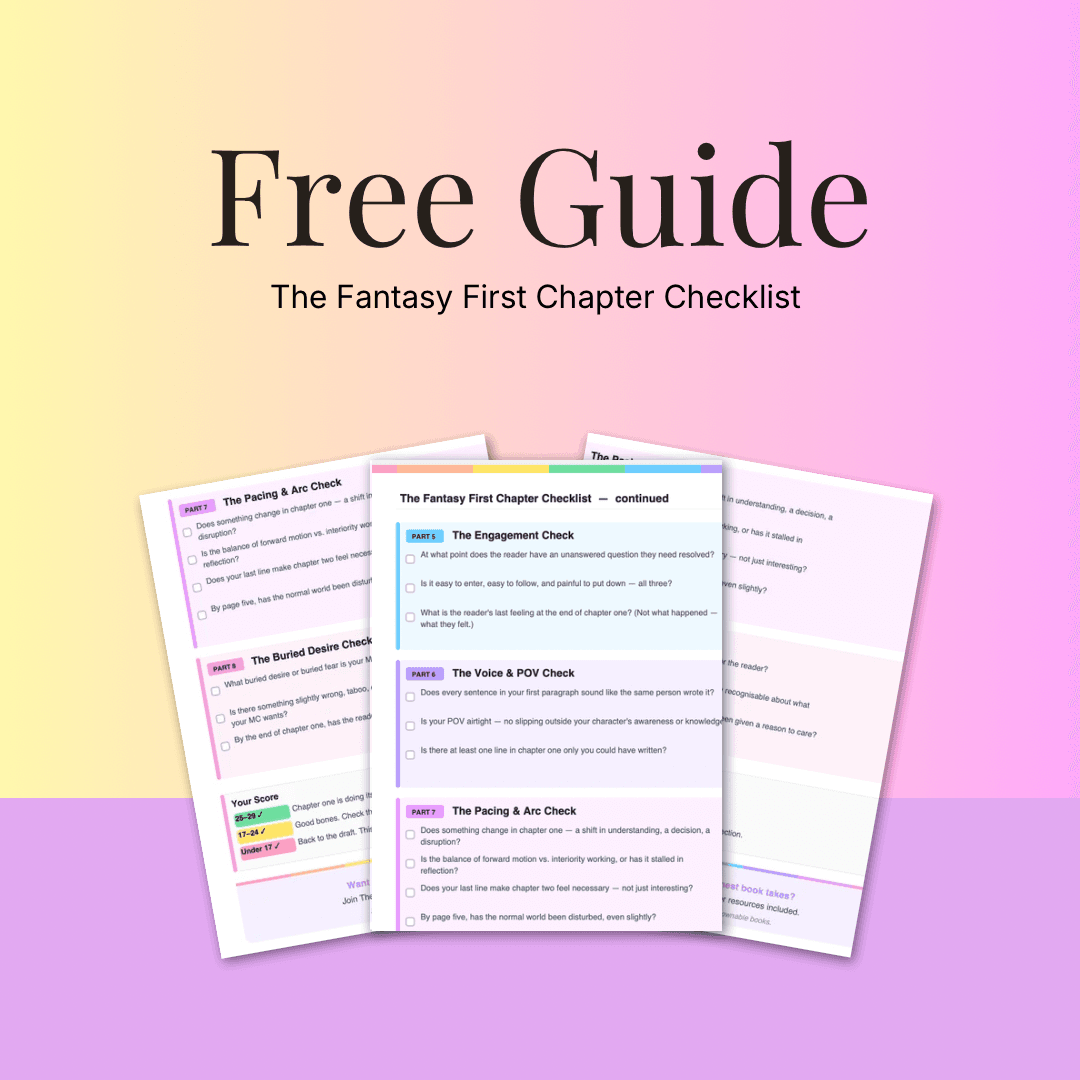 The First Chapter Checklist (PDF)
The same things I check when a writer pays me to look at their opening, condensed into a checklist you can run yourself.
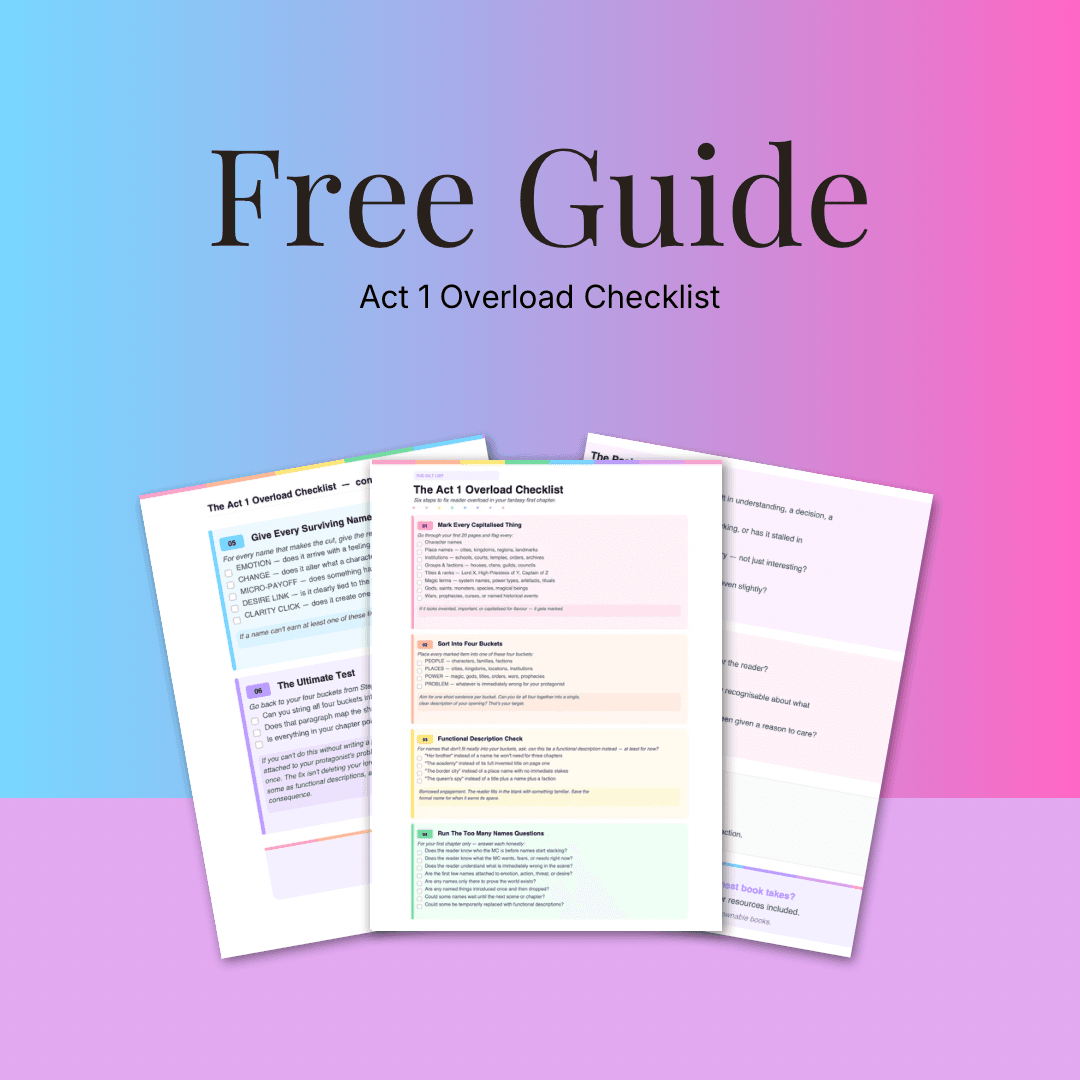 The Info Dump & Worldbuilding Guide (PDF)
How to tell when your worldbuilding is arriving in the wrong order, and what to do about it.
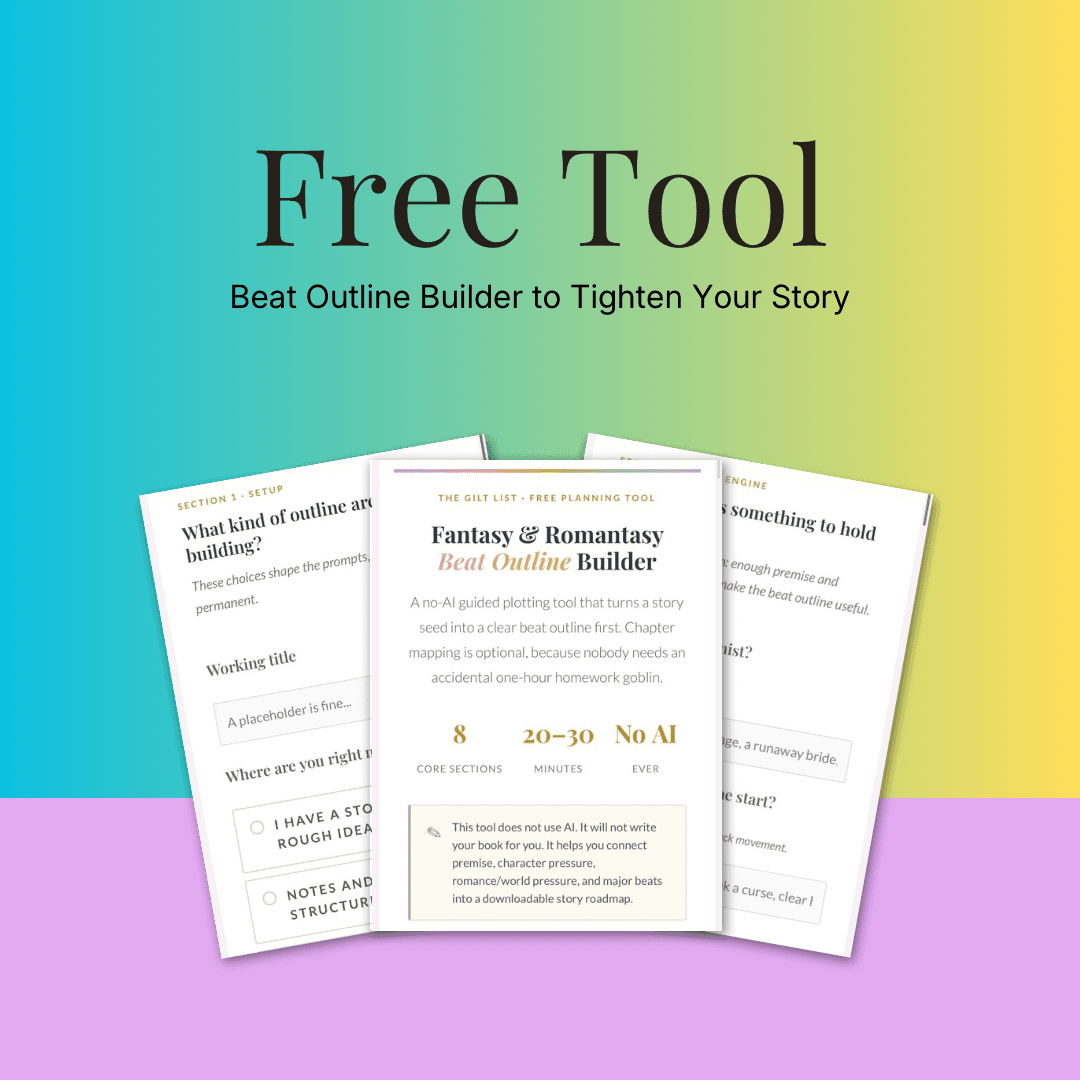 Novel Outline Tool
Plot your beats before the structural problems bake themselves in. Free to use, no email required.
Try the Outline Tool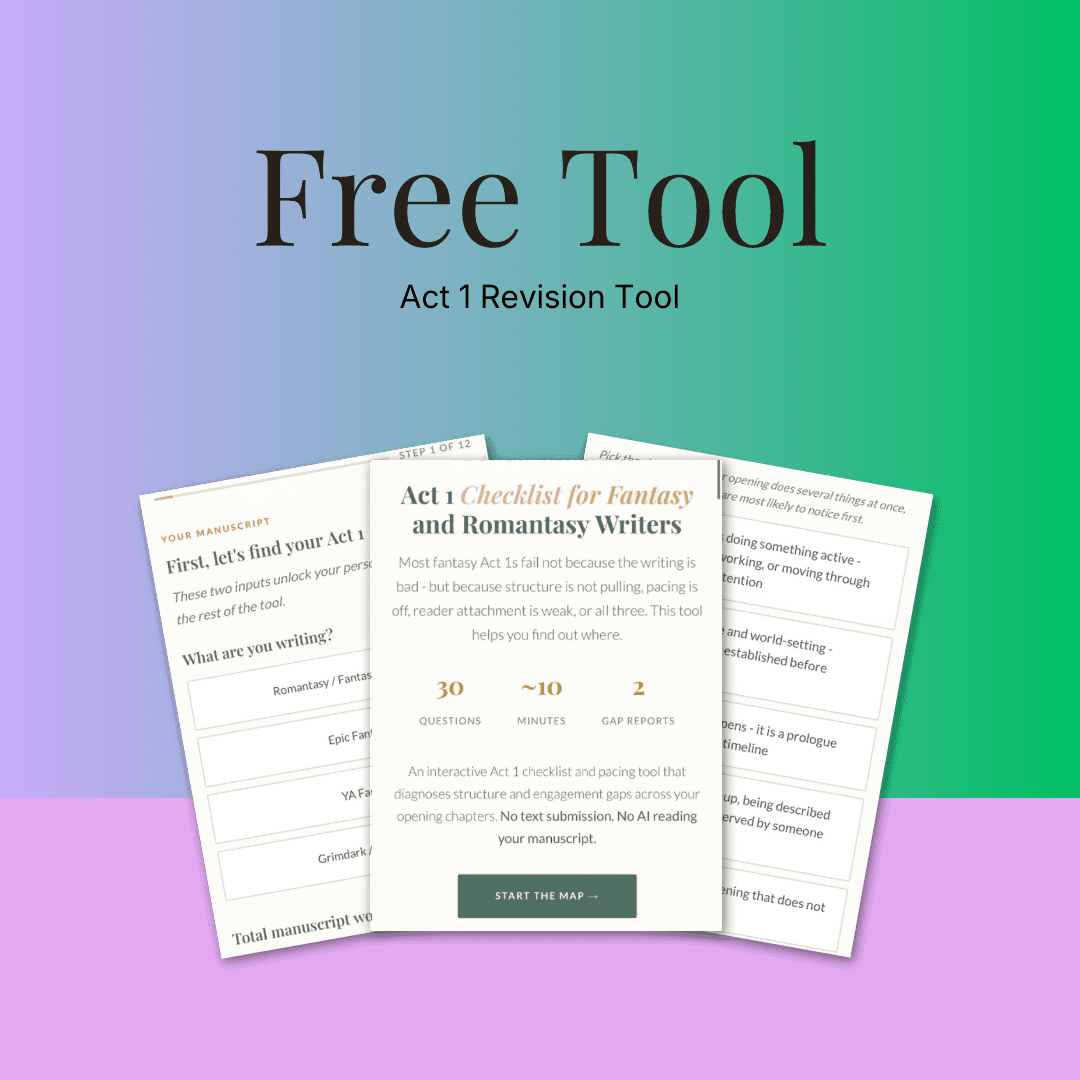 The Act 1 Revision Tool
An interactive checklist that helps you diagnose your plotty Act 1 problems yourself. No AI, just the tool.
Try the Act 1 ToolWhat You Get
Developmental editing that helps you understand the whole manuscript, not just individual scenes
With a full-manuscript service, I am looking for the patterns you cannot easily see from inside the draft. The goal is not to bury you in a terrifying scroll of everything that is “wrong.” The goal is to help you understand what the book is already doing well (lean into it, this is what will make you a stronger writer), where the reader will struggle, and what to revise first, second, and third.
Both services start with the same full read and the same diagnosis. Once I’ve seen your plot holes, I can’t unsee them. What changes between the two is how much help you get fixing them. The Manuscript Diagnostic Review gives you the editorial letter and trusts you to run with it. The Full Developmental Edit is much more in depth with chapter and scene notes, inline comments where they’ll clarify a recurring issue, and a follow-up call so the feedback is something we work on together as a breathing piece of work.
You will not receive feedback designed to flatten your voice or turn your book into a copycat of someone else’s. We need more strange, beautifully magical books in the world, not fewer. We need you as an author and I’m a big believer in that. Every story needs a different approach, and the work here is to find the revision path that makes this book more itself.
The Problem
Why beta reader feedback may not be enough
A lot of writers know something is wrong with the manuscript long before they know what exactly it is. The book feels off, or almost right in a way that is deeply annoying because “almost” is impossible to revise from. You may have scenes you love, characters who matter, a world with incredible fanciful magic, and a romance or emotional arc you care about deeply that speaks to your voice and themes…and yet, still, something about the book is refusing to come together.
The feedback writers receive and cannot always revise from
These notes are often pointing at a real problem in the work. But because they describe the reader’s reaction, not the cause, you’re left guessing. “It felt slow but I loved the main character” might mean the pacing is off, but it might also mean the character goal isn’t clear on the page, the scene order is blurring together, the stakes are escalating in the wrong order, the worldbuilding is arriving alone, or the romance arc is going in circles. It’s just not helpful advice unless you as the writer can tell instantly what they meant, and even then, can you really see that deep into the draft? Phew.
That is where developmental editing helps. I read your manuscript as both a fantasy reader and a developmental editor, looking for the structural patterns underneath the symptoms, and which revision will make the biggest difference first.
This is especially useful if you are revising after beta readers, preparing to query, self-publishing, restructuring a messy draft, or staring at a pile of contradictory beta notes wondering which ones to believe. (Some of them. I can help you figure out which.)
Genre-Aware Editing
Why your manuscript needs a fantasy editor, specifically
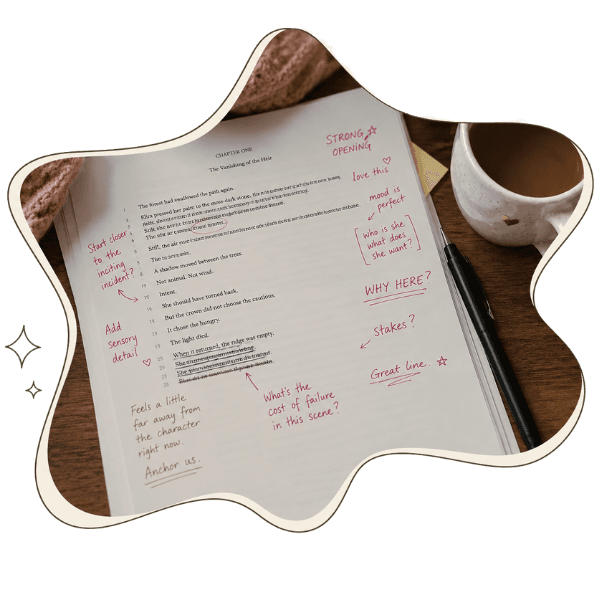
A fantasy or romantasy manuscript has to do an unreasonable amount of work while pretending it is simply telling a story. Frankly, it’s hard to do. Your reader is learning a world, a magic system, a political landscape, and a cast of invented names while you’re also trying to make them fall in love with someone.
A general developmental edit can help with structure. A fantasy developmental edit has to understand how structure behaves when the reader is carrying all that extra load, and a romantasy edit also has to track the relationship arc. (Think wounds, conflicting goals, escalation, and whether the romance is changing from chapter to chapter or just appearing in repeated moments.)
One of the most common problems I see is a manuscript where plenty is happening (traveling, arguing, training, kissing) and yet nothing really moves in a real way. Scenes can be full of action and still feel static if the character’s options, emotional state, relationships, or understanding of the world are basically the same at the end as they were at the start, or worse, go back and forth and back and forth. Once you know what kind of movement is missing, revision stops being confusing and becomes target based. Make sense? Hopefully so.
The Editorial Lens
What I look for in your manuscript: the fantasy developmental editing framework
A fantasy or romantasy manuscript is teaching the reader what kind of book they are in, what kind of emotional experience they can expect, and what kind of payoff they should keep reading toward. When I read yours, I’m asking very practical questions. Does the character want something specific enough to create movement? Are the scenes changing the reader’s understanding or the character’s options? Is the worldbuilding making the story more interesting, or asking the reader to memorize information without emotional context? Is the romance arc escalating? Do the characters suddenly change without cause? Are there continuity issues?
About Me
About the fantasy developmental editor and romantasy editor behind The Gilt List

I’m the writer and editor behind The Gilt List, a reader-first book platform focused on romantasy, fantasy romance, viral books, Kindle Unlimited discovery, reader behavior, and why some books become stupid hard to put down even when they are messy, dramatic, trope-heavy, or doing things literary snobs like to pretend they would never read in this lifetime, thank you very much. I spend a lot of time looking at books from both sides. As a reader who cares about satisfaction, and as an editor who cares about structure, clarity, pacing, scene function, and all the technical things I’ve loved since my teen years.
I think many are surprised to learn, likely because of my whimsical ways, that some of my favorite works outside of fantastical reads like Fourth Wing, are Shakespearian plays, The Great Gatsby, Animal Farm, 1984, The Ones Who Walk Away from Omelas, If We Were Villains, Project Hail Mary, and non-fiction like A Brief History of Time.
Ultimately, my background sits between editing, writing, marketing, and reader behavior. I work with marketing content professionally half the week, and this the other half, which means I think a lot about what people search for, what makes them click, what keeps them reading, and what makes them leave. That perspective matters for fiction more than people think. Fiction is a product readers want to engage with. We just have to make it easy for them to care.
I’m also an EFA-trained developmental editor, and I have worked on fantasy manuscripts including a self-published novel that reached Amazon bestseller status in its category.
In my personal life I’m a spoonie, from England, who lives in the U.S. and loves spending time with my 2 autistic boys, my ADHD maniac of a middle child, and beautiful daughter whose art will always amaze me.
How It Works
How the developmental editing process works
After you send your project details, I review the genre, manuscript length, service fit, timeline, and what kind of feedback you are looking for, then send your quote with a free 2-page sample of feedback. You do not need everything perfectly polished before reaching out, but the manuscript should be complete or close enough that a full read will be useful. If it’s missing the ending and you’re not sure how to end it, that’s fine. If it’s a handful of scattered scenes with no true order, you may need to keep writing first.
If the project is a good fit and you like the sample, I send the service terms, payment details, manuscript instructions, and estimated turnaround. Your spot is confirmed once the terms are signed, payment is complete, and the materials are in.
Calls are audio only. I’m a spoonie with a spine that has strong opinions, and some days I’m reading your manuscript while lying flat. Audio keeps that easy for everyone.
- Send your project details. Tell me about your genre, word count, manuscript status, goals, and the kind of feedback you need.
- You get a quote and a free 2-page sample. I confirm whether the manuscript, service, and timeline are a good match, and you see exactly how I give feedback before deciding anything.
- You confirm your booking. If you’re in, I send terms and payment details. Your spot is confirmed once payment, signed terms, and materials are received.
- I read your manuscript. The full book, through a fantasy and romantasy developmental lens.
- You receive your feedback. The editorial letter, and depending on service, chapter/scene notes, selective inline comments, and a follow-up call.
- You revise with a clear plan. Instead of trying to fix everything at once, you know what the manuscript is doing and what needs attention first.
Getting Started
What I’ll need from you
For a full-manuscript service, I will need your manuscript word count, genre/subgenre, a short summary, your current revision stage, and the main concerns you already have about the book. I may also ask for a synopsis, outline, or brief context document if it will help me understand where the manuscript is meant to go. You can never overwhelm me with notes, send everything you have.
You do not need a perfect draft. Developmental editing is for manuscripts that need diagnosis and revision direction. If your draft were already polished, you wouldn’t need me.
- Your full manuscript word count
- Your genre and subgenre
- A quick summary of the book and your goals
- Your main concerns or revision questions
- An optional synopsis, outline, or notes document if you have one
- Your preferred service: Diagnostic Review or Full Developmental Edit
Not Ready Yet?
Before you go: the free stuff, one more time
If the manuscript isn’t there yet, or the budget isn’t, don’t disappear. I built these for exactly where you are right now, and they’re free. Pop your email in for the PDFs (you’ll also get craft posts, editing offers, and writerly advice as they go out, unsubscribe whenever), and the tools are free to use on the spot.
The First Chapter Checklist (PDF)
The same things I check when a writer pays me to look at their opening, condensed into a checklist you can run yourself.
The Info Dump & Worldbuilding Guide (PDF)
How to tell when your worldbuilding is arriving in the wrong order, and what to do about it.
Novel Outline Tool
Plot your beats before the structural problems bake themselves in. Free to use, no email required.
Try the Outline Tool
The Act 1 Revision Tool
An interactive checklist that helps you diagnose your plotty Act 1 problems yourself. No AI, just the tool.
Try the Act 1 Tool50% off with a named testimonial
Ready to find out what your manuscript is really doing?
Send me your project details. You’ll get a quote, a free 2-page feedback sample, and an honest opinion on whether you need a diagnostic review, a full developmental edit, or just a first chapter critique for now.
Standard rates from $0.033/word
FAQ
Fantasy Developmental Editing FAQ
What does a fantasy developmental editor do?
A fantasy developmental editor works on story-level problems across your manuscript: structure, pacing, character arcs, stakes, worldbuilding, scene function, reader engagement, and whether the fantasy elements are being introduced and paid off in a way readers can follow and care about.
Do you work as a romantasy developmental editor?
Yes. I work as a romantasy developmental editor for fantasy, romantasy, fantasy romance, urban fantasy, paranormal romance, and related speculative genres. For romantasy and fantasy romance, I pay close attention to the romance arc, emotional escalation, relational tension, genre promise, and whether the love story is carrying enough weight for the reader experience you are promising.
What is the difference between a Manuscript Diagnostic Review and a Full Developmental Edit?
Both start with a full manuscript read and the same diagnosis. The Diagnostic Review gives you the editorial letter and you handle the revision from there. The Full Developmental Edit adds chapter/scene notes, selective inline comments, and a follow-up call, so you have guidance inside the manuscript while you revise. If you’re an experienced self-editor, the Diagnostic may be all you need. If you want help turning the diagnosis into action, choose the Full Edit.
How much does a developmental editor cost?
My standard rate for a Manuscript Diagnostic Review is $0.033/word, and my standard rate for a Full Developmental Edit is $0.05/word. For example, an 85,000-word manuscript would be $2,805 for the diagnostic review or $4,250 for the full developmental edit, before the named-testimonial discount.
What is the named-testimonial discount?
Any client who agrees to a named testimonial, with a link back to their site, socials, or Substack, once their edit is delivered, gets 50% off: $0.0165/word for the Manuscript Diagnostic Review or $0.025/word for the Full Developmental Edit. It’s limited to one discount per client and cannot be combined with first chapter critique upgrade discounts, other discounts, or future promotional offers.
Can I see a sample before booking?
Yes. Every quote comes with a free 2-page sample of feedback on your pages, so you can see the tone and depth of my work before committing to anything. There’s also a sample letter you can download right now in the Sample Feedback section above.
Do you use AI on my manuscript?
No. Your manuscript will not be run through AI. I read and evaluate the manuscript myself.
Is developmental editing the same as line editing?
No. Developmental editing focuses on the story-level elements of the manuscript: structure, pacing, character arcs, worldbuilding, stakes, romance arc, scene function, and reader engagement. It is not a grammar pass, copyedit, or sentence-level polish.
Should I book a first chapter critique or a full developmental edit?
Choose a first chapter critique if you want a smaller, lower-cost way to understand whether your opening is doing its job (and Tiers 2 and 3 earn a discount toward a future full edit). Choose a full-manuscript service if you need feedback on the whole book: structure, pacing, arcs, stakes, worldbuilding, payoff, and revision priorities.
Can I combine the named-testimonial discount with my first chapter critique discount?
No. The named-testimonial discount, first chapter critique upgrade discounts, and promotional discounts cannot stack. If you qualify for more than one discount, only one discount may be applied.
Do I need a finished manuscript?
For a full-manuscript developmental edit or diagnostic review, the manuscript should be complete or close enough that feedback on the whole book will be useful. If the manuscript is unfinished, a first chapter critique or smaller opening review may be a better starting point.
What kinds of problems can a fantasy developmental editor help diagnose?
A fantasy developmental editor can help diagnose unclear stakes, weak scene function, pacing problems, flat character arcs, romance arcs that do not escalate, worldbuilding overload, confusing magic systems, sagging middles, rushed endings, unclear genre promise, and places where the manuscript is asking readers to work too hard before they care enough to continue.
Ready to find out what your manuscript is really doing?
Your manuscript does not need to be perfect, but it does need a clear revision path. If your fantasy or romantasy book feels slow, confusing, overstuffed, emotionally flat, or just slightly off in a way you cannot diagnose, this is the work I do all day, and I’d love to do it on your book.
Send me your project details. You’ll get a quote, a free feedback sample, and an honest answer about the right next step, even if that next step is smaller than a full edit.
Request a Developmental EditGet 50% off with a named testimonial and link back. Discount cannot be stacked with other offers.