
Slow burn is a contract. You agree to wait, and the book agrees to make the wait worth it. When it works, the moment can keep you toasty and smiley for days, but when it does not, it’s frankly a pitchfork moment, and I will be having none of it. These four honor the contract, and they do it in one book, so you get the whole agonizing build and the payoff without committing to a saga.
Standalone Romantasy With Slow Burn: Takeaways
- Pick Spinning Silver if you want a Rumpelstiltskin retelling where the slow burn is built on impossible bargains and the romance grows through competence and grudging respect.
- Pick Daughter of the Forest if you want Irish mythology, a heroine under a geas of silence, and a romance built almost entirely through small acts of faith over a long stretch of pages. Go in knowing about the content warning.
- Pick Uprooted if you want a cold wizard, Polish folklore, and a romance that builds through an intellectual partnership and breaks devastatingly in the final third.
- Pick A Deal with the Elf King if you want slow-burn fae romance where the warmth is built through proximity, defiance, and a frozen castle garden.

What Counts as Slow Burn Here?
For this list, slow burn means romantic tension present from early in the book and unresolved until the final third, with the wait feeling active rather than stagnant. Something should be happening emotionally even when nothing is declared. The payoff must be proportional to the build. And it must resolve in one book.
What Is the Spice Level for These Standalones?
Slow burn standalones tend to sit in the lower range. The restraint is usually what makes the payoff land.
- 🌶 Low: the emotional payoff is the point. Physical intimacy implied or minimal.
- 🌶🌶 Medium: the slow build earns real heat when it arrives.
Daughter of the Forest carries a content warning for sexual assault earlier in the story, flagged in the book block below.
When Every Scene Deposits Something
Spinning Silver →
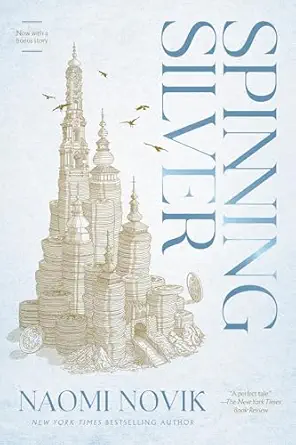
by Naomi Novik
Feel / reader experience
Miryem is the daughter of a struggling moneylender who turns the family business around so well that she draws the attention of the Staryk, the cold fae king of a winter realm, who sets her an impossible task and binds her to him as the price. Her story braids together with two other women caught in the same magic. The slow burn is built on bargains, not longing. It first heats up with the Staryk king arrives a third time, fully expecting her to fail; she does not, and for the first time he has no next move, and she does.
Spice level
🌶 to 🌶🌶, cold and sparkling. The heat earns its place because the negotiation did.
Tropes
Rumpelstiltskin retelling, impossible bargain becoming an arrangement, ice king, multiple POVs, fairy-tale-as-negotiation, three women’s stories braided
Tone
Wintry, precise, and deeply smart. The romance is built entirely on transactions that stop being transactions.
Why it made the list
The burn is built on negotiation rather than pining, so you do not know how these two feel until, all at once, you do, and that certainty hits harder for being earned through cold bargaining instead of swooning. Exceptional prose, fully standalone.
Read this if
- You want a fairy-tale retelling where the romance grows through how the protagonists relate to each other’s competence.
- You like multiple POVs where each thread adds to the central emotional tension.
- You want prose that is doing something with language rather than just getting the story told.
Skip this if
- The multiple POVs can fragment the slow burn, readers who want a clean two-person arc may find the structural shifts interrupt the momentum.
- You need warmth in your love interest. The Staryk King is cold and the thaw is very gradual.
What readers are saying
- The slow burn being built on economic competence rather than longing is the most consistently praised structural choice.
- The moment Miryem has the next move when the king doesn’t is frequently cited as the exact moment readers became invested.
- Multiple POVs divide readers between those who found each thread enriching and those who found the switching interrupted the romance.
- The prose is called exceptional by almost everyone regardless of how they feel about the structure.
- Some readers wanted more time with Miryem and the Staryk King and felt the other threads took too much space.
- Likely DNF trigger: if multiple POVs are a hard stop for you, this structure will not work regardless of the quality of the central romance.
Daughter of the Forest →
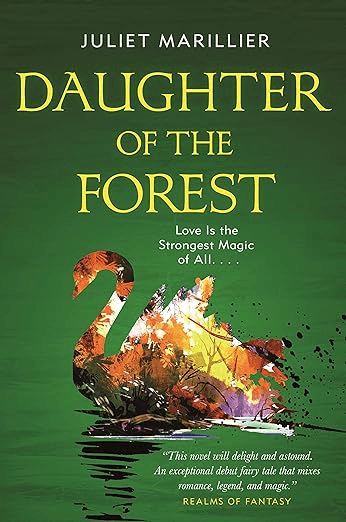
by Juliet Marillier
Note: Sorcha’s story begins and ends here, a complete arc, though the Sevenwaters world continues through other characters in subsequent books. The book contains a non-con scene earlier in the story, go in prepared, not surprised.
Feel / reader experience
Sorcha is the youngest child and only daughter of an Irish lord, and when her brothers are turned into swans by a curse, the only way to free them is for her to weave six shirts from a painful nettle-like plant in complete silence, unable to speak a word until the task is done. In the middle of it, a wounded foreign soldier named Red finds her, and a romance grows entirely without words. The slow burn is built in small acts of faith: he brings her food, sits at a distance, comes back the next day, and the next, and never asks for anything.
Spice level
🌶 Low, no explicit content. The restraint is total and it is what makes the emotional payoff as devastating as it is.
Tropes
Irish mythology, Children of Lir, silence as plot mechanism, slow trust build, soldier love interest, folk horror elements
Tone
Profound and slow and devastating. The silence is not a gimmick, it is the structural mechanism through which the romance must grow.
Why it made the list
The romance grows so slowly that Sorcha does not seem to notice it is there until almost the end, and it is sweeter for it. You feel the love accumulate the way real trust does, too gradually to clock and then suddenly undeniable. It is long and patient and asks for your full attention.
Read this if
- You want a slow burn where the patience is structural, built into the premise rather than just the pacing.
- You love Irish mythology and want it treated with real depth rather than used as backdrop.
- You are willing to read a very long book with very few declarations and a very quiet central romance.
Skip this if
- The content warning is a hard stop. It is handled with care but it is there.
- You need declarations, conversations, or explicit romantic development to track the relationship.
What readers are saying
- The silence mechanism is described as the most inventive structural choice readers have encountered in a romance.
- Red’s quiet, patient returns are the most cited moments, the romance in small acts of care.
- The content warning is consistently mentioned and described as difficult regardless of the craft around it.
- The pace is slow by any measure, readers describe it as requiring full emotional presence rather than being a slump-buster.
- Readers who connected with it describe it as one of the most emotionally significant books they have read.
- Likely DNF trigger: if you need any romantic reciprocation or spoken connection to stay engaged, this will lose you well before the payoff.
Uprooted →
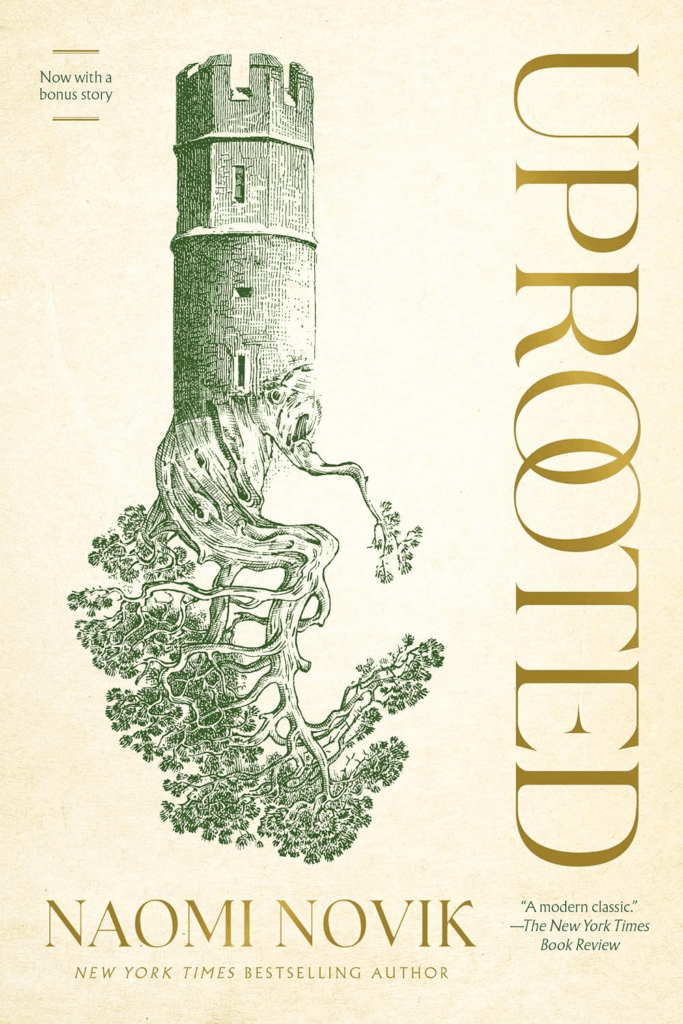
by Naomi Novik
Feel / reader experience
Agnieszka is a village girl in a kingdom menaced by a corrupted, sentient forest called the Wood. Every ten years the cold wizard known as the Dragon takes one young woman from the valley to serve in his tower, and to everyone’s shock he picks Agnieszka. She turns out to have a wild, instinctive magic that clashes with his rigid, precise kind, and the two of them argue their way toward each other while the Wood’s threat grows. The burn builds in between how little he thinks of her and how much he starts to notice.
Spice level
🌶🌶 Medium, slow and reluctant. When it breaks it hits hard.
Tropes
Cold mentor figure, reluctant chosen one, magic partnership, Polish folklore, enemies-to-lovers slow burn
Tone
Fairy tale atmosphere that keeps escalating. The romance lives in the middle of a book that is also about war.
Why it made the list
The arc is about independence, not rescue. He comes back to her. When the tension finally breaks it lands like an explosion you did not see coming, and the whole thing resolves in one book.
Read this if
- You want a slow burn where the intellectual connection arrives before the romantic one.
- You like heroines who are stubbornly, impressively themselves even when they are doing everything wrong.
- You want the payoff to feel realistic rather than a dramatic declaration.
Skip this if
- You need the romance to remain the primary thread, the book pivots hard to war in the second half.
- You need a love interest who is warm from early on.
What readers are saying
- The romantic payoff is called quiet and devastating in almost the same breath by nearly everyone who recommends it.
- The forest as villain gets consistent praise as genuinely unsettling.
- The pacing shift to war in the second half divides readers sharply.
- Readers who go in for the romance and stay for the fantasy consistently say it was worth the adjustment.
- Agnieszka’s impulsive decision-making is either the best kind of messy or genuinely maddening, depending on the reader.
- Likely DNF trigger: if you need the love interest to be readable from the start, the Dragon’s early coldness may be too much.
A Deal with the Elf King →
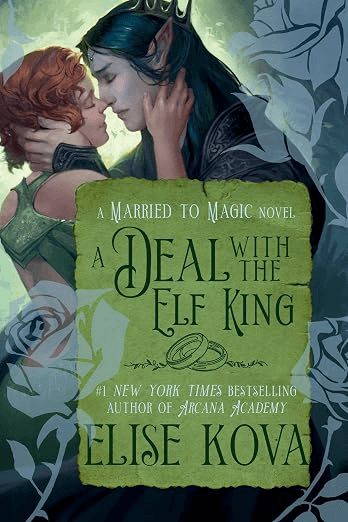
by Elise Kova
Feel / reader experience
Luella is a young herbalist chosen as the next Human Queen, bound by ancient law to marry the Elf King and restore spring to his dying realm, and she arrives furious at losing the life she built. Eldas is cold, ancient, and indifferent to what she wants. The slow burn crawls up to the moment he finds her planting a garden in his frozen castle and just stands at the edge, watching, saying nothing. Every scene after that drops you a little something to root for.
Spice level
🌶🌶 Medium, tender and earned when it arrives.
Tropes
Arranged marriage, cold thawing love interest, human in fae world, hidden magic, slow-burn fae romance
Tone
Warm fae fantasy with a slow, genuinely sweet build. The warmth has to be earned against the coldness of the opening.
Why it made the list
The whole pleasure is watching someone learn to want something for the first time. Eldas has been cold so long that warmth is foreign to him, and watching him fumble toward it is the book. Slow, sweet, earned, and finished in one go.
Read this if
- You want fae slow burn where the thaw is earned rather than a personality transplant.
- You like heroines who find ways to maintain agency even inside a structure that removed their choices.
- You want warmth that arrives gradually and feels genuinely accumulated.
Skip this if
- You need the love interest to be readable from early on. Eldas is cold for a significant portion.
- You want fae court intrigue to carry equal weight with the romance.
What readers are saying
- Luella planting the garden is the scene readers cite most often when recommending this book.
- Eldas’s thaw is described as one of the most satisfying cold-to-warm arcs in recent fae fantasy.
- The court politics being thinner than the romance is the primary criticism from readers who wanted equal weight.
- Some readers found the pace slow in the middle section before the emotional shift.
- Readers who love slow-burn fae romance consistently call this one of the cleaner executions of the trope.
- Likely DNF trigger: if you need the love interest to show warmth or vulnerability early, the patience required may test you.
Also Worth Reading
The Bird and the Sword by Amy Harmon
A mute heroine with dangerous magic and the cold king who takes her captive. Every interaction carries extra weight because communication is already constrained. Low spice, high feeling.
Bound to the Battle God by Ruby Dixon
A battle god who has not felt human connection in centuries, and a slow build that does not reach a kiss until the halfway point. Monster romance with slow-burn discipline.
For the Writers in the Room
All four of these books understand that slow burn only works when the wait is active. Nothing in Spinning Silver is static; every transaction changes something. Every time Red comes back to Sorcha, something is added into a relationship that cannot be spoken. Every scene between Luella and Eldas moves the gap between them, even incrementally. Every argument between Agnieszka and the Dragon changes what they know about each other. The reader feels time passing and trust accumulating.
The weaker version of slow burn is romantic stasis: two people who like each other, separated by misunderstanding rather than a genuine obstacle, going through scenes that don’t change the emotional landscape between them. Readers can feel when nothing is happening beneath the surface, and it’s all just a miscommunication trope, and they tend ot hate it.
If you are writing slow burn as a standalone, the pacing question is: what does each scene leave the reader with that the previous scene didn’t? Every chapter should deposit something, a small revelation, a crack in the armour, a moment that cannot be taken back. The burn should be a gradient, not a flatline that breaks at 80% and resolves in a rush.
If you want structural feedback on your opening chapter, the First Chapter Critique is built for exactly this. For a full manuscript look, Developmental Editing at The Gilt List covers story structure, genre promise, and Act 1 mechanics.
More craft posts at the Writers Hub.
More From The Gilt List
Browse all romantasy recs by trope, spice, and mood at the Romantasy Hub.
For more standalones, the Standalone Romantasy Guide covers picks across every spice level, and the Standalone Romantasy on Kindle Unlimited list has the KU-specific finds.
Frequently Asked Questions
Spinning Silver by Naomi Novik is the most recommended for readers who want a slow burn built on competence and negotiation. Daughter of the Forest by Juliet Marillier is the pick for the most patient, most devastating quiet build.
A good slow burn keeps the wait active, every scene deposits something, even when nothing is declared. A slow burn that is just slow has two people liking each other while nothing changes between them. All four picks here keep the tension moving.
Daughter of the Forest contains a rape scene earlier in the story. It is handled with care but go in prepared. The others on the list do not carry comparable warnings, but always check the author’s site.
Mostly yes. Slow-burn standalones tend to sit at the lower end of the scale, with the emotional payoff being the point. Spinning Silver and Uprooted reach medium; Daughter of the Forest is low.
Start with Spinning Silver if you want a smart, sparkling slow burn, or Uprooted if you want one where the payoff hits like a quiet explosion. Save Daughter of the Forest for when you have the emotional bandwidth for it.