
Editorial Feedback for Fantasy & Romantasy Writers
First Chapter Critique for Romantasy & Fantasy Writers
Your first chapter should convince the right reader to keep going. That’s where I come in. I mark up your opening pages scene by scene and show you exactly where readers drift, why, and what to revise first.
This service helps you capture readers to sell more books, spot common craft issues that may be showing up throughout the manuscript, or prepare your opening pages for querying agents.
What is a First Chapter Critique?
Melissa Jay at The Gilt List reads your fantasy or romantasy opening and shows you where readers may drift, why, and what to revise first. I read your pages myself; I don’t process manuscripts through AI.

Real editor · real reader lens
Feedback from someone who reads the genre, studies reader behaviour, and understands why openings actually lose people.
I read your pages as both a developmental editor and a fantasy/romantasy reader. During the process I analyze your hook, voice, characters, clarity, story promise, worldbuilding, and what to revise first.
This fantasy first chapter critique gives you clear, genre-aware editorial feedback on your opening pages, including inline markup comments, scene-by-scene notes, and written guidance on what to revise first. You can choose feedback on your first 10 pages (5k words) or your first 20 pages (10k words), depending on how much of your opening sequence you want reviewed.
The fantasy developmental editor and romantasy editor behind this critique
Editing track record
Amazon Category Bestseller
I edited a self-published fantasy novel that went on to reach Amazon bestseller status in its category with a four-star reader rating. That result comes from knowing what readers need from an opening (specifically what fantasy and romantasy readers need) and being honest about where a manuscript is losing them before they decide to leave.
EFA-Trained Developmental Editor
Trained through the Editorial Freelancers Association. My focus is story structure, reader engagement, and the opening pages.
The Gilt List: Genre-First Editorial Platform
I write and edit The Gilt List, a romantasy and genre fiction platform covering reader behaviour, book trends, and why some fantasy openings grip and others lose people. The editorial thinking you will receive is the same thinking that goes into that analysis.
Reader and Editor in the Same Room
Most editors read as editors. I also read as a fantasy and romantasy expert, which means I notice not just what is structurally wrong but what the trends are right now in the genre. Those two lenses together are what makes first chapter feedback useful rather than just technically correct.
Studied Reader Engagement in Fantasy
I have spent considerable time researching why readers quit fantasy novels; cognitive load, pacing, worldbuilding order, romantasy promise signals, and the specific beats that cause DNFs in this genre. That research is built directly into the critique framework.
Get a discount for an in-depth testimonial
This first chapter critique offer is new, the editing behind it isn’t. I’ve helped writers land results like Amazon bestseller status before, just never packaged as a standalone service like this one. To help build a public record for it, the first 3 clients, any tier, who agree to a longer, in-depth testimonial with a link back to their site, socials, or Substack get a discounted rate: $99 on Tier 1, $175 on Tier 2, or $333 on Tier 3, instead of the normal rate. When the 3 spots are gone, everyone pays the normal rate listed on each tier.
- Discounted rate for an in-depth testimonial
- Direct editor access
- First come first serve, any tier
- Only 3 spots available
What Writers Say
Feedback writers actually feel good about
Of all the editors I used on this book, you were by far one of the best. You helped improve my passive voice and strengthen my character arcs.
— Past developmental client
You made some great observations. Thank you so much for the excellent crit.
— Past manuscript client
Feedback is a collaborative process
Editorial feedback works best as a middle ground between your goals and talent, and what it takes to make readers fall in love. If someone tries to tell you not to follow your intuition with something you passionately feel in your work, they’re wrong. Once your critique is delivered if something needs clarifying, expanding, or looking at from a different angle, please get in touch. I am here to help you find the right solution for your opening, not pass judgement on who you are as a writer and whether it’s good enough. It almost always is.
Sample Feedback
Download real critique samples before you spend a penny
See how inline markup comments, scene-by-scene notes, and the short feedback paragraph work together.
Download Tier 1 SampleA closer look at how inline markup comments work.
Download Inline SampleSee how the editorial letter expands the feedback beyond the page comments, connecting patterns across the first 20 pages and explaining what to revise first.
Download Tier 2 SampleSee how the revision plan turns the critique findings into a step-by-step path, that can apply to the entire manuscript.
Download Tier 3 SampleChoose Your Tier
Choose your fantasy first chapter critique tier
All three tiers include inline markup comments and scene-by-scene notes. Tier 1 fees count toward a full edit if you upgrade later, and Tiers 2 and 3 earn a discount on a future developmental edit. I like working with authors long term.
Only 3 in-depth testimonial discount spots left — first come, any tier
Tier One
First 10 Pages Critique (5k words)
Best for writers who want focused feedback on the first 10 pages for queries and a clear sense of whether the opening is setting up the right book.
What’s included
- Up to 10 pages reviewed
- Inline markup comments on the manuscript
- Scene-by-scene notes
- Short feedback paragraph at the bottom
- Story promise and reader expectation notes
- Opening clarity, pacing, and hook feedback
- Upgrade later and your fee counts toward a full edit
Best for writers who want a quick but useful read on whether the first pages are clear, compelling, and starting in the right place.
Rate
$99 with an in-depth testimonial (first 3, any tier)
Click through, fill out the form, and upload your pages there.
Tier Two
First 20 Pages Critique (10k words)
The best fit if you want a fuller editorial read on the complete opening sequence, including an editorial letter that pulls the patterns together.
What’s included
- Up to 20 pages reviewed
- Inline markup comments on the manuscript
- Scene-by-scene notes
- Editorial letter
- What’s already working
- What is causing friction and why
- Reader engagement, pacing, clarity, and genre positioning feedback
- Story promise and opening-page expectations
- What to revise first
- 10% off a further full developmental edit
Best for writers who want enough depth to understand the full opening sequence, not just the first impression.
Rate
$175 with an in-depth testimonial (first 3, any tier)
Click through, fill out the form, and upload your pages there.
Tier Three
20-Page Critique + Revision Plan
For writers who want the critique, the diagnosis, and the strategy, including a step-by-step revision plan and calls to talk through the work.
What’s included
- Everything in Tier Two
- Step-by-step revision plan
- Story promise and genre positioning guidance
- Clear revision order — what to tackle first, next, and later
- 30-minute call before the critique to discuss context and goals
- 30-minute call after delivery to walk through the feedback and revision plan
- 15% off a further full developmental edit
Best for writers who want editorial feedback plus a practical plan for revising the opening.
Rate
$333 with an in-depth testimonial (25% off, first 3, any tier)
Click through, fill out the form, and upload your pages there.
Free Tools
Not ready to book? Take the free stuff first
If the budget isn’t there yet, or the chapter isn’t, don’t leave empty handed. Pop your email in for the PDFs (you’ll also get craft posts and writerly advice, unsubscribe whenever), and the tools are free to use on the spot.
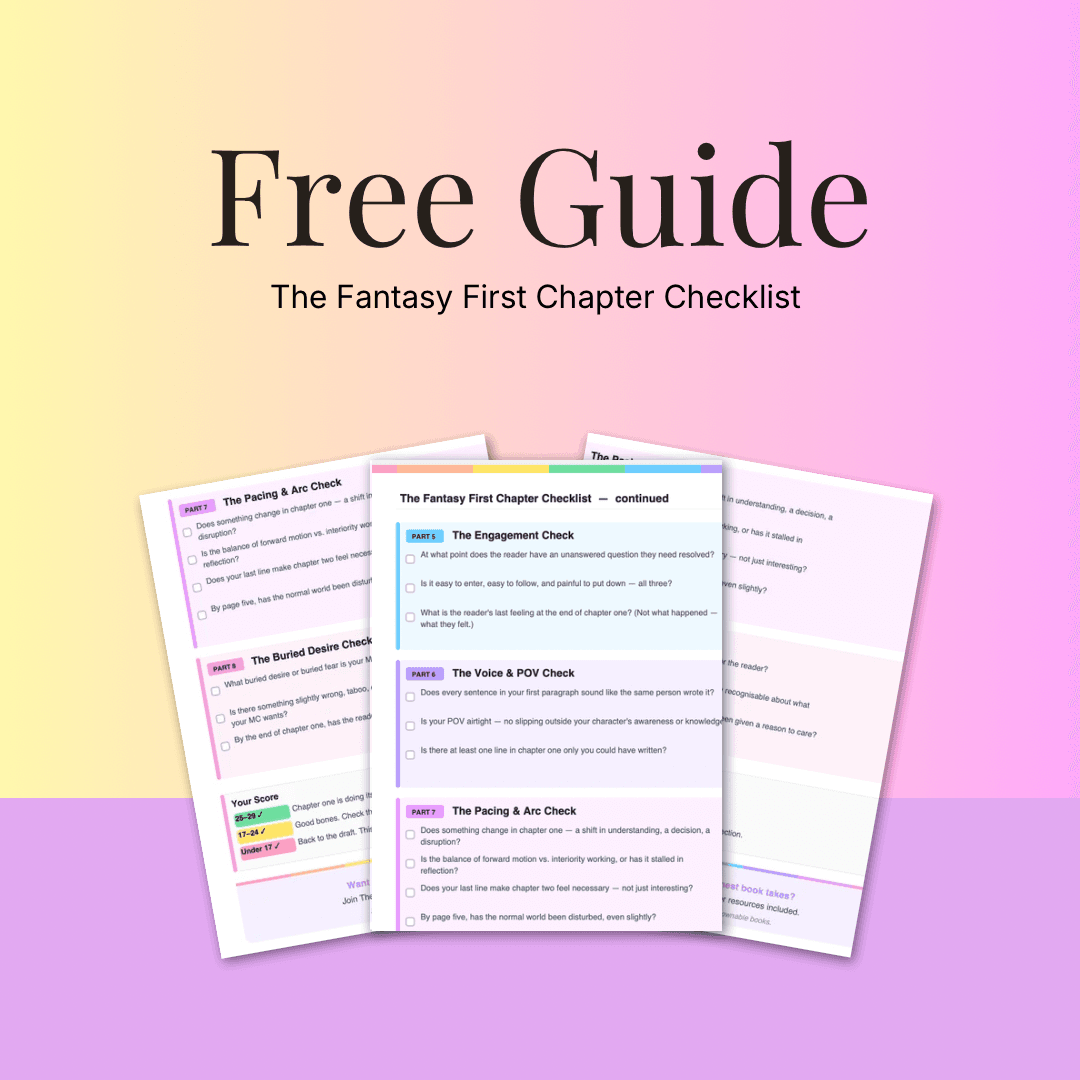 The First Chapter Checklist (PDF)
The same things I check when a writer pays me to look at their opening, condensed into a checklist you can run yourself.
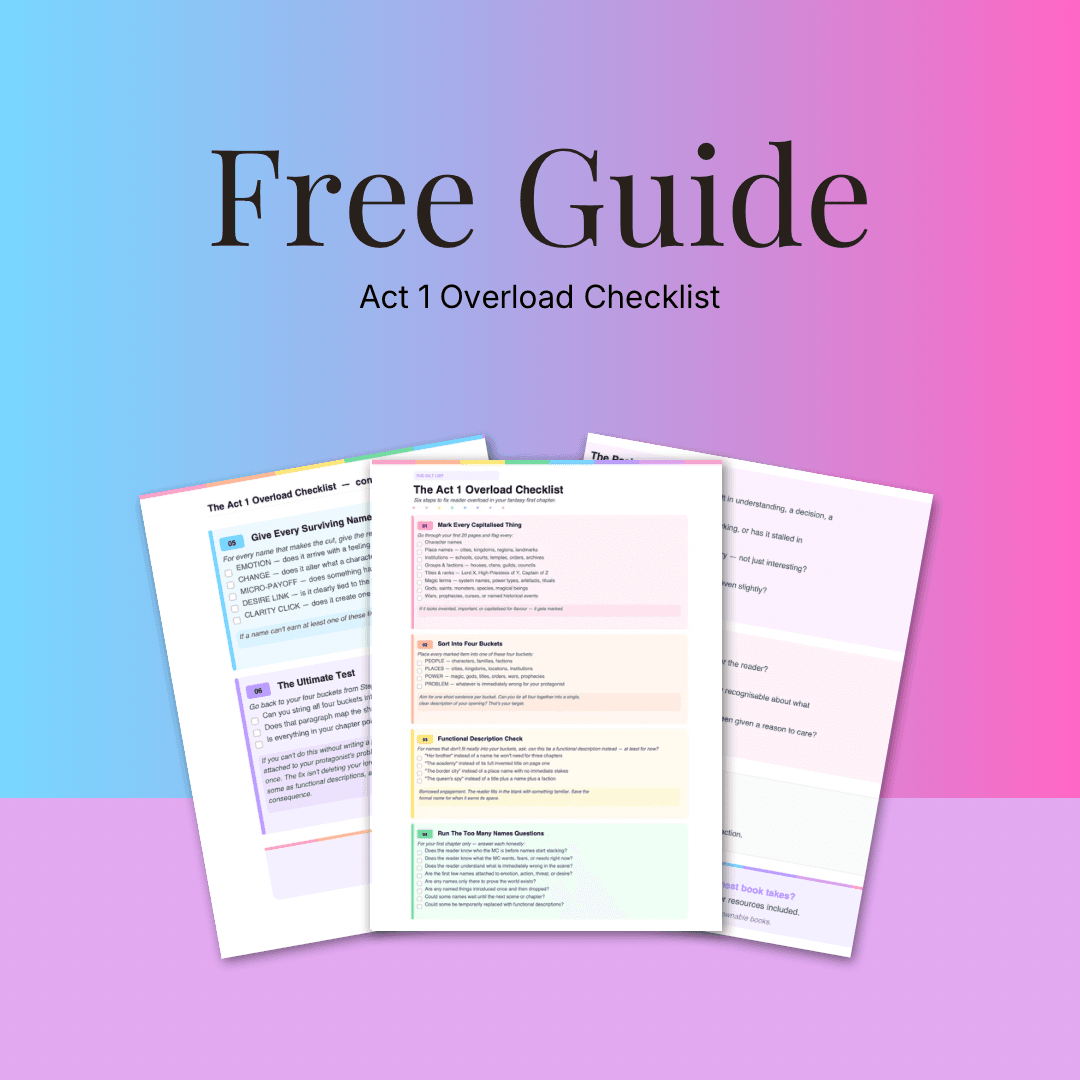 The Info Dump & Worldbuilding Guide (PDF)
How to tell when your worldbuilding is arriving in the wrong order, and what to do about it.
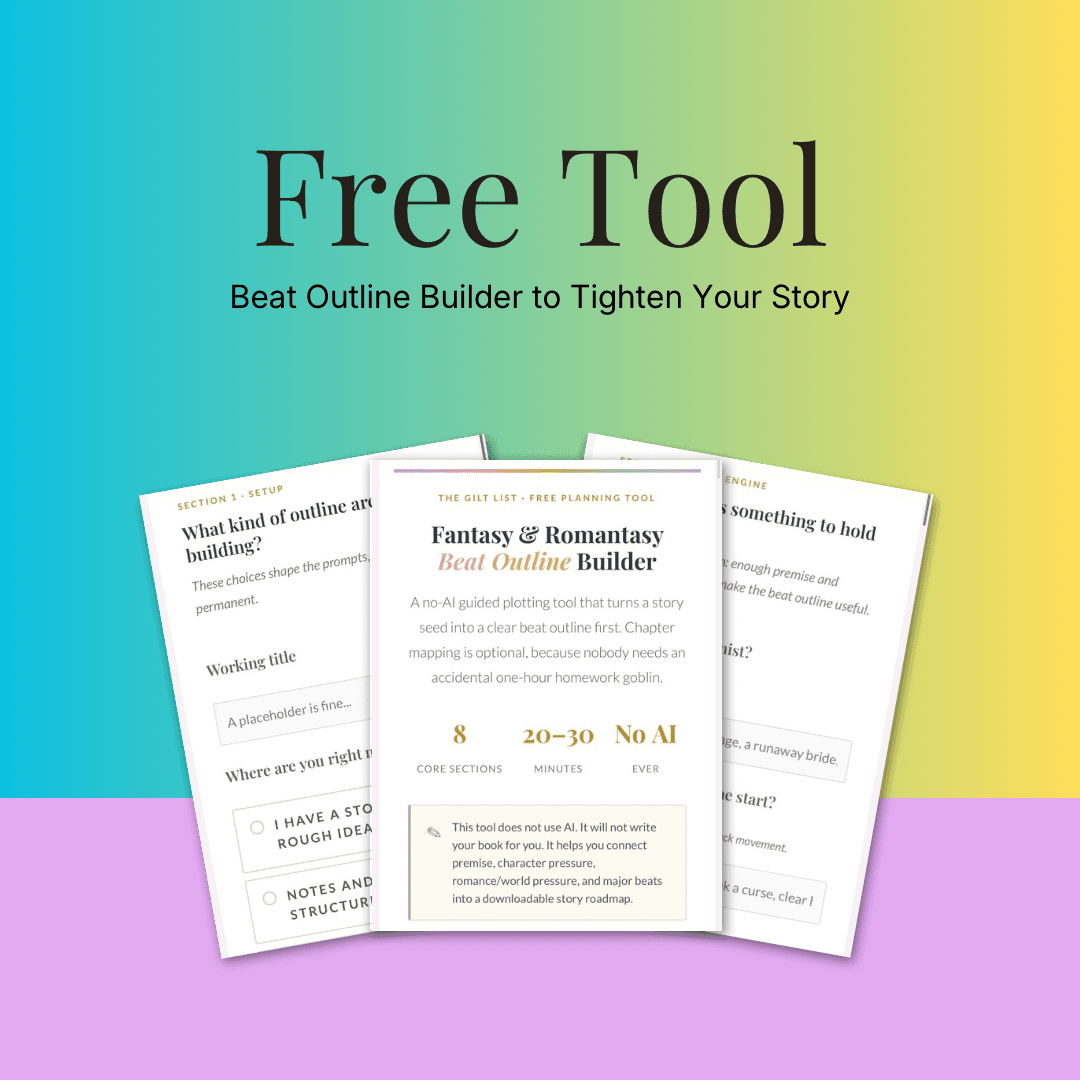 Novel Outline Tool
Plot your beats before the structural problems bake themselves in. Free to use, no email required.
Try the Outline Tool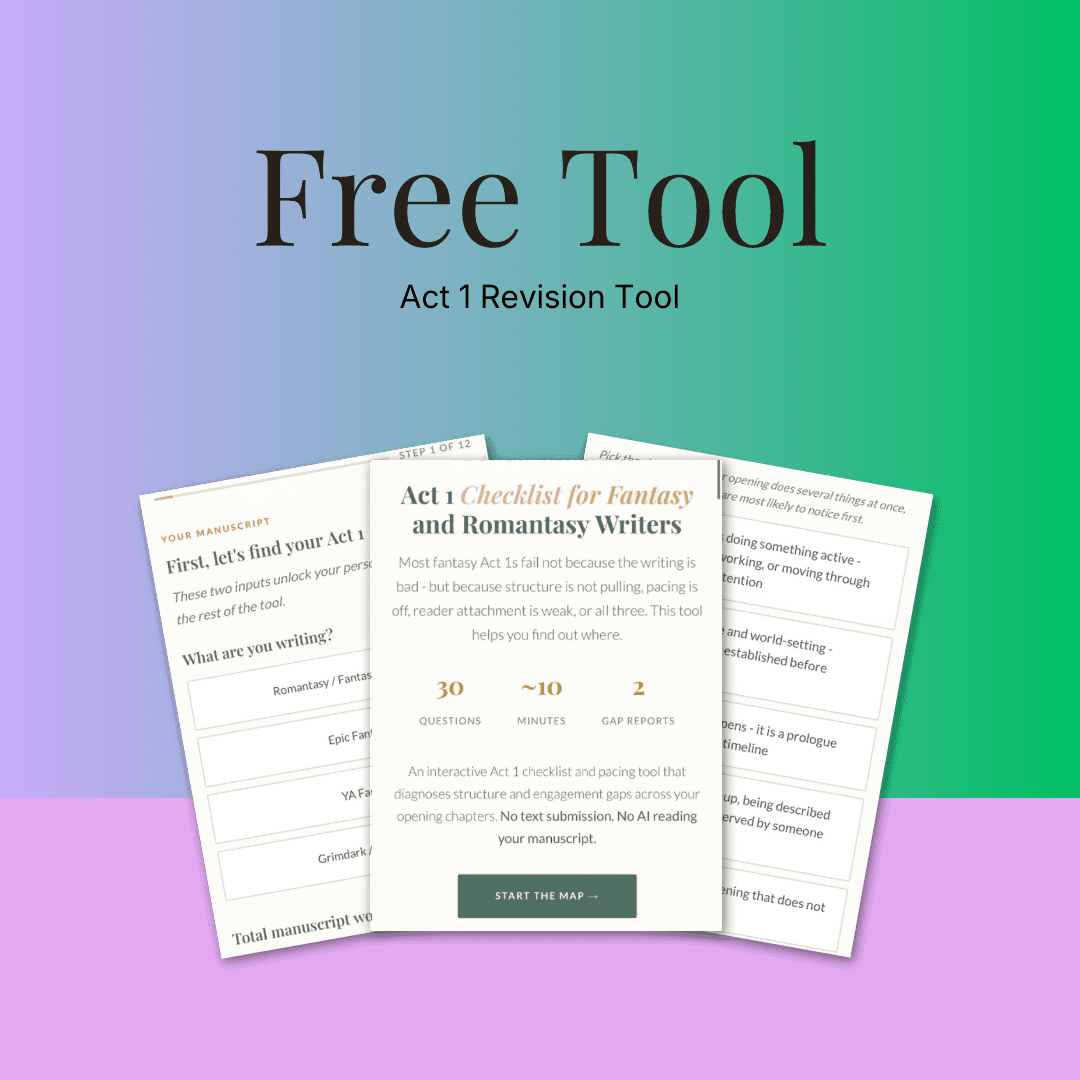 The Act 1 Revision Tool
An interactive checklist that helps you diagnose your Act 1 problems yourself. No AI, just the tool.
Try the Act 1 ToolMore About the Critique
Everything you may want to know before handing over your opening pages.
What exactly is included in a first chapter critique?
Every tier includes real, considered, editorial feedback on your manuscript pages. The difference is page count, depth of written analysis, revision strategy, and whether you want calls to talk through the work. Tier 1 gives you focused feedback on your first 10 pages or 5k words, including inline markup comments, scene-by-scene notes, and a short feedback paragraph at the bottom with actionable feedback. Tier 2 expands that to 20 pages or 10k words and adds an editorial letter. Tier 3 includes the 20-page critique, the editorial letter, a step-by-step revision plan, and 30-minute calls.
What will I understand after the critique?
By the end of your critique, you should have a clearer sense of what your opening is doing for the reader.
What can an editor tell me that beta readers usually can’t?
Many writers consider beta readers before editors but this can cause more problems than its worth. Many beta readers are good at reading, and experiencing the world, but are not trained in the mechanics of writing. They may give feedback such as:
These notes are not useless, exactly, but they are not enough to revise from. They tell you the reader felt something you didn’t intend, but not why, how to fix it, or what caused it. An editor can tell you exactly why they felt that way and how to fix it step by step.
That is where a focused first chapter/opening critique helps. I read your opening pages as both a fantasy reader and a developmental editor.
This critique is especially useful if you are preparing for beta readers, querying, self-publishing, revising after confusing feedback, or trying to decide whether your opening pages are actually doing the job you need them to do. It is also useful if you keep polishing the same sentences because something feels off, and nothing is changing.
Why does fantasy and romantasy need genre-specific feedback?
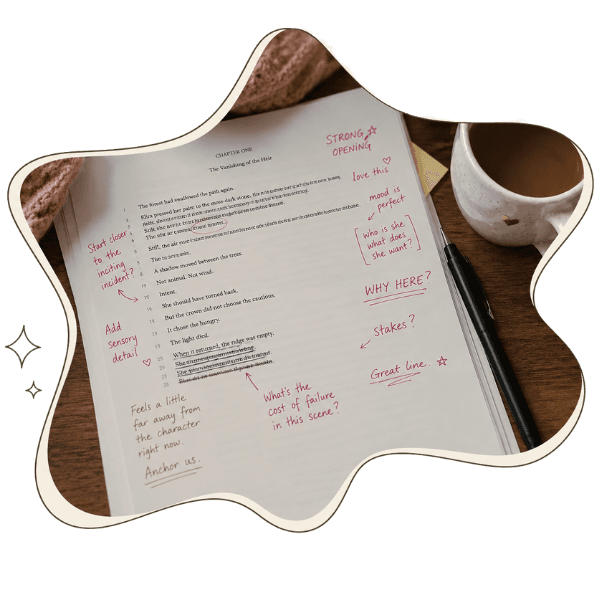
A fantasy or romantasy first chapter has to do an unreasonable amount of work without looking like it is doing an unreasonable amount of work. It may need to introduce a protagonist, a world, a tone, tension, or a slew of other things.
A common mistake is thinking the first chapter or opening has to explain a lot immediately, or your reader will be completely lost. Unfortunately, that is usually where fantasy openings start to lose readers, who are really there for the story of it all. The reader does not need why things work before they understand why they should care (even if they leave comments when critiquing that they are confused).
A strong fantasy opening gives the reader a person to attach to, a situation to track, a question to hold, and a world that feels interesting. A strong romantasy opening also needs to signal that love is the answer, even if the love interest has not appeared yet (think Belle avoiding Gaston).
That is why this critique is not a generic “first chapter/opening review.” A professional fantasy first chapter critique has to understand worldbuilding load, trope expectation, genre promise, reader engagement, romantic tension, pacing, clarity, and the difference between mystery and confusion. Then explain how to get your story on track to easily achieve all of that with the skill set you currently have.
What does too much worldbuilding in chapter one actually look like?
This is one of the most common problems in fantasy and romantasy manuscripts, and one of the hardest to spot from the inside. You may have spent months building the world so it all feels essential. The reader, meanwhile, is being asked to process too much before they have a single character they care about or a situation they understand well enough to be invested in.
Too much worldbuilding in chapter one rarely announces itself as worldbuilding with an info dump if the writer is seasoned. It arrives disguised as context, as necessary backstory, as useful orientation. What it actually creates though is cognitive load which is a general sense that reading this chapter requires work, and that the reader is being tested rather than invited in. Once that feeling settles, most readers will not push through it. They will put the book down with the full intention of coming back later, and later will not come.
A fantasy opening pages critique looks at how much of the chapter is devoted to establishing the world versus establishing the person the reader is supposed to follow. The question is not whether there is too much worldbuilding in absolute terms, unfortunately it isn’t that simple, some books need a lot of world early. The question is whether the worldbuilding is arriving in the right order and the right way.
If your opening chapter includes long passages of explanation before a character makes a meaningful choice, if the first scene describes the world rather than showing a person inside it, the problem is likely worldbuilding load rather than prose quality. This is one of the most specific and actionable things a fantasy manuscript critique can diagnose because knowing that the worldbuilding is arriving in the wrong order gives you an exact revision target, rather than the vague instruction to “start stronger.” Or “explain better.”
What do you actually look for in my opening pages?
A fantasy or romantasy first chapter is teaching the reader what kind of book they are entering, what kind of emotional experience they can expect, and what kind of questions they should begin tracking. The chapter may be gentle or dramatic, romantic or dangerous, funny or unsettling, but it still needs to create a sense that we are going somewhere.
When I read your opening, I look at how the page manages attention, desire, clarity, pressure, and reward. Those words sound clinical, but on the page they become very practical. Does the reader know who to care about? Does the character want something specific enough to create motion? Is the worldbuilding making the scene more interesting, or is it asking the reader to memorize information without emotional context? Is the opening creating curiosity, or is it simply withholding explanation and hoping that counts as intrigue?
I also look at whether the chapter is giving readers the right kind of promise. A romantasy opening with no emotional charge may accidentally promise fantasy first and romance much later for example.
Free Tools
Before you go: the free stuff, one more time
If the budget isn’t there yet, or the chapter isn’t, don’t leave empty handed. Pop your email in for the PDFs (you’ll also get craft posts and writerly advice, unsubscribe whenever), and the tools are free to use on the spot.
The First Chapter Checklist (PDF)
The same things I check when a writer pays me to look at their opening, condensed into a checklist you can run yourself.
The Info Dump & Worldbuilding Guide (PDF)
How to tell when your worldbuilding is arriving in the wrong order, and what to do about it.
Novel Outline Tool
Plot your beats before the structural problems bake themselves in. Free to use, no email required.
Try the Outline Tool
The Act 1 Revision Tool
An interactive checklist that helps you diagnose your Act 1 problems yourself. No AI, just the tool.
Try the Act 1 ToolAbout Me
About the fantasy developmental editor and romantasy editor behind The Gilt List

I’m the writer and editor behind The Gilt List, a reader-first book platform focused on romantasy, fantasy romance, viral books, Kindle Unlimited discovery, reader behaviour, and why some books become genuinely hard to put down. I spend a lot of time looking at books from both sides. 1. As a reader who cares about emotional payoff, 2. As an editor who cares about the mechanical side of story.
My background spans across editing, writing, marketing, and reader behaviour. I work with marketing content professionally half the week, and this the other half; which means I think a lot about what people search for, what makes them click, what keeps them reading, and what makes them leave. That perspective matters for fiction more than people think.
I’m also an EFA-trained developmental editor (Advanced Developmental Editing Certified), and I have worked on fantasy manuscripts including a self-published novel that reached Amazon bestseller status in its category.
Through The Gilt List, I spend a slightly insane amount of time thinking about the reader side of fantasy and romantasy. Like why readers binge some books and abandon others, why certain tropes create instant hunger, why worldbuilding can feel either delicious or exhausting, and so much more. That is the lens I bring to your first chapter critique. I read like a fan. I think like an editor. I care about the reader staying in the story. And most of all, I care about story.
How It Works
Start wherever you are
You do not need to have everything figured out before reaching out. Please feel free to ask me a question, request a sample edit, or choose a critique tier and send your pages when you’re ready.
- Get in touch. Ask questions, request a sample, or book the critique that feels right for you.
- Send what you have. If we move forward, I’ll need your first 10 pages for Tier 1 or 20 pages for Tiers 2 and 3, plus a short questionnaire. A synopsis or extra notes are welcome but never required.
- I read your opening. I look at hook, character desire, pacing, worldbuilding, clarity, genre promise, emotional tension, and where a fantasy or romantasy reader may start to drift.
- You get a clear revision path. Depending on your tier, that may include inline comments, scene notes, an editorial letter, a revision plan, and calls. You’ll know what is working, what needs attention, and what to tackle first.
Your pages do not need to be polished!!
Ready to Fix Your First Chapter?
Your first chapter does not need to be perfect. It needs to make the reader want the second one. If your fantasy or romantasy opening feels slow, confusing, overloaded, or simply a little off, a first chapter critique can help you work out why.
Send me your opening and I’ll show you where the chapter is working and what to revise.
Book Your First Chapter CritiqueOnly 3 in-depth testimonial discount spots left, first come, any tier. Once they’re gone, everyone pays the normal rate.
FAQ
Fantasy First Chapter Critique FAQ
What is a fantasy first chapter critique?
A fantasy first chapter or opening critique is focused editorial feedback on the opening pages of your fantasy, romantasy, or fantasy romance manuscript. It looks at whether your first chapter is hooking the reader, setting up the right story promise, introducing the world clearly, creating enough emotional or narrative pull, and giving you a practical next step for revision.
What is included in Tier 1?
Tier 1 includes feedback on up to 10 pages. You receive inline markup comments on the manuscript, scene-by-scene notes, and a short feedback paragraph at the bottom explaining the main issue, what is working, and what to revise first.
What is included in Tier 2?
Tier 2 includes feedback on up to 20 pages. You receive inline markup comments, scene-by-scene notes, and an editorial letter that goes deeper into what is working, what is causing friction, and how to approach revision.
What is included in Tier 3?
Tier 3 includes everything in Tier 2, plus a step-by-step revision plan and 30-minute calls. It is best for writers who want detailed feedback and a clearer strategy for revising the opening pages.
Do all tiers include inline markup comments?
Yes. Every tier includes inline markup comments directly on the manuscript pages. The difference between tiers is the number of pages reviewed and the depth of the written feedback and revision strategy.
Is this a line edit?
No. This is a developmental critique of your opening pages, not a line edit or copyedit. I may comment on sentence-level issues if they affect clarity, voice, pacing, or reader engagement, but the main focus is the story-level function of the opening. I won’t correct their vs. there, I’ll attack the meaning behind the words not the words themselves.
Do you work with romantasy and fantasy romance?
Yes. This service is specifically built for fantasy, romantasy, fantasy romance, urban fantasy, paranormal romance, and related speculative genres. If your manuscript involves magic, desire, danger, romantic tension, morally questionable people in crowns, or some combination of the above, you are likely in the right place.
Can I book if my manuscript is unfinished?
Yes. You do not need a finished manuscript to book a first chapter critique. This can be useful if you are drafting and want to make sure the opening is setting up the right book before you keep building on it.
Will you use AI on my manuscript?
No. Your manuscript will not be run through AI. I read and evaluate the pages myself.
Which tier should I choose?
Choose Tier 1 if you want focused feedback on your first 10 pages. Choose Tier 2 if you want a fuller critique of your first 20 pages and an editorial letter. Choose Tier 3 if you want the 20-page critique, an editorial letter, a revision plan, and calls to talk through the feedback. If you are unsure, Tier 2 is the most common starting point.
What if I already know my first chapter has problems?
That is completely fine. You do not need to arrive with a polished opening. This critique is designed for writers who know something is not working but need help identifying the actual issue and deciding what to revise first.
What is a fantasy developmental editor?
A fantasy developmental editor works on the story-level elements of a manuscript — structure, character arcs, pacing, scene function, stakes, world integration, and genre promise — rather than on prose style, grammar, or line-level writing. A fantasy developmental editor reads with an understanding of the specific demands the genre places on a manuscript: the cognitive load of worldbuilding, the trope expectations of the audience, the particular pacing of romantasy versus epic fantasy, and the reader-engagement patterns that cause DNFs in this genre specifically.
What is an opening pages critique?
An opening pages critique is focused editorial feedback on the first section of your manuscript — usually your first 10 or 20 pages — rather than on the full book. It looks at whether the opening is doing its job: hooking the reader, establishing the story promise, introducing the protagonist with enough to care about, managing worldbuilding load, and creating enough forward momentum to carry the reader into the next chapter. An opening pages critique is especially useful before beta reading, querying, or self-publishing, when you need to know whether the first impression your manuscript makes is the right one.
Why are readers not hooked by my first chapter?
Readers are usually not hooked by a first chapter for one of a handful of structural reasons: the protagonist does not yet have a clear, visible goal; the chapter creates activity without creating pressure or stakes; the worldbuilding is arriving before the reader is emotionally attached to anyone inside the world; the chapter starts too early, before the situation that actually matters to the story; or the chapter does not create a clear enough question to keep reading toward. The writing itself is rarely the primary cause. Most writers who suspect their opening is not working are right that something structural is off, and wrong that the sentence-level prose is the problem. That’s what line editors are for.
What should I do if my first chapter has too much worldbuilding?
Too much worldbuilding in chapter one is one of the most common and diagnosable problems in fantasy manuscripts. The fix is usually not to remove the worldbuilding entirely, but to move it: information that arrives before the reader cares about anyone inside the world creates friction; the same information, filtered through a character’s emotional experience later in the chapter, becomes immersive, for example. A first chapter critique can identify where the worldbuilding is landing relative to the character attachment beats, and give you a specific target for where the information order needs to shift.
What is the difference between a first 10 pages critique and a first 20 pages critique?
A first 10 pages critique covers the opening hook, the first scene or scenes, the protagonist’s initial situation, and whether the very first impression of the manuscript is working. If you’re sending letters to agents this is the section they ask for. A first 20 pages critique extends that to cover the full opening sequence, including how the chapter develops after the first scene, how the story promise is established across the opening, and whether the chapter ending creates enough momentum to carry readers forward. With this section an editor can usually see full story level problems before they crop up. For most fantasy and romantasy manuscripts, the first 20 pages is where the structural patterns become clearest, which is why Tier 2 tends to give the most actionable revision direction. Plus with more content, we have more to move and understand to make those first 10 pages engaging.