
You can get professional editing help for your fantasy first chapter through freelance developmental editors, first chapter critique services, specialist fantasy editors, and critique workshops. The best option for your fave WIP depends on what sort of help you’re looking for. If you need a deep structural diagnosis, a line-level polish, a grammar tweak, or raw reader reactions, then you have different problems that will need different approaches.
Most writers searching for this question already know something is wrong with their opening. They just don’t know what kind of wrong…once you know the round-about answer to that question, you can decide who you should be paying. If you’re on a budget you can check out my guide on fantasy editing for the budgeting author or see all the guides I create on writing to try and muddle through on the writers hub.
What Kinds of Professional Editing Help Exist?
Developmental editing looks at the structural questions all the way through your manuscript. Those who specialise in this kind of book surgery answer things like whether each chapter and scene is doing its job. Whether the reader will be hooked from the start. If your character is introduced and goes on a journey in a way that makes them intriguing, likeable, or worth following.
First chapter critique services are a focused, lower-cost version of developmental editing. Some editors offer these as an entry point, but they can do a lot to help a writer really hone in on the overall problems. Sometimes, one chapter is all a dev ed needs to be able to diagnose a whole host of problems. That’s why you see agents requesting that first. (This is what I specialise in!)
Line editing works at the sentence level, like the rhythm, clarity, how a line lands, or if there are any clarity issues. It is not proofreading; it won’t fix all your grammar and formatting, but it will find things you think make sense, but only to you. A good line editor on a fantasy first chapter might tell you your prose is slowing down or your worldbuilding drops. This is the right tool when your structure is already solid, you’ve nailed the mystery, romance, and dark night of the soul, and now you need pacing and line tweaks. I offer developmental editing for those interested.
Copyediting and proofreading are about correctness, thinking about grammar, consistency, sometimes formatting, and typos. Don’t pay for these on a chapter you’re about to backspace, as it’s a waste of money. This should be the final check.
Beta readers are not professionals, but a well-briefed beta who reads heavily in your genre is giving you something editors sometimes can’t – a trendy reader take. Since they are not trained to spot exact problems, threads within the story that were accidentally plotted or dropped, pacing, or complex craft, they may know what’s wrong but not how to fix it.
Manuscript critiques are becoming more popular lately. This is like a full developmental edit but it’s not as in depth. In this case, the editor will do a once over read through your manuscript and give you the major things that you will need to fix before sending to beta readers, or your copyeditor. I offer a manuscript critique for those interested.
Which Type of Feedback Do Fantasy Writers Usually Need First?
Line editing is often what writers think they need because they can see a sentence that isn’t doing the work it should. What’s much harder to see from inside your own draft is that you opened on three characters, accidentally hinted at a story that won’t happen, brought a best friend into the mix then never brought them up again, wrote in a voice that doesn’t match the character, made the character incredibly unlikeable in an effort to open on action, or created a protagonist who doesn’t make active choices (the plot makes it for them).
Those are structural problems, and it’s quite common for a first draft. No matter how pretty the story looks on the page, if you don’t fix these issues, the book won’t be the best it can be. And for that, you’ll need a developmental edit.
What Specific Feedback Can Professionals Give for First Chapters?
The specific problems that professional feedback catches most reliably in fantasy first chapters are the following:
- Hook placement. A lot of fantasy writers open with context — world, setting, history — because the world feels important to establish first. Readers want to care or feel something.
- Pacing misalignment. Epic fantasy can earn a slower opening than romantasy, but only if the prose is doing compensatory work. These are genre-specific calibrations that a generalist editor will often miss entirely.
- Worldbuilding overload. The most cited first chapter problem in fantasy, across every professional, workshop, and beta context. Every page of worldbuilding in chapter one needs to earn its place and fight to the death if need be.
- Character introduction. Your protagonist is described in cliches, or your protagonist is conflicting in some way, or is unlikable. Editors can point to why and give you easy changes based on skillset.
- Genre positioning. If your chapter reads like cozy fantasy but you’re writing dark romantasy, professional feedback will catch that faster than you will because you know what you meant to write
If what you need is structural feedback on hook, pacing, worldbuilding, character setup, and genre positioning — rather than grammar cleanup — a focused first chapter critique is usually the most efficient paid option, and a lot more cost-effective than an entire dev edit. That’s the kind of feedback I offer for fantasy and romantasy writers who need to know what their opening is actually doing on the page, not just what they intended it to do.
As I often say, editing your own work is almost impossible, as you read what you thought you wrote.
How Do You Know If You Need Professional Feedback Yet?
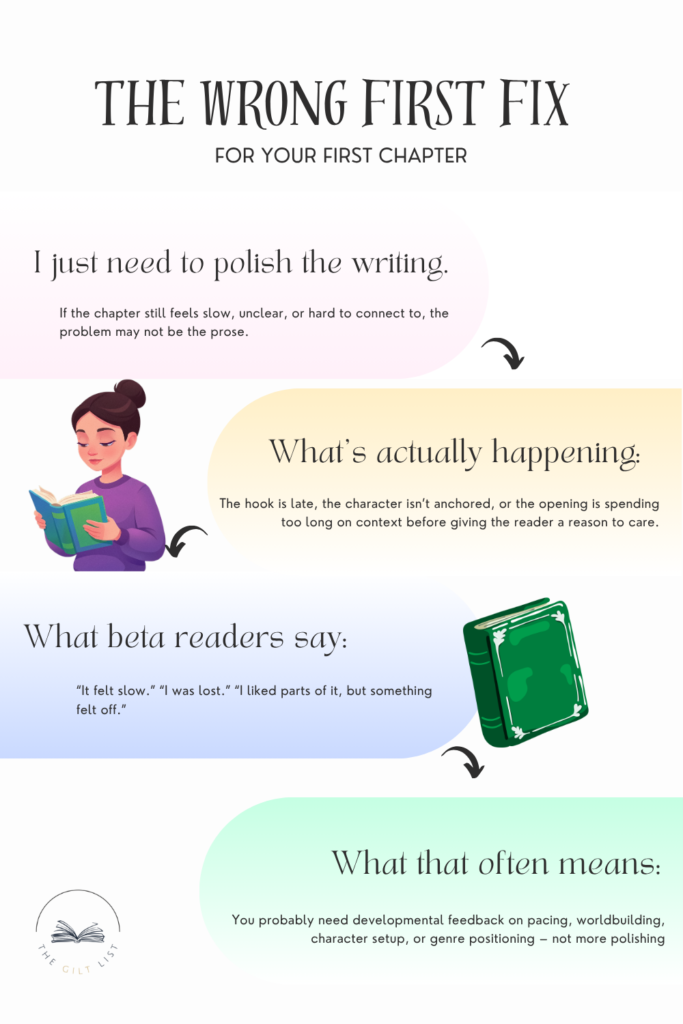
You’re probably ready when you’ve revised the chapter past your own ability to judge whether the pacing or opening point is actually working. If you’re stuck in the messy middle and need someone to see the hints you set up for yourself to keep going with the story. You’re ready to submit to a final line or proof edit and want to make sure the opening chapter is amazing and catchy enough to set up the world, voice, characters, and genre. Or you’ve had at least one round of beta feedback, and you still don’t know why it isn’t working.
- You’re too close to it when: you’ve revised so many times you no longer know if it’s working. You know what you meant to write, but you can’t tell anymore whether a reader is receiving it.
- Your beta readers aren’t enough when: the feedback is contradictory, vague, or clearly coming from personal taste rather than craft knowledge. “I don’t know, I just stopped feeling as invested,” or “the vibe changed,” repeated across multiple readers, means someone needs to explain in craft language, not preference.
When Is Professional First Chapter Feedback Worth It?
Actually, I’ll be contrary to what people tell you and say, pretty early on in the editing process. A good first chapter critique is not just a fix for one opening…of one WIP…the end. It teaches you something about your own patterns as a writer in general and where you are in craft. It can even tell you what kind of story would be too ambitious for you to write, this time. It can point out things like what you over-explain, where you hold back too long, how your character introductions feel, what your pacing is doing, and whether your opening is setting up the book you think it is.
At this price point, that kind of insight can pay off across this manuscript and every book you write after it. It’s completely worth it over a complete developmental edit, which can cost thousands, if you want to invest in your skillset.
What Should You Look For in a Fantasy First Chapter Editor?
The things that matter before you hire anyone:
- Fantasy-specific language on the service page. An editor who understands fantasy openings will talk about hook, pacing, worldbuilding, character setup, voice, and genre positioning.
- Developmental lens. Especially for a first chapter. Line editing just one chapter is a little pointless unless you want to build on your English skills (for example, English is your second language and this is your first should-be-published work). If the sample deliverables are mostly tracked changes and corrections about what would sound better instead of what you’re saying under the text, they’re offering a different service.
- Clear deliverables. You should really know exactly what you’re getting back before you pay. A written editorial letter with specific structural notes is not the same thing as a paragraph of general impressions in a comments sidebar. You’re looking for an editorial letter that outlines the entire thought process, what you’re doing well, or not doing well, etc.
- Whether they read in your genre. An editor who names the books they work in — who can talk about what Fourth Wing did in chapter one versus what Rachel Gillig does differently — is demonstrably more useful on your fantasy manuscript than someone with a strong literary fiction background approaching it as an exercise in general craft
- Whether the service is designed for a chapter-one diagnosis specifically. A developmental editor working on full manuscripts is solving the whole story setup front to back.
What Should You Send When Asking for First Chapter Feedback?
- The pages. Formatted clean, as in double-spaced, 12pt, page numbers.
- A brief synopsis. One paragraph that basically says who the protagonist is, what the central conflict is, what this first chapter is supposed to set up, and where the story is going. If you want to send an entire outline you have in a Google sheet or document, most developmental editors of all kinds won’t complain. This helps as it tells the editor what your chapter is trying to do, and what you might want to set up earlier, or leave until later.
- Your concerns. Tell your dev editor what you think isn’t working. You might be spot on; or it could be that you think that isn’t working, but actually, something else you haven’t thought of is the compounding problem. Every bit of information helps.
- Your publishing goal. Traditional and self-publishing will have different goals. A self-published book has more room to breathe than a traditional one. If you’re about to start querying, for instance, we’d want to start with the hook to get the agent excited. It also tells us who your writing competition is, so we can make sure you have a good footing in the market.
Is a First Chapter Critique Worth It for Fantasy Writers?
Usually yes, but specifically in three situations.
When the opening is the bottleneck.
If you’re stuck on chapter one, if you’ve rewritten it multiple times and still feel like something structural is wrong, outside diagnosis is almost always faster than continuing to revise in circles.
When you’re about to pitch.
A first chapter critique run before an agent submission round is one of the highest-return editorial investments a querying writer can make. Agents make decisions fast, often on the first page; they don’t have time to invest like a reader would. If yours isn’t doing its job, you want to know now, not after you’ve submitted to your dream agent.
When you suspect the chapter is mispositioning the book.
If beta readers who should like your book are putting it down or declining to help. If you’re getting feedback that is too vague and not helpful.
If you’re stuck in the messy middle or can’t find your ending
Believe it or not, sometimes explaining the story to a developmental editor and showing them the first chapter can be enough to start exploring threads you set up in the beginning.
Did your character mention a third uncle she hadn’t seen in years in passing? Did she jump out of her skin when someone rang a doorbell, and that fear hasn’t been explored?
Writers are very subconscious, and often the beginning will echo the ending. Most times, there will be little strings or tiny threads buried in the first chapter that can help unfold the rest of the book.
How Much Does a Professional First Chapter Critique Cost?
A first chapter critique from a specialist editor runs anywhere from $100 to $400+, depending on depth, deliverables, and the editor’s experience level. The question to ask isn’t really about how much it will be, but if it will solve the problem, therefore saving you time and money down the line.
Professional Editing Help for Your First Chapter
If you’ve revised your opening past your own ability to judge it and you still don’t know whether the problem is your writing, hook, pacing, worldbuilding, character setup, or genre positioning, then my fantasy first chapter critique is built for exactly that. You send the chapter through the form, and I’ll tell you what’s working, what isn’t, and what to fix first.
[Fantasy First Chapter Critique]
Frequently Asked Questions
You can get professional editing help through freelance developmental editors, first chapter critique services, specialist fantasy editors, workshops, or paid beta-style feedback. The right option depends on whether you need big-picture structural feedback, sentence-level editing, or reader-response insight.
Yes. Many editors offer first chapter critiques or sample-level developmental feedback. This can be a smart way to get targeted help on hook, pacing, worldbuilding, character introduction, and genre positioning without paying for a full manuscript edit.
For most writers, a developmental editor or first chapter critique service is the best fit. Fantasy openings usually need feedback on structure, reader expectations, and setup before they need line editing or proofreading.
Usually, yes. A focused critique can help you understand what your opening is actually doing on the page, what signals it is sending to readers, and what to revise first. It can also teach you a lot about your own writing habits for future books.
A fantasy first chapter critique usually looks at hook, pacing, character introduction, clarity, worldbuilding balance, emotional pull, and genre positioning. It should help you see whether the opening is setting up the right kind of book for the right reader.
Not necessarily. Many writers get useful first chapter feedback before the full book is finished, especially if they are stuck in revision loops, unsure whether the opening works, or trying to understand how the book is landing with readers.
Usually your first chapter or first pages, a short synopsis, and a few notes on your concerns or goals. The more specific your questions are, the more useful the feedback tends to be.
A beta reader gives reader reaction. A professional editor gives diagnosis. Beta readers may tell you something feels slow or confusing; an editor should be able to explain why and tell you what craft issue is causing it.
Costs vary depending on the editor, the depth of feedback, and whether the service includes comments on the pages, a written editorial letter, or both. A first chapter critique is usually much more affordable than a full manuscript edit.
Look for someone who understands fantasy conventions, uses genre-specific language, explains their process clearly, and offers feedback on structural issues like hook, pacing, worldbuilding, and character setup — not just grammar.