
When I wake up, the other side of the bed is cold.
Eleven words. That’s all it took for Suzanne Collins to create a familiar emotion in the reader, one they will instantly register as anxiety. One, they might have even felt, or imagined, themselves at one point, so that it hinges them immediately to the POV.
That’s the trick of it, making your character so emotionally resonant, and quickly enough, that everything thereafter is the backdrop to how you feel, both in the world and about the protagonist.
If you’ve always sensed that The Hunger Games does something magical, then in this blog, we’re going to break down the how of it. Chapter one has about 20 pages (depending on where you read it, for me, right now that’s my Kindle), and in this short time Collins is able to build a complete world, establish Katniss with a fully formed emotional life, set up a political system worth exploring, and hit us with absolute devastation by the final words: It’s Primrose Everdeen. Mirroring her opening line.
Here’s exactly how she does it.

The First Line Isn’t About the Cold Bed
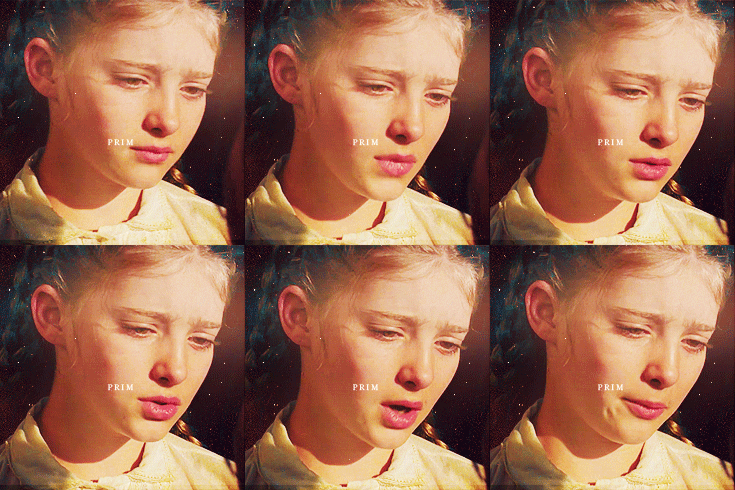
Isn’t mentioning the weather, or the temperature of the room, a faux pas? That’s the beauty of this first sentence. It does something all incredible craft should do, takes the rules and breaks them the right way.
The other side of the bed is cold, is an absence, not just a setting, not just a character waking up on the first day of the book. It snaps you to attention immediately as it takes something safe, a bed, and makes it fear.
The first thing Katniss registers when she wakes on reaping day is that her sister — the person she has organised her entire existence around protecting — is not beside her.
You don’t know that yet. Collins hasn’t told you. But you feel the wrongness of it anyway, because absence is one of the most instinctively readable things a writer can put on a page. We are wired to notice what’s missing more than we are wired to notice what’s in the room. And we are wired to notice a lack of comfort, more than we are the warm, fluffy sheets of a bed.
By the time you learn who Prim is, what Katniss’s relationship to her is, and why it matters, you already care, because they are missing. Therefore, you want to hear more, notice more, understand more, and know the importance of paying attention. Lest she goes missing again. The brilliance of the end of this chapter is that is exactly what happens…it’s as if Collins is saying, are you paying attention yet?
If you want to understand more about why this works as an opening move, when character desire isn’t enough in fantasy gets into the mechanics of what’s actually hooking the reader when it isn’t just want.
The World Is Built Through Consequence, Not Explanation

The worst thing you can do with worldbuilding is to explain it. Have you ever sat in a lecture hall and tried to learn the difference between capitalism and communism? With little lists to compare, and colored maps, and all that jazz. I have, it’s dull. It’s far more exciting to see the story play out around it through wars, newspapers, and people’s stories.
That’s why show, don’t tell is such a big thing. It’s not about perfecting your lines, it’s about not boring readers into a coma.
Collins doesn’t say, “we were tired all the time, and scared of Snow, because he makes up mean games. So we close our shutters to stay hidden.”
She mentions how characters, despite the reaping, should choose to sleep in, with their shutters closed. This shows it must be one of the few days off this populous gets, and they are so exhausted they may sleep in even on a day like this. No energy to fight back. Only hiding in the shadows, afraid.
By now you can see that Collins packs several meanings into each sentence. It’s this inference that helps us to understand the world she is creating. Readers are pretty clever; we pick up on every piece of information, and even if we don’t fully remember, we do hold onto something that strikes us as odd. Shutters closed, rats in the streets, an electric fence, a cold bed.
World-building isn’t about the details you choose to share; it’s about the consequences of those details. The closed shutters are a consequence of their political environment. The rats are a consequence of a lack of infrastructure or unhygienic neighborhoods. The electric fence is a consequence of living close to a forest, of having guards patrolling.
When you create a world, what impact does it have on everyday living? It’s those details the character lives and breathes through that should wave through Chapter 1.
Another impact Collins pays attention to is the emotional impact. If you always grew up with guards on your streets, would you slink past them with your heart pounding? Or would they appear as if furniture, prebacked into everyday life? The reader should feel afraid that there are guards, but should your character?
Even the Hob — the black market — doesn’t get a paragraph of exposition in this first chapter. Katniss goes there to trade. That’s it. You understand what it is from the fact that it exists and she uses it, the way you’d understand what a market is if someone mentioned they went to buy bread.
This is called embedded world-building, and it is genuinely difficult to do if you are not an experienced writer. The instinct, especially for new writers, is to make sure the reader understands before moving on. They might make a heart race if something evil comes along, they might describe the electric fence and how much the character hates it. Collins trusts the reader to catch up. She’s right to. All writers should take notes.
If you’re curious about learning more on worldbuilding and where to put it in your first chapter, I wrote a little something on it here.
What Katniss Wants vs. What Katniss Needs (They Are Not the Same Thing)
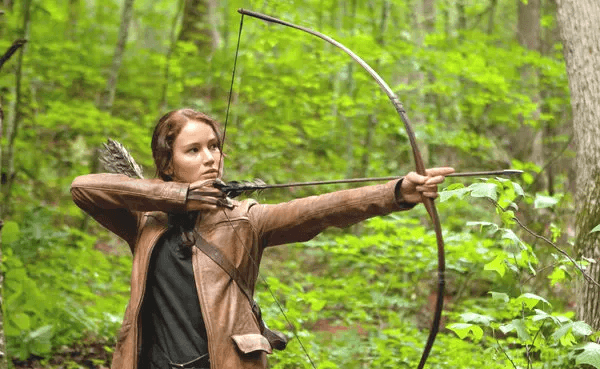
Katniss’s stated desire in chapter one is survival. Feed Prim. Keep the family alive. Don’t die. This is a pretty simple want that a reader can quickly understand and live through with Katniss. Knowing this, the reader may look out for danger everywhere and emote more. This first desire helps put the reader in the right state of mind for what they need to pay attention to. But it isn’t the inner desire of Katniss.
That inner desire is ease and freedom. You find this out in a conversation with Gale, where he says that they could run away and live in the woods. But Katniss cannot, because of her first desire. Now you have two clashing desires, both of which a reader can completely understand, both of which make the reader feel and look for details intrinsic to the story later.
The two desires continue to clash throughout the entire series. There is always a question of self vs. duty, protection vs. living, and a need for survival that pulls the tension tight across it all. If you’ve ever read Save the Cat or done any story structure work, you might recognise this moment, in beat terms, this declaration of Gale is called “the stated theme.” The next time you read a story, see if you can spot one. It’s when one character says something the other character should probably listen to, and if they had listened from the start, they would have gotten what they wanted much faster.
What they wanted, but not what they needed. For the need, you have to wait until the end of the book, and so does the protagonist.
The Politics Are Personal
The tesserae — the system where children from poorer families can add their names to the reaping pool additional times in exchange for a small amount of grain and oil — is explained in two paragraphs. It is one of the most efficient pieces of systemic injustice I have ever read in genre fiction, because it is personal first.
Collins doesn’t tell you that the Capitol designed a system to make the poor fight each other; what she tells you through dialogue and inference is: Gale has entered forty-two times, and Katniss twenty, Prim once. This tells you quickly about the disparity between the rich and the poor.
In our world, it’s the kid with the right trainers versus the kid without, but the stakes are different. New shoes might protect a child from being bullied, because we value appearance-based wealth. In Panem, the equivalent currency is food, and the consequence of not having enough of it isn’t social ostracism and inability to climb a social ladder to more money. It’s your name in the bowl forty-two times, and the very real possibility of death.
Here, Collins takes a gap we already recognise, something so quick and easy even a child would get it, and takes it to the extreme. The horror is in how far the stakes have fallen from shoes to survival.
This is the difference between world-building that informs and world-building that hits you right in the gut and won’t let go. Collins knows that abstract political injustice is hard to care about, we don’t care about distant wars, or how the capital has food, and fashion, and the arts and District 12 doesn’t. We’re too numb to that. The injustice needed to be cruel, and right on our doorstep.
Collins Doesn’t Start at the Reaping (And That’s Not a Mistake)
There is a piece of writing advice that goes around perpetually — start with action, start where the story starts, don’t delay the inciting incident — and it is handed to new writers like the freaking gospel 2.0. The Hunger Games ignores it completely. And it works, right?
The reaping doesn’t happen until the end of chapter one. Collins spends the majority of those pages on a morning in the woods, a conversation with Gale, the texture of Katniss’s ordinary life before it ends. If you wrote that scene idea down on paper, it would look boring, let’s be honest. But she keeps it interesting by adding two types of desires that conflict, immediate opening emotion, expectation-breaking world building, and the promise that something big is just about to happen.
When Prim’s name is called, it doesn’t feel fun, and you don’t shrug. This is the baby, the one Katniss is supposed to save; her heart from a sick cat, her shirt from disarray, her body from starvation. But also, I mean, the odds were supposed to be tiny, and didn’t we all expect Katniss to be chosen? After all, she has less chance than Gale, Collins practically said, ” Hey, Gale is the red herring, it will be Katniss.” Prim was yet another expectation-breaking event.
Now imagine if we didn’t have anything before the reaping. How would that have made the reader feel? Sure, they would understand Katniss emotionally and start to feel invested. But that’s the issue, start to feel…they wouldn’t truly care yet enough to understand why she had to choose to be tribute.
Imagine a world where that happened. How many readers would bicker that Katniss should have just stayed home then? And why didn’t Katniss just live in the Capitol afterwards? Why is she so difficult, so resistant, so unwilling to just play the game?
If Collins had opened at the reaping, it would have been plot. Opening where she does makes it grief.
The Dialogue Is Working Three Jobs Simultaneously
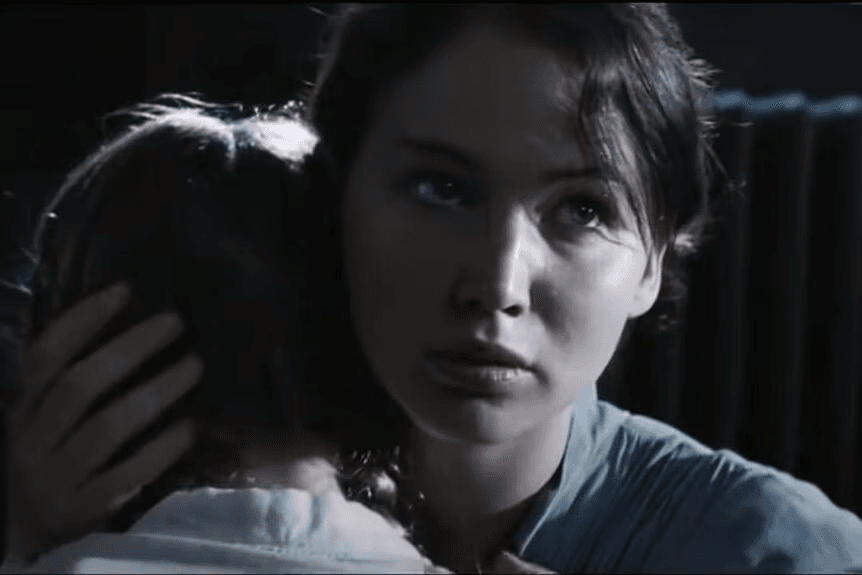
The scene in the woods between Katniss and Gale is the chapter’s real hinge for dialogue. It’s where we learn a lot about the characters, and the fears, and the general beliefs of the people. There are two other spots where dialogue is holding weight. One where Madge and Gale have a bitter exchange, and where Katniss and Prim have playful, light banter.
Dialogue should always have at least 3 currents running through it. What the character is saying, what the character wishes they could say, what the character desires, and whether they are choosing to say it in the dialogue or not. I am sure if we sat together and thought about it, there would be more, but those three always come top of mind for me when I’m looking at dialogue in a scene.
Collins, of course, pulls this off every time. Gale is practically begging Katniss to leave with him and have his babies. He’s spitting mad at Madge that she has privilege and he doesn’t, so uses passive aggression. And to make Prim even more lovable, she responds with a little quack, something small children often do when talking about animals. (There is something very endearing about hearing your child repeat back animal sounds that is somehow universal and so human).
We could pick apart all the layers in every example here, but that might get a bit long. So we’ll stick with Gale and Katniss. Their conversation reveals information. Like the reaping odds, political systems, the geography, how people eat, and how they could hunt.
It also reveals character: Gale is angry, political, restless. Katniss is pragmatic, contained, focused on the immediate. You understand both of them from how they speak to each other — the things they agree on easily, the things they fundamentally disagree on, which is whether hope is worth the risk.
And the things they won’t talk about. What each character brushes past. What desires this shows they have.
Finally, it creates low-level tension that has nothing to do with the plot: Gale wants to run. Katniss won’t. That’s a disagreement they’re not having yet, but it’s there in every line, there after. It makes the scene feel alive in a way that straight exposition never would.
This is dialogue doing what dialogue is actually for. Which is not, it turns out, just people talking.
For the Writers in the Room
Here’s the short version of what this chapter is actually doing, if you want to steal it. If you want to spot your top issues check out the Act 1 Checlist Tool, without using AI it can give you a run down of your entire Act 1 and what to pay attention to, specified to you and your genre.
If you’re writing and you’ve made it this far, here’s what chapter one of The Hunger Games is actually teaching about the craft:
- Lead with absence, not presence. The cold bed is more arresting than a warm one. What’s missing from your protagonist’s life is often more revealing than what’s there.
- Let the world arrive through habit. Your character doesn’t explain the fence. She checks if it’s live. The reader will do the work if you trust them to.
- Give your protagonist a charge before you give them a crisis. We care about the reaping because we already love Prim. Build the thing your protagonist is protecting before you threaten it. Too many characters in your fantasy first chapter?, that’s a related problem, and it has the same root cause.
- Make your politics personal. Forty-two names in a bowl. That’s the whole speech about class inequality. Find your version of the number.
- Starting before the inciting incident is not a flaw. It’s how you make the inciting incident matter. The question is whether what comes before earns the hit.
- What your protagonist refuses tells you more than what they do. Katniss won’t run. That refusal is her entire character in one decision.
The Hunger Games is seventeen years old now. It still works because Collins understood, page one, sentence one, that story is not about what happens. It’s about who it happens to, and whether you’ve made the reader care enough to feel it. That world-building is about habit, and diverting expectations more than making the reader see it. And competing desires are the game.
20 pages. That’s all it took.
Talking of 20 pages: Want a second pair of eyes on your own first chapter before you query or send it off to your betas? First Chapter Critique for Fantasy and Romantasy is exactly that.
Frequently Asked Questions
The Hunger Games works because Suzanne Collins builds emotional investment before she builds plot. By the time the worst thing happens at the end of chapter one, the reader already cares deeply enough that it lands as grief rather than just story event. The world-building, the politics, and the stakes all arrive through character habit and personal consequence rather than explanation, which means the reader absorbs them without ever feeling lectured at.
Chapter one of The Hunger Games is effective because it does several things simultaneously without any of them feeling forced. It establishes Katniss’s emotional logic, introduces the world through consequence rather than description, makes the political system personal through three numbers rather than a history lesson, and earns the inciting incident by making the reader love Prim before she’s ever in danger.
No, and that’s part of why it works. The reaping — the inciting incident — doesn’t happen until the final pages of chapter one. Collins spends the chapter building the ordinary world Katniss is about to lose, which is what makes losing it feel devastating rather than just dramatic.
Collins uses embedded world-building, competing character desires, absence as emotional hook, and dialogue that carries character, tension, and exposition simultaneously. She also delays the inciting incident deliberately, using the space before it to build the emotional stakes the plot then tests.
The tesserae system allows children from poorer families to enter their names into the reaping additional times in exchange for small amounts of grain and oil. Collins uses it to show class disparity through three numbers — Gale has entered forty-two times, Katniss twenty, Prim once — rather than through political explanation. It’s one of the most efficient pieces of world-building in YA fiction.
Katniss volunteers when Prim’s name is called at the reaping. Her entire emotional architecture in chapter one is built around protecting Prim — keeping her fed, keeping her shirt tucked in, keeping her safe. Collins spends the whole chapter building that charge so that when it’s threatened, volunteering is the only thing Katniss could possibly do. A reader who met Katniss at the reaping, without that chapter before it, might have questioned the decision. After chapter one, it’s unthinkable that she’d do anything else.
Yes, particularly for writers working in YA, fantasy, or dystopian fiction. Chapter one alone is a masterclass in embedded world-building, competing desires, delayed inciting incidents, and making political systems emotionally legible. It’s a short, dense, endlessly useful piece of craft to return to.