
You find an editor for self‑publishing by looking for someone who edits for reader behaviour (page turns, read‑through, future sales), not just for whether a publisher might say yes. Editors with a traditional‑only background aren’t wrong, but they often optimise for gatekeepers; if you’re self‑publishing, you want someone whose first question is, “Will a stranger keep reading this on a Tuesday night?” “What are the trends on platforms like KU?”
What Does “The Right Editor for Self‑Publishing” Actually Mean?
For self‑publishing, the right editor is someone who understands that your book has to grab a distracted Kindle Unlimited reader who is three clicks away from a different fantasy romance with dragons and better reviews.
A traditional‑leaning editor will often be thinking in terms of: “Would this work for a Big Five imprint, will this fit a neat genre slot on a publisher’s list, will this be easy to sell to bookshops?” A self‑publishing‑fluent editor will be thinking: “Will this hook on page one, does the midpoint kill momentum and dip payout, will this trope delivery get readers to tap ‘Next in Series’ before they’ve even finished the epilogue?” Those are different success metrics, and if you’re looking to self-publish, you want an editor who gets it.
How Do You Find an Editor Who Understands Self‑Publishing?
Start by filtering for people who explicitly say they work with indie or self‑publishing authors, specifically in your genre, especially if they like your tropes too. You’re looking for language on their site like:
- Mentions of Kindle, KU, indie, or self‑publishing strategy
- Talk about read‑through, series hook, or launch plans
- Case studies or testimonials from self‑pub authors
Then, instead of asking “Have you worked in publishing?”, ask: “What changes would you typically make to help a self‑published fantasy novel keep readers engaged through the middle?” The answer will tell you instantly whether they edit for reader retention or just line‑level polish.
You can also reverse‑engineer this from books you love. If there’s a self‑pub series you inhaled on Kindle, check the acknowledgements to see who the author thanks for developmental editing or story edits. Those are the people who already know how to make readers binge.
How Is a Self‑Publishing‑Focused Editor Different From a Trad‑Focused One?
A trad‑focused editor is trained to think in terms of lists, markets, and sales reps. They’re considering:
- “Does this align with what a specific imprint is buying?”
- “Is this too long/too weird for a debut slot?”
- “Can I make this summarisable for an acquisitions meeting?”
A self‑publishing‑focused editor is thinking more like a very nerdy data‑driven reader:
- “Is the hook on page one strong enough that a KU reader doesn’t DNF?”
- “Does Act 2 sag in a way that will cost you page reads?”
- “Is the trope promise delivered in a way that earns reviews and read‑through?”
- “Will this make people talk in the comments?”
Trad editors often (not always, but often) assume there will be marketing support, bookstore placement, and time for slow word of mouth. In self‑publishing, you’re often relying on algorithms, voracious KU readers, and your ability to keep a stranger awake past midnight. An editor who has never thought about read‑through rates can give you technically correct but strategically unhelpful notes.
This makes them very good at their job, just not the job you want them to do.
What Should You Ask a Potential Editor Before You Hire Them?
When you’re self‑publishing, your vetting questions need to be annoyingly specific. Things worth asking:
- “Do you read in my exact niche?” (e.g. romantasy, cosy fantasy, dark fantasy romance)
- “How do you think about reader engagement when you edit?”
- “Can you give an example of a change you suggested that improved page‑turning or series read‑through?”
- “What’s different about how you’d edit for a trad‑querying author versus someone going straight to Kindle?”
You’re listening for answers that reference:
- Hook, stakes, and midpoint as engagement levers
- Trope delivery (when, not just what)
- Series potential, not just single‑book neatness
- Specific platforms: “This opening won’t work for KU,” or “This cliff‑hanger is perfect for book one of a trilogy”
How Do You Find an Editor If You’re Self‑Publishing Fantasy or Romantasy?
For self‑pub fantasy/romantasy specifically, you need someone who lives where you live: in the land of morally grey heroes, slow‑burn pining, and 4‑book arcs with trauma in book three.
Look for:
- Editors who name tropes and sub‑genres you actually use (enemies to lovers, monster romance, cosy low‑stakes fantasy, etc.)
- Blog posts, social shorts, or threads where they talk about KU trends, BookTok reader expectations, or series structure in fantasy romance
- Evidence that they understand spice expectations and content boundaries, even if your book is low‑spice, they should know what readers are comparing you to
If you want a taste of how I think about openings for fantasy and romantasy, my writing craft hub is full of breakdowns on worldbuilding, too‑many‑characters problems, and all the other ways Act 1 can quietly sabotage you.
Should You Choose an Editor Who Does Both Trad and Self‑Pub?
You can, but you need to know which “hat” they’re wearing when they edit your book.
If you’re querying agents first and planning to self‑publish later if that fails, someone who understands both worlds can be helpful, as long as you’re clear about the primary goal for this edit. “Please edit this as if I’m going straight to Kindle” is a very different brief from “Please edit this assuming I want to pitch UK and US publishers in the next six months.”
Personally, my editorial work is built for:
- Authors querying agents in fantasy/YA/romantasy who want an opening that actually keeps an agent reading the sample pages
- Indie and self‑publishing authors who care about reader engagement, quick addictive Act 2s, characters that come to life and are gossip worthy, binge‑ability, and emotionally gutting Act 3s
How Can My Services Help If You’re Self‑Publishing?
If you’re self‑publishing (or aiming at an agent but thinking like an indie), my job is to help you build a book people finish, talk about, and buy the next one of, not just a manuscript that’s technically clean and marketable.
Two ways I do this:
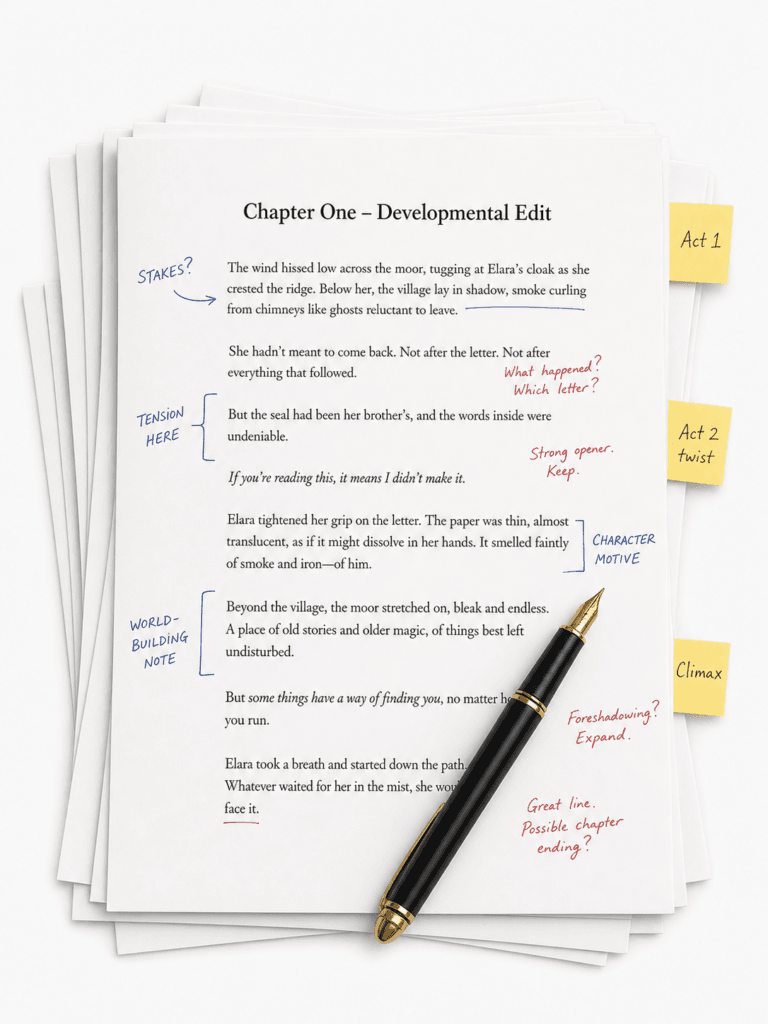
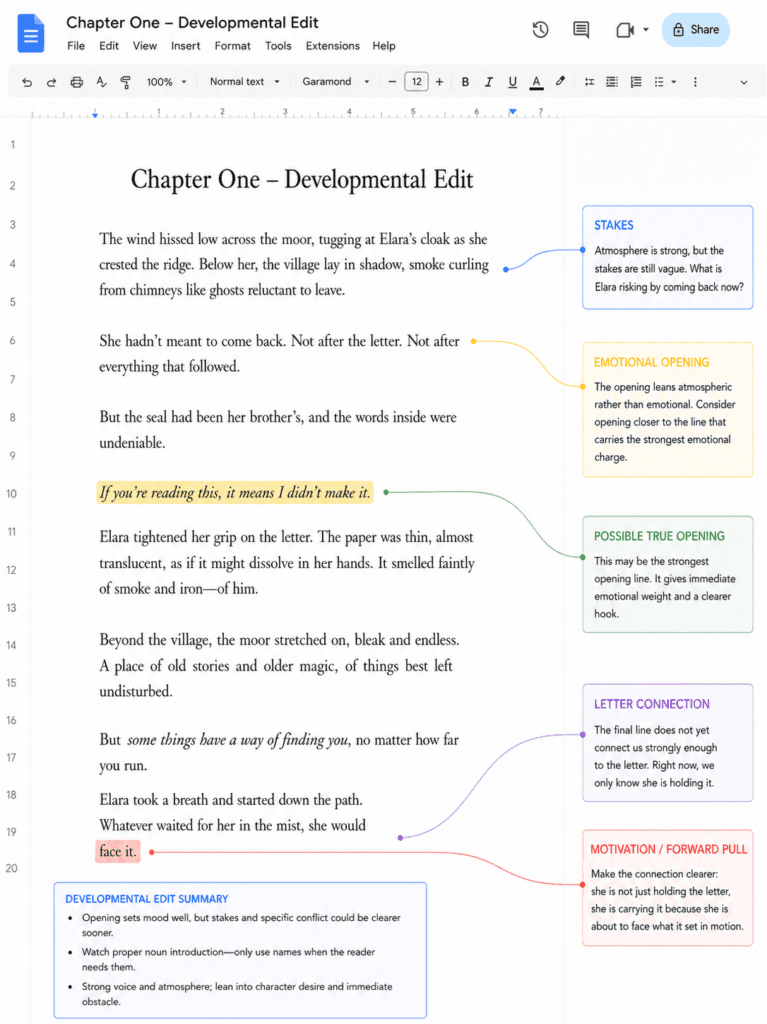
- First Chapter Audit – A deep developmental read on your opening chapter specifically for fantasy, YA, and romantasy writers. We look at hook, stakes, clarity, worldbuilding, and whether an exhausted reader would actually keep going. It’s designed for both agent‑curious and self‑pub authors who know the first chapter is doing too much or not enough.
- Act 1 Tool – A self‑guided diagnostic for the first 25% of your book, built to catch common fantasy/romantasy problems: too many characters, delayed stakes, vague world rules, or romance energy that arrives 50 pages too late.
- Manuscript Critique – A read through of your manuscript with a letter that quickly diagnosis the major issues you should be revising and where to take your manuscript next, be that beta readers, line edits, or straight to query.
- Developmental Editing – A developmental edit that looks and the structure of your manuscript, leaving in-line notes, and a step-by-step plan. I even offer a higher service that holds your hand a bit more with calls, and further edits.
FAQ
Start with people who explicitly work with indie authors in your genre, then ask targeted questions about how they edit for engagement, page‑turning, and series potential — not just line edits.
You can, but it’s not ideal. Trad‑focused editors often optimise for what publishers expect, while self‑pub editors think in terms of KU readers, pacing, hook strength, and read‑through rates. If your heart is set on self‑publishing, choose someone who lives in that ecosystem.
Most self‑pub authors are under‑edited at the developmental level and over‑focused on proofreading. Big‑picture work on structure, pacing, character arcs, and trope delivery will do more for your sales and reviews than another round of typo‑hunting.
If you’re early in the process or worried your opening isn’t doing its job, a focused first chapter edit is cheaper and more strategic than a full dev edit you’re going to keep revising anyway. Once the story’s shape is solid and you’ve done at least one self‑revision pass, then a full dev edit makes sense.
Some can, some can’t. Editors who specialise in self‑pub often have opinions about blurbs, positioning, and series planning; trad‑only editors are less likely to think about Amazon categories or KU reader behaviour. If strategy matters to you, ask about it before you hire anyone.