
You finish the manuscript. You type the last line. You sit back, feel briefly magnificent, and then open a new tab and search “developmental editor fantasy romance.” You look at the prices. You close the tab. You think…welp, not in this life time.
A full developmental edit for an 80,000-word fantasy manuscript can run anywhere from $1,500 to well over $6,000 depending on the editor, the manuscript’s condition, and how deep the structural work needs to go. That is not a small number, especially if you are an indie author mid-series, or someone writing their first book and genuinely unsure whether it’s working yet. But here’s the thing that nobody says clearly enough: not knowing if your book is working is not a problem that only a full developmental edit can solve. There is an entire spectrum of options between “ask my mum” and “spend three grand,” and most writers don’t know it exists.
This is that guide.
Understand What You Actually Need First
Before you spend anything — or decide you can’t — it helps to fully understand the problem. “I need editing” is actually more complicated than you might imagine.
Are you missing chunks of the middle? Did you change your premise halfway through, and the book now has two different spines pulling against each other? Do you have three different endings written and no idea which one serves the story? Are you on draft four, post-beta, and still feeling like something structural is off but you can’t name it? Are you querying agents and want to know if your first chapter is doing its job before you send it out? Or are you at an earlier stage — first draft finished, no reader feedback yet, not even sure if the concept works?
All of those are different problems. They need different kinds of help. Getting clear on which one you have will save you money, time, and the frustration of paying for feedback you can’t yet act on.
If you want a broader look at what different editors actually do before you decide anything, Choosing the Right Editor for Fiction (How Not to Lose Money) is worth reading first.
Fantasy Novel Editing: The Free Tier
Beta Readers
A beta reader is a reader, not an editor. They’ll tell you where they lost interest, what confused them, whether the romance landed, whether they believed in the world. They won’t tell you why those things happened at a structural level — that’s what an editor does — but knowing that three separate readers put the book down at the same chapter is information with real value, and it costs you nothing but time.
Where to find them: r/fantasywriters and r/romanceauthors run regular beta matching threads. Goodreads has genre-specific beta reader groups. Facebook groups for romantasy and fantasy romance indie writers tend to be active and fairly niche. Most beta readers work on a swap basis; you read theirs, they read yours.
One thing worth knowing is that beta reader feedback is subjective reader experience, not a structural diagnosis. If every beta says chapter eight drags, that’s a flag worth taking seriously. But “I didn’t connect with the heroine” from one reader is not the same as a craft problem, and treating it like one will send you down revision rabbit holes that didn’t need to exist. Don’t do that to yourself. With that said, get multiple beta readers.
Critique Circle

Critique Circle has been running since 2003 and is one of the most useful free tools available to writers. The model is credit-based: you critique other writers’ work to earn credits, then spend those credits submitting your own writing for feedback. It keeps things honest, and the process of reading other manuscripts critically is one of the best ways to start seeing your own problems more clearly. Quality of feedback varies, as it does in any community, but at the draft stage, with no budget, it’s absolutely worth your time.
Critique Partners
A critique partner is a fellow writer who reads your full manuscript in exchange for you reading theirs — ideally someone at a similar stage, writing in a similar genre, who will tell you the truth. A good partner will engage with craft rather than just the reader experience. Finding one takes longer. Writing Discord servers focused on romantasy and fantasy romance are currently the fastest route in.
Act 1 Diagnostic Tool
The Gilt List Act 1 Tool is an interactive checklist that lets you diagnose the structural and engagement gaps in your opening act without submitting your manuscript anywhere and without AI reading your work. You work through the beats yourself, flag what’s missing, and it tells you where the highest-impact problems are. It’s free, it takes about fifteen minutes, and it will tell you a lot about how well your story is set up for readers. I will be adding other Act tools in the future, if you want to know when you can join my email list.
You’re Not Ready for a Full Edit but Beta Readers Aren’t Enough
There’s a stage a lot of writers hit — usually post-beta, post-revision, sometimes post-multiple drafts — where they know something is wrong and they can’t figure out what. Betas keep flagging the same chapter but the notes contradict each other. The story has been through several structural changes and the joins are showing. There are missing chunks, or two endings, or a premise that shifted mid-draft and left the whole book feeling like two different books in one skin.
That’s when professional eyes start to feel tempting.
This is also, notably, a situation where a full developmental edit might actually not be what you need yet. If the manuscript is mid-restructure or has structural gaps, spending on a full dev edit before the bones are in place is a bit like paying for a professional paint job while a wall is still missing. The smarter move is a diagnostic read…something that tells you what the actual problem is and what order to fix it in before you invest in the bigger work.
Manuscript Diagnostic Review
The Gilt List’s Manuscript Diagnostic Critique is built specifically for this stage. It’s a full manuscript read-through resulting in an quick editorial letter covering:
- Structure and pacing
- Character and relationship arcs
- Worldbuilding and genre promise
- Reader engagement diagnosis
- Revision priorities
I won’t add in-line comments, or scene by scene blows, instead I’ll tell you what is working, and what isn’t, and what to tackle first. It’s best suited for writers who have been through the draft process already — possibly through multiple betas and revisions — and need to understand the manuscript-level picture before the next round of work.
First Chapter Critiques
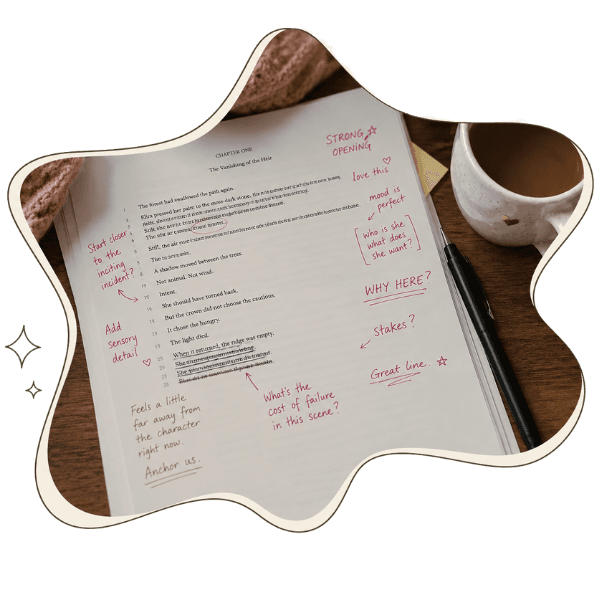
Writers tend to make the same craft mistakes consistently throughout a manuscript. If your pacing habits in chapter one are creating tension problems, those habits don’t vanish in chapter twelve. If your character’s interiority is flat at the opening, that’s a pattern, and I’ve seen this carry over again and again. A targeted professional critique of your first chapter — done with your synopsis included, so the editor understands the full shape of the book — can find book-wide patterns without requiring a full read.
My Tier 3 First Chapter Critique covers your first 5,000 words plus synopsis, with feedback on story promise, positioning, voice, and the craft and structural issues most likely to recur across the full manuscript — followed by a one-on-one conversation to talk through the findings. So you can tell me what you think isn’t working, and we can discuss how to get the book where it needs to be. It’s a genuinely useful diagnostic for writers who want a professional read before committing to a bigger investment, or who want to know whether the concept and opening are doing what the genre needs them to do.
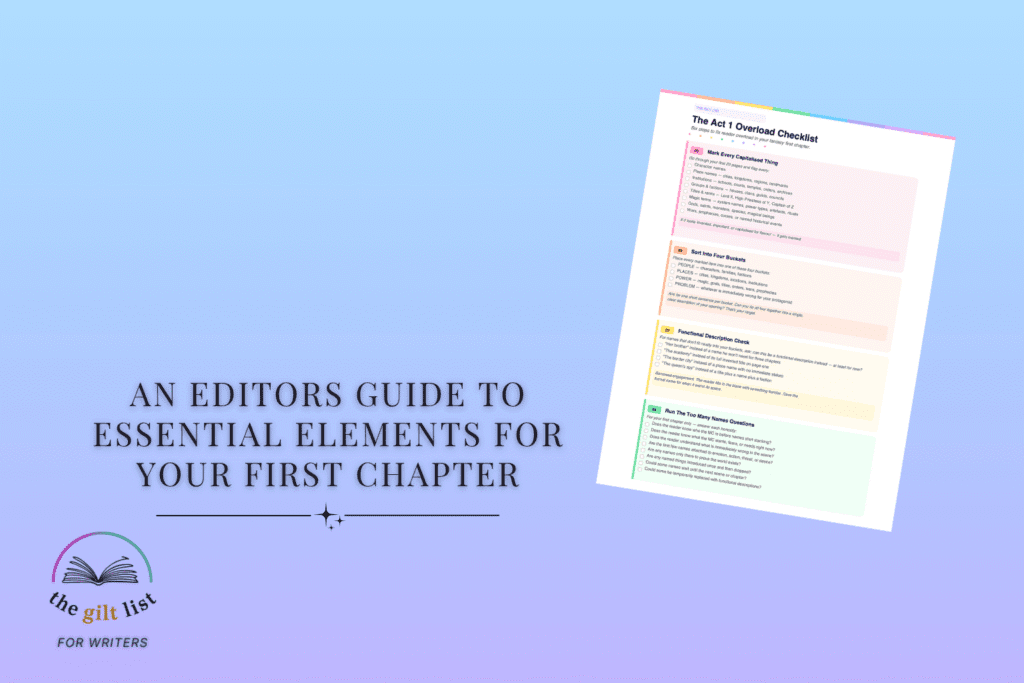
For a closer look at what makes a first chapter actually work, An Editor’s Guide to Essential Elements for Your First Chapter is a good companion read.
Full Professional Editing: What It Covers and When It Makes Sense
A developmental edit covers the full manuscript at story level: structure, pacing, character arcs, worldbuilding, stakes, romance arc, scene function. It doesn’t touch prose at the line level — that’s what a copy editor or line editor does. A dev edit is asking whether the story works. That’s all of it. Characters, dialogue, common craft issues, arcs, world, magic system, you name it.
It can happen at any stage. Some writers want a professional structural read before beta readers ever see the manuscript — so the bones are solid before reader feedback comes in and betas are working with a version that already has the obvious issues resolved. That way your betas can tell you other things, like scenes that are too slow, dialogue that feels off, or whether they really don’t like a particular character, and this book is totally like another they read and you should pitch it that way. Others use betas first to identify what isn’t working, then bring in a professional to understand why. Some writers need a dev edit on a manuscript that’s been through several revisions and it’s now gotten to the point of complete confusion, you can’t tell what the story is or isn’t doing anymore, and just need fresh eyes that understand storytelling, not reading experience. There is no single correct order. What matters is what stage the manuscript is at and what question you’re trying to answer.
I offer developmental editing for fantasy and romantasy manuscripts, covering structure, pacing, arcs, worldbuilding, stakes, and romance arc, and I’m an EFA-certified developmental editor with genre specialism. Genre specialism matters more than people realise. An editor who knows romantasy and fantasy romance understands the reader expectations your book is being held to, which changes what “working” actually means for your specific manuscript.
For more on finding the right fit before you commit to anything, How to Find an Editor for Self-Publishing Who Gets It is worth a read.
The Fiverr Conversation Nobody Wants to Have

There are editors on Fiverr charging $15 to $50 for what they’re calling a developmental edit or manuscript critique. There are documented cases of those editors using AI to generate feedback and deliver it as their own professional work. There are writing groups full of authors who found this out after they’d already paid and submitted their manuscripts. Now, if you’re writing a book with AI (no judgement), you might not care, but for those who do, this is devastating.
A $15 edit is not editing. It is not even a particularly good free read and the risk is well-documented enough that it’s worth saying directly to you before you can’t sell your book to a publisher because you can’t morally say it hasn’t been put through AI.
For proofreading something short and low-stakes, Fiverr can be fine. For your novel — the thing you have spent months or, more likely, years writing — it is not a good idea. I wouldn’t trust that price point ever.
The question to ask any editor before you hire them: What does your editing process look like, and can I see a sample edit? A working professional will have clear answers to both. If they can’t describe their process or won’t provide a sample, that is your answer.
Now, if you find the readers on their making money for beta reading, and can’t find a decent one in forums and so on, it might be worth checking out the reviews for that.
There’s No Single Right Order for The Editing Process
Earlier drafts of guides like this one tended to suggest a tidy path — edit yourself, alphas next, edit again, betas turn, then dev edit last. That’s too prescriptive, and it doesn’t reflect how writers actually work.
Some writers might be completely green and need a professional structural read before betas ever see the manuscript, so the bones are already solid before reader feedback comes in. Some are on draft six post-betas and need someone to tell them why the revision is driving them to madness. Some have a manuscript with missing sections, a changed premise, multiple endings, or two different books fighting to be one, and betas can’t help with that.
The free options are great, particularly at early draft stage. But the idea that you have to exhaust them before professional feedback is allowed is a myth, and an expensive one if it keeps you revising in circles when what you actually need is a clear professional read of what the manuscript is doing.
Figure out what question you’re trying to answer. Then find the tool that answers it.
If you want support beyond just editing — craft guides, structural tools, and resources built for fantasy and romantasy writers specifically — the Gilt List Writer Hub is the place to start.
To Wrap Up
- Beta readers and Critique Circle are amazing at draft stage and cost nothing — they catch reader experience issues and give you an early signal before you spend money
- The Manuscript Diagnostic Review is the right tool for writers who’ve been through multiple drafts or betas, have structural uncertainty, missing sections, or a changed premise — full read, editorial letter, revision priorities, no inline edits
- The Tier 3 First Chapter Critique covers 5,000 words, synopsis, and a one-on-one debrief which is good for diagnosing book-wide patterns from the opening, or for understanding whether the concept is landing before you invest further
- Developmental editing covers the full story at structure level and can happen at any stage, think before betas, after betas, or after several rounds of revision when something still isn’t working
- Ask for payment plans, as many editors understand their services can be unattainable without one. Some offer 50% up front, 50% at delivery; others offer payment plans to help you pay off the service over time, or things like Klarna.
- Avoid very cheap Fiverr editors. AI-generated feedback sold as professional editing is a documented reality.
- The Writer Hub has craft guides, structural resources, and tools built for fantasy and romantasy writers and is a good place to be working while you figure out what your manuscript needs next
FAQ
It depends on the editor’s experience, the manuscript’s length, and how much structural work is needed. Industry averages run from around $0.03 to $0.07 per word — so for an 80,000-word manuscript, you’re typically looking at $2,400 to $5,600 for a full developmental edit. The Gilt List’s founding rate for a full developmental edit is $0.028 per word, with the Manuscript Diagnostic Review available at $0.018 per word for writers who need a full read and editorial letter without inline edits.
Not necessarily. A manuscript in genuinely strong shape does not always need a pre-submission dev edit, especially if it has already been self-edited thoroughly and tested with beta readers. Where professional editorial help tends to be worth it pre-query is if you’ve had rejections pointing to structural issues, or you genuinely cannot tell what is not working on your own.
A beta reader gives reader-experience feedback — where they lost interest, what confused them, whether they connected emotionally. A developmental editor works at story level, diagnosing structure, pacing, character arcs, and the deeper reasons those reader problems are happening. Both are useful, but they answer different questions.
You can get useful free feedback through beta readers, critique partners, and Critique Circle-style peer workshops, but that is not the same thing as a professional developmental edit. Free options are most useful at early draft stage, when you need broad reader reaction and repeated problem-spotting before paying for professional diagnosis.
Start by naming the actual problem. If the manuscript has structural confusion — missing sections, changed premise, multiple endings, or a post-beta draft that still is not landing — you are likely looking at a diagnostic review or developmental edit. If the opening is the main concern, a first chapter critique is often the better first investment. If Act 1 feels shaky, your free Act 1 tool is the obvious first stop.
Yes. A manuscript diagnostic review gives you a full read and editorial letter without inline comments, which makes it cheaper than a full developmental edit while still addressing structure, pacing, arcs, and revision priorities. A first chapter critique is an even lower-cost option that can still surface book-wide patterns, especially when paired with a synopsis.
Ask what their editing process looks like and whether they offer a sample edit, because a real professional should be able to answer both clearly. It is also worth checking whether they specialise in your genre, since fantasy and romantasy carry specific pacing, worldbuilding, and reader expectation issues that a generalist may miss.