
Writers lose entire weekends to the first sentence. You rewrite it eleven times, read it aloud, test it on a friend, and convince yourself the whole book lives or dies on whether it hooks your reader in and keeps them there. It matters. I am not going to pretend it doesn’t, there are some incredible examples out there and I’m sure you’ve seen them too. But the opening line of a novel does one job, and it is a smaller job than the internet has told you.
A gorgeous first line can sit at the top of a badly structured chapter and do absolutely nothing, because the sentence got someone in the door of a room where nothing is happening. Is your first line there to look pretty only? Or is it creating the first notches of a roller coaster to help propel the scene forward? So let’s talk about what the first sentence actually does, what a hook actually is, and why fantasy makes this harder than any other genre.
For more writerly advice check out the writers hub or How to Start a Fantasy Novel.
The Opening Line Lie: Takeaways
- The first sentence matters, but it cannot carry the whole opening.
- A hook is a reason to keep reading, not a single clever line.
- Shock is not the same as a hook. A shocking line still needs meaning.
- Confusion is not intrigue. A question pulls readers in; bafflement pushes them out.
- Fantasy openings have to give orientation and curiosity at once.
- The first scene, not the first line, is where the reader decides.
What Does the First Sentence Actually Do?
A strong opening line establishes voice, gives a first impression of who is talking, and puts one image, character, mystery, or conflict in front of the reader. If you want to see my breakdown on a particularly incredible first line and why it works check out my Hunger Games breakdown. An opening line should take something ordinary and flip it on its head, so much so we instantly understand who the character is, and what they want and fear.
What Is a Hook, Really?
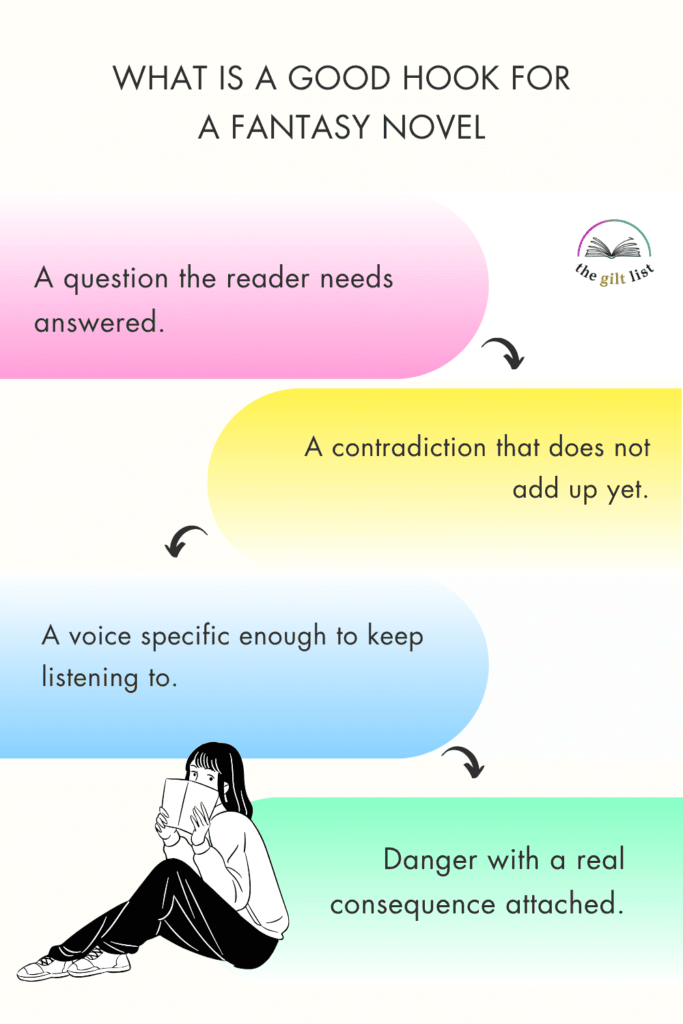
A hook is a reason to keep reading. They come in a lot of shapes:
- A question the reader needs answered.
- Trouble already encroaching on the character.
- A contradiction that does not add up yet.
- Danger with a real consequence attached.
- A desire strong enough that the reader wants to see it met.
- A voice specific enough to keep listening to.
- Tension in a relationship that is clearly going somewhere.
- A moral problem with no clean answer.
Most of these are not single lines. Your opening line should capture the flavor of it, but the opening pages need to carry it successfully, too.
Can a Beautiful Sentence Fall Flat?
Easily. A page of stunning description of a floating city will not hook a reader if nothing is happening inside it. A lot of new writers are very concerned with how their prose sounds on the page, more than how it is moving the reader. A reader will highlight the ever-loving-goodness out of good lines and may even buy you patience, but it won’t keep them in the story. For a reason to turn the page you need a question, conflict, or a person in trouble.
So if your opening is gorgeous and readers still drift, the prose is rarely the issue. Hence, your first line shouldn’t be the part you’re editing time and time again until you know the mystery your opening is holding for the reader. Once you can name the mystery your Chapter One ends on, the desire and fear your character has, their unique personality, and something unusual about the world, then go back and try trying all of those together in your first line. But, start with the opening first.
Does Shock Count as a Hook?
Sometimes. Often it is a hook for one sentence and then a hole. A scream, a death, a severed head, an explosion grabs the reader by the collar. It works for a beat. Then the reader needs a reason to care. Why do I care if there’s a rolling head bouncing down a set of stairs? An opening line that leads with how the character feels about that, especially if it’s unusual and sensory, is far more compelling.
Is Your Opening Intriguing or Just Confusing?
Read this one twice, because it matters more in fantasy than anywhere else. A mystery gives the reader a clear question and makes them want the answer. Fantasy openings tip into confusion when they front-load invented terms with no emotional backing. A first line stuffed with three proper nouns, a title, and a piece of lore reads as homework, and the reader has not agreed to do homework yet. It’s best not to lead with confusing worldbuilding, start with human connection.
What Fantasy Openings Need That Others Don’t
A contemporary novel can open on a coffee shop and a bad text in a quirky voice and the reader already knows the world, genre, and likely ending. Fantasy has to build the world and create the hook at the same time, which is harder, and why so many fantasy openings get abandoned for reasons the writer never sees. I went deep on that in why readers DNF fantasy novels.
So your fantasy opening does two jobs at once: orient the reader enough that they are not lost, and give them one clear conflict or question so they want to stay. Too much orientation and it is an info dump. Too much mystery and it’s a fog of confusion. World and no character, and we have an atlas or textbook. It’s a very precarious balancing act.
Why the First Scene Matters More Than the First Line
A strong first line cannot rescue a first scene where the protagonist wants nothing, nothing changes, the worldbuilding buries the page, and the reader has no reason to continue. The sentence got them in the door. The scene keeps them in the house, so to speak.
Stop polishing the first line until the first scene works. Instead, polish the first chapter so you know exactly what your first line should say to foreshadow, orient, and peak interest. If your opening pages are not holding readers, the Fantasy First Chapter Checklist is a faster fix than another rewrite of sentence one.
A Better Opening Hook Test
Forget the first line for a second and run the whole opening through this:
- What question does the first page create?
- What does the reader now know to watch for?
- What conflict is active in the scene?
- What does the character want, or want to avoid?
- What promise is the opening making about the book?
- What makes the next page necessary?
- What theme weaves into the opening that also weaves into your ending?
If you can answer those, your opening will shine, and so will your opening line.
Want a Read on Whether Your Opening Hooks?
Make your first sentence and then scene clean and voicey, then put your real effort into the Chapter behind it: a character who wants something, a pressure already on, one question the reader needs answered. That is what hooks. That is what they stay for.
To pressure-test your opening, start with the Fantasy First Chapter Checklist. It walks through what your opening is asking the reader to hold, and whether it gives them a reason to keep going. For eyes on the actual pages there is the first chapter critique, or developmental editing if the whole opening needs a structural look. More craft breakdowns are in the writing guides hub.
Frequently Asked Questions
It matters, but less than most writers think. The first sentence sets voice and expectation and gets the reader into the scene. It cannot carry the whole opening. The reason a reader keeps going is the question or pressure the opening sustains.
It establishes voice and creates one clear impression: an image, a character, a situation, or a pressure. It does not need to shock or dazzle. It needs to be clean, specific to your book, and pointed at something the scene is about to develop while remaining layered.
A reason to keep reading: a question, a pressure, a contradiction, or a character in trouble that the opening creates and sustains across the first scene. It is a condition, not a single sentence. The single sentence should lead us into it.
Not bad, but risky if the description does all the work. A beautiful setting will not hold a reader if nothing is happening inside it, or there is no double meaning. Description works when it carries tension, a character’s feeling, or an implied question alongside the imagery.
Yes. A first line packed with invented names and lore gives the reader work with no direction. Ground them in one clear thing first, then give them one thing to wonder about.
Give orientation and curiosity at the same time. One clear foothold so the reader is not lost, one clear pressure so they want to stay. Fantasy openings fail when they choose only one: pure info dump or pure fog.
It can, but action is not the same as a hook. Action only holds readers when they care who wins and what it costs. A calmer opening with a clear want and real stakes will outperform a loud one the reader has no reason to be invested in