
Querying a fantasy novel is really daunting. Most writers are quite content to hide behind their desk, peering over their coffee every so often, and squeaking at who ever walks by. What we don’t do is tell the world how amazing we are. I mean, if we did, we probably wouldn’t choose a hobby that can never be perfected, where you must bash yourself over the head with internal and external critique forever. So here you are, you’ve spent two years or more building a world, learning your characters, and murdering your favorite subplot in cold blood, then you have to sell the whole thing to a stranger in three paragraphs. The kicker? That stranger will decide in roughly ninety seconds whether to read a single word of your actual book. Crazy brutal. If the blank query document is the bit making you want to fake your own death, the free fantasy query letter builder will walk you through the structure without writing it for you.
Querying a fantasy novel is not the same job as querying a contemporary romance or a thriller. Fantasy asks you to pitch a world, a magic system, a subgenre, and a hook, all inside the word count of about 250 characters, without the agent needing a map and a glossary to follow it. This guide walks you through the whole thing so hope you have a half fighting chance.
Querying at a glance
The fantasy query package. Before you send a single email, you need five things ready:
- A finished, revised manuscript. Fantasy is one of the only categories where “finished” is non-negotiable, and revised means more than spellchecked.
- A query letter: the hook, the stakes, the metadata (title, word count, genre, comps).
- A synopsis: the whole plot, ending included, on one to two pages.
- Your opening pages: usually the first five to ten, sometimes fifty, depending on the agent.
- Comp titles: two recent-ish books that tell the agent where yours sits on the shelf.
How to query a fantasy novel: quick takeaways
- Querying means pitching your finished manuscript to literary agents in the hope one offers to represent it and sell it to a publisher.
- You query with a package, not a book: a query letter, a synopsis, opening pages, and comp titles.
- Fantasy is harder to query than most genres because you are selling a world and a subgenre, not only a story.
- Most rejections are silence or a form no. That is normal, not a verdict on your talent.
- When form rejections come across the board, the opening pages under your query are usually where the read is being lost.
What does it actually mean to query a fantasy novel?
Querying a fantasy novel means sending a short pitch to literary agents, asking one of them to represent your book and sell it to a publisher on your behalf.
That’s the whole game, in trad publishing at least. Your goal, should you so choose it, is to try and sign with an agent, and the agent is the one who loves your work enough to stand beside it, take it to editors at publishing houses, use their contacts, and haggle over the scary contract bits so you don’t have to. No agent, no Big Five deal, generally speaking.
Querying is the traditional path to becoming a published author. It is slow, competitive, and free, mostly. Self-publishing skips agents entirely, which means no query, faster control, and a very different set of costs and skills. They are different businesses, and both have their difficulties and talents. Plenty of writers even query first to test the waters, and if the requests don’t come, they revise and self-publish the same book.
What do you need before you query a fantasy novel?
Before you query, you need a finished and revised manuscript, a query letter, a synopsis, your opening pages, and comp titles. All five. No exceptions for the manuscript one.
Let me take these in the order they’ll actually trip you up.
1. A finished, revised manuscript
Fiction has to be complete before you query. This is not a suggestion, it’s the rule, and fantasy has no exemption because it’s long. Agents request pages, and if they love those, they ask for the full. “The full what” cannot be “the full three-quarters I’ve written.” If they ask and it isn’t ready, you either lie or lose the request, and both are worse than waiting.
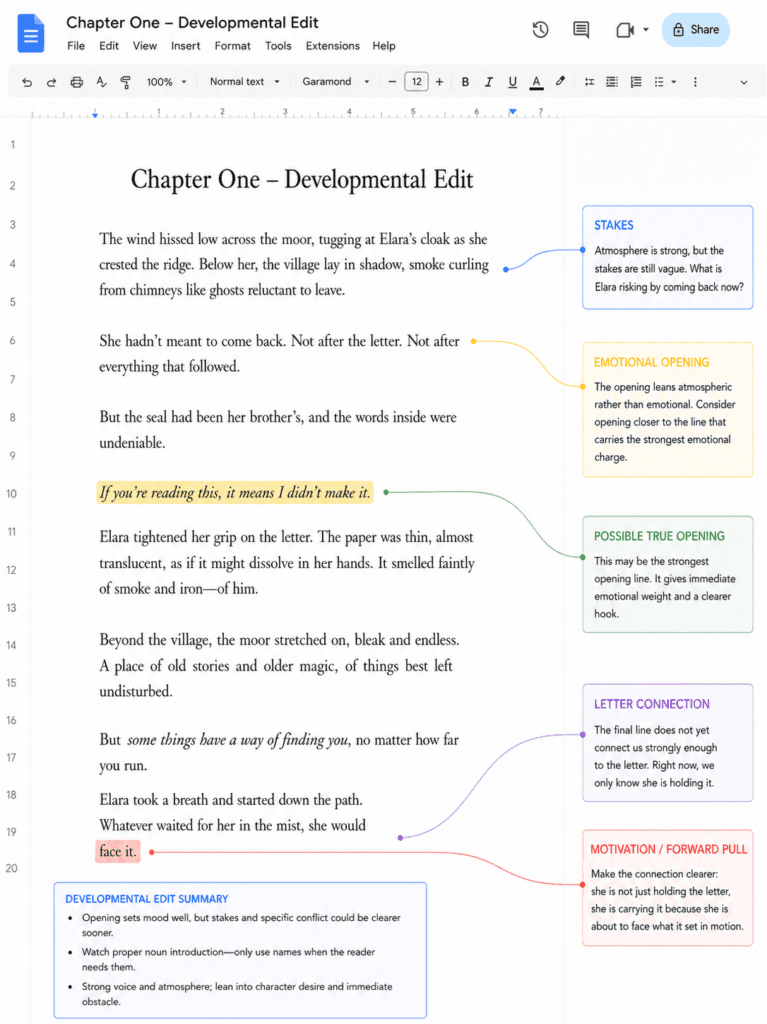
Revised means revised, a first draft you spellchecked is not a revised manuscript. If you already suspect the structure is the issue and not the sentences, that’s what a developmental edit is for, before you ever hit send.
2. A query letter
The query letter is a one-page pitch. It has a hook that makes the agent want the book, a paragraph or two of stakes that shows what your protagonist wants and what stands in the way, and a short block of housekeeping: your title, your word count, your genre, and your comps. That’s it. It is not a summary of the whole plot but a pitch that makes them want to read the plot.
The fantasy-specific issue here: you will want to explain the world. Resist. The query needs exactly enough world to make the stakes make sense and not one fraction more.
3. A synopsis
The synopsis is the one most writers find hardest. It’s a one to two page account of your entire plot, ending included, spoilers and all. Its job is to prove the story holds together and the ending pays off, which for fantasy means proving your magic system and your plot don’t collapse under their own worldbuilding in act three.
4. Your opening pages
Most agents ask for the first five or ten pages pasted below the query. Some ask for fifty. These pages are where the request is actually won or lost, which we’ll get to, because it’s the most important thing on this page.
5. Comp titles
Comps are two comparison books that tell the agent where yours belongs. “For readers of Fourth Wing and The Cruel Prince” does more work in six words than a paragraph of description, because it hands the agent a shelf, an audience, and a sales angle all at once, and at the end of the day that’s the goal, high sales. Fantasy comps have their own rules, mostly around being recent and not reaching for the untouchable megasellers as if they’re peers.
Why is fantasy harder to query than other genres?
Fantasy is harder to query because you are pitching a world and a subgenre alongside a story, and you have to do it in the same small space every other genre gets for the story alone.
A contemporary romance query can have a shared reality because the agent already knows what an office is, what a wedding is, why it’s bad when your ex shows up. A fantasy query has to build just enough of an unfamiliar world for the stakes to mean anything, without tipping into an info dump problem that sinks so many opening chapters. It’s the same load-management skill your first chapter needs, compressed into an email, so if you have a strong first chapter, then you’ve got this.
Three places fantasy queries specifically wobble:
- Word count. Fantasy runs long, and agents know it, but debut fantasy still has a ceiling. Word count is one of the few things an editor can say no to before they’ve read a single line, because it’s an objective number tied directly to what a book costs to print, so it works against you at acquisitions long before craft enters the conversation. Fantasy gets more room than most genres, but a debut that stretches past roughly 120k starts working against itself. Romantasy tends to sit tighter than epic. Know your number, stick to it, cut, cut, cut.
- Comps. Fantasy writers reach for the giants. Comping your debut to A Court of Thorns and Roses reads to an agent less like positioning and more like you don’t really know your genre well enough, so chose the first big name vague genre looking thing. Recent, mid-list, same-lane comps will help you more.
- Subgenre clarity. “Fantasy” is not a genre to an agent, it’s a category with a dozen shelves under it. Romantasy, epic, grimdark, cozy, YA, urban. If your query can’t tell them which shelf, they can’t tell their editor contacts, and a book they can’t place is a book they pass on. Imagine yourself in Target or Barnes and Nobles, who would you sit by?
How does the querying process actually work?
Querying works as a funnel: you send queries, a fraction become requests for pages, a smaller fraction of those become requests for the full manuscript, and a smaller fraction again become an offer of representation.
The numbers are really brutal, know this going in, we’re talking sometimes hundreds of requests. Agents request from a small share of the queries they receive: one analysis of QueryTracker data put the average manuscript request rate per agent at somewhere between 0.03% and 1.1%, eesh, and an editor’s dataset of science fiction and fantasy agents found rejection rates averaging around 87%, ranging from 70% to 98%. Not because writers are bad, but because an agent is looking for the specific book they personally can sell right now, and most of the pile, however good, isn’t that exact thing. It’s more fated than you can imagine.
Writers who track their querying on tools like QueryTracker can watch their own request rate build over time, which is a far healthier number to obsess over than the raw rejection count. Forget rejections, because it can’t measure your talent, only random timing. Instead, shoot for a couple of full partial or full requests.
If your requests look like this, it might mean that; a table:
- No requests at all, all form rejections? The problem is usually your opening pages, sometimes your query.
- Requests for pages, then passes? Your query and hook are working. Something in the pages isn’t.
- Full requests, then passes? You’re close. It’s often subjective, or a structural issue in the back half, a messy middle where the opening drops off a cliff in comparison to the back end of the book, or it wasn’t what they thought it was when requesting.
Why am I not getting requests?
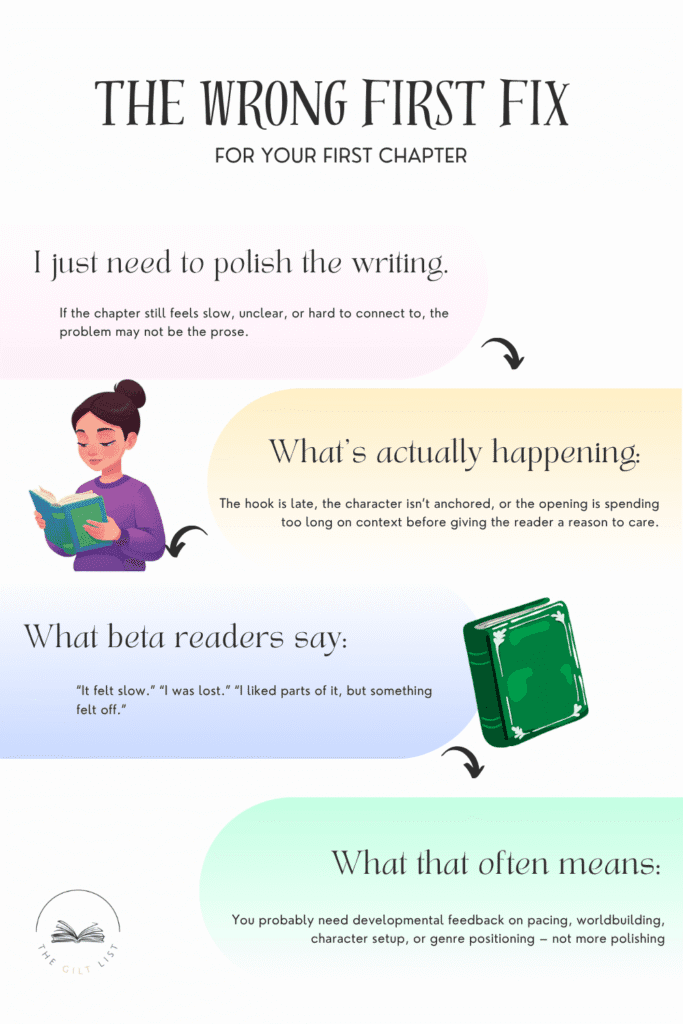
Most agents ask for your opening pages pasted right under the query, so when you’re getting only form rejections, the cause is usually one of two things – the query isn’t hooking them, or those pages under it aren’t holding attention, or it’s the wrong agent for you, or the wrong timing. And when writers do get a request, then a pass at the pages stage, it’s almost always the pages themselves, or how the story plays out.
Writers pour weeks into the query letter and assume the pages will speak for themselves, that they have that part down pat, then the pages open with a prologue full of history, or three paragraphs of worldbuilding before a person wants anything, and the agent stops reading before the query’s clever hook ever gets a chance to pay off. Imagine reading a whole story synopsis of your book for the complete layout of how it’s going to go, then having to trawl through a prologue. Ouch.
There’s research underneath why this happens, and it’s not agents being lazy or wrong about how story works. Work on processing fluency by Reber, Schwarz and Winkielman found that when text is harder for the brain to process, we don’t read it as more sophisticated, we read it as worse, simply not good. And research on narrative transportation by Green and Brock shows that immersion, the actual “lost in a book” feeling, breaks the moment the reader hits confusion or friction. A fantasy opening that front-loads names, lore, and unfamiliar terms before it gives the reader a person to care about is manufacturing exactly that friction, on exactly the pages an agent uses to decide.
So the query got you the read, but the pages lost it and you can’t fix that by rewriting the query for the fortieth time. But if you are at this stage, congrats, you have a compelling story idea that is marketable. Which is very valuable. If you want the pages to match I built a first chapter critique service. When a fantasy writer is getting form rejections across the board, nine times out of ten the diagnosis lives in the opening pages, in the order the information arrives and the moment the reader is given a reason to stay. If you haven’t gotten a bite yet for a full, or you just want reassurance, a first chapter critique is relatively inexpensive and can give you the peace of mind you need, or the one thing to fix that gets you the agent.
Should you query or self-publish your fantasy novel?
Query if you want a traditional publisher, an agent, a little marketing help, prestige, and bookshop distribution, and you’re willing to trade speed for that. Self-publish if you want control, speed, and higher royalties, and you’re willing to run the business side yourself.
Plenty of the romantasy authors currently eating the bestseller lists started self-published and plenty went the agent route, what matters is which business you actually want to run, because self-publishing makes you the publisher, marketer, and project manager, while querying makes you a very patient person refreshing an inbox and doing the job the publisher asks of you with a leg up here and there.
My Many Guides on Querying to Help You Get Started
The Services I Offer to Help You Become The Author You Want to Be
Frequently asked questions about querying a fantasy novel
Months, usually, and often longer than a year from first query to offer or shelving the project. Agents can take weeks to months to respond, and you query in waves rather than all at once. Querying is a slow-cooking process, not a weekend.
Yes. Fiction must be complete and revised before you query, because agents who love your pages will ask for the full manuscript, and you need to have it ready to send that day.
Query in small batches, often five to ten at a time, so you can adjust your materials if a round gets no traction. If nobody’s biting after a batch or two, that’s information, not failure, and it usually means the pages or the query need a pass before you spend the rest of your list.
A lot. Agented authors report sending anywhere from four to over a hundred queries before signing, with no relationship between how many they sent and how fast the book then sold. The rejection count matters less than the pattern of your responses, which tells you what to fix.
If you’re getting requests for pages but then passes, your query works and your pages need attention. If you’re getting no requests at all, it’s usually the opening pages, sometimes the query. The shape of your rejections is the diagnosis.
Pick two recent-ish books in your exact subgenre that share your tone and readership, and avoid comping to the untouchable megasellers as though your debut is their peer. Comps are positioning, not aspiration.