
I’m sure you’ve experienced this in fantasy many times, where some pages are easier to read even when they are not simpler. You glide through a dense, lyrical paragraph from one writer and have to read a plain one from another three times. This is what’s called processing fluency.
Processing fluency is how easily the reader’s brain takes in and moves through a sentence. When prose is fluent, the reader moves without friction and the writing tends to feel better, clearer, even more true, an effect Rolf Reber, Norbert Schwarz, and Piotr Winkielman have documented: ease of processing nudges how much we like and trust what we read. When prose has friction, the reader stumbles, rereads, and starts to feel that something is off.
The trap though is thinking fluent writing means plain. It doesn’t. Strange, voicey, lyrical prose can be perfectly fluent; the goal is to remove the friction you did not mean to create while keeping every bit of the, quote, “difficulty” you did.
Why Some Writing Feels Easier to Read: Takeaways
- Easy to read does not mean basic. Fluent prose can be lyrical and strange.
- Fluency means the reader can move through the sentence without stumbling.
- Friction can be at the sentence level (line editing) or the context level (structural editing).
- Fantasy adds friction through invented names and terms.
- Some difficulty is intentional and good. Some is accidental and costing you.
- Revise the accidental difficulty first, and leave the deliberate kind alone.
What Is Processing Fluency in Writing?
It is the ease with which a reader takes in your words. High fluency means the sentence goes down smoothly and the reader keeps moving. Low fluency and the reader’s eye snags, backs up, and rereads, which breaks the spell of being inside the story.
Prose that reads smoothly tends to feel more competent and more pleasing, and prose that reads with friction tends to feel wrong in a way readers blame on the story rather than the sentence. You can win or lose a reader’s trust at the level of how easily their eye moves down the page.
Does Easy-to-Read Mean Simple?
Fluent prose can be complex, lyrical, rhythmically odd, and emotionally dense. What makes it fluent is that the reader can follow it, not that it is simple. A long, winding sentence can be entirely fluent if its structure guides the reader through the turns. A short sentence can be a stumble if its reference is unclear. Fluency is about clarity of movement, not the size of the vocabulary.
Beautiful Difficulty vs Accidental Difficulty
Beautiful difficulty is doing work for you:
- Intentional ambiguity that holds two meanings at once.
- Poetic compression that asks the reader to lean in.
- Layered meaning that rewards a second read.
- A strange, specific voice.
- Emotional complexity that resists a tidy summary.
Accidental difficulty is just costing you:
- Unclear pronouns, where the reader cannot tell who “she” is.
- A delayed subject that keeps the reader waiting to know what the sentence is about.
- Too many clauses stacked into one breath.
- A pile of names in a single sentence.
- Vague referents, where “it” or “this” points at nothing clear.
- Sentence order that hides the point until after the reader needed it.
What Causes Line-Level Friction?
The usual culprits, worth searching your own pages for:
- Ambiguous pronouns with more than one possible owner.
- Unclear antecedents, where a word refers back to something the reader has to guess.
- Long sentences that take too many turns before they resolve.
- Big unbroken blocks of paragraph with no place for the eye to rest.
- The same sentence rhythm repeating until the prose drones.
- Abstract nouns where a concrete image would move faster.
- Action buried in the middle of a sentence instead of driving it.
- Invented terms dropped in with no context to hold them.
Why Fantasy Adds Extra Friction
Fantasy stacks another layer on top of the usual suspects, because so much of its vocabulary is invented, and invented words have no prior meaning to lean on:
- Invented names for people and places.
- Magic terms with no everyday equivalent.
- Titles and ranks the reader has to learn.
- Old wars, dead rulers, historical events with no reference point.
- Place names that blur together.
- Species and gods.
- Capitalised concepts that look important but arrive unexplained.
- Made-up calendar and time terms.
A sentence that would be perfectly fluent in a contemporary novel can trip in fantasy purely because two of its words are ones the reader is still learning. This overlaps with cognitive load, which I cover in why readers DNF fantasy novels: introduce invented terms slowly, and give the reader something to attach each one to.
Those terms still need somewhere to live behind the novel. The World Bible Builder lets you build the systems and terminology first, then its World Reveal Plan helps you decide which information belongs on the page now.
Why Context Makes Sentences Easier
A sentence is easier to read when the reader already knows what matters in it. Context arriving before a sentence makes that sentence fluent. Context arriving after it makes the same sentence a stumble the reader has to reread.
If you describe a character’s strange reaction and only afterwards explain the history that makes it strange, the reader processes the reaction with nothing to hold it, then has to go back and re-feel it once the context arrives. Give them the small piece of context first, and the reaction reads cleanly the first time.
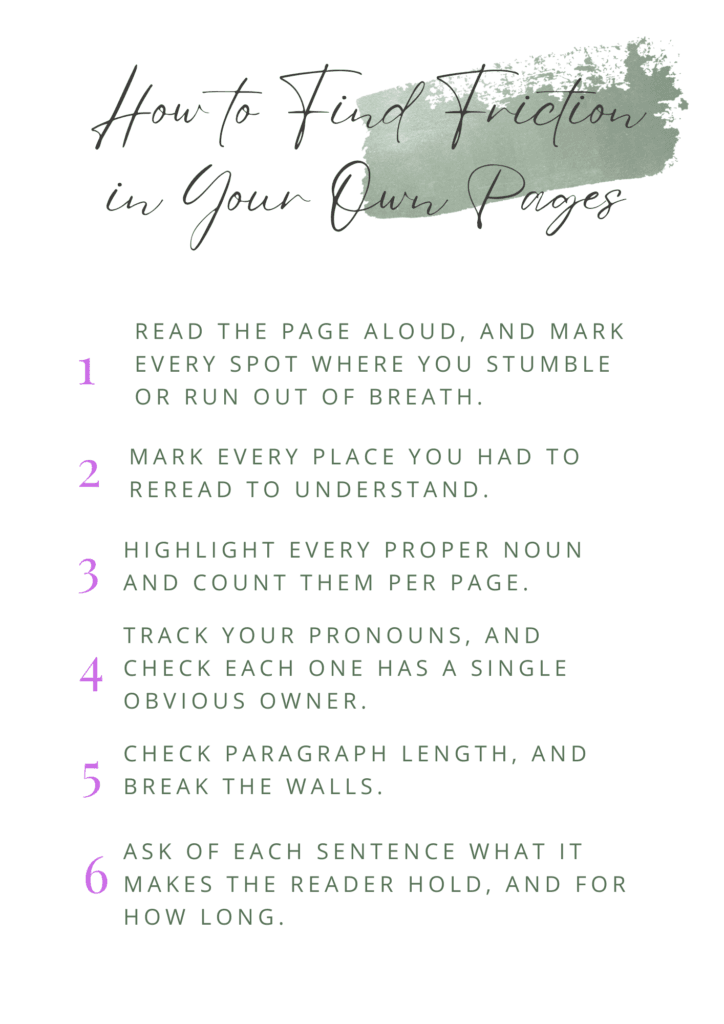
How to Find Friction in Your Own Pages
A practical pass you can run today:
- Read the page aloud, and mark every spot where you stumble or run out of breath.
- Mark every place you had to reread to understand.
- Highlight every proper noun and count them per page.
- Track your pronouns, and check each one has a single obvious owner.
- Check paragraph length, and break the walls.
- Ask of each sentence what it makes the reader hold, and for how long.
Reading aloud is the cheat code because your eye forgives friction your ear will not, so your mouth tripping over a sentence is the most reliable signal you have.
How to Fix Prose Without Flattening Voice
The fear is that clearing friction sands off everything interesting; it will not, if you aim only at the accidental difficulty:
- Clarify referents, so every “she,” “it,” and “this” has one clear owner.
- Move context earlier, so the reader has the key before the lock.
- Break overstacked sentences into two.
- Vary paragraph length, so the eye has somewhere to rest.
- Repeat important terms instead of swapping in elegant synonyms that make the reader work.
- Cut decorative confusion, the difficulty that is not doing anything for you.
- Keep the intentional strangeness, the ambiguity and compression you chose on purpose.
When a Critique Helps With Friction
It is hard to feel friction in your own prose, because you know what every sentence means before you read it. Your eye glides over the ambiguous pronoun because you know who she is. The reader does not, and you cannot un-know it to find out.
A first chapter critique gives you a reader meeting the pages cold, who can tell you exactly where they stumbled, reread, or lost the thread.
Want to Find the Friction You Can’t See?
Some writing is easier to read even when it is not simpler, and the difference is friction the writer mostly did not mean to create. Clear the accidental difficulty, the unclear pronouns, the buried subjects, the unexplained terms, and keep the difficulty you chose. The reader moves more smoothly and your voice stays where it was.
To start on your own, the Fantasy First Chapter Checklist includes the friction checks worth running on your opening. If you want a cold reader to find the snags you cannot feel, the first chapter critique is built for it. For friction across a whole manuscript, developmental editing covers the full draft. More craft breakdowns are in the writing guides hub.
Frequently Asked Questions
How easily a reader’s brain takes in and moves through your prose. High fluency means the reader glides; low fluency means they stumble and reread. Ease of reading also shapes how much readers like and trust the writing.
Usually because of friction the writer did not intend: unclear pronouns, delayed subjects, overstacked clauses, or unexplained invented terms. The sentence may be well written and still snag the reader.
No. Fluent prose can be lyrical, complex, strange, and emotionally dense. What makes it fluent is that the reader can follow it, not that the vocabulary is small or the sentences are short.
Clarify your referents, move context before the sentence that needs it, break overstacked sentences, vary paragraph length, and explain invented terms when they appear. Reading aloud is the fastest way to find the spots that need it.
The small stumbles inside sentences: ambiguous pronouns, vague referents, buried action, too many clauses, or names piled together. Each one makes the reader slow down or reread, which breaks immersion even when the writing is good.
Fantasy adds friction because so many of its words are invented and carry no prior meaning. A sentence can snag purely because two of its terms are still being learned. Introducing invented terms slowly and anchoring each one helps.
Target only the accidental difficulty: clarify references, reorder for context, and break sentences that hide their point. Keep the intentional strangeness, ambiguity, and compression you chose. Voice lives in word choice, rhythm, and attitude.