
Writing the first chapter of a fantasy novel is a horrible, wonderful, impossible thing. It has to do everything at once and somehow still feel effortless. That is exactly where the right professional editor can literally (ok, kind of) save your life.
Finding the right editor is everything. You need someone who can refine your narrative without crushing your voice. Someone who understands fantasy, and all the quirks of maps, magic systems, and strange exotic names (that come in a list longer than my arm).
Fantasy often needs more than other genres because you need someone who sees the pieces holding everything up under your world-building and character work, and knows when to reinforce it rather than tear it all, or rearrange it.
In this guide, we’re walking through how to get professional editing help for your fantasy first chapter without losing control of the story you’re meant to write. From the different types of editing to how you actually vet editors, we’re covering the practical bits and pieces you actually need to know before getting started.
For more fantasy and romantasy editing guides to help you through your rough draft, check out the writers hub.
Why Your First Chapter Matters in Fantasy
In fantasy, that opening has to work harder than most other types of novels, editing fantasy is not for the weak of heart or scattered for this reason. It needs to orient readers fast without feeling like a lore dump, set the exact tone, establish the rules you and the reader will be playing by, and set up hints about the themes right away. That’s a lot for about 20 pages.
Your first chapter has a few core jobs:
- Introduce the main character and give us a sense of what they want.
- Establish the setting and tone of the story.
- Present a compelling conflict, question, or mystery we need answered.
If the chapter doesn’t engage, readers have endless other books to pick up instead. A well-edited opening holds attention, builds trust, and makes that “buy now” or “one more chapter” decision very easy. And if it’s really good, coupled with an exciting blurb? Well, they might just buy the whole series (or more of your work right away).
Which is why choosing the right editor to polish that chapter/opening is so important for, well, everything bookish. Their expertise can amplify what’s already working and your story deserves to feel strong from the very first page.
Types of Editing: Which Does Your Chapter Need?
Before you hire anyone, you need to know what kind of editing your chapter actually needs. “Editing” is not one monolithic service; it’s several different passes that all do different jobs.
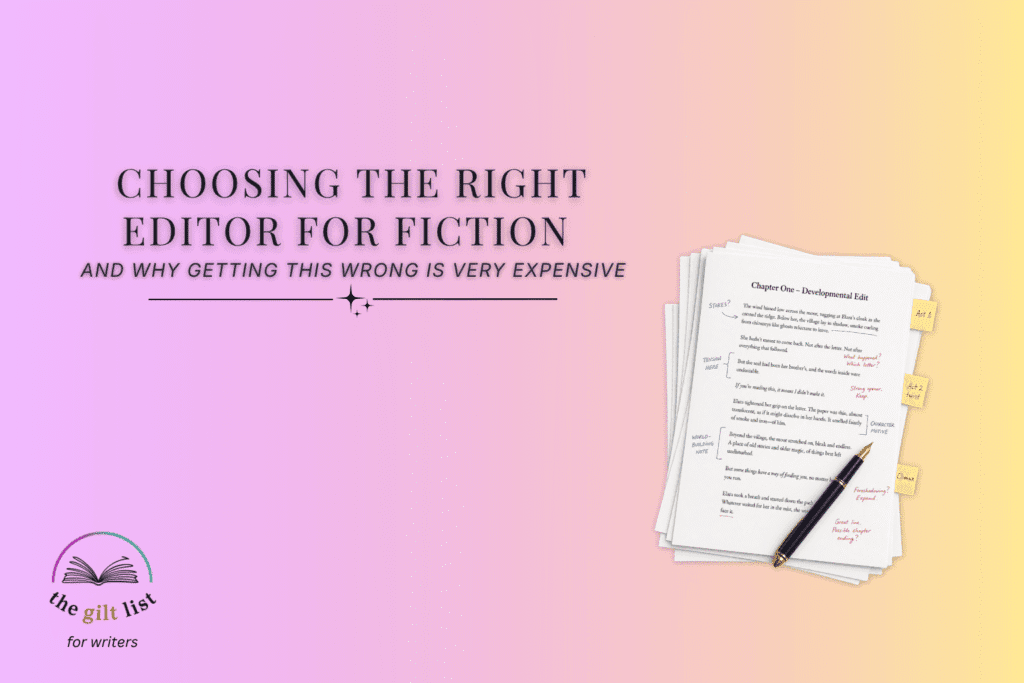
Developmental editing is the big-picture stage. This is where someone looks at plot, structure, character arcs, pacing, and world-building. For fantasy, this is the pass that makes sure your magic system isn’t contradicting itself and your first chapter is starting in the right place. This is what makes everything exciting, come together, make sense, and tell your story. You can see my developmental editing services here.
Manuscript Critique: Budget is a real concern for many writers these days, especially as a debut author who is trying to break into the industry or into self-publishing. That’s why more and more editors are offering manuscript critiques. These are less in-depth versions of developmental editing services that give you something to work with to improve your WIP before beta readers. Some may even look over beta reader comments and diagnose them for you into actionable steps. You can see my manuscript critique service here.
Line editing comes next. This is about how the story sounds on the page, think, rhythm, clarity, and style. A good line edit will make your sentences cleaner and more vivid, and help your fantasy world feel cinematic instead of foggy.
Copy editing is about correctness. Grammar, spelling, punctuation, consistency in your terminology and names, they ask “is it polished enough to show another human being” level of detail. It’s what stops three different spellings of your kingdom’s name from sneaking through.
Proofreading is the final safety net. It’s a last pass for typos, formatting glitches, and any errors that have survived all the previous rounds. This is the check you do right before agents, editors, or readers see the book.
Each type of editing matters in a different way:
- Developmental editing: Structure and story coherence.
- Line editing: Style, flow, and readability.
- Copy editing: Language accuracy and consistency.
- Proofreading: Final error check.
To work out which one you actually need for your first chapter, be honest about where you are. If you’re still moving scenes around in your head, unsure if you’re telling the story you want to tell, unsure of your characters and world, you’re in developmental territory. If the story bones are solid but the prose feels messy, line editing is your friend. If everything else is done and you’re just worried about rogue commas, you’re probably ready for copy edit and proofread. I have a whole long guide on finding the right type of editor and how it saves you money here.
How Do You Find an Editor of a Book? Proven Strategies
Finding an editor is actually easy; finding the right editor for your fantasy novel is the bit that takes effort. You are looking for experience, genre fit, and a working style that doesn’t make you want to yeet your laptop. The advice I’m going to give for this might be biased, but I’ve heard this said by enough editors that I feel like it’s worth saying to you, editors do their best work when the story the writer is trying to tell lights them up.
If your editor doesn’t seem excited, do not proceed.
Some reliable places to start:
- Professional organizations. Groups like the Editorial Freelancers Association often have directories you can search by genre, service type, and experience. This is a good way to find people who treat editing as a profession, not a quick side hustle. I have an advanced EFA developmental editing cert and can attest there are some great people there who really care about the craft.
- Online platforms. Sites such as Reedsy or vetted freelance marketplaces let you filter by genre, so you can look specifically for editors who work with fantasy. You can view profiles, rates, and client reviews in one place. But keep in mind, sometimes these places do rip off editors a bit, finding them on their website or via email might help you both get better rates.
- Writing communities. Forums, Discord servers, and social media groups for writers are gold mines for recommendations. Other authors will happily tell you who helped shape their book—and who to avoid.
- Workshops and conferences. In-person (or online) events give you a chance to meet editors as actual people, not just headshots and bios. You can get a sense of their communication style and whether they “get” your work.
Practical strategies to use:
- Join professional editing or writing organizations with member directories.
- Use online platforms with genre filters to narrow your search.
- Ask in writing communities for fantasy editor recommendations.
- Attend workshops and conferences where editors are on panels or offering critiques.
- Follow up on personal recommendations from fellow authors.
Finding the right editor means trying more than one avenue. The goal is to land on someone who understands what you’re trying to do with your story. If you want to learn more about how to find an editor you can check out my guide.
What to Look for in a Fantasy Editor
Not every skilled editor is a good fit for fantasy. You’re not just looking for technical skill; you’re really after genre literacy.
A strong fantasy editor will have a clear understanding of world-building. They know how to help you build a complex, believable setting without turning your first chapter into a textbook. They’ll flag where your rules feel fuzzy, where your stakes aren’t clear, and where the world could be richer with one or two well-placed details.
They should also care deeply about character. Fantasy characters often go through big, messy arcs—moral compromises, magic-induced trauma, enemies-to-lovers-level emotional chaos. You want an editor who can track that development and make sure the first chapter sets the right foundation.
When evaluating a potential fantasy editor, look for:
- Experience with fantasy as a genre (bonus points if they name books/authors you actually like).
- A strong grasp of world-building techniques.
- A clear eye for character development.
- Familiarity with current fantasy trends and reader expectations.
- The ability to maintain your unique voice instead of rewriting you to sound like someone else.
Genre awareness matters more than people admit. An editor who understands where fantasy is right now—traditional, romantasy, grimdark, cosy, whatever you’re writing—can help refine your manuscript in a way that feels contemporary without chasing trends.
The right editor will respect your creative vision while nudging the story into its best possible shape. They will also understand what advice to give based on your skill, if the advice leaves you in the editing trenches for a very long time, then they may not be the editor for you.
Evaluating Editors: Credentials, Samples, and Compatibility
Once you have a shortlist, this is where you stop scrolling and start actually investigating. After all, you’re starting a collaboration that could last several books. Credentials are a decent jumping-off point. This could mean formal education, publishing experience, or memberships in professional organizations. You’re looking for some signal that they operate with standards and accountability.
Samples, however, are where you really see how they work. Many editors offer sample edits on a few pages of your manuscript. Pay attention to how they handle your lines: do they clarify or flatten? Do you feel more like yourself on the page, or less? Do they completely get what you’re trying to do?
Compatibility is the part people sometimes ignore and then regret later. You need an editor who understands your vision, respects your voice, and can give honest feedback without making you want to quit writing. If I hear one more story about a writer who was so crushed by an editor that they stopped writing for a while, I will pop. We need more voices just like yours in the world. Don’t let anyone tell you otherwise.
When evaluating editors, consider:
- Educational background and any relevant certifications.
- Client testimonials and reviews (look for specifics, not just “they were nice”).
- Sample edits applied directly to your pages.
- Communication style, responsiveness, and how their feedback makes you feel.
Taking time at this stage pays off later. A good editor-author relationship is part skill, part trust. You want to feel safe enough to be ambitious with your story, knowing someone smart is watching your blind spots.
The Editing Process: Setting Expectations and Collaborating
Set clear expectations and ask questions, questions, questions.
Begin by defining the scope. Is this a developmental edit on your first chapter? A full-manuscript line edit? Something in between? Get very clear about what you’re paying for and what you’re not.
Collaboration is where the magic happens. Be open to their suggestions, but also honest about where you’re willing to experiment and where something is non-negotiable for you. A good editor isn’t trying to rewrite your book.
Useful things to discuss upfront:
- Specific goals for your first chapter (e.g., “clearer stakes,” “stronger hook,” “less info-dump”).
- Preferred communication methods and how often you want updates.
- Timelines and deadlines for each round of edits.
- How feedback and revisions will work (track changes, comments, calls).
- File format and any preferences for markup.
Treat it like a partnership. You’re both invested in the story being excellent. Respect, flexibility, and a shared sense of purpose make the process more productive and a lot less terrifying. You should walk away from this inspired. Editing is supposed to add to your work and process, not take from it.
Costs, Contracts, and Protecting Your Work
Let’s talk money and paperwork, because wonderful writer, it totally matters to protect both parties.
Editing can be expensive, and prices vary widely depending on the type of edit, the editor’s experience, and the length and complexity of your manuscript. A 3,000-word first chapter will cost less than a full epic, but the rate per word or per hour still adds up. Go in with a rough budget and a clear sense of priority. If your funds are limited, you may choose to invest in a strong developmental or line edit on the opening rather than spreading yourself too thin across the whole manuscript. In fact, there are such edits in the developmental world that are rough passes with less feedback; this is a little better than a beta reader and could be right on a budget. You may also be able to negotiate with a developmental editor who is willing to read your work quickly and give you one or two bigger issues to fix, rather than the whole cake. Not every editor will appreciate this, but many will.
A written contract is non-negotiable. It should cover payment terms, deadlines, the exact scope of work, what happens if either of you has to delay, and how many rounds of revision are included.
The likelihood of an editor stealing your work is next to none, it’s expensive editing a book, and not really worth it if it’s not a labor of love, your own love. Almost no editor wants to take your work and use it. But there are writers for whom this is a real limiting thought for them, and stops them from getting help. Most reputable editors will include confidentiality clauses as standard if you ask, but if you’re uneasy, you can ask for a non-disclosure agreement (NDA) on top. It’s about peace of mind as much as legal protection.
These days, there is also the issue of AI. It’s important if you’re strongly against it to make sure your editor knows this, and signs something to say they will not submit your work to an LLM.
Key points to keep in mind:
- Decide on an editing budget before you start sending inquiries.
- Agree on milestones for payments, not just a lump sum at the end.
- Make sure the contract spells out scope, deadlines, and revision limits.
- Ensure confidentiality is covered clearly, whether in the contract or an NDA.
Making the Most of Editorial Feedback
Editorial feedback is not a personal attack; we promise. If someone makes you feel that way, please don’t work with them. When you get your edits back, give yourself a moment before you start making changes. Read through everything once without touching the document, just to see the shape of the feedback. I then suggest putting it down and walking away. Your feelings will be a little hurt, no matter how much the editor loves the work. This is normal and part of the culture around us. Once you’ve breathed and feel better, then go back and tackle it in stages. A good deep developmental edit will give you some kind of order to work in, but for other kinds of edits, starting top to bottom and setting goals can help.
If something doesn’t make sense, ask. If a suggestion clashes with your vision, you can explain if you’re going back to that editor for another round, or you can simply ignore it. This is YOUR book.
It can also help to look for patterns in the feedback. If multiple notes mention confusion around your magic rules, or a lack of emotional reaction from your protagonist, those are areas to prioritise. A good developmental editor, however, should summarize all issues as part of a package. (Check what they include in your package first.)
High-impact areas to focus on include:
- Plot inconsistencies or missing connective tissue.
- Character development and emotional logic.
- Clarity, coherence, and pacing in your first chapter.
The great thing about editorial feedback, is that you can learn for your next work, and the next one, and the next one.
Beyond the Edit: Preparing for Submission or Publication
Once the editing rounds are done, your focus should go to marketing, and final touches, or agent submission.
If you’re submitting to agents or publishers, check their guidelines obsessively. Page length, font, spacing, file type, sample length, get all of that right so the only thing they’re judging is the writing, not whether you can follow instructions. Losing an agent you love over semantics sucks. There are services that can help with query letters and submission if you’re nervous.
If you’re heading towards self-publication, you’re now thinking about the book as a product: layout, formatting, and cover design. There are services for this, too!
Building a Lasting Relationship with Your Editor
A good editor isn’t just a one-book fling; they can become a long-term collaborator who grows with you. They should get to know you, so the editing process gets faster and the books keep getting better.
The more you work together, the better they understand your style, your recurring themes, and the specific ways you like to break the rules. Keeping communication open is the way. Share your goals for each new project, talk honestly about what’s working and what isn’t in the process, and don’t disappear between drafts if you plan to work together again. Let the editor know when they might expect to see you again, book them in advance as sometimes slots fill up fast.