
An agent read the query, liked the sample, and asked for the whole book, but then the rejection arrived weeks or months later, often in language so polite that you could spend an evening analysing the placement of a comma and still learn very little. Jargon, jargon, jargon, ach.
That pass hurts because the book got close enough to be read properly. It also gives you more information than a form rejection, so congrats. The difficult bit is working out how much weight to give one person’s decision as a full rejection can come from the middle, the ending, the market, the agent’s list, or simply taste.
For more information check out the writerly hub for all the guides or the major guide on How to Query for all you need to know, or even Literary Agent Letter Meanings.
Takeaways
- A full request is evidence that your query letter and opening pages worked. The problem, if there is one, is usually somewhere deeper in the manuscript.
- Fantasy manuscripts most often lose momentum in the middle, where scenes contain activity but stop changing the story.
- In romantasy, the romance and fantasy plots should strengthen each other, not take turns disappearing.
- Strong endings resolve both the external conflict and the protagonist’s internal journey.
- Worldbuilding only pays off when the promises made early in the novel matter later.
- One full rejection is not enough to justify rebuilding the manuscript. Look for repeated feedback and repeated patterns.
- A manuscript critique is for diagnosing why full requests become passes. Developmental editing is for rebuilding the book once you know the problem.
- A full request is good news hidden inside a rejection, it just proves someone wanted to keep reading.
What does a full request followed by rejection tell you?
The request confirms that your pitch and opening created interest for at least one well-matched agent, which is incredible. This is good news. Your query is working.
The pass tells you that the agent could not commit to representing the finished book. Representation asks for far more than enjoyment of your actual writing. The agent has to believe in the manuscript enough to revise it with you, pitch it repeatedly, and spend a long time dealing with editors who may also say no. A book can be strong and still fall below that level of personal conviction, and that has nothing to do with your work, and everything to do with another persons dreams and desires.
Where fantasy and romantasy full manuscripts often lose their way
The middle stops changing the story
Fantasy middles can contain an impressive amount of activity while the central story remains in roughly the same position. The characters travel, train, attend councils, gather lore, and meet a bunch of new allies and enemies…all while the conflict and desire never changes.
Each substantial scene should alter the character’s options, relationships, understanding, or level of danger. The story should reveal layers like an onion. Also, don’t just edit the opening tightly and think the middle will be fine once the agent gets there. They’re actually checking the middle for this exact problem and are expecting it to go down hill. Be the writer that knows better.
The romance and fantasy plot begin taking turns
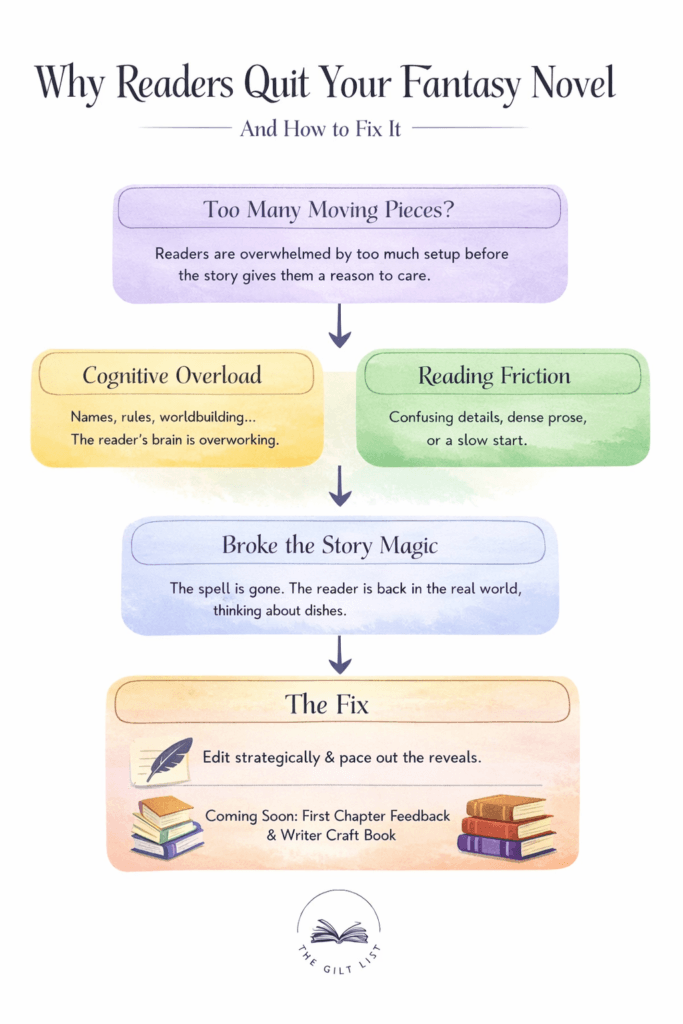
Romantasy has two major sources of conflict. The relationship affects the external conflict, and the external conflict changes what the relationship can become. When those strands separate, the book develops a stop-start rhythm. Political danger disappears during romantic scenes. Romantic tension goes missing during battles and court manoeuvring. We want the romantic characters to each fill a hole, while also being very bad for each other because of the plot/world/fantasy conflict. Silly example here, but take Twilight. Bella is Edwards silence, his calm from thoughts. Edward is the strong, competent figure she is missing in her life. But the vampire thing? Bella shouldn’t know Edward even exists, and Edward is pained by his intense desire to eat her. All of these intertwine in every scene.
The central desire loses its conflict after a major payoff
A first kiss, confession, victory, or revelation can release the tension that carried the opening half. They love each other now? Cool, why do I need to read the rest? This is why you need a new conflict ASAP. Like, the couple may have admitted what they want, while loyalty, power, grief, or incompatible duties make that want harder to live with.
Some drafts leave a long gap between the romantic payoff and the next meaningful complication. The characters remain together, repeat the same concern, and wait for the climax. You see this sometimes where the couple start arguing about the same thing over and over a lot as they wait for the plot to move. Readers can feel that empty stretch even if they don’t know why.
The ending closes events without completing the emotional movement
Fantasy endings often have a great deal to resolve. The villain falls, the city survives, the magic returns, and the correct heir takes the throne. The emotional question can get buried under the machinery.
Think back to the problem the protagonist carried into the book. Perhaps she believed love made her weak, power had to be earned through suffering, or belonging required obedience. The ending should show what she now understands and what that understanding costs her. A spectacular climax can still feel oddly thin when the character finishes with the same inner position she began with. We need to break our characters, fill them with their greatest fear, and actually make them overcome it.
The worldbuilding pays off unevenly
Early fantasy pages create expectations through rules, histories, prophecies, objects, and repeated images. The full manuscript has to remember which of those details felt important, which is hard if you’re dumping a lot of information on the reader, this is why it’s sometimes better to track worldbuilding in the second draft, alongside how important it is.
A magical limitation that disappears during the climax will make the solution feel convenient. A prophecy discussed for half the book needs a satisfying ending. You can’t forget to finish what you started. If you told the reader a piece of lore, it better have changed the story somewhere, somehow.
Just too many pages, not enough story
Length becomes a craft issue when scenes repeat work already completed, and if you have a wordcount sitting at 120,000 you either have this issue, or you have an incomplete duology. Are you telling them the story from the correct POV? Do you need more POVs? Is there really a novella here trying to sneak into the main story? Are you repeating conversations several times because it makes logical sense, instead of fantasy sense? Do you have a subplot because it seems fun, but has nothing to do with the main characters’ wants, desires, and fears?
Agents also consider how a debut will sit in the market, and an unusually long fantasy manuscript brings production and sales concerns with it. If you got a full request despite a very long, or very short manuscript, your hook is incredible, but they may be looking for you to cut the fat.
How much should you revise after one full rejection?
One full rejection deserves a note in your tracking sheet and a little time before you touch the manuscript. The wording may contain a specific observation. If so, save it. Then compare it with feedback you already trust from beta readers, critique partners, or an editor. A lot of agents don’t want to say, I didn’t personally love it enough to sell it, in fact I kind of disliked it, and I totally can’t sell this to anyone. So they might instead say, I’d love to see more interiority.
Major revision makes more sense when several readers identify the same area, one persons taste is just that.
Personal feedback still deserves careful reading, though, Agents rarely have time to provide it, so if they say something, grain of salt it and re-read with it in mind. The helpful question is whether the comment describes a problem you can also see in the manuscript.
How can you diagnose a full manuscript pass?
Start with your own reading experience. Put the manuscript away for a short period, then read it without editing each sentence as you go. Mark the places where your attention dips, a scene repeats an earlier point, or anything else that could be improved.
Then look at the book by story thread. Track the romance, the external plot, the protagonist’s internal movement, and any major mystery or prophecy. A thread that disappears for several chapters may be contributing to the loss of momentum. A thread that receives setup without enough payoff may be weakening the ending. Honestly, there is so much to diagnose that this deserves its own series that I haven’t written yet.
Chapter endings will tell you plenty as well. Notice how often a chapter leaves behind a changed decision, increased pressure, an answer, or an emotional shift. A series of chapters that simply stop after the scheduled scene has finished can make the middle feel longer than it is. Read others, read your own, hire betas, hire editors, and revise, revise, before an agent ever sees your query letter. This is how you give yourself the best shot.
When a whole-manuscript critique makes sense
Opening-page feedback has already been partly validated by the full request, so your chapter one is probably working. The remaining concern sits somewhere in the complete reading experience, which, I know, that’s vast. A manuscript critique can trace almost every problem you might not be spotting on your own.
A developmental edit goes further when the book needs detailed structural work across scenes, arcs, and story threads. The right choice depends on how much diagnosis you already have. Writers who know the problem and need help rebuilding it will need a different service from writers who only know that several fulls have ended in passes. The first needs a dev ed, the second needs a manuscript critique and a re-write.
The next edit should match the evidence
A full request tells you the query and opening created enough interest for an agent to read the manuscript. The most sensible next step is a whole-book review. My Fantasy Manuscript Critique is built for writers who need the major structural problems identified and put into revision order without paying for a full developmental edit.
The critique covers story structure, character arcs, pacing, the connection between the fantasy and romance plots, story promise, the middle, and the ending. You receive a clear account of what is holding the manuscript back and what deserves attention first. That matters after a full-request pass because another query-letter rewrite will leave the actual evidence untouched.
When a full developmental edit makes more sense
Choose Developmental Editing for Fantasy and Romantasy when the manuscript needs detailed scene-level guidance, deeper structural work, or support through a substantial revision. This is the stronger option when several full reads have produced similar concerns, the ending has changed repeatedly, or the romance and fantasy arcs keep pulling apart.
Writers who want to map the revision themselves can start with the Fantasy and Romantasy Novel Plot Planner and use the writing craft guides for targeted help with pacing, chapter endings, attachment, and worldbuilding.
Do not waste the good news inside the rejection
A full request means the book already persuaded someone to keep reading well beyond the sample. That is evidence worth respecting. A manuscript critique can show you where the book stopped fulfilling the promise that earned the request, so the next revision has a target rather than a general sense of doom.
Frequently asked questions
No. The request confirms that the concept, query, and opening created enough interest for the agent to read the book. The pass means the agent chose against representation after reading more. Craft, market fit, list space, and personal taste can all contribute.
Very common. Agents request more full manuscripts than they eventually offer to represent. A full request is a strong result within a querying campaign, although it carries no guarantee of an offer.
Look for repeated feedback or a repeated stage of disengagement. Two or three full passes can justify a careful manuscript review, especially when beta readers have raised similar concerns. One vague pass rarely supports a complete rewrite by itself.
You can pause new submissions while you decide whether the pattern has become clear. Existing requests can stay active unless you have found a problem serious enough that you would rather revise before another agent reads the book.
Yes. Agents consider their current list, editor interest, recent sales, and whether they can position the book confidently. A market-based pass may say little about the manuscript’s craft.