
Literary agent rejection letters are written in a strange little language where everyone is being very kind and absolutely nobody is telling you anything.
‘I didn’t connect with the voice.’ Fine. Which bit? The actual narrative voice? The character? The fact that the book opens with four pages of funeral history and a woman called Vaelith who never appears again?
Mostly, you will never know.
This is what makes querying so uniquely good at driving otherwise sensible writers mad. You receive three polite sentences, reread them twelve times, search the exact wording online, and eventually decide that ‘not right for my list’ means your entire fantasy novel needs to be rewritten from page one.
It probably doesn’t.
Agent rejections can still tell you something, especially when the same result repeats across a properly researched query list. But they are not tiny editorial letters disguised as professional courtesy. Most are simply no. The useful part is working out when a no is just a no, and when the pattern around it suggests your query, opening pages, or manuscript may need another look.
Psst. See How to Query for the massive in-depth guide with everything you could possibly need and Why I’m Not Getting Requests if you’re stuck. Or head to the writers hub for more writerly guides.
Takeaways
- Most literary agent rejection letters mean only one reliable thing… the agent has decided not to pursue the book.
- A form rejection is not an editorial diagnosis. It may reflect taste, timing, market concerns, list space, the premise, the pages, or simple lack of enthusiasm.
- One vague rejection should not trigger a full rewrite.
- Always consider how much material the agent saw.
- Repeated form rejections with no requests may point toward the premise, query letter, positioning, comps, or opening pages.
- Repeated partial or full-request passes suggest the query and opening are working, but the manuscript may not fully deliver on its early promise.
- Personalised feedback matters most when multiple agents independently identify the same concrete concern.
- A revise and resubmit is a serious expression of interest, but the requested changes should still align with the book you want to write.
- Do not reply to form rejections. A brief thank-you is enough for meaningful personalised feedback or an R&R.
What do literary agent rejection letters actually mean?
Most literary agent rejection letters mean the agent has decided not to pursue the book. That sounds painfully obvious, but you need to know this because lots of writers often try to pull a developmental diagnosis out of wording that was never designed to provide one.
A form rejection may cover taste, timing, list space, market concerns, the premise, the pages, or nothing more dramatic than the agent not feeling strongly enough. You cannot reliably reverse-engineer which one from a template. A more detailed response after an agent has read substantial material deserves more attention, but even then it is one professional reaction, not the revealed truth of your manuscript.
The safest way to read a rejection is by asking two questions; how much material did this agent see, and is the same outcome repeating? That will not turn querying into a clean little science. Nothing will. It does stop one vague email from sending you into a six-week rewrite based on the phrase ‘didn’t fall in love.’
The main types of literary agent rejection letters
1. No response
Some agents state in their submission guidelines that silence after a set period should be treated as a pass. It is frustrating because there is no clean ending, just a date in your spreadsheet quietly turning grey.
Once the agent’s stated window has passed, log it as a no and continue querying. Follow their guidelines rather than chasing for closure they have already told you they will not send.
2. The form rejection
A form rejection contains no book-specific feedback. It usually tells you the submission is not right for the agent and wishes you luck elsewhere. That is all you safely know.
One form rejection means almost nothing. Twenty form rejections from agents who genuinely represent your category may justify checking the materials they all saw; the premise, query, synopsis if requested, and opening sample. May. Not proves.
This distinction matters because writers are very good at blaming the pages when the agent list was poor, or rebuilding the query when the actual issue is that they pitched adult romantasy to agents asking for middle grade fantasy. Research first. Panic later.
3. A form rejection with one personal line
This is still mostly a form, but the agent has added something unique; they liked the premise, admired the writing, wanted more grounding, or struggled with the opening. Save it.
Do not immediately revise around one sentence. If another agent independently raises the same concrete concern, it becomes more useful. Or you can request an editor take a look with the feedback in mind. Two readers noticing that the opening takes too long to reach the protagonist is information you can use. One reader saying the voice was not for them is taste, probably.
4. The personalised rejection
A personalised rejection means the agent spent enough time with the material to respond to the actual book. It is encouraging in the narrow, annoying sense that something worked well enough to earn thought, while still being a rejection.
Read the note carefully. Separate craft concerns from broad preference. ‘The midpoint loses momentum after the tournament’ is actionable. ‘I did not connect deeply enough’ is honest, but it does not tell you anything.
A short thank-you is appropriate when an agent has offered meaningful feedback. Do not argue, explain the book, or ask them to provide the rest of the editorial letter for free. Publishing is small, and nobody has ever been won over by a six-paragraph email beginning ‘I think you misunderstood.’
5. A partial or full request followed by a pass
This one hurts more because the submission crossed several gates. The premise interested the agent. The query worked. The opening pages made them ask for more. Then the manuscript did not become an offer.
That does not automatically mean there is a broken middle hiding in the bushes with a machete. Agents pass on strong full manuscripts for taste, positioning, list overlap, confidence in the market, and so on.
Repeated full-request passes are worth examining, though, especially when the notes point in a similar direction. The opening may promise a sharper romance than the middle delivers. The political plot may swallow the character arc. The final act may resolve the external problem while leaving the emotional promise oddly unpaid. At this stage, the question has moved beyond whether chapter one can hook though.
6. A revise and resubmit
A revise and resubmit, usually called an R&R, is a pass on the current version with an invitation to revise actual concerns and send the manuscript back. It is a serious expression of interest.
Decide whether the notes make the book stronger in the direction you want it to go. Then revise properly with an expert on board, like a developmental editor. An R&R often involves structural work, not changing six sentences and returning three days later with ‘fixed it!’ energy.
What does “I didn’t connect with the voice” mean?
Usually, it means the agent did not connect strongly enough with the reading experience to continue. That is less satisfying than a tidy definition because voice is not one isolated craft setting. It includes the narrator’s personality, distance, rhythm, worldview, character presence, and the general feeling of being in the book.
It may also be polite shorthand for a response the agent doesn’t have time to make “you”. The voice may be perfectly competent and simply not theirs. This is why rewriting your entire narrative style around one vague rejection is a magnificent way to remove the thing another agent might love.
Other common phrases need the same restraint;
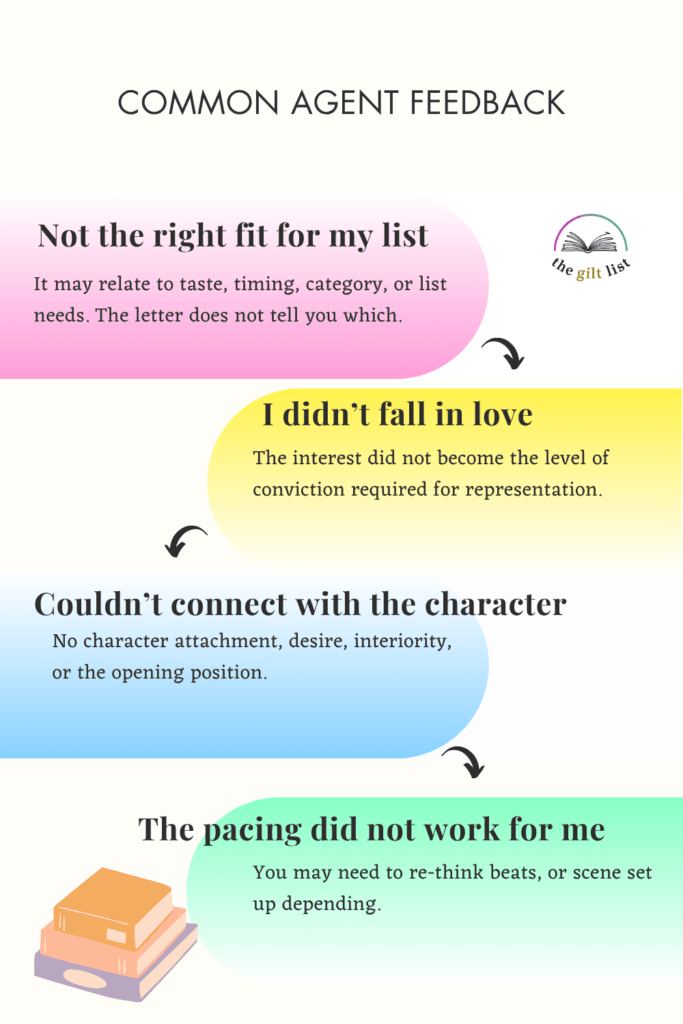
- ‘Not the right fit for my list’ means the agent is passing. It may relate to taste, timing, category, or list needs. The letter does not tell you which.
- ‘I didn’t fall in love’ means interest did not become the level of conviction required for representation.
- ‘I struggled to connect with the character’ may point towards attachment, desire, interiority, or the opening position, particularly if the same concern repeats.
- ‘The pacing did not work for me’ is only useful when you know what the agent read or they identify where the pace changed.
- ‘Please send future work’ is worth saving when it appears personalised.
When does a rejection pattern become useful?
The pattern becomes useful when the variables are reasonably controlled. You queried agents who represent your genre and age category, for example.
Even here, think in possibilities rather than verdicts.
- Mostly form rejections and no requests; revisit the query package and opening sample. Check the premise, genre positioning, comps, clarity, story promise, and whether the first pages give the reader a person and situation to follow.
- A healthy number of requests that become passes; the submission materials are doing something right. Look at the manuscript’s follow-through, particularly the middle, escalation, relationship arc, and ending payoff.
- Several personalised notes raising the same issue; take the repeated concern seriously, even when you do not accept every proposed solution.
- Mixed responses with no obvious pattern; this may simply be querying. Annoying, subjective querying.
Is a rejection a verdict on my writing?
No. It is one publishing decision made with limited time, limited information, and a specific list in mind.
The healthier position sits in the irritating middle for this read; a rejection may contain information, but it is not a verdict. Your job is to collect enough evidence to decide whether the book needs work without treating every no as a command from the mountain.
How should I respond to a literary agent rejection?
Do not reply to a form rejection unless the agent’s instructions say otherwise. For a genuinely personalised rejection or R&R, a brief thank-you is enough.
Do not argue. Do not ask the agent to reconsider. Do not explain that the slow opening becomes important in book three. They know they have passed, and you now know they have passed.
Read the patterns
A single rejection rarely tells you enough to rebuild a book. A repeated pattern across a thoughtful query list may tell you where to look.
Mostly no requests? Review the pitch and opening pages before dismantling the entire manuscript. Requests that repeatedly become passes? The book may need a whole-manuscript read rather than another polish of chapter one. Several agents naming the same concern? That deserves your attention.
And sometimes the answer remains; this agent said no.
If your query results keep pointing back to the opening and you cannot tell where a cold reader starts to drift, my first chapter critique looks at the story promise, clarity, genre positioning, character pull, and the places your pages may be making the reader work before they care. Or start with the free first chapter checklist below and run your own pass first.
Frequently asked questions
It means the agent is passing and has not supplied book-specific feedback. One form rejection tells you very little. A repeated lack of requests from a well-researched list can justify reviewing the query package and opening pages.
A form rejection uses standard wording and contains nothing unique to the submission. A personalised rejection refers to the actual book, pages, premise, or a particular concern. Personalised feedback deserves attention, especially when the same point repeats.
No. It means the agent is not pursuing it. The reason may involve taste, timing, category, market confidence, list space, or the material itself, and the phrase does not reliably tell you which.
When an agent’s guidelines state that no response after a particular window means no, yes. Follow the agency’s published policy and log the submission accordingly.
A revise and resubmit is an invitation to make substantial changes based on an agent’s feedback and send the manuscript back. It shows real interest, but it is not a guarantee of representation.
There is no universal number that proves a manuscript has failed. The quality of the agent list and the pattern of responses are more useful than the raw count.