
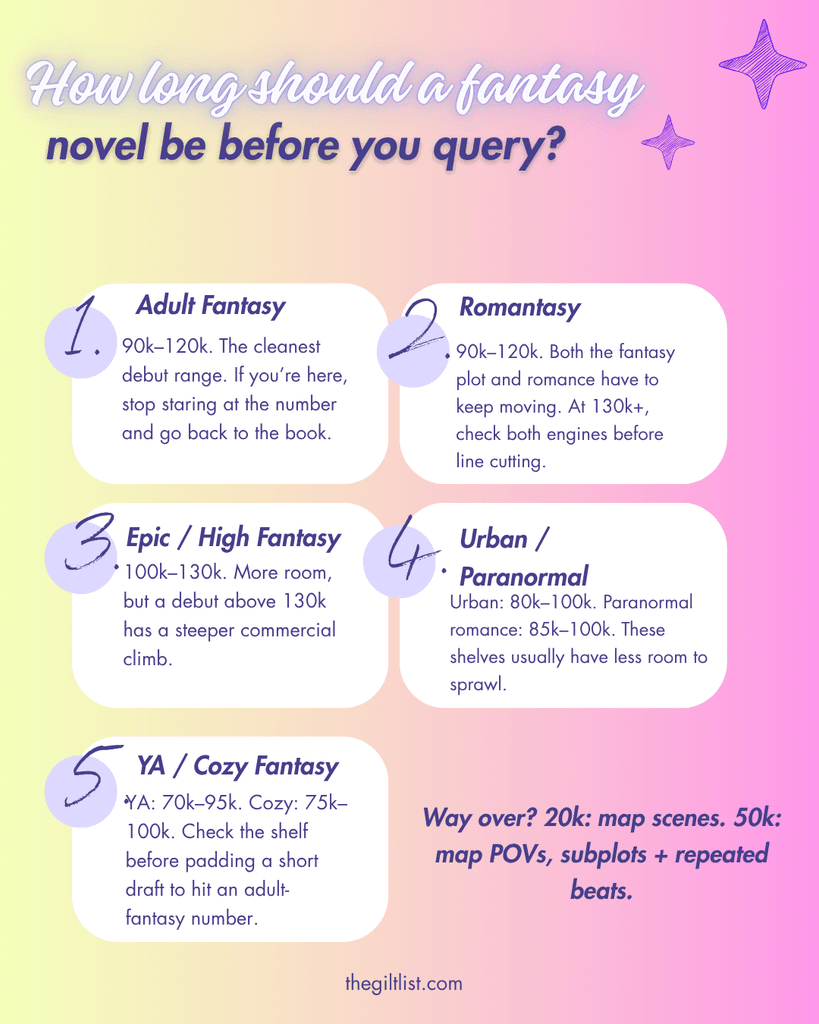
For an adult fantasy debut, 90,000 to 120,000 words is the cleanest querying range. Romantasy falls in roughly the same band. Epic has more room, while urban fantasy and YA run shorter. Once a manuscript moves far outside the range for its shelf, word count can become the first objection from an agent before the pages get a fair read.
Over the years (because I’m old now I guess) I’ve seen many writers claim that their story is worth it though, and once someone reads it they’ll be persuaded that a longer word count is needed. But the grim news is that longer word counts don’t just affect the enjoyment of the reader, it also comes down to money, risk, and literal shelving space. If your book is too long for the genre it’s intended for the problems will go far beyond readership and will cause long term sales issues. The kind that established authors don’t have to worry about.
Takeaways
- Adult debut fantasy: 90,000 to 120,000 words is the working range.
- Romantasy: 90,000 to 120,000 keeps a debut comfortably inside current querying territory.
- Epic and high fantasy have more room, but 130,000 to 150,000 words creates a much steeper climb for a debut.
- Urban fantasy: 80,000 to 100,000. YA fantasy: 70,000 to 95,000.
- A manuscript tens of thousands of words over range needs a structural pass before line trimming but it is curable with a good editor.
What word count do agents want for a fantasy novel?
For adult debut fantasy, query at 90,000 to 120,000 words unless your subgenre has a well-established reason to run shorter or longer. The range reflects production economics and market risk alongside story length so it really doesn’t matter if the story is made to be longer…the production and sales process isn’t.
Published authors get more room because publishers can price that risk against sales history and make a good case to vendors. A debut has no backlist data yet for you to stand on. An unusually long manuscript therefore asks an agent and publisher to take on more cost before they know how the author sells but also asks everyone involved from vendor, to editor, to agent to have an uphill battle.
Fantasy word count by subgenre
These are some great working ranges to keep in mind, a little under or over this boundary is fine.
Romantasy and fantasy romance: 90,000 to 120,000
At 90,000 to 120,000 words, the number itself is unlikely to stop the query before the pages have even shown what an amazing writer you are. At a recent 2026 query event, an agent reviewing a 93,000-word historical romantasy still pushed the writer to tighten the synopsis, even though the manuscript itself was comfortably in range because sometimes the structure needs a little less or more.
This genre needs to carry both plot and a romance so it can take a little more wordage. If you’re sitting at 70k there is probably something structurally missing and an editor (like me!) can go through the story and tell you exactly what that is and what scenes are missing.
At 130,000 words or more, I would inspect those two lines of story before touching the prose and trying to make sentences shorter or something. Has the romance stalled between major plot turns? Did the central plot lose pressure while the relationship took over for too long? Did the romance reach the climax too early and leave the back half looking for something to fill it up so you added an extra sub plot? Those kinds of questions will tell you what actually needs cutting. There are many more issues it could be of course which is why a second eye is where I would start first.
Adult epic and high fantasy: 100,000 to 130,000
Epic is where the shelf in a bookstore can mislead you. You see a 700-page bestseller, then look back at your 160,000-word draft and feel vindicated. I mean look how long those monsters are right? Yours is way shorter than that. But that bestseller may be from an author whose publisher already knows the audience will devour it, either because they were a famous fanfic turned trad or an established writer.
A debut fantasy above about 130,000 words has to face a much tougher production-cost conversation, basically, a bunch of faceless people will decide your 160,000 word story isn’t worth the cost when looking at their quarterly reports. And I’d just hate that to be the reason a good writer didn’t get published.
Urban fantasy: 80,000 to 100,000
Urban fantasy relies on compression, think fast paced and whipping romance. The pace, contemporary scaffolding and narrower exposition gives it less reason to natter on and add up that wordcount. At 130,000 words, I would look hard at how many plotlines the book is trying to pull off and whether the manuscript has drifted into a different kind of fantasy. Or maybe you’ve added a lot of unnecessary scenes because they are fun to read.
Paranormal romance: 85,000 to 100,000
Paranormal romance is near urban fantasy in length, but often has a little more explaining to do when it comes to the magic system and world.
YA fantasy: 70,000 to 95,000
YA fantasy runs shorter across the board for many reasons but one of those being it’s for a younger audience with less attention span. The upper end can support larger casts and more epic plotting, but a 120,000-word YA fantasy needs a strong reason to exist and should not be your debut.
Cozy fantasy: 75,000 to 100,000
Cozy fantasy has a tighter external plot and fewer large-scale set pieces to work with. Normally it’s one town with a small cast of characters. A shorter count can fit the experience readers came for as usually someone reads a cozy book over a weekend for comfort.
Why do agents care so much about the number?
A longer book costs more to print, bind and ship, I know that’s crass but at the end of the day that’s really what it comes down to. After all, any good writer can make any length work with careful planning. It may need a higher retail price when it comes to selling it as well and a debut gives the publisher no sales history to offset that cost, and the reader no reason to spend an extra 4 quid/dollars/what ever on a writer they don’t even know they like, compared to a cheaper book from someone established. Word count therefore enters the commercial conversation before an editor has fallen in love with the story and puts everything to bed before you’ve even started your writer journey if you refuse to take it into account.
The number can also expose a structure issue and is one of those things editors are trained to keep in mind and pick apart to get to the bottom of. In the manuscripts I read, a large overage comes from scenes, POVs and subplots far more often than it comes from sentence-level prose…basically, some big offenders are that there are two scenes that could be one and three characters that should be two, or scenes that feel fun but have no point. A middle that stops escalating so they can train and run in circles with relationship arguments can add thirty thousand words by itself. So can a POV that duplicates information or a subplot that never changes anything for the main character anyway.
My fantasy novel is 150,000 words. What do I do?
Do not start by deleting sentences to see if that might tighten it, those sentences might be what you actually need. I have watched writers spend weeks shaving sentences from a manuscript that is still 30,000 or 40,000 words over at the end only for the writing to now sound stiff and over edited and the plot to not be any better. By this point they are exhausted, the structure has not changed, and now they no longer trust the prose either. It’s a disaster.
A cut this large needs scene-level decisions and an arc to look at from a distance before that surgery begins. If you find yourself in this position and think you can fix it yourself start by making yourself a chapter/scene list so you can see the whole story play out quickly. Is there a part where too many scenes in a row do the same thing? Is the arc flat anywhere? Can you remove or combine things? Another good trick is to print out the manuscript and look at the page from a distance. Can you see a lot of dialogue that goes on for pages? A lot of white space? Or is it fairly balanced. If it isn’t balanced you might have a rambling issue or an issue of over reliance on dialogue. Some things that might help are to remove or combine scenes, collapse repeated beats, reduce POV exposition that is repeating or explanations the reader doesn’t need right then and there, and to cut subplots that do not alter the central story.
Start with three places:
- The middle. Travel, training, research and setup can expand the story in a bad way without anyone noticing because each scene feels individually defensible, I mean we have to get from point a to point b right? If you have a bunch of those put those scenes side by side and ask what changes by the end of each one. If the answer repeats, or worse, it’s nothing, combine them.
- Multiple point-of-view. Every POV needs entrance time, interiority, context and its own arc. A viewpoint that mainly witnesses events another character is already covering can cost thousands of words across a novel. If you cut that and are only left with a couple of chapters from that POV ask yourself if it’s really needed. (If it’s the love interest near the end of the story though, that’s a defensible keep and readers love it).
- Subplots. Follow each thread to the ending and ask what changes if you remove it. If the main plot, protagonist arc and relationship arc survive its removal, you have found room. Time to cut it. It can still exist in the background to make the world feel alive but it doesn’t need entire scenes.
This is hard to diagnose from inside the manuscript when you’ve been working with these characters and this world for a long time. You remember why every scene was added and what problem it solved was three drafts ag so it still seems important but a new reader only experiences what is on the page now. Not what you want to be on the page.
If your fulls keep coming back as passes when you are querying and you think the middle is where the book loses people a full request then a pass covers that pattern in detail. The Novel Plot Beat Planner gives you a free structural map before you pay anyone to help you so you can see the story from up high. For a whole-manuscript diagnosis, the Manuscript Diagnostic Critique identifies where the length is coming from and what to cut first; fantasy developmental editing is the deeper option when the structure needs rebuilding across the book.
How do agents count words, and how should you?
Use the total manuscript word count from Word, Scrivener or your drafting software and round to the nearest thousand. A manuscript at 97,842 words goes into the query as 98,000.
Ignore the old 250-words-per-page calculation. Page count changes with formatting; the digital word count does not. Use the number from the manuscript file.
Does word count change if it’s book one of a series?
Series plans do not buy book one extra room when it comes to word count and might even make the situation worse. Selling a series as a debut is just as hard as a high word count. Five planned novels and an enormous world may explain why the draft grew into the monster it is, but the agent still has to sell the first book and whether it needed that space or not is really immaterial.
Make book one complete enough to stand on its own, keep the count defensible for the subgenre, and pitch series potential instead and see how much better the story does.
What if my fantasy novel is too short?
Below about 80,000 words, adult fantasy can raise the opposite question to what we have been discussing in this blog so far. Ask things like, has the book built enough story to support the world, cast and ending level? A short count can point to compressed emotional beats, a thin middle, or a world that never becomes active on the page. One of the things I often see for a story too short is lack of interiority. The writer hasn’t really helped us see inside the main characters head and instead we get more of a script with dialogue, and action.
If low word count is your issue try to deepen the story. Let the emotional turns breathe show us all of the pain and joy, strengthen the middle with more foreshadowing and support for your ending, add subplots where there are none that mirror the theme of the story, and give the world consequences that affect decisions the main character is making so things aren’t jus happening to the characters. Do not just tack on extra description of environments, this can be the issue, but rarely is.
YA and cozy fantasy run lower by nature, so check the range for the book you are actually querying before adding anything blindly.
Does any of this apply to self-publishing?
Self-publishing gives you much more room on word count because no agent or acquisitions board is screening the manuscript before publication.
That freedom still has a reader and cost side and now it falls on you. A very short or very long romantasy can feel different from the book a reader thought she/he/they were buying, and page count changes print cost, pricing and subscription-read behaviour. You get to make the call; make it with the trade-offs in view and understand you will sell less books this way and if the book is long it will eat into your margins. If all you care about is staying faithful to the story you want to tell, even if it never sells, more power to you, sometimes as a writer that’s exactly the project we need to keep us motivated and I’m not going to knock that.
To wrap it all up
If you cannot see where the length is coming from, start with the Novel Plot Beat Planner. Is my fantasy manuscript ready to query covers the rest of the submission checklist, the Writer Hub collects the craft guides, and the querying pillar maps the process from finished draft to submission.
Frequently asked questions
For most adult debut fantasy, 90,000 to 120,000 words is a strong querying range. Epic fantasy has more room; urban fantasy and YA run shorter.
For most fantasy subgenres, 150,000 words creates a difficult commercial hurdle for a debut. Epic has more room, but I would inspect structure before querying a manuscript at that length.
A debut romantasy at 90,000 to 120,000 words is comfortably within the range agents see for the category. Larger manuscripts need enough plot and relationship movement to justify the extra length.
Yes. An adult fantasy well under 80,000 words can feel underdeveloped if the world, middle or character arcs have not had room to build. Add story depth rather than decorative description.
Yes. Count every word in the manuscript, including prologue and epilogue. A title page and other front matter do not belong in the manuscript count you report.