
Developmental editing fixes the beating heart of the story and line editing works on how that story is written sentence by sentence. Which seems like two totally different things, but really they can get quite tangled. Ultimately, developmental fixes should always go first, because there is no point in fixing lines you will cut or change, but line editing mistakes that repeat will often be pointed out by a developmental editor as part of their coaching (depending on how robust the service is).
A true, line by line deep dive should come once developmental editors and beta readers have run their course. You should pretty much be sold on your story at that point and ready to solidify each word.
For more guides like this check out the writerly hub.
Jump to:
- What is Developmental Editing
- What is Line Editing
- Is it a Developmental Problem?
- Is it a Line Editing Problem?
- Which Edit Comes First?
- What Does My Scene Need?
- What Does My Prose Need?
Developmental Editing vs Line Editing: Takeaways
- Choose developmental editing first when the problem involves plot and characters. Or you are new to writing.
- Choose line editing when the story is structurally stable and the sentences need work on clarity, rhythm, or flow.
- For most unfinished structural revisions, developmental editing comes first. Line editing comes once you have every scene exactly how you want it.
What Does Developmental Editing Cover?
Developmental editing works on the architecture of the book. Think plot, characters, and reveals. A good dev editor will also help you hone your craft, teaching an array of writing methods from show to tell all the way to tracking characters and worlds with bibles. This is basically a writing coach who gets right in the story trenches with you and steers the ship…trench-tank…you get my point. I hope.
So, for romantasy specifically that means way more than “is the plot good?” For instance, the fantasy plot and romance plot have to keep affecting each other, and crossing in theme and beats. Also, the protagonist needs reasons to act, and those actions should give consequences that steer the plot. The worldbuilding also has to arrive ONLY when it matters. Romantasy is, developmentally at least, more complex that most readers would initially understand. If you are still building those moving parts, my structural guide to writing a first romantasy novel goes much deeper into the dual fantasy/romance arc.
Developmental editors (like me) look at things like:
- plot structure and escalation
- character desire, motivation, conflict, and arc
- scene function
- pacing and pressure
- worldbuilding order and clarity
- magic-system logic
- story promise and genre positioning
- romance progression
- chemistry and tension
- power shifts
- emotional payoff
- subplots and story threads
- setup, foreshadowing, and payoff
- forgotten characters or threads
- how other threads might be linked together in ways you haven’t seen
- what to revise first, second, third and HOW
My Developmental Editing for Fantasy & Romantasy service is built around all of that. I am EFA-trained in developmental editing, work specifically with fantasy, urban fantasy, and romantasy, and read the genre as a reader too. You can reach out with the chat-bot and request a free sample.
What Does Line Editing Cover?
Line editing is a lot closer to sentence level. A line editor may look at awkward rhythm, repetition, weak verbs, unclear meaning, overwriting, underwritten transitions, clunky dialogue, point-of-view consistency, tonal wobble, or places where the prose is making the reader work hard. I wanted to list out a lot of the issues because many writers might think this is grammar and syntax. It’s actually a lot more about conveying meaning than you would think. If this is the part you are struggling with, Processing Fluency for Fiction Writers is the next guide I would read.
Good line editing should also preserve voice ALWAYS (as should a good dev edit). Request a free sample and make sure they are not changing who you are as a writer to something generic. You will know if they are by sweeping statements such as: your style is quite hard to understand or antiquated.
This is also different from copyediting by the way (I know so many editors so little time). A line editor is working on style and readability. A copyeditor is more concerned with correctness, consistency, grammar, punctuation, and technical accuracy. There is overlap depending on the editor, some will be doing both (I do at my more technical writing day job!), so always check the actual scope.
How Do I Know If My Romantasy Has a Developmental Problem?
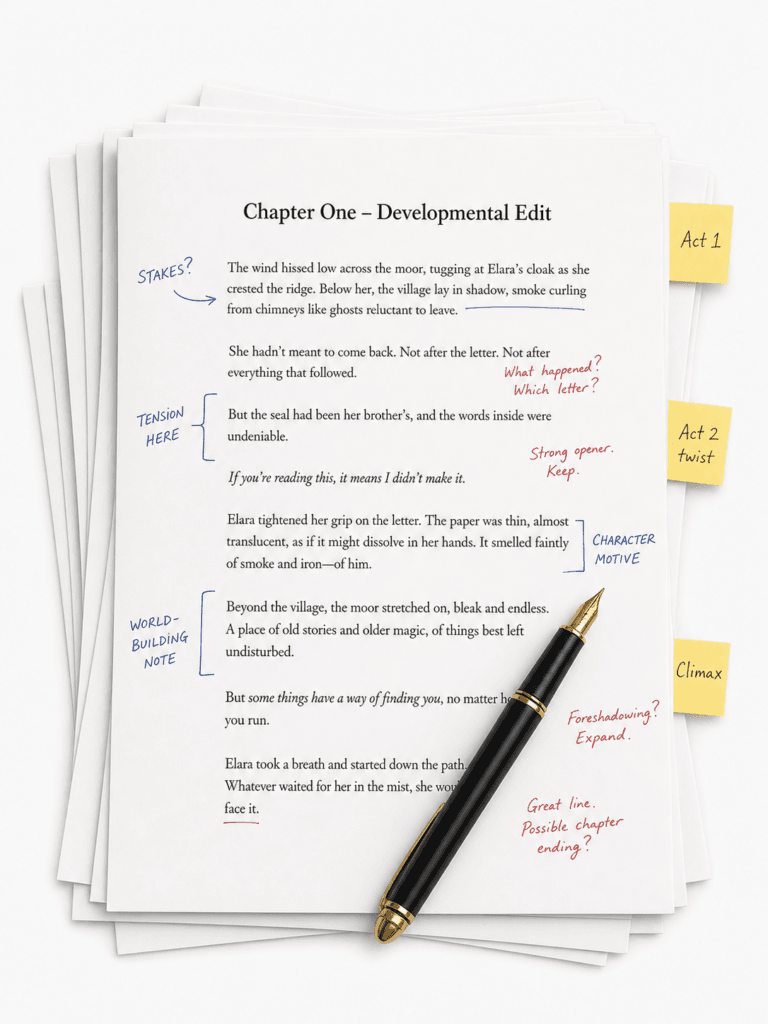
Ask whether changing the wording would solve the reader complaint, and well, if the answer is no, you probably have a developmental problem. Another way to tell, is if you are stuck in the beginning drafts and keep wanting to change entire scenes, or it just feels…incomplete somehow, or like the story is hopping around. Or you don’t like the way certain characters are appearing. Gosh, there is so much a developmental edit can do, but some things you might notice are:
- “The enemies-to-lovers chemistry is not convincing” is developmental if it’s rushed. A dev editor can help show you tools to achieve what you wanted for that story.
- “The middle feels slow or goes back and forth” is developmental. It’s probably either a tension issue or lack of confidence in the readers.
- “The heroine feels passive” is developmental because usually it comes down to a character with no agency in the plot. Or whose motivation is unclear. Why Readers Don’t Care About Your Main Character Yet gets into the attachment side of this problem.
- “The worldbuilding is confusing” is developmental. This could be a whole host of issues, from the world itself having plot holes, to the wrong kind of info dumping. If the issue is that readers are carrying too many new terms or rules at once, read Cognitive Load in Fiction.
- “The ending feels flat” is developmental. It could be a foreshadowing issue, a setup issue, or simply that you weren’t confident in your ending and the true one is still inside of you.
If your manuscript feels active but weirdly slow, read Why Your Fantasy Novel Feels Slow Even When Things Are Happening. Pacing is one of the easiest problems to misdiagnose as a prose issue by accident.
How Do I Know If I Need Line Editing Instead?
You are probably ready for line editing when you’re having fun reading your story, it makes sense, and all of your scenes are flowing both as a standalone scene and within the story itself. Beta readers are also excited all the way through and are not confused, you’re having lots of feedback that says “wow, I didn’t see that coming”, rather than “why did this happen, I don’t get it?”. And generally positive reactions.
Also, if other editors or readers have pointed out repeated grammar issues, clunky sentences, or paragraphs that get muddy…a developmental editor isn’t the major fix for this.
Line editors are great when your sentences are consistently overlong, dialogue tags and action beats repeat, paragraphs bury the lead and meander, pronouns are unclear, or there is a lot of head hopping (a developmental editor will flag head hopping, and give you a way to fix it, but won’t fix each individual instance).
How Do I Know if My Scene’s Need Line Editing or Developmental Editing?
Fixing the logical order or sequence of full events within a scene is for a developmental editors hands, while trimming over-explained prose or wordiness is the job of line editing. So, if you are worried about whether the dialogue should come before the internal emotional breakdown, or the descriptions or worldbuilding should come before the villains speech, then developmental editing is actually the go to here, not line editing.
However, if you notice you “show don’t tell” a lot, for example, “How dare you,” he said, angrily. Then that’s the job of a line editor. Line editing can also tackle things such as: He gasped. A bullet hit his thigh…this is a sequencing issue, because how did he gasp before the bullet hit his thigh?
Basically, line editing does not change the order of your lines unless it is subtle.
Should I Get Developmental Editing or Line Editing First?
Developmental editing will go first. You do not want to spend your money having each line perfectly arranged, only to cut hundreds of them because you spot a glaring plot hole. If you are an experienced writer, working on a standalone, then developmental editing might get bypassed altogether. However, I wouldn’t recommend it, unless you are a seasoned pro.
One exception, to getting line editing first, is when a writer has really clunky, confusing sentences that make a developmental read difficult. This can happen when English is not your first language, or you’re simply very inexperienced (which is nothing to be ashamed of – a developmental editors job is to help you reach your writing goals and there’s no gatekeeping, in my house at least). In this case, you may reach out to a line editor and ask for a non-exhaustive line edit so that it can be passed along to beta readers, the developmental editor, and then the publisher who will give it further edits. You may also learn enough from this line edit that it strengthens your abilities as a whole.
But as a default is to fix what the scene is for before paying someone to perfect every sentence.
Can a Developmental Editor Comment on Prose?
Yes, when the prose is affecting story-level reading we will absolutely point it out, and show you how to fix it so you can apply it to future works. For example, I may flag several sentences or paragraphs because they create confusion for the reader in the same way, then explain why it creates confusion and offer solutions so you can apply them to each instance.
A line editor will go through each with an exacting pen and re-write them all one by one.
What If My Prose Is Beautiful but the Book Still Feels Wrong?
Then please do not make it more beautiful yet. If this is the case you are likely a talented writer who is a notorious pantser, or have simply never been taught how to glue all the pieces together (which is a skill that takes years of study).
Sentence level skill can also hide your structural weaknesses. A reader may absolutely be thrilled by all the highlighting they can now exact across the page to re-read later, all the wonderful dialogue between the characters that makes them feel alive, and balled over by epiphany’s that put into words something they themselves have experienced. But that doesn’t mean they are looking for twists and feeling satisfied by them, understand why character’s are doing what they are doing, or feel compelled to keep reading until 4am.
If the manuscript is polished but inert it is a structural issue.
My Developmental Editing for Fantasy & Romantasy service is designed for exactly that level of work. If you are not sure you need the full service, the Fantasy Manuscript Critique is a smaller whole-book option that can identify the largest visible problem and tell you whether deeper editing is actually the next move, or if you can fix it yourself.
What If the Story Works but the Prose Is Rough?
Then line editing/copyediting may be the correct answer. If I get a copy of your synopsis, start reading the work and everything is working, then I would push the WIP back to you and tell you to look to a line editor. If structural issues can be fixed with sentence level tweaks then they are not structural.
There is no prize for buying every kind of editing.
More Writer Guides Like This
If you are still working out what kind of feedback your book needs, read Beta Readers vs a Developmental Editor for Fantasy next. That one is about whether you need reader reaction, professional diagnosis, or both.
If the problem feels more like story structure, How to Write Your First Romantasy Novel goes into the fantasy/romance braid, while Why Your Fantasy Novel Feels Slow Even When Things Are Happening is for manuscripts with plenty going on and somehow no forward pull.
If the sentences themselves are the issue, go to Processing Fluency for Fiction Writers. And if you want to browse everything by the actual problem you are trying to solve, the Writing Craft Guides for Fantasy & Romantasy Writers hub is where all of the writer-side guides live.
Frequently Asked Questions
Developmental editing works on story-level elements such as plot, character arcs, pacing, stakes, worldbuilding, scene function, romance progression, and payoff. Line editing works sentence by sentence on clarity, rhythm, repetition, flow, word choice, and style.
Usually, yes. Developmental changes can move, cut, combine, or rewrite scenes, so it makes sense to stabilise the story before paying for detailed sentence-level polish.
A romantasy novel may benefit from developmental editing when the fantasy plot, romance arc, pacing, character development, worldbuilding, or emotional payoff are not working together. Genre-aware editing can be especially helpful because readers are tracking both romantic and fantasy promises.
A developmental editor may comment on prose when it affects clarity, pacing, tone, characterisation, or reader engagement, but full sentence-level polishing belongs to line editing.
Ask whether changing the wording would solve the reader complaint. If the answer is no, the problem is probably developmental. If the scene works but the sentences are difficult, repetitive, awkward, or inconsistent, line editing is more likely the right next step.