
Beta readers are brilliant at telling you what happened to them while they were reading. You get a lot of:
“I got bored here.”
“I did not trust the romance yet.”
“I forgot who this person was.”
“I loved chapter twelve.”
“I thought she was going to choose the other guy.”
“I am confused, but possibly in a fun way?”
That is valuable information to get a feel for how the reader is experiencing your work. But it doesn’t really help you fix the structural issues in the most efficient way. That’s where Developmental Editing comes in.
A developmental editor’s job is to interpret the pattern that caused those reactions and help you decide what to change, with the ultimate goal remaining “how do I write the story I actually wanted to tell in my voice”.
So if you want to know which to choose you really have two questions.
How are readers experiencing my world? – That’s for beta readers
Why are they experiencing this and not that? – That’s for a developmental editor
Beta Readers vs Developmental Editor: Takeaways
- Use beta readers when the manuscript is coherent enough for a reader to sink their teeth into and now you need reactions to gauge what to edit next.
- Use a developmental editor when feedback is cloudy and not giving you much to work with.
- Use both when you want professional structural work followed by a reader test, or reader feedback followed by professional diagnosis.
- Do not treat beta readers as cheap developmental editors. It isn’t fair to them and usually produces revision decisions that are not sound.
What Does a Beta Reader Actually Do?
A beta reader reads the manuscript from the reader side and tells you exactly how they feel about the story. Like where they dropped off a cliff, or which character they trusted most, or which plot twist really caught them off guard. And so on and so on.
When you get good beta feedback you will know because it feels experiential. It gives you insight into whether someone is reading the story how you wanted them to. Which is why something like “this bit confused me” is great. If it confused one reader, it’ll confuse more. And if you’re a very experienced writer you should be able to track down why they are confused.
What Does a Developmental Editor Do Differently?
A developmental editor takes the symptoms a reader feels and translates them into actionable steps for you to help guide you through the edit. A full in-depth developmental edit will walk you through the manuscript step-by-step and show you exactly how to piece everything together to get the result you’re looking for. They won’t just tell you that you need to make the love interest more likeable, they’ll tell you exactly how to do it.
When I work on fantasy and romantasy, I am looking at reader experience and story mechanics together. By the end of the edit there will be a roadmap on where to add more conflict (and ideas as to how), which characters didn’t complete their arc (and how to fix it), how to create stronger scenes when they fall flat, and so on and so on.
Why Your Fantasy Novel Feels Slow Even When Things Are Happening is a good example of how I break reader reactions down into mechanisms.
When Should I Use Beta Readers First?
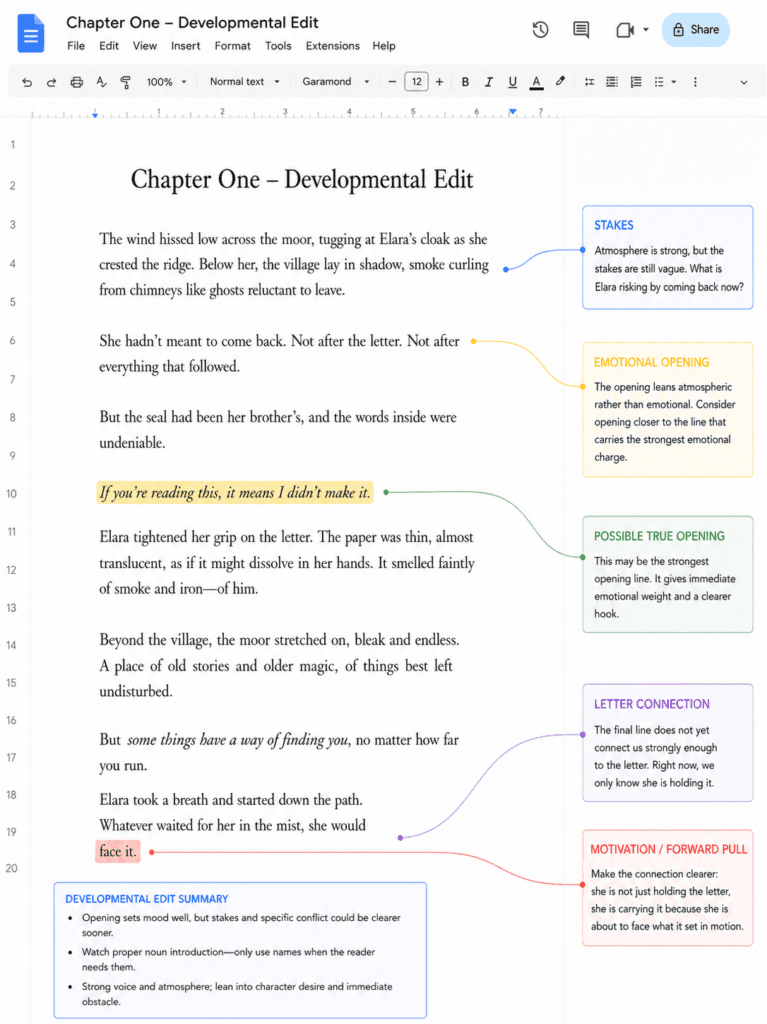
Use beta readers first when the manuscript is structurally coherent enough that you want to know how real people experience it. Especially if you’re the kind of writer who has written a lot of books already, and know when something is almost there. At this point you should have a full draft that has been editing a couple of times and looks nothing like the first run. This is really about asking, did what I write here work?
Beta readers are especially good for questions like:
- Did you care about the protagonist?
- Where did your attention dip?
- Which relationship did you trust or distrust?
- What did you think was going to happen?
- Where were you confused?
- Which scenes did you remember later?
- Did the ending feel earned?
- Did the book match what the opening made you expect?
The goal is to pay attention to similar negative reactions and hunt down why it might be happening. Having said this it’s also important to consider that your beta reader may simply not enjoy certain aspects of your genre, such as enemies to lovers. Vet them beforehand so you know things like this, so you don’t make big structural changes based on taste.
When Should I Use a Developmental Editor First?
If you have never published before, and have never had a developmental editor look at your work, it will be invaluable to you. This isn’t just about the draft you have right now, a good editor can spot weaknesses and teach you how to fix them to better your craft for years to come. If you have published before or written a lot of books then you likely know when a manuscript has some structural issues. Something isn’t quite working the way you want it to, and you feel it.
Professional editing may make more sense first when:
- You cannot explain what the protagonist wants.
- Major character arcs are still changing.
- The ending is not locked in.
- The romance exists, but you are not sure it progresses too fast, or too slow.
- The worldbuilding rules change because the plot needs them to.
- You have several versions of the manuscript stitched together.
- The voice keeps changing half way through scenes or acts
- You keep receiving beta feedback but cannot turn it into a revision plan.
- Every fix creates another problem somewhere else.
- You keep going over and over the story and can’t bring yourself to finish it.
- Or frankly, you just want someone to be there with you, writing can be lonely.
Having said all that, this does not always mean you need full developmental editing. If you mainly need the largest problem identified before another pass, a Fantasy Manuscript Critique may be enough for you. There are more affordable, flexible options that many writers are not aware of.
What If My Beta Readers Disagree With Each Other?
They will. Believe me. In fact, you may get it back and think, how is this helpful? Everyone spotted a different problem. Or worse, they spent half the manuscript correcting your grammar before you even know if you want the sentence on the page at all.
At the end of the day, reading is subjective. Your job is to look for the pattern, and use your gut.
Look for critique that actually has a problem with things like worldbuilding, goals, motivations, confusion, foreshadowing, and so on.
I have seen writers receive perfectly sincere feedback and then damage the manuscript by trying to incorporate all of the feedback because they didn’t understand why a writer felt that way. For example, one reader might say, I don’t understand why that monster showed up in chapter 3, so the writer removes it, or creates a new one, when really a small piece of careful foreshadowing was needed. A reader in general wouldn’t know how to explain that, or even spot the issue. My piece on, Does Your Main Character Actually Need to Be Likeable? gets into some interesting thoughts on one example of why advice many readers throw out isn’t actually what they mean.
Can a Developmental Editor Replace Beta Readers?
Nope. Developmental editors are great at craft, structure, spotting patterns. But half the time they might not read your genre and tropes religiously. Any editor worth their salt can help you find the patterns and fix them, find the craft issues and mold them, even when they don’t enjoy your kind of writing. But it’s not the same as beta readers who are in love with your tropes. Furthermore, an editor is just one reader. Albeit a trained one reading with a very specific job.
Beta readers give you breadth. They help you see whether several people respond similarly after revision. Which is truly invaluable.
This is also why I choose to work specifically in fantasy/romantasy/urban fantasy and would tell most writers when I am not a fit for their book. I am EFA-trained in developmental editing, I read the genre as a reader when I am not editing it so I am looking for the tropes to play out in a surprising way, as well as the mechanics behind it all.
What Order Should Beta Readers and Editing Happen In?
Either order can work: use beta readers first when the draft is stable, and developmental editing first when you already know the structure is broken.
You know, either way wouldn’t hurt. If the manuscript is coherent and you want reader data, beta first can be excellent. Simply run the beta round, collect patterns, then bring the confusing or high-impact feedback to an editor. Done and done.
But if you’re looking at the story and know there are big structural issues like, man I’m missing several scenes I know it, I can’t figure out the right ending, does my character arc even work? What even is my theme? Then you probably need a developmental editor first, because beta readers will point out all the holes you know are there, and that isn’t helpful.
If you have already beta read the book several times and keep going in circles, or haven’t, and keep going in circles. At some point you need an actual diagnosis and medicine.
Writers can get stuck in beta purgatory because feedback feels productive and relatively safe. The beta reader won’t give you a plan, so you think you’re making progress by continually asking and using their services, tweaking a bit, and trying again. I hate that for you. There should be an end goal, a good developmental editor will give you an end goal and a real plan.
What Kind of Editor Should Fantasy Writers Look For?

First check for genre knowledge. You don’t want a sci-fi editor for an epic fantasy. There are tropes and information in each genre that you study as an editor to be good at your craft. Next look for an editor who has actually studied alongside other editors, has reviews, and who you get along with. I think the best editor to have is one who is just as excited about your book as you are. The best way to discover this is to send a sample, and your ideas about the story, and see how they react.
Also, you want an editor in this genre with the same goals. Listen, you might be the kind of fantasy writer who loves a good KU read and that’s your story goal, or you could be aiming to be the next Tolkien. If you send a fast paced fun read to an editor who thinks fantasy novels should be in-depth and complex you’re not going to get the feedback you want. Finding an editor who is excited about your goal, and understands it, is the best fit. If you are still figuring out what that fit looks like, Finding the Right Editor for Fantasy goes deeper into it.
Do I Need Beta Readers, a Manuscript Critique, or a Full Developmental Edit?
Use beta readers when you need reader reactions to what you think is a story pretty close to done.
Use a Fantasy Manuscript Critique when you need an experienced full-book read to identify the biggest issue and tell you what sort of revision comes next. Or, if your betas have given you the same kind of feedback and you’re not sure how to implement it.
Use Developmental Editing for Fantasy & Romantasy when you need deep structural diagnosis, manuscript-level notes, a revision plan, and more support through a complicated revision. Or have a story that’s pieced together and want to actually have a novel.
Now, if you’re past all this and think it’s time for queries you could benefit from something like a First Chapter Critique. This looks at just your opening to see how it’s going to impact the agent, or the reader picking it up off the shelf to see if they want to buy it.
If the same feedback keeps coming back to you on your own reads or via beta readers, the Fantasy Manuscript Critique gives you a professional whole-book diagnosis so you can have a quick, actionable plan to get your story to the next level.
Frequently Asked Questions
A beta reader primarily reports their experience of reading the manuscript. A developmental editor analyses the story-level causes behind reader reactions and gives professional revision guidance across structure, character, pacing, worldbuilding, stakes, romance, and other developmental elements.
Hire an editor first when the manuscript has known structural problems that would make beta feedback noisy or repetitive. Use beta readers first when the manuscript is coherent and you mainly want real reader reactions before another revision.
There is no perfect number. A small group of thoughtful readers who fit the intended audience and actually finish the book can be more valuable than a large group producing shallow notes. Look for repeated patterns rather than trying to turn feedback into a vote.
Some can offer excellent ideas, especially experienced writers and critique partners, but that is not the core beta-reader job. Treat their reactions as data and be cautious about implementing every suggested fix literally.
Often, yes. Beta readers can test whether the revised manuscript now creates the experience you intended. Developmental editing and beta reading work best when they are allowed to do different jobs.