
There is a special kind of sinking feeling when you hear “I just didn’t connect with the main character.” It is vague, it feels personal anyway, and it does not tell you what to do. So writers reach for the obvious fix and try to make the character vaguely nicer.
That is usually the wrong thing to do. Readers do not bond with a character because they are nice and caring and sweet, they bond when they can see what the character wants, fears, risks, hides, or chooses. Half the most magnetic protagonists in fantasy are difficult people, and the reader cared anyway, because the character was legible and fought for or against something.
Why Readers Don’t Care About Your Main Character Yet: Takeaways
- Likeability is not required. Plenty of difficult characters are magnetic.
- Readers attach when they can read what the character wants and fears.
- A clear scene-level want gives the reader something to track.
- Fear creates attachment fast, even without big danger.
- Backstory alone does not make readers care.
- Fantasy protagonists feel distant when the world arrives first in the story.
Does Your Character Need to Be Likeable?
Likeable and compelling are different things, and compelling is the one that keeps readers reading. Think about the protagonists you could not put down, what were their best traits, i bet none of them on the list was wishy-washy, each trait should feel distinct. I unpack the cogs beneath the system in character desire is not enough in fantasy.
What Do Readers Actually Latch Onto?
The reader needs something to hold in the early pages, something like this:
- A want, clear enough that the reader knows what success looks like, and you actually name it on the page, out loud.
- A fear, named or shown.
- A wound the character is working around.
- A secret they are protecting.
- A contradiction in how they act or what they say.
- A vulnerability, something they could lose.
- Conflict already on them.
- A choice they have to make.
- A strained relationship.
Why a Clear Want Makes Readers Care
A character’s desire is what orients the reader inside a scene because if the reader knows what the character is trying to get, they know what counts as winning and what counts as losing. This makes the story much easier to follow, and also has the reader asking themselves questions about what they would do to get that thing if they were in the main character’s shoes. Now they’re connected. That’s why you often hear readers upset with characters’ actions, like the trope of the horror movie protagonist who opens the door to go check for the big bad ghost instead of running away.
Why Fear Hooks Readers Quickly
Fear is one of the fastest ways to make a reader care, and it does not need a dragon, or a big fire, or anything….large in general. Small extrernal fears work just as well, often better, especially if they’re tied to mild childhood traumas we have all experienced as the inner fear:
- External fear: Fear of being discovered as cursed. Internal fear: Fear of being wrong deep inside.
- External fear: Failing during a speech. Internal fear: Losing the respect of people who matter.
- External fear: Magic showing at the wrong moment. Internal fear: Rejection of who you are.
- External fear: Afraid of not winning a fight. Internal fear: Being too ordinary, not special enough.
- External fear: Fear of being chosen for a ritual. Internal fear: Fear of losing all safety.
Does Backstory Make Readers Care?
A sad past is not attachment, and front-loading it often delays the very thing it is meant to create: tension, conflict, sympathy. Backstory works when it connects to present behavior, ie., a character does a bad deed, but they have to do it because their father died and now they have to raise their sibling alone. Diving into a flashback scene for no reason just to make the character gain sympathy won’t work. A childhood wound the reader watches shape a choice on the page is much more distinct.
Why Fantasy Heroes Can Feel Like a Camera
When the opening is all geography, history, magic, and atmosphere, the protagonist becomes a lens the reader looks through rather than a person they care about. The fix is to bring the character’s experience into the world description, so every observation carries something they want, know well, or fear. The same castle described by a character dreading what waits inside it stops being scenery and starts being a story.
Can a Passive Protagonist Still Work?
Yes, with one condition. A character can begin trapped, silenced, controlled, or avoidant and still grip the reader, as long as the reader can feel the internal pressure and understand the constraint. There is a reason they aren’t willing to fight back. Maybe it’s to protect someone, maybe it’s because they have tried so many times before and are beaten down. There has to be a reason for the passivity, and that passivity should start to evolve as the story goes on to complete the character arc.
The difference between a compelling trapped character and a flat passive one is interiority. If the reader can see the character pulling against their own noose, they will care. So a withdrawn protagonist needs more inner pressure on the page, not less, and we should see the moment it snaps. Usually right at the dark night of the soul or the inciting incident.
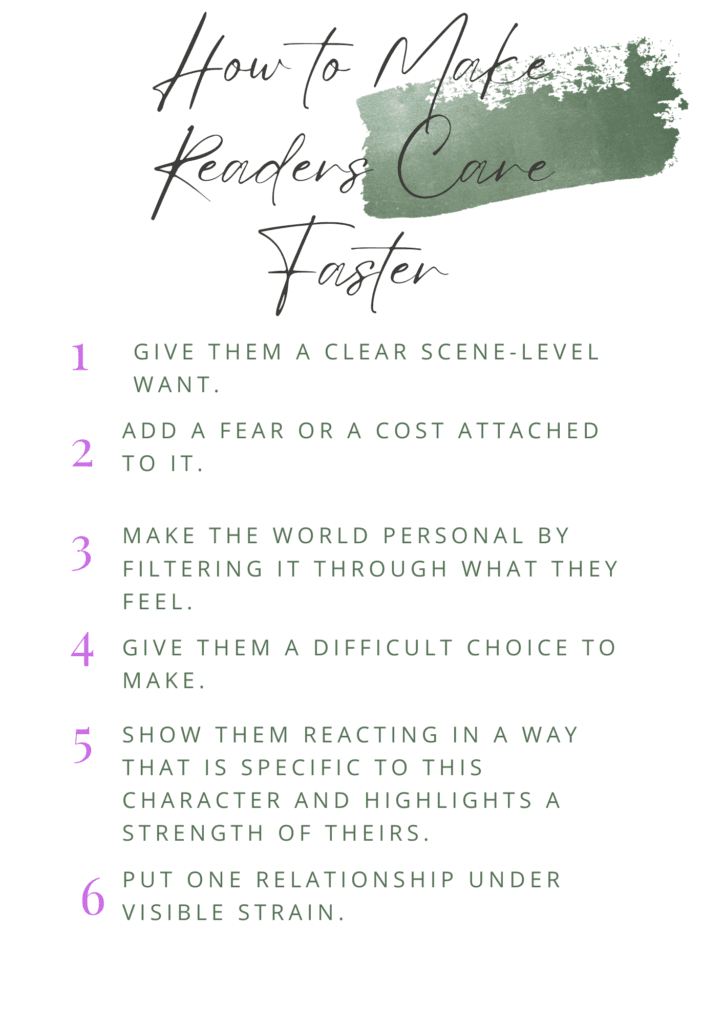
How to Make Readers Care Faster
- Give them a clear scene-level want.
- Add a fear or a cost attached to it.
- Make the world personal by filtering it through what they feel.
- Give them a difficult choice to make.
- Show them reacting in a way that is specific to this character and highlights a strength of theirs.
- Put one relationship under visible strain.
If you manage all of that in the first Chapter you are doing well.
When the Problem Is in Chapter One
Most “I didn’t connect” notes trace back to the opening pages, where the reader either got a handhold or did not. It is hard to diagnose from the inside, because you already love this character.
A first chapter critique shows you what a reader can actually see of your character in the opening: which wants, fears, and pressures are on the page versus only in your head. To check it yourself first, the Fantasy First Chapter Checklist walks through the attachment pieces an opening needs.
Want to Know Why Your Protagonist Isn’t Connecting?
Readers do not need to like your main character; they just need to get them. Most “I didn’t connect” notes are really “I couldn’t see why I should care.”
If that note keeps coming back on your opening, the first chapter critique shows you what a reader can and cannot see of your character on the page. The Fantasy First Chapter Checklist is the faster, do-it-yourself first step. If the connection problem runs through the whole manuscript, developmental editing covers the full draft. More craft breakdowns are in the writing guides hub.
Frequently Asked Questions
Give them something to read in the character: a clear want, a fear, a wound, a secret, or a choice. Readers attach when they can see what is driving the character and what it could cost. Likeability helps but is not the requirement.
No. Many of the most gripping protagonists are difficult, cold, or morally grey. What they share is legibility: the reader can see the want and the wound under the behavior.
Usually because the page is not giving them a handhold. If the reader cannot see what the character wants, fears, or risks, there is nothing to attach to, however well written the prose is.
Bring the character’s pressure into the world from the first description, so the reader meets a person, not a camera. Filter the setting through what the character wants or fears, and give them a scene-level want quickly.
No. A sad history does not create attachment on its own, and front-loading it often delays attachment. Backstory works when it connects to a present choice the reader can see.
Yes, if the reader can feel the internal pressure and understand the constraint. A character who is trapped or silenced can grip the reader as long as their straining is on the page.
A clear want, a fear or cost attached to it, a hint of a wound or contradiction, and a choice or strain that shows who they are under pressure. Two or three strong signals early will usually do it.