
You’ve written at least 10,000 words of your novel. First, good for you. That’s quite the feat. I mean, your characters are introduced, your world is coming together, and you’ve probably already written something exciting enough to make you giggle and want to share it with everyone.
Second? I bet you woke up about a week into the WIP and thought…you really don’t want to write this anymore.
Maybe you have a good reason for this, like hating your main character, or maybe it’s more of a feeling…or lack of feeling. So what now? You want to win the writing challenge you’re in, or you really want to finish a book, even this book, so why is this happening?
Please don’t abandon your novel yet. Feeling like this doesn’t mean there’s something wrong with it or you.
Losing interest in writing a novel is normal, especially once the excitement of starting a new story wears off. Writing enthusiasm comes and goes throughout a manuscript. It’s a waxing and waning moon, not a bright, shining star. Sometimes you need to keep writing until it returns, but many newer writers have no idea that feeling actually comes back, so they don’t last long enough to find out.
Other times, the problem is actually with your plot, and it needs sorting out because it’s causing a block in your writing. Writers are subconscious creatures who have a way of sensing when something isn’t right with their story, even before they can explain why.
If you’re doing NaNoWriMo, or any November writing challenge, or just trying to write a book, you might hit this wall much sooner than you expected. But I promise we can work it out before you drag another perfectly good manuscript into the trash.
Quick answer: If you’ve lost interest in writing your novel around 10,000 words, first work out whether you’re experiencing a normal motivation dip, a gap in your plot, or genuine exhaustion. Try a short writing session or jump ahead; if you still feel stuck, check your character goals and the story’s major beats before abandoning the manuscript.
Jump to:
- Why motivation fades around 10,000 words
- Motivation slump or plot problem?
- Six things to try before giving up
- When the story itself needs work
- Staying motivated during NaNoWriMo
Why Do Writers Lose Interest in Their Novels Around 10,000 Words?
First, there’s nothing particularly magical about 10,000 words or so, even though, if you’ve done this a few times, you’ll start to think you’re cursed (for me, the number is around 20k).
But somewhere around the early chapters, a lot of writers experience their first proper loss of enthusiasm and, if you’re anything like me, a dragging feeling of dread every time you open the WIP.
I think it’s because starting a novel is incredibly exciting.
You’ve been imagining these people for weeks, months, maybe years. Or imagining yourself as a published author.
It’s all rather wonderful when it’s happening in your head.
Then you have to write the bloody thing. And well, it’s as much work as any job. And as much study, too.
Writing a novel means connecting all those beautiful scenes together. Your characters have to make decisions, those decisions need consequences, and you have to work out how to get everyone from chapter three to that glorious scene you’ve imagined for chapter twenty-seven.
I’ve been writing for years, and I think one of the hardest things for newer writers to learn is that how excited you feel about your book is going to change throughout the writing process.
You can love a story and still dread writing it, the same way you can love going to work and still not want to get out of bed in the morning.
Does Losing Motivation Mean You Don’t Like Your Story Anymore?
No. Losing motivation doesn’t automatically mean you’ve chosen the wrong novel to write, believe it or not. And that other shiny idea you’ve had doesn’t mean you should swap to it, either.
Think about it like going for a run. Hopefully, you’ve tried this before.
At the beginning, you’re feeling rather pleased with yourself. You’ve got your music on, you’re moving along, everything is lovely.
Then you hit a wall.
Your legs are tired. Your breathing is annoying. You’re wondering why anyone voluntarily does this, and the sofa at home starts sounding like the finest invention humanity has ever produced.
Sometimes, if you slow down and keep going for a bit, you find your rhythm again.
I think writing works much the same way.
There will be days when the words are practically falling out of you, and days when writing 300 words is torture designed specifically for you.
The problem comes when writers interpret that temporary lack of enthusiasm as evidence that the entire story is rubbish. Or start looking at the greener side, aka that new story idea.
So they start a new book.
And it’s wonderful! New characters! New romance! New magic! Everything feels exciting again.
Until they reach the difficult part of that manuscript, too. And…you can see how this becomes a cyclical problem.
Now, sometimes the new idea really is better. Sometimes you’ve learned enough from the old project to recognise that it isn’t the book you want to write anymore.
But give yourself a chance to work through the slump before deciding. Maybe finish it first, then decide whether it’s worth keeping. Finishing a book will teach you things that drafting a new one never could.
How Do You Know If You’re Just Bored or Your Novel Has a Plot Problem?
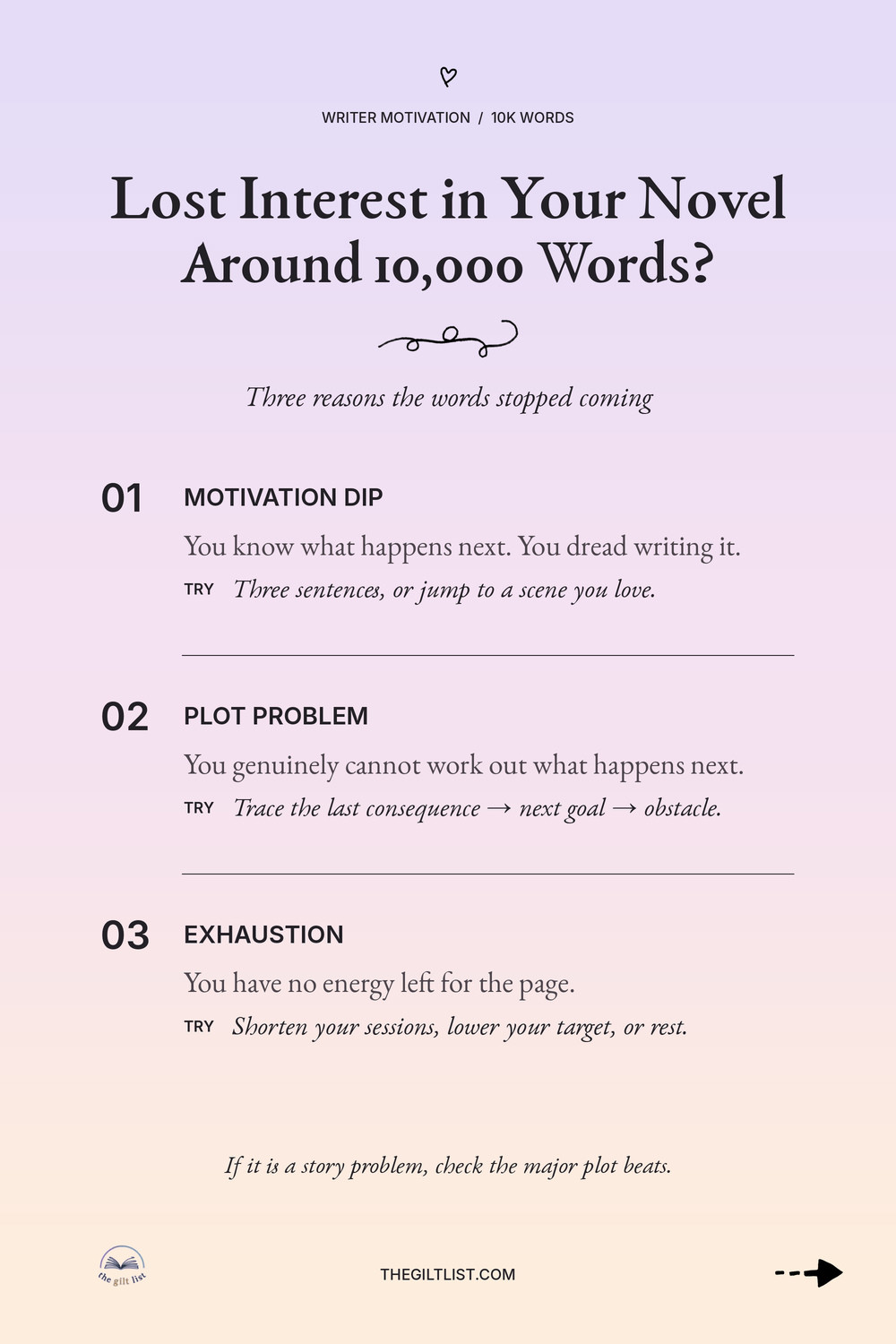
Which one feels familiar?
1. You Know What Happens Next, but You Don’t Feel Like Writing It
This is probably an ordinary motivation slump, and like every writer on the planet, you sometimes have to push through.
A good hack I find is to daydream about the idea first. Get in the shower, go on a drive, turn on music, and daydream about how it will look. What will the characters say? Can you feel how your MC feels in that moment?
Now tell yourself to write just three sentences. Getting started can trick your brain into following through.
Also? Write badly. Seriously. Use the same metaphor over and over again. It’s editor-you’s problem.
Or skip the scene altogether and write something you’re excited about. I like to have a bank of scenes that I’ve daydreamed about and love, and I’ll start sketching those out and writing them instead. You can always edit them later if they don’t line up quite right.
2. You Have Absolutely No Idea What Happens Next
Now we need to investigate because this is a developmental problem, and here is where I thrive.
A helpful way to think about scenes is as action scenes and reaction scenes. Stories often move back and forth between the two.
What was your last scene? Did something big happen? Or did your character mope about something for a bit?
If something big happened and now you’re like, what happens next? Stop. Have your character think through what happened as they go on a walk. Even if this scene doesn’t fully make it into the book, it will help you understand what comes next.
If the last scene was a reaction, what goal did your character determine? Have them try to reach that goal next.
If it’s something lofty, like travelling halfway across the world and breaking into a castle, what’s the first step toward getting there? Is it asking someone who might know the way?
Once you know whether your character needs to act or react, you can work out what they want and why.
Now you need to come up with what gets in the way of that want, and why. The conflict.
What stops them from finding that piece of knowledge? Or do they find out something else entirely? What terrible thing do they realise while thinking about what just happened?
If you can get something on the page again, wonderful. But if you keep running into the same problem, come back and look at the bigger plot.
I have a tool for that: Novel Plot and Beat Planner. It’ll help you work out where the story is going without needing to throw away everything you’ve already written.
And if you’re still figuring out the basic ingredients of your fantasy story, I also have a guide to the seven decisions you should make before starting a fantasy novel. You can go back and answer those questions even if you’ve already started writing.
3. You’re Exhausted and Writing Has Become Another Obligation
If you’ve been working, looking after your family, sleeping badly, and trying to produce 1,667 words every day because November, duh, you might just be tired.
It’s time to throw things out of the window…I don’t mean literally this time.
Listen, I don’t do the same chores when I’m doing big projects. It’s future me’s problem, who is also editor me. Use paper plates, meal prep over the weekend or live on snacks, cut down other obligations.
And most of all?
Stop expecting yourself to do all your writing at your desk, in the only free time slot you have left.
It’s time to grab your phone or a notebook and write in checkout lines, in the parking lot before work, at child pickup.
And before you tell me, in your head, that it’s very hard to get motivated during those little gaps, here’s the trick: stop your scenes halfway through.
When you take those 30 minutes in the morning or at night to write your book, stop the scene before you finish it. Picking it up at random during the day will allow you to quickly slip back in and get more words. Trying to do this on a blank page is harder.
Moreover, try finishing your writing sessions at roughly the 75% mark of any given scene and watch how much easier it is to keep going every time you get back to writing.
If you’re genuinely exhausted, unwell, or struggling to function, adding another writing target isn’t going to help.
NaNoWriMo is a challenge you choose to take part in. The book will still be there in December, and so will the rest of us, willing to cheer you on. Just join any social media platform and declare your own goal.
What Should You Do When You’ve Lost Interest in Writing Your Novel?
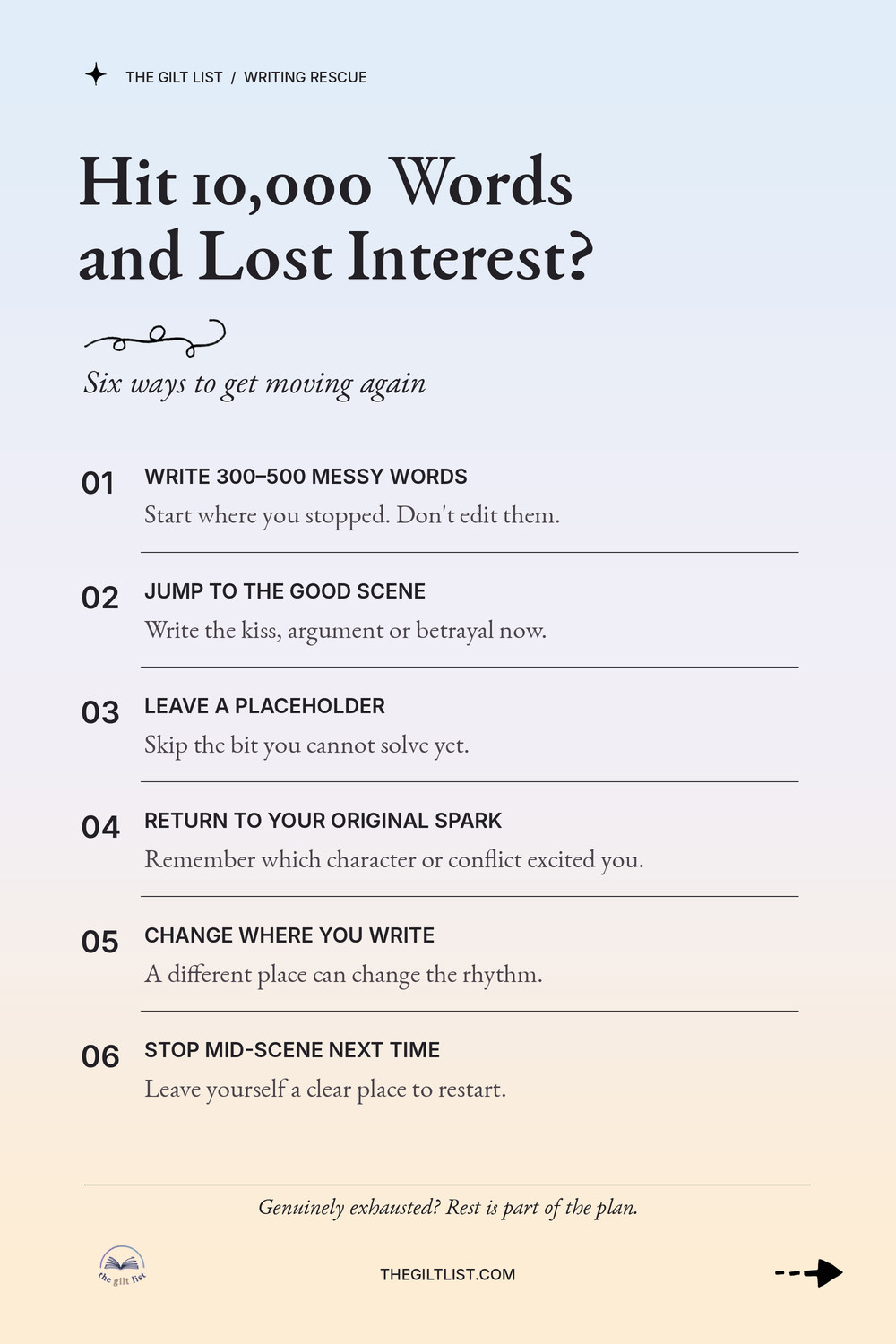
Before you abandon the book, try this over your next couple of writing sessions.
- Write 300–500 words without editing. Start wherever you left off and write whatever happens next, even if it’s dreadful. Sometimes a few days of this will get your brain back in gear.
- Skip to a scene you’re excited about. That argument, kiss, betrayal, magical disaster, or particularly satisfying murder you’ve been planning. Write it now. Nobody will ask why you wrote that scene first once it’s done.
- Leave placeholders for difficult parts. Write something like [They escape the palace here. Need to work out how.] and continue with the scene you know. Future you can sort out the details. And you will, if you allow your brain to ruminate in the background.
- Return to what made you want to write the book. Was it a particular relationship? A horrible moral choice? The world? The protagonist’s anger? Find a way to bring some of that back onto the page.
- Stop treating every writing session as a religious experience. Some sessions will be good, some will be rubbish.
- Change locations. Writing in a forest, by a lake, or even in your backyard can give you a new perspective. Sometimes a change of scenery is all you need.
I’d also recommend keeping a small collection of scenes you want to write later. I talked about creating a scene bank in my guide to outlining a novel before NaNoWriMo, and it’s particularly handy for days like these.
What If You Keep Writing and Still Can’t Get Your Motivation Back?
Alright, you’ve tried writing badly, you’ve skipped ahead to the exciting scenes, you’ve wandered around daydreaming about your characters like a lunatic, and you still dread opening the manuscript.
Now I want you to look at the whole book.
Sometimes we’re stuck because we can sense something isn’t working, even if we haven’t developed the editing skills to explain exactly what it is yet.
And this is where learning a little about story structure can save you an awful lot of grief.
Check Whether Your Major Plot Beats Actually Connect
Start with your major plot beats. Your inciting incident, your point of no return, your midpoint, the darkest moment, and the climax. You don’t need to have written all of these yet, especially if you’re only 10k words in, but look at what you’ve planned or what your draft seems to be building toward.
Ask yourself a few things:
- Inciting incident: What happened that disrupted your protagonist’s life? Did it actually change anything, or could they have carried on as before?
- Point of no return: What decision commits your protagonist to the main conflict? Is it their choice, or are they simply being dragged around by the plot?
- Midpoint: What discovery, failure, or reversal is going to change the way they approach the problem? Take the goal they had at the point of no return and turn it on its head. Is your character trying to bring down the throne? What if they realise the true power is elsewhere? Suddenly, overthrowing the king won’t solve anything. They need a new approach, and that leads them toward…
- Darkest moment: What will your protagonist lose, and how does that loss connect to the choices they’ve made? Perhaps their new plan has cost them the one person they needed to succeed.
- Climax: What will they have to do, decide, or sacrifice to resolve the central conflict?
You can use my Novel Plot and Beat Planner to work through these, or look at the different plot structures for fantasy novels if you’re trying to figure out how everything fits together.
What If You’ve Looked at Everything and the Story Still Isn’t Working?
Before you throw the manuscript away, I’d recommend editing some of it.
Yes, I know we’re supposed to be writing a first draft in November, and I’ve spent half this article telling you to stop editing. But if you’ve reached the point where you’re seriously considering abandoning the project, you have an opportunity to learn a tremendous amount from the pages you’ve already written.
Go back to a chapter and examine it like an editor would.
Look at your characters’ motivations. Does your protagonist want something specific in each scene? Is there enough opposition to make the outcome interesting? Does the scene change anything?
Then look at your dialogue. Does everyone sound the same? Are the characters saying exactly what they mean? Is there conflict underneath the conversation, or are they simply exchanging information for the reader’s benefit?
Try rewriting one scene with stronger motivations, better dialogue, and a more meaningful consequence. Then compare the two versions. If you’ve added words to your manuscript, that may count toward your writing challenge too, depending on its rules. And either way, you’ve gained more skill for your next book.
Do the same with a chapter that you think is particularly boring. Work out why it’s boring. Maybe two scenes are doing exactly the same job. Maybe the character’s decisions don’t make sense. Maybe the problem is that you’ve promised the reader one kind of story and spent the next fifty pages writing another.
If you suspect that’s happening, my guide to why your fantasy novel feels slow can help you spot some of those structural issues.
I promise you, there’s a lot to learn from that.
And even if you never finish this particular manuscript, those lessons will come with you into the next one. Every abandoned book can teach you something if you actually examine what went wrong.
What If Your Novel Is More Complicated Than Your Current Writing Skills?
There’s one more possibility I want to mention, because I don’t think writers talk about it enough.
Sometimes the book you’re trying to write is more complicated than the skills you’ve developed so far.
Are you newish to writing and chose a political fantasy with multiple POVs? Or a vast worldbuilding idea? Or a story with three timelines, six kingdoms, and an entire cast of people plotting to overthrow one another?
You might have an incredible idea that would make an amazing book. But the technical work required to make all those elements come together is still substantial.
And if you’re still learning how to control pacing, build a scene, or write a convincing character arc, trying to manage all of that at once can become overwhelming. It can demotivate you and lead to thoughts like, Why am I such a bad writer?
There’s nothing wrong with putting that book aside and writing something simpler, then coming back to it later when you have more experience. There’s nothing wrong with rewriting scenes several times in rough form to learn from them instead of finishing. There’s nothing wrong with outlining a hundred books before you write one if that’s how you’re learning what makes a story work.
Next time, try a single-POV fantasy with one central conflict, one goal all of the characters either want to achieve or prevent. Write a shorter novella with a smaller cast. Write a fantasy with no romance. Write a romcom with predictable twists. Give yourself room to practise the craft without having to solve complex issues that would challenge even an experienced writer.
That original idea isn’t going anywhere. You can come back to it when you’ve learned a little more. And? You’ll do it better and give the story the writer-you it deserves.
Should You Start a New Novel When You Get Bored of the Old One?
Sometimes, absolutely. If hitting the 50k goal is what matters most to you this November, for example, why not write five different novel openings and learn all you can from them? If your challenge allows you to count that work toward your goal, who’s to say it won’t be the very thing that helps hone your craft?
If you’ve never finished a book before and always look back on older work thinking, Wow, this isn’t good, maybe developing your craft is the skill you need to concentrate on first.
But I wouldn’t start a new novel simply because writing it sounds more exciting than finishing your current one. At least for NaNoWriMo or Novel Writing Month. Because this time, you might just be self-sabotaging.
Try writing the new idea down instead. Give it a few notes. Make a Pinterest board if you like. Add me on Pinterest too while you’re at it so I can see the board!
Then give your current manuscript another chance. One more good, big chance.
And if you decide to move on, at least you’re making that decision because you gave it your all.
How Do You Stay Motivated During NaNoWriMo?
My advice is to stop expecting every day of NaNoWriMo to feel like November 1.
The first day is exciting. You’ve got a lovely fresh document, possibly a writing playlist, and all the confidence of someone who hasn’t yet had to figure out what happens in chapter nine.
A week later, things are going to look rather different.
Keep your writing targets manageable, and don’t spend hours revising yesterday’s words when you’re supposed to be drafting today’s, unless you’re revising to add a missing scene, more dialogue, more description, or get the story moving again. Then go ahead, it’s a great little trick.
If you’re very, very new to writing, I recommend leaving every typo and typing like a maniac. I can write 5k words an hour, so I can afford to sit and really discover each scene, but when I started I couldn’t. So I would type and ignore typos and write the worst sentences ever. And learn story structure.
That first WIP? Still taught me more than any book ever could on the subject, typos and all. That typo-ridden mess? Parts of it still won me some awards later (awards that hardly matter, but it’s not where you start, it’s where you end).
If you need help making the daily word count work around an actual life, I’ve also written a guide to writing 50,000 words in 30 days without burning out.
And if you need more help with character development, pacing, plot structure, or simply figuring out what on earth to write next, I’ve collected my fantasy and romantasy writing guides and free tools in the writer hub.
If you’ve reached 10,000 words and suddenly can’t stand the sight of your manuscript, give it a few more pages before deciding its fate.
You may need to fix the plot. You may need to rest. Or you may simply be experiencing the thoroughly unglamorous business of writing a book.
I rather like that last possibility.
Because somewhere in those chapters you don’t particularly want to write, there’s probably something you haven’t discovered about your story yet.
Frequently Asked Questions About Losing Interest in Writing a Novel
Yes. Many writers experience periods of low enthusiasm while drafting, particularly after the excitement of beginning a new story fades. It doesn’t necessarily mean the book is bad. Try writing a little further, taking a break, or checking whether the plot has lost direction before abandoning it.
You may be reaching the point where your opening ideas have run out and the story needs more developed conflict and consequences. You might also be experiencing a normal motivation dip. Check whether you know what your protagonist wants and what happens next before assuming you need a new story.
Return to the characters, scenes, or conflicts that originally interested you. Try writing a scene out of order, drafting without editing, or introducing a meaningful consequence that changes the story. Sometimes excitement returns after you’ve started writing again.
You can try a short, manageable writing session when you’re simply uninspired. If you’re exhausted, ill, or experiencing burnout, take a break instead. Continuing through an ordinary motivation dip is different from ignoring your need for rest.
Absolutely. First drafts often reveal stronger character motivations, conflicts, and possibilities than the original outline. Update your plan when you discover something that improves the story. Just make sure the new direction still gives your protagonist a goal and a reason to pursue it.