
Fifty thousand words in thirty days sounds completely doable in October. You’ve got the idea, the playlist, the fresh notebook…and then November 4th arrives, the kids are sick, work wants another report, and you’re sat at 3,000 words wondering why you ever thought this was a good idea.
Oh wait. That’s me.
And probably you too.
So if you want to write 50,000 words in 30 days and still like your book (and yourself) on December 1st, here’s how I’d do it….from the daily maths to a schedule that might actually work, and what to do when you stall or fall behind.
Haven’t prepped yet? Start with my NaNoWriMo 2026 prep guide, and if you’re still picking a challenge, here are the NaNoWriMo alternatives worth joining this year. Everything else lives in the writer hub.
Still haven’t figured out what your fantasy novel is actually going to be about? Here are the seven decisions I’d make before starting chapter one.
Quick answer: To write 50,000 words in 30 days, you need about 1,667 words a day, or roughly 2,381 a day if you only write on weekdays. To avoid burning out, write ahead in the first week, set a small daily minimum alongside your bigger goal, draft in short sprints, save editing for December, and recalculate your target if you fall behind.
Jump to:
- How many words a day you need
- How to write 50k without burning out
- A week-by-week plan
- What to do when you get stuck
- What to do if you fall behind
- What happens after 50,000 words
How Many Words a Day Is 50,000 Words in 30 Days?
About 1,667 words a day if you write every single day. Which, let’s be honest, you won’t. I mean, there’s Thanksgiving in the US for one, Guy Fawkes in the UK for another, Santa Claus Parades in Canada….and I’m sure other countries have holidays too I just haven’t lived there.
So with that in mind here’s the math:
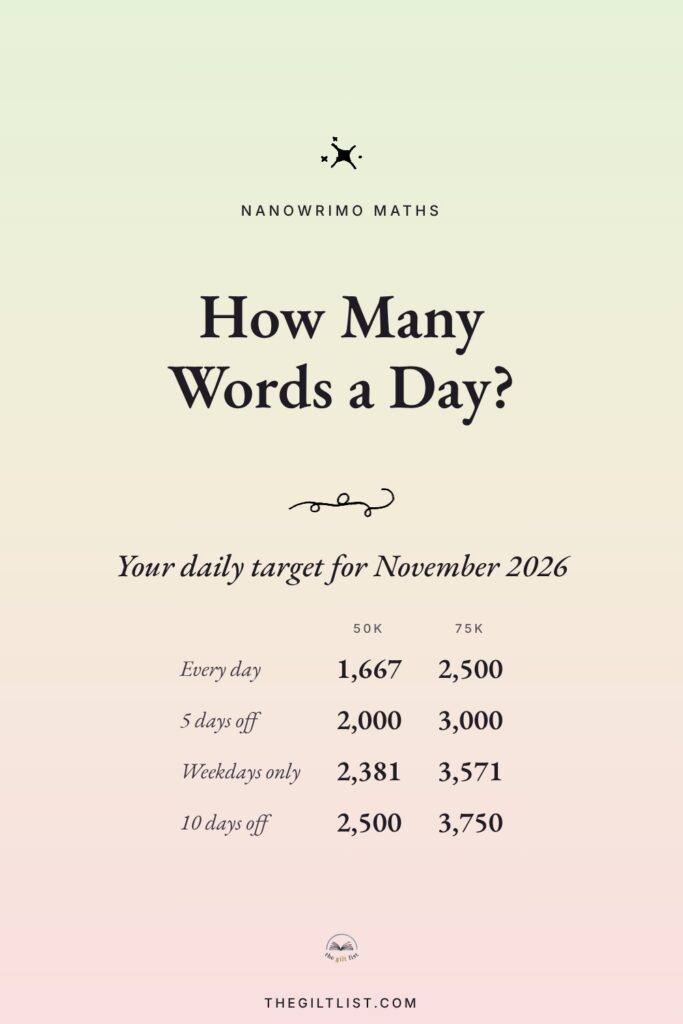
- Every day (30 days): about 1,667 words
- Five days off (25 days): 2,000 words
- Weekdays only (21 days): about 2,381 words
- Ten days off (20 days): 2,500 words
Personally, I aim for 2k-3k a day, so I’ve got breathing room for the days I can’t write at all, with a chronic illness, that’s a lot. And if you want an actual finished fantasy or romantasy draft, 50k is probably only half of it to boot. 75k works out to about 2,500 a day. Let’s break that down:
- Every day (30 days): 2,500 words
- Five days off (25 days): 3,000 words
- Weekdays only (21 days): about 3,571 words
- Ten days off (20 days): 3,750 words
Not sure how long your book should be? The fantasy novel word count guide breaks it down by genre.
How Do You Write 50,000 Words in 30 Days Without Burning Out?
Pace yourself for the whole month. Here’s what actually works for me.
1. Bank Words in the First Week
Week one is when the idea is shiny and you actually want to sit down. Use it! If you can push to 2,000 a day for the first seven days, you’ll have 14,000 words instead of 11,669, and that buffer will save you later. Because later is coming. You will crash, burn, or need a nap.
2. Set a Floor and a Goal
Your goal is the big number that you try and write, like 2k. But remember you can have a small minimum too. Maybe it’s 300, or trying for 10 minutes on your phone while brushing your teeth and swishing mouthwash.
3. Write in Sprints
Set a timer for 20 or 25 minutes and type like your laptop is on fire. Hit the socials too, like YouTube, where there’s almost always a sprint going in November. There is also a cool site I like to use called OhWrite where everyone just racks up the numbers for the night…remember to copy and paste often on that one though. And you can use my trick CHARACTER NAME HERE…or LOCATION THING HERE, for when you forget the names for things. Just me? Probably, I’m terrible with names. Heart Breathings Rough Draft Challenge also runs a lot of sprints and sit-ins.
4. Steal the Dead Time
Ten minutes in the pickup lane with nothing to do? Type a scene into your phone’s notes or an email to yourself and paste it into your WIP later. In fact, start doing it everywhere, train, bath, waiting room, while cooking, it all adds up. If typing slows you down, try speech-to-text while you’re walking the dog, or doing the dishes. It will add up fast.
5. Stop in the Middle of a Scene
Sounds wrong, doesn’t it? But it works brilliantly. If you stop halfway through a scene you know how to finish, you set your brain up for that scene tomorrow. You’ll find your mind will ruminate on it, and you’ll come back with more ideas for that scene, and the one after it. Another tip is to reread the last page you wrote then just keep going, it can sometimes help jog you back into the flow.
6. Look After Your Body
Sleep, water, food that isn’t just Halloween leftover candy (put the Snickers down)….and a walk now and then, talking into your phone’s mic…just pretend you’re on a call if anyone walks by and you feel self-conscious. Books take time, none are written overnight, and burning yourself out in week two means you lose weeks three AND four.
What Does a Realistic 30-Day Writing Plan Look Like?
Want to know what it actually feels like or need a refresher? Here, let me paint the picture.
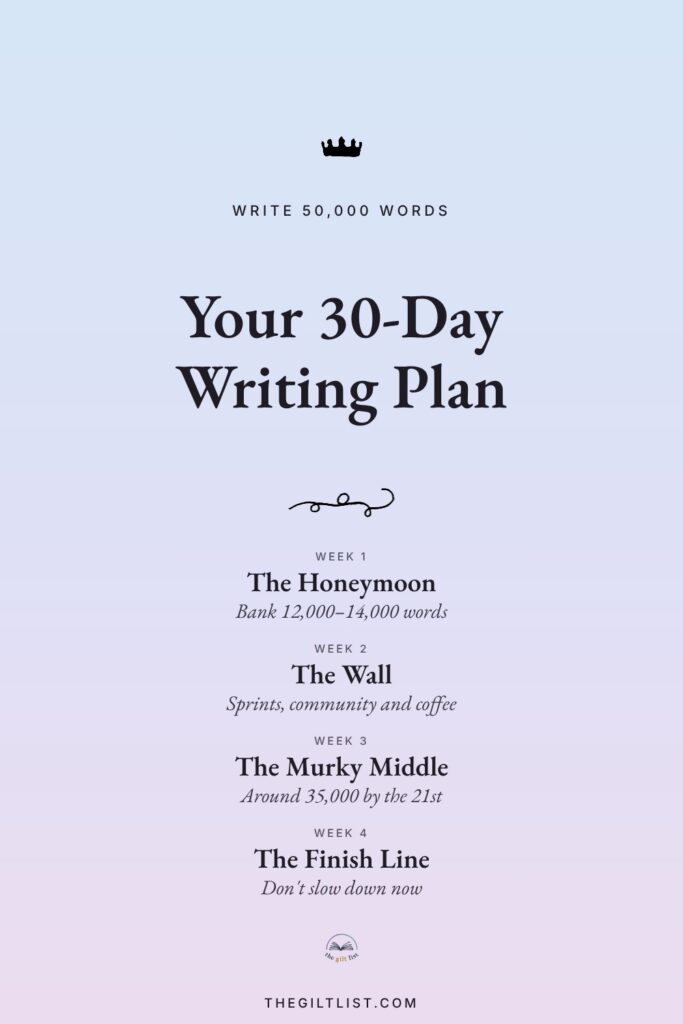
Week 1 (November 1–7): The Honeymoon
Everything is exciting and the words flow, you write so freaking much. You’re a genius writer who was made to write…which is why you need to bank up all the words now. Aim for around 12,000–14,000 by the end of the week if you really want to help later you out.
Week 2 (November 8–14): The Wall
This is where most people quit, around day 10 I’d say, because the magic has worn off and you’re past the inciting incident, so things feel a little shakier. That’s normal, and it happens with EVERY book, to every writer (almost, anyway). If you have to slow down a bit here, that’s understandable. This is where you need lots of sprints, community and tips. Oh, and coffee. Lots of coffee.
Week 3 (November 15–21): The Murky Middle
You start to feel a bit proud of yourself, and you’re really getting to know your characters, so you pick up a little here….you’re also looking at that word count like, man, I’m so behind. If you don’t have a plan by now and feel a bit lost, theNovel Plot and Beat Planner will help you out. You should be somewhere around 35,000 by the 21st.
If you’d rather start with something less detailed, my five-step novel outlining guide will help you get the big turns down without planning every scene.
Week 4 (November 22–30): The Finish Line
This is the make-or-break week because you’re almost at the finish line, and if you’re in the US? There’s a lot of family stuff coming. It’s time to buckle in though, because the more you write, the more you will thank yourself later. If you feel let down by how little you’ve written at this point, just try and double it, does that feel better? If so, just imagine if you kept going for another 4 short weeks! Don’t plan on slowing down now, no matter what you manage to write, you will have written more than most. Only 3% of people who start writing a novel actually finish it. And look how much closer you are!
What Should You Do When You Get Stuck Mid-Draft?
Try asking yourself these three questions, and open with a thought dump. What does my character want right now? What’s stopping them? What’s changed in the last scene? If you can’t answer any of that, is this scene even needed? If you have absolutely no idea at all where this is going next, even past this scene, it’s time to use the novel beat tool or the Story Spark tool for some inspiration.
If the scene is looking like it should work but you’re still stuck:
- Skip ahead to a scene you’re excited to write, leave a note in brackets about what’s missing, and keep going.
- Write only dialogue for ten minutes, have your characters natter. Add the description once you know where the conversation is going.
- Daydream the scene before you sit down, and jot the main beats so you’re not starting with a blank page.
- Plan tomorrow’s scene before you finish today’s session, even if you write nothing.
- Go back. This is a last resort, but if you’re really stuck, go one or two scenes back and start adding details. NO CUTTING. Adding only.
If the story has plenty going on but still feels like it’s dragging, my guide to why your fantasy novel feels slow will help you spot what’s going on.
Should You Edit While Writing 50,000 Words?
Nope. Only fix things that stop tomorrow’s writing from happening. Like, have you renamed a character? Broken a magic rule? Changed who the villain is? Write it in your notes doc and carry on as if the change already happened and stop worrying about it. That’s a problem for editing you. Or your editor.
In December, when you deal with all that, the plot hole guide will help you out.
What If You Fall Behind?
Do the maths again. Take the words left and divide them by the days left. If you’re at 25,000 on November 20th, you need 2,500 a day for the last ten days. Yeah, that’s tough, but it’s doable if you talk them into an app, or just start typing with all the typos left in.
If the new number makes you want to cry? It’s time to change the goal. Seriously. If you have 35,000 words of a book it’s still 35,000 more words than you had in October, and your health matters more than a badge. And this is the thing you need to remember: Nobody is going to sit you down for a future author interview and ask if you hit your word count for NaNoWriMo the year you wrote your book. No one is going to give two…ticks.
Your Daily 50k Writing Routine
- Check today’s number (and tomorrow’s).
- Reread the last page you wrote.
- Write your floor first, even if it’s 300 words.
- Sprint for 20–25 minutes, then take a break.
- Repeat until you hit your goal, or your floor if it’s a bad day.
- Note any big changes in your notes doc instead of fixing them.
- Stop mid-scene and jot down what happens next.
- Back up your manuscript.
What Happens After You Hit 50,000 Words?
Celebrate! Yay. But….then keep going. For most adult fantasy and romantasy, 50k is about half a book, so use that momentum and get to THE END before you start revising, before.you.revise. Please, and thank you. A very messy draft, with a quick sweeping edit, is the perfect thing to send to your friendly developmental editor, who will hand you the revision plan you need to get it to the finish line.
When you’re ready, the fantasy first chapter checklist is a good first pass, and my First Chapter Critiques are there when you want a second pair of eyes.
Frequently Asked Questions About Writing 50,000 Words in 30 Days
About 1,667 words a day if you write every day. If you only write on weekdays in November 2026, it’s about 2,381 words a day.
Yes, but it’s a demanding pace. Beginners often do better with a smaller daily minimum alongside the bigger goal, or a lower target like 25,000 or 30,000 words.
It depends on the writer, but many people can write 1,667 words in one to two hours of focused drafting, especially using timed sprints.
Write ahead in the first week, set a small daily minimum, draft in short sprints, take breaks, save editing for later and adjust your goal if life gets in the way.
Divide the words you have left by the days you have left. If that number is unrealistic, lower your goal and keep writing.
Usually not for adult fantasy or romantasy, which often run much longer. 50,000 words is more likely to be half a draft.