
It’s Halloween weekend, NaNoWriMo starts on Sunday, and all you’ve got is a vibe, a Pinterest board and one scene you’ve replayed in your head about four hundred times.
Same, honestly.
The good news is you don’t need a fifty-page document with color-coded timelines. An outline can be a sheet of paper that says “she has secret powers, gets kidnapped by the state, and tries to bring it down from the inside”. That’s still a book!
So, with that said, here’s how to outline a novel before NaNoWriMo, fast, with the extra bits fantasy and romantasy need.
This blog is super helpful alongside the NaNoWriMo 2026 prep guide and the guide to writing 50,000 words in 30 days without burning out. Everything else for writing tips can be found on the writer hub.
Quick answer: To outline a novel before NaNoWriMo, write a one-paragraph premise (who wants what, what stands in the way and what happens if they fail), then plan five big turning points: the disruption, the point of no return, the midpoint reversal, the worst choice and the ending. Add one to three sentences for each scene, a bank of scenes you’re excited to write and, for fantasy, a one-page note on how the magic works and what it costs.
Jump to:
- Do you need an outline for NaNoWriMo?
- How to outline a novel in 5 steps
- Outlining a romantasy
- If you hate outlining
- How long should an outline be?
- The one-weekend outline checklist
Do You Need an Outline for NaNoWriMo?
Nope. Plenty of writers fly by the seat of their pants and finish just fine. But a little planning makes November SO much easier, because when you sit down at 9pm with forty minutes and no energy….that TV show you wanted to watch suddenly sounds super tempting.
Now am I someone who outlines? Like a mad woman. I have outlines so in-depth they would look like conspiracy boards, but when I first started writing 30 years ago, I was a pantser through and through. I think it’s the best way to learn to write, as the best kind of writing is instinctual writing.
All you need to remember is, even a loose outline stops the classic November disaster of running out of things to write about.
How Do You Outline a Novel in 5 Steps?
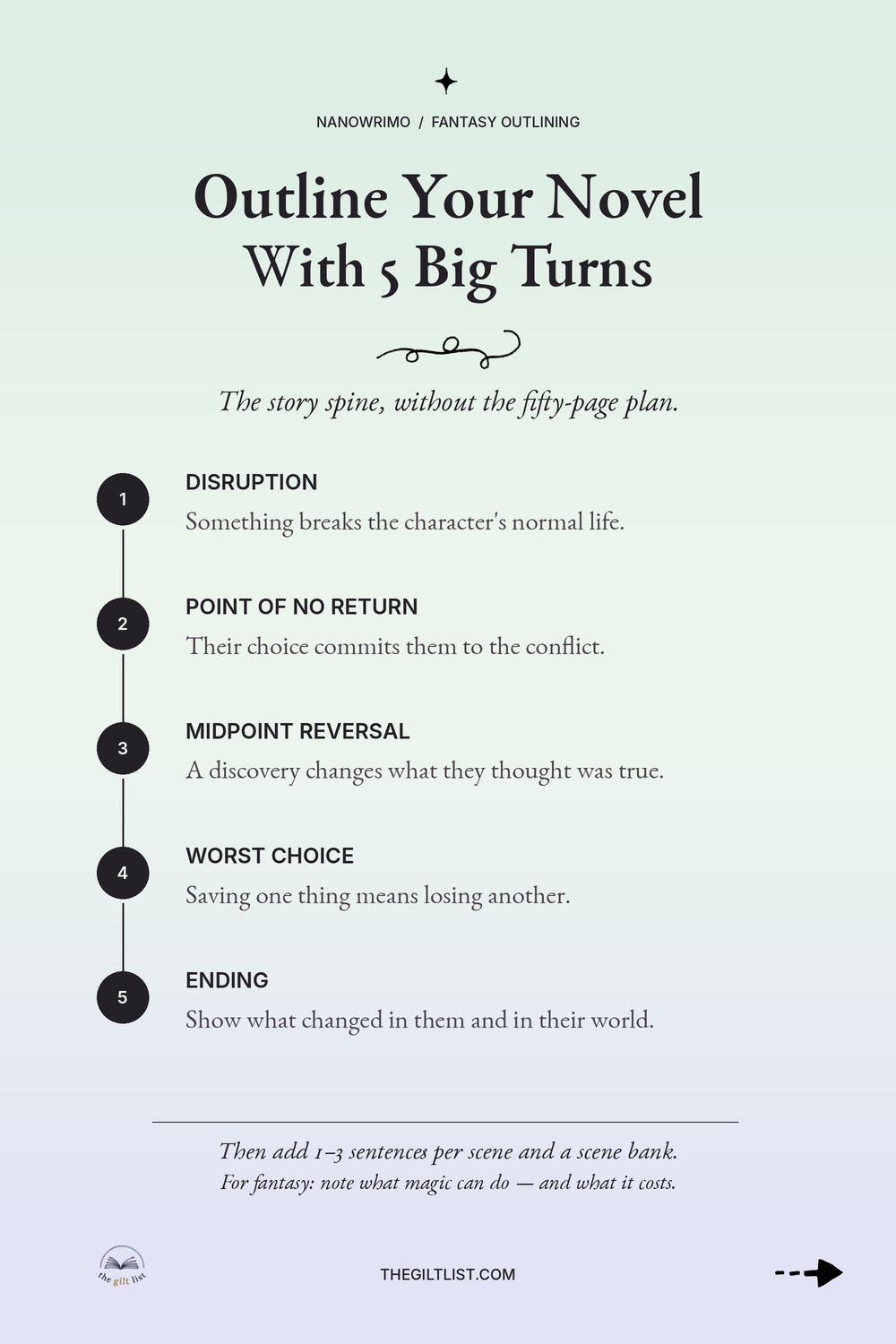
This is the quick version I’d use if NaNo started tomorrow.
1. Write a One-Paragraph Premise
Who wants what, why, what’s in the way, and what happens if they fail? Write it in plain words, like you’re explaining it to a friend who doesn’t read fantasy so when you look back on it later, you’re not confused. The amount of notes I leave on my calendar that make me think, wtf did I mean, has taught me that being clear is very important, even if you think you won’t forget.
Sarah, a palace thief, steals the queen’s crown to pay off her brother’s debt. The crown is cursed, and it’s slowly binding her to the throne, and some evil whispering spirit-like thing. The only person who can break the curse is Bob, the guard she framed for murder to get in.
If you can’t write this paragraph yet, try using my Story Spark tool; it will add in missing pieces that might inspire you. I love tools like this, because sometimes seeing what you don’t want is as valuable as seeing what you do want. My prep guide walks you through this part in depth as well.
And if you’re still figuring out the basic ingredients of the story, start with the seven decisions to make before writing a fantasy novel. There’s no point outlining fifty scenes for a protagonist who doesn’t want anything yet.
2. Pin Down Five Big Turns
These are the big things that will happen in your book.
- The disruption/inciting incident: something stops your character’s normal life. Sarah steals the crown and it won’t come off.
- The point of no return: the choice that commits them to the big problem. She breaks Bob out of prison, because she needs him.
- The midpoint reversal: something changes what they think is going on. The curse isn’t binding her to the throne. It’s choosing her as queen, and even if she tries to put it back, it won’t let her.
- The worst choice: saving one thing will cost another. Break the curse and lose the power to save her brother, or keep it and lose Bob.
- The ending: what’s different now, in them and in the world. Whatever Sarah chooses, she’s not a thief anymore.
Do you want to plan these properly? The Novel Plot and Beat Planner walks you through each one, and the fantasy plot structures guide has more options if five turns feels too simple for your monster of a book.
3. Fill In the Scenes Between
Now write one to three sentences per scene to get the juices going. Like, whose goal is active, what gets in the way, and what changes by the end.
Sarah breaks into the archive to steal the treaty. Bob turns up wanting the same document. They find someone has already changed the text.
Goal, conflict, outcome. Boom. Now you’re a scene writer who can do it well.
4. Build a Scene Bank
List ten scenes you’re dying to write, come on, you know the ones. The kiss, that little argument that keeps going around and around in your head, the beautiful rain falling through the forest trees. The bits that make you daydream about the book. You don’t need to have any kind of order for any of this, these are the scenes that will make you excited about the book when you lose motivation later. Which you will.
Also, when you get stuck in November and don’t know what to write next you can grab one from the bank and write it anyway. It’s like a little treat for future you. If you’re worried about that scene not working in the book later because other things will change, it really will be ok. So much of your book will be edited in the end, that it really doesn’t matter if it doesn’t line up perfectly. Plus, changing some of the scene later to fit better will give you more words. Win. Win.
5. Write a One-Page World Note
Fantasy writers, I see you with your seventeen-page magic system and an actual family tree and map system. Yeah, you know who you are. But for November, you only need one thing: what the magic can do, what it can’t, what it costs, and which rule is going to hurt your main character the most.
Go ahead and write that down, and give the magic a real cost. It’s the best way to make sure your world’s magic feels real.
You can also, if you want to, add the few places, factions and politics that actually drive the conflict, and stop there.
It’s actually a bit of a hack to decide on a lot of the worldbuilding later, as the best kind of books tell their readers those details sparingly in the right places. Knowing those details when you go back to your second draft, instead of right from the start, can actually make editing a lot easier, believe it or not. This is because so many writers end up info-dumping world details that they love, and want the reader to know, but just aren’t relevant and make the story boring for the reader. So on that second draft they have to cut so much, and fill it with something else.
Writing those details is exciting for you, and boring as fudge for the reader.
Deciding on some worldbuilding details after you have the first draft means adding details very carefully. So, don’t panic if your whole world isn’t put together yet.
The free fantasy worldbuilding tool will help you build out world details that actually matter, and help you see how they would look in real settings. So go ahead and use this if you have time, or save it for when you finish so you know the little idiosyncrasies that you can add.
How Do You Outline a Romantasy Novel?
Romantasy has two plots, believe it or not, and they need to crash together. Basically, you outline the relationship right alongside the fantasy plot, and check that each big turn affects both.
So grab those five turns you made for yourself and add five more for the relationship.
- Disruption: they meet, and it’s a problem. (She framed him for murder. Awkward.)
- Point of no return: they’re stuck together, through a bargain, a quest or forced proximity.
- Midpoint: the relationship changes. A kiss, a confession, or finally seeing who the other person really is.
- Worst choice: the plot forces them apart, and it’s at least partly their own fault.
- Ending: they choose each other, and that choice changes how the fantasy plot ends.
If the romance could be lifted out and the plot would still work exactly the same? That’s a problem if you’re writing romantasy with romance at the centre of the story. Fantasy romance and romantasy are often used interchangeably, though, and books balance the two plotlines differently.
The big guide to writing your first romantasy novel goes deep on making both plotlines matter.
What If You Hate Outlining?
Then don’t do a full one! You will create one anyway…while writing. That big messy manuscript at the end of it will be an outline in and of itself.
Pantsers, discovery writers, and chaos monsters alike should consider a few things though:
- A problem: what your character wants and what’s stopping them.
- A destination: a rough idea of where it ends, even if it changes.
- A bank of consequences: things that could go wrong, so you never run out of stuff to write.
Leave yourself room to be surprised in all fiction, no matter if you plot or not. That’s half the fun, and what makes the book alive.
How Long Should a Novel Outline Be?
As long as you need to draft from it, and not a page more. For some people that’s one page. For me it’s every scene. I can see some of you cringing at that.
It’s hard for me to say how many scenes because some people write longer scenes than others. I like my scenes quick and whippy for fantasy, and slower for a romcom for example.
I think 40–50 scenes for a 75k fantasy is a reasonable starting point. I will usually hit about 60.
If you must have a real in-depth outline, like me, remember that outlines can be thought about away from your desk. Just make sure you have your phone with you, with a note app of some kind. Write the first day’s words, then outline the major beats, and fill them in as the first week goes on.
You won’t get to the midpoint before the end of the week, unless you’re trying to do NaNo faster, so you should be able to outline ahead of yourself.
The One-Weekend Outline Checklist
Only got this weekend? Here’s the order I’d do it in.
- Write your one-paragraph premise.
- Pin down your five big turns.
- For romantasy, match the relationship to each turn.
- Write one to three sentences for each scene you can see so far.
- List ten scenes for your scene bank.
- Write a one-page world and magic note.
- Decide on the first scene you’ll write on November 1.
- Then stop planning and go to bed.
What Happens to Your Outline During November?
It changes. Probably a lot. Your characters will do something you didn’t plan, the villain will turn out to be more interesting than your heroine, and that’s GOOD. Update the outline when the draft shows you a better idea, and keep going.
Then in December, when the draft is done and you’re wondering whether the structure actually works, that’s exactly what developmental editing is for. Or start smaller with my First Chapter Critiques.
Frequently Asked Questions About Outlining a Novel
Write a one-paragraph premise, plan five big turning points, add one to three sentences for each scene, and keep a bank of scenes you want to write. You can do all of that in a weekend.
No, but even a loose outline makes it easier to keep writing every day in November, especially when you’re tired or stuck.
Your premise, your main character’s goal and conflict, the major turning points, a short note for each scene and, for fantasy, the key rules and costs of your magic.
As long as you need to draft from it. Some writers use a single page, others plan every beat. A scene-by-scene outline for a 75,000-word fantasy is often around 40 to 50 scenes.
Outline the romance alongside the fantasy plot, and make sure each major turning point moves both the relationship and the main story.
Yes. Update your outline whenever the draft shows you a stronger idea, then keep writing.