
No. And here’s what you need instead.
I once watched someone get, what would be considered genuinely good craft feedback and go on to completely ruin the story they were trying to tell. No one was trying to be cruel, in the first couple of pages, the changes would absolutely work for quick reader attachment.
The feedback? Your main character isn’t likeable enough.
The writer went home, took their time, had experience, and they were truly thoughtful about it all. They even gave the MC a rescue-the-stray-cat moment, gave her some self-doubt, maybe a dead mum for good measure — because nothing says please root for me quite like literary orphan syndrome — and then brought it back the following month.
Better, everyone said. Much more likeable. Someone we can root for.
The book lost everything interesting about it.
What “Make a Character Likable” Actually Means
To be fair, “make them more likeable” usually isn’t malicious feedback. What the person giving it is almost always trying to say is: I don’t know why I should care yet. Which is a real problem. A legitimate one. The issue is that “likeable” is a lazy shortcut to solving it. It works in Act 1. But past that? It all sort of…falls apart.
Likeable is a moral category. It means: would I invite this person to my birthday dinner? Would they send me a gift at Christmas? Would they not say something weird about my haircut? Could I see myself in this person, and do I agree with their actions?
But who we wish we could be, and who we actually are. Dear wonderful writer, that gap is huge. And it’s the difference between real characters that engage and turn our lives upside down, and a good story.
And yet most craft advice — workshops, beta readers, well-meaning writing groups in pubs — reaches for likeable every single time a character doesn’t immediately create attachment.
It is not a solution. It is a very convincing-looking coat of lipstick on a pig in a tutu.
The Real Reason Readers Follow Characters
Here is the thing that real research on character attachment keeps arriving at: readers don’t attach to characters because those characters are a reflection of who we want to be, or who we want our friends to be.
They attach when they can deeply, viscerally track what a character wants, and when the gap between where that character is and what they’re desperately reaching for creates enough tension that leaving feels genuinely uncomfortable.
But I’d push it even further than that.
Readers don’t just want to follow desire. They want to use the character. Like a borrowed body for all the feelings, fantasies, and impulses that polite society has quietly trained them not to act on.
The character does the thing the reader can’t. Nay, the character MUST do the thing we can’t. They must go too far, want too much, make bad choices, act out horrible things, be a little whiny maybe, selfish, mean. Take revenge even. And if you want to step into the world of morally grey characters, even hurt someone, on purpose.
That’s why entire franchises get built around people we’d never actually want to know.
The Borrowed Body Problem (Or: Why Kaz Brekker Has No Interest in Saving Cats)
Take Kaz Brekker from Six of Crows.
He is not likeable. He is cold, calculating, and prepared to sacrifice basically anyone — including people he arguably cares about — if the job requires it. He has one and a half soft spots, and he guards them with the energy of someone who once got hurt and decided never again with his whole chest.
He is also one of the most followed characters in modern fantasy. Tattooed on people’s arms. Named in countless “my favourite character ever” threads. People have cried over him. People have written essays about him. People have felt things about Kaz Brekker that they are not entirely sure are proportionate to reading a YA heist novel.
Why?
Because Kaz is living out a fantasy most people keep buried. Control over chaos. Competence so absolute it becomes its own kind of ruthless power. The fantasy of being the most dangerous person in the room, not through violence alone, but through being cleverer than everyone who ever underestimated you. Being the one who always, always has a plan.
It’s like those shower thoughts where you come up with the perfect come back, 6 hours too late. You would have been cruel, you would have done it, you would have taken back your power, if only you could be fast, mean enough. In the light of day though? You’ll stay likeable.
Kaz Brekker never saves a cat. He barely saves himself, emotionally speaking. But readers cling to him because he’s doing something for them that a warm, relatable, save-the-stray-cat protagonist simply cannot.
He’s carrying their fantasy.
The Desire Underneath the Desire
This is where it gets interesting. And a little bit uncomfortable. Which is exactly how you know you’re in the right territory, and your book is actually saying something.
Every really magnetic character — the ones people obsess over, reread, follow across sequels they know are going to hurt them — is hitting two things at once. A buried desire and a buried fear. At the same time. In the same person.
Amy Dunne from Gone Girl is the easiest example I can reach for, because almost everyone has read it or seen it, and if you haven’t, fix that.
Amy is not likeable. Amy is meticulous, calculating, genuinely terrifying, and operating on a level of sustained fury that most of us have only ever felt for about forty-five seconds before talking ourselves back down. Ok, maybe an hour, but I won’t tell anyone if you don’t. She does things that are — let’s be honest — objectively monstrous.
And yet. Half the people who read that book were rooting for her on some level, they weren’t entirely comfortable admitting.
Because Amy is living out the fantasy of being seen. Of refusing to be edited down. Of making the people who underestimated her, who performed love at her rather than actually giving it, understand exactly what that cost. She is terrifying and she is doing something that reaches somewhere primal in a lot of readers.
That desire to be taken seriously. To stop being small. To make the person who got it wrong understand what they actually lost.
That’s the buried desire. And the buried fear — the one Amy is also pressing on — is: what if I’m also the villain of my own story without knowing it? What if wanting more makes me into something monstrous?
That’s two things happening at once. That’s why you can’t look away.
What Your Workshop Got Wrong
When someone in your critique group says make them more likeable, they are describing their symptom, not your diagnosis. The symptom is: I didn’t attach. The diagnosis might be any number of things, but many aren’t taught to actually look for that. The character’s desire isn’t clear enough. The reader can’t track what might come next. There’s no gap between now and later, no longing. The fear underneath the desire hasn’t been named in the prose.
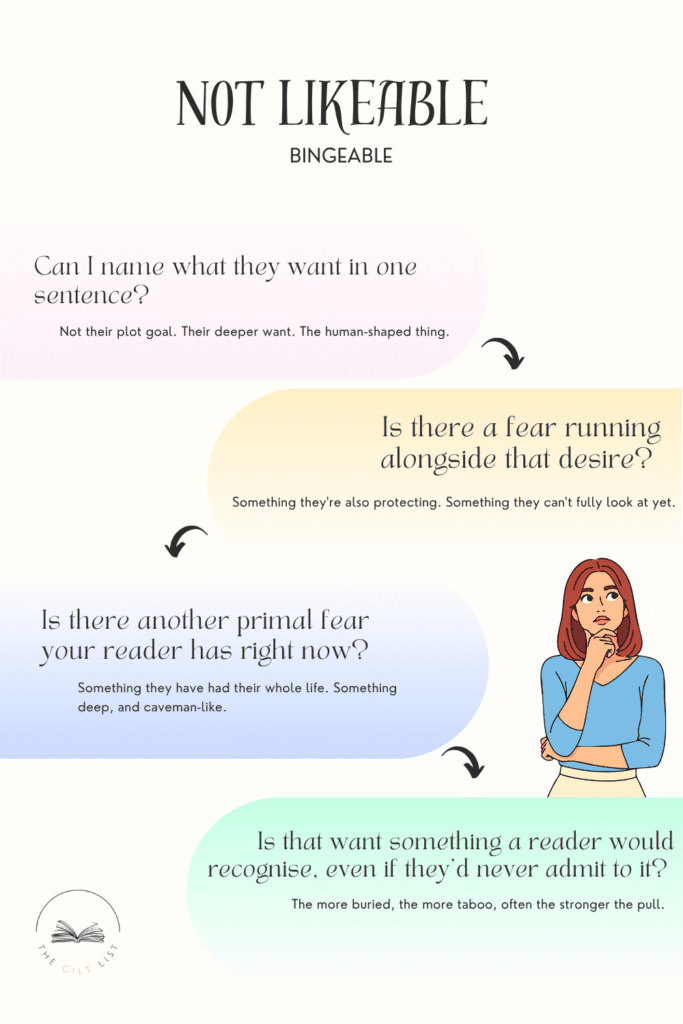
None of those things are fixed by making the character nicer.
In fact, making them nicer sometimes makes it actively worse because now you’ve taken the very quality that was almost interesting and replaced it with a character who is pleasant, functional, and entirely forgettable.
The feedback you need is not is this character likeable. The feedback you need is: what does this character want, and can I feel it in my body by page three?
Can I feel the ache of it? Has a part of me dreamed this too, even though it is so taboo?
Needing love as a goal isn’t enough to make addictive books. We must create a fantasy. Acting out in revenge. Doing whatever we want as if there is no tomorrow. Shutting down every room we walk into and owning it. A part of the desire of your character will be a childhood fear, more on that in my blog How to Create Character Desire in Fantasy the Right Way. But if you can also make that a little wrong to want, it will hit the reader right in the gut.
What Your MC Actually Needs Instead
To save you from the next workshop, here’s the actual checklist. Not are they nice, but:
- Can I name what they want in one sentence? Not their plot goal. Their deeper want. The human-shaped thing.
- Is there a fear running alongside that desire? Something they’re also protecting. Something they can’t fully look at yet.
- Is there another primal fear your reader has right now? Something they have had their whole life. Something deep, and caveman-like.
- Is that want something a reader would recognise, even if they’d never admit to it? The more buried, the more taboo, often the stronger the pull.
- Is there a gap? Between where they are and what they want. If there’s no gap, there’s no tension. If there’s no tension, the reader has no reason to keep going.
- Are they doing something for the reader? Acting out something the reader can’t. Living it for them, safely, on the page.
Want to Know if Your First Chapter Is Actually Doing This?
This is one of the first things I look at in a first chapter engagement audit — not whether your MC is likeable, but whether the reader can feel what they want by page three. Whether there’s a buried desire doing any work. Whether the gap is there.
If you’ve just had the quiet realisation that your protagonist might be very nice and not very magnetic, it’s a fixable craft problem. And it’s exactly the kind of thing an audit is built for.
And if you want to go deeper — the why behind all of this, the full engagement framework, the things no one tells you about first chapters — my mini guide on first chapter engagement is coming soon. It covers everything from cognitive load to character desire to the real reason readers DNF in the first twenty pages.
Join the list and you’ll be the first to know when it lands.
Already read the post on why readers DNF? That’s the other side of this argument. Worth a read if you’re deep in a first chapter revision at midnight.
Frequently Asked Questions: The “Likeability” Myth
No. While many writing workshops push for “likeability,” real reader attachment comes from competence and desire, not niceness. Readers don’t need to want to be friends with your character; they need to be able to track what that character wants and why they are willing to do anything to get it. A character who is “too nice” often lacks the tension required to keep a reader turning pages.
Readers often DNF (Do Not Finish) books with overly nice characters because there is no “Borrowed Body” experience. If a character always makes the polite, moral choice, the reader has nothing to “practice” or live out through them. High-engagement characters act as a vessel for the reader’s buried impulses—revenge, absolute competence, or sustaining fury—allowing for a transformative experience that a “pleasant” character cannot provide.
The Borrowed Body theory suggests that readers attach to characters who act out fantasies or impulses that polite society has trained the reader to suppress. Characters like Kaz Brekker or Amy Dunne are magnetic because they go “too far.” They allow the reader to safely experience being the most dangerous person in the room or refusing to be “edited down,” creating a visceral psychological connection.
To make a morally grey or unlikable character magnetic, you must establish a Buried Desire and a Buried Fear simultaneously. If the reader can feel the character’s “primal ache” by page three, they will follow that character anywhere. The key is transparency of intent: the reader must understand the “human-shaped want” driving the character’s monstrous or selfish actions.
The “NICER” check is a developmental audit to ensure your character is magnetic rather than just pleasant. It asks:
Name: Can you name their deeper want in one sentence?
Internal Fear: Is there a fear running alongside that desire?
Connection: Does it mirror a primal fear the reader has?
Expanse: Is there a clear gap between where they are and where they want to be?
Representation: Are they acting out a taboo fantasy for the reader?