
The problem isn’t your world. It’s where you put it.
The brain interprets ease as pleasure. If a reader has to “maths” out your world rules on page one, they register friction, not sophistication.
The brain is constantly asking: Is this worth the effort? Every new name or system is a “cost.” Readers only pay when they’re attached.
Use familiar settings (tropes/human fears) to lower the entry barrier. This keeps the brain in “receiving mode” for later worldbuilding.
You write something that feels genuinely epic at midnight. The magic system is elegant. The history is layered. The politics make sense. There is a whole civilisation in your head, breathing, real, and you have spent considerable time making it that way. You freaking rock.
But then you read it back in the cold light of day and think: huh. This should work. And yet…
The love you put into your world and craft just isn’t showing on the page for some reason. And the problem isn’t your prose, you can’t line edit your way out of it, promise. This is what you should really be doing.
Changing the order.
If the world itself is still the bit you are trying to untangle, use my free fantasy worldbuilding tool first. The World Bible Builder walks you through magic, geography, politics, factions, culture, history and the other systems underneath the book, then gives you a World Reveal Plan for deciding what actually belongs on the page.
To Show Good Worldbuilding Change The Order
Most worldbuilding advice circles around the same small set of tips that include weaving in tidbits to not overwhelm, using dialogue to show not tell, and creating a layered world by thinking of technology, clothing, food, and so forth that these people would eat as a result. Even light or urban fantasy needs those pieces, and my guess is you probably know this, and have tons to share. After all, you’re a creative, you’re a writer.
This advice is useful, but it’s useful in the way most craft advice is: it’s useful to you, the writer, to live in your world as you write it. It doesn’t help the reader.
The real problem with having your reader live that world isn’t how you’ve put the worldbuilding in. It’s when. And I’m not talking info dumping.
Step 1. Make Your Worldbuilding Easy
Fantasy gives you endless ways to annoy your reader; it’s one of those genres that authors slip into once they’ve proved themselves in other genres for a reason. It takes real work to be good, a true understanding of the basics, and epic hoarding of the more advanced advice.
Fantasy gives you endless ways screw it up.
Here’s the secret you probably haven’t heard. You know it, but you probably haven’t acknowledged it consciously. Your reader’s brain is not a blank page waiting to receive information. It is an active, somewhat lazy, deeply self-interested organ that is constantly making a single calculation: is this worth the effort?
Every sentence in your opening chapter gets run through that filter. And worldbuilding — no matter how beautifully written — costs more to process than almost anything else in fiction. New names. New systems. New rules. New geography. The brain has to hold all of it somewhere while also trying to understand what’s happening and why it should care.
Your reader has already spent most of their budget on real-world goods. This is why you often hear feedback in reviews of top writers that say the first book in the series was good, but it didn’t have much worldbuilding, and yet devour the entire series anyway. That’s not a sign of a bad writer; that’s the sign of a writer who cares more about a reader falling in love with a story than showing off their imaginative skills. A writer who knows what they’re doing and understands the cost.
Research on processing fluency — from Rolf Reber, Norbert Schwarz, and Piotr Winkielman — found that when something is harder for the brain to process, it doesn’t go ah, how sophisticated, how detailed, how rich. It registers friction instead. Something feels off. Something feels wrong.
Work is not something people do for fun on a Tuesday night after a long day. Just think about what your dream reader does every day, do you really think they want to sign up to study basically the equivalent of a new language?
So the reader puts the book down. With every intention of coming back to it, after all the writing and the author are brilliant. But they never come back. You gave them homework, not a story.
Step 2. Attachment First. Then the World Earns Its Space.
Here is the actual sequencing that works.
First, the reader needs a person. Someone they can track, someone whose wants they can feel, someone whose situation creates enough of a question mark that leaving feels uncomfortable, but enough trauma that feels like the reader’s own, that they’re scared that putting the book down will actively hurt them. More on that in my blog How to Create Character Desire in Fantasy The Right Way.
Once that attachment exists, hopefully by the end of the first chapter, the world stops being noise and starts being context; it starts to become something the reader needs to pay attention to if they want to say “I told you so,” when the character makes a choice they totally shouldn’t have made.
Now the magic system, politics, and magical teapots are interesting because it affects our inner fears and characters’ wants.
Step 3. What “Worldbuilding Before Attachment” Actually Looks Like
It doesn’t always look like an obvious info dump. Unfortunately, you can’t scan the pages and just look for the moment you went into a tangent about something. Or the character had a big sprawling inner monologue. You probably should look for that, just in case, in the start, that also needs to go. But writers who know what they’re doing usually know to look for that.
Not to scare you with monsters under the bed, but bad worldbuilding is often subtle enough that you read it back and genuinely cannot see the problem.
It looks like this: the chapter opens with a description of the city, bread sold on the streets, and smoke pluming in the air. Our character snatches bread from an Olean table, named after the great philosopher, but our character thinks this person was wrong. And then he’ll tell you why. Beautifully written. Three paragraphs of sensory beauty. We learn the district names, the approximate political geography, and the fact that the lower city smells like fish and politics. The prose is good.
Your reader is checked out, skimming details. They can’t enjoy it, and later, when you bring up Olean, they’ll be like, who?
It also looks like this: we meet the protagonist in the middle of a scene, but the first two pages are spent in her head explaining the factions, the war that ended thirty years ago, and why her particular village holds a certain complicated relationship with the crown. The explanation is necessary. The reader cannot follow the story without it. But it arrives before we know if we like her, want her, or care whether any of this affects her.
It also looks like this: the chapter opens on action, a sword fight! With blood, and bruises, and oh, a yelling crowd. On a dusty street, in a desert. The Vrethian Guard are pursuing the Sael’kori. The Binding has been broken. The reader doesn’t know what any of this means and spends the first page doing terminology maths instead of feeling anything.
In all three cases, the worldbuilding isn’t bad. The writing isn’t bad. The sequencing is the problem. It’s too info-dumpy for Chapter One.
The Attachment Test: What Has to Be True Before You Build the World
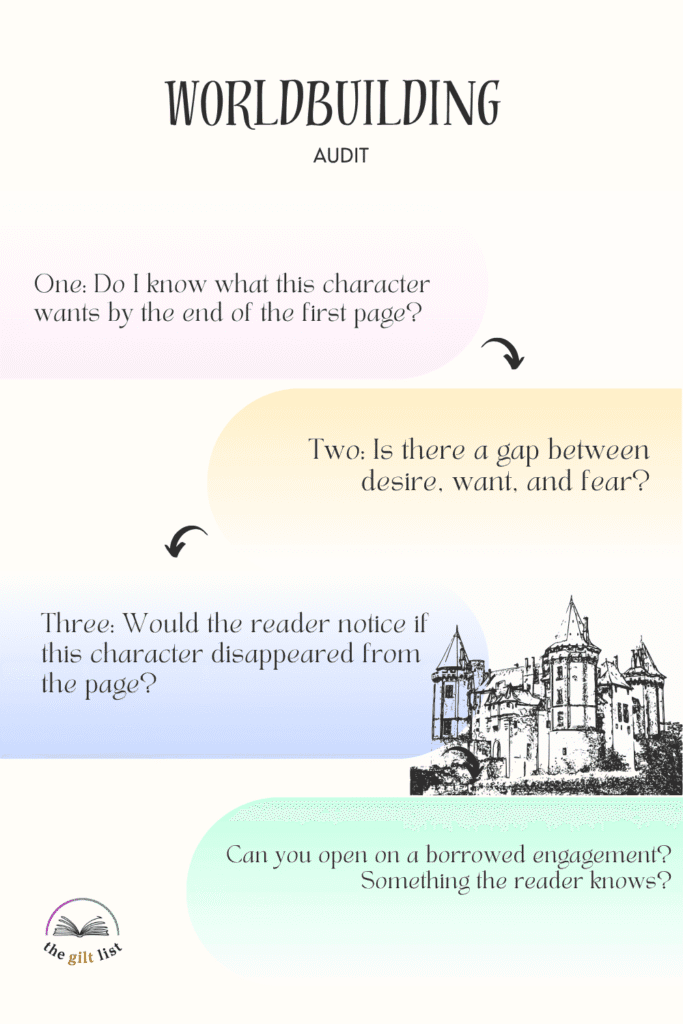
Before you drop worldbuilding into your first chapter, run this test. It is not complicated, promise. Would I do that to you?
One: Do I know what this character wants by the end of the first page?
Not their plot goal, they might not even know that yet. Their human want. The thing underneath the plot, the fear that is mirrored back in the reader. If the reader can feel it — even faintly — attachment has started. This character is like them, so of course they care.
Two: Is there a gap between desire, want, and fear?
Between where this character is and where they need to be. Between what they have and what they’re reaching for, and is that gap longer than 2 pages? Tension doesn’t require action, just the gap.
Three: Would the reader notice if this character disappeared from the page?
Harsh question. Useful one. If the answer is no — if the reader is more aware of the setting than the person inside it — the attachment isn’t there enough to give them any details their brain has to work for.
Open simple. Open on something I like to call “borrowed engagement”, open on settings the reader instantly recognizes enough they don’t have to do any extra work (they’re already engaged with those things every day, could even be tropes they’re used to reading). Add the attachment layer, with a human fear they’re also already engaged in. Then add some worldbuilding.
How Much Worldbuilding Is Too Much in Chapter One?
The honest answer is: it depends entirely on when attachment happens.
If your reader is already tracking a character they care about by page two, you can introduce more world than you think, especially if that world is pressing on the fear like a bruise. It doesn’t feel like an info dump because it’s kicking the dog when it’s down. The reader is hungry for more context now. They want to understand this world because they want to beat this fear, this world, just as much as the character does.
And your character doesn’t have to be likeable, even, more on that in this blog on likeability.
If your reader is not yet attached, even one paragraph of worldbuilding is too much, maybe even one sentence, one word. It doesn’t matter how beautifully it’s written. The brain isn’t in receiving mode yet; the reader will skim.
This is why the how much question is the wrong question. The right question is when.
Want to Know if Your Opening Has the Sequencing Right?
This is one of the first things I look at in a first chapter engagement audit. If you’ve just recognised your opening in one of those three examples above, that’s not a failure; I imagine you’re rather talented and brilliant. You must have a world that’s so alive under the current. This is one of those easy-to-fix issues when you have someone who knows what to look for. And it’s exactly what an audit is built to find and walk you through.
→ Get your first chapter engagement audit here
And if you want the full framework — cognitive load, character desire, attachment sequencing, the works — my mini guide on first chapter engagement is coming soon. Everything you need to stop your chapter working against itself, in one place.
If you’re deep in a first chapter rewrite and want to understand why readers are putting your book down before this, the post on why readers DNF fantasy novels is the place to start. It’s the other side of this argument.
Frequently Asked Questions
The problem is usually sequencing, not the world itself. According to research on processing fluency, the human brain registers “friction” when it is asked to process new names and rules before it has attached to a character. If you prioritize worldbuilding over character desire, the reader feels like they are doing “homework” rather than reading a story.
The amount of worldbuilding depends on when attachment happens. If a reader is viscerally tracking a character’s desire by page two, they will view worldbuilding as necessary “context” rather than “noise.” However, if attachment hasn’t happened yet, even a single sentence of worldbuilding can trigger a reader to DNF (Do Not Finish).
Borrowed Engagement is a technique where you open your story on settings or tropes the reader already recognizes (e.g., a dusty desert street or a crowded market). This reduces the cognitive load on the reader, allowing them to focus their “brain budget” on attaching to your character’s human wants and fears first.
Subtle info-dumping often looks like high-quality sensory prose or action scenes that use terms the reader doesn’t understand yet. If your reader has to do “terminology maths”—trying to figure out what a “Vrethian Guard” is while also trying to follow a sword fight—they will check out. Run the Attachment Test: if the reader doesn’t care about the person on the page yet, the worldbuilding is arriving too early.