
Most fantasy writers do not have a magic system problem. They have a timing problem. You know your system cold. The seven branches, the three forbidden subtypes, the historical reason blue fire got banned after the Sundering, and which noble house still does it in secret anyway.
But the part that sucks? The reader needs almost none of it on page one/chapter one. A magic system is only easy to understand the moment the reader sees what it costs, blocks, reveals, or breaks. So this post is about timing. When does a rule earn its place on the page? The short answer: the moment a character has to make a choice the reader cannot follow without it. I call it the Decision-Moment Rule, and once you spot it you will start seeing it in the books you already love.
For more writerly advice check out the writers hub or How to Start a Fantasy Novel.
How to Introduce a Magic System Without Stopping the Story: Takeaways
- Introduce magic through use, not explanation. Show someone do the thing before you tell us how the thing works.
- Attach every rule to a consequence.
- Skip the category lecture. T
- Delay terminology wherever you can. Show the metal-burning before you ever name it Allomancy, etc.
- Teach one clear rule before you start stacking exceptions on top of it.
- Let character choices carry the system. What a character refuses to do teaches the rules as fast as what they actually do.
- In chapter one, only the magic that touches the opening situation has to be on the page.
If the problem is happening one step earlier and you are still working out what your magic changes about the wider world, use the free Fantasy Worldbuilding Tool. The Magic Systems module takes you through rules, limits, costs, jobs, law and what magic changes about ordinary life, then ties those decisions into the rest of your World Bible. No AI writes the system for you; you make the calls.
What Does Your Magic Actually Change?
Magic is interesting when it does something to the scene in front of us. Otherwise it is just a detail about the world. So before you explain how a power works, ask what it changes in this exact moment. A few that pull their weight straight away:
- A character uses magic and someone who absolutely should not have seen it, sees it.
- A character refuses to use magic because the cost is more than they can pay right now.
- Magic reveals a secret the character was working hard to keep.
- Magic breaks a law.
- Magic fails at the precise second the character needs it most.
- Magic reacts to an emotion the character is trying not to feel.
These teach the reader something about how the system works while something is also happening, adding interest, and information.
Vin in Mistborn is the cleanest example I can point you to. Brandon Sanderson does not sit you down with a slideshow on Allomancy. Vin swallows metals and burns them mid-chase, on rooftops, while people are actively trying to kill her, and you pick up the rules because you desperately want to know whether she will make the jump. The explanation rides underneath the tension. You are never once pulled out of the scene. This is basically Sanderson’s First Law at work: the reader can only enjoy magic solving a problem if they understand the magic first, so he teaches it through use, exactly when it matters.
When Should You Explain How the Magic Works?
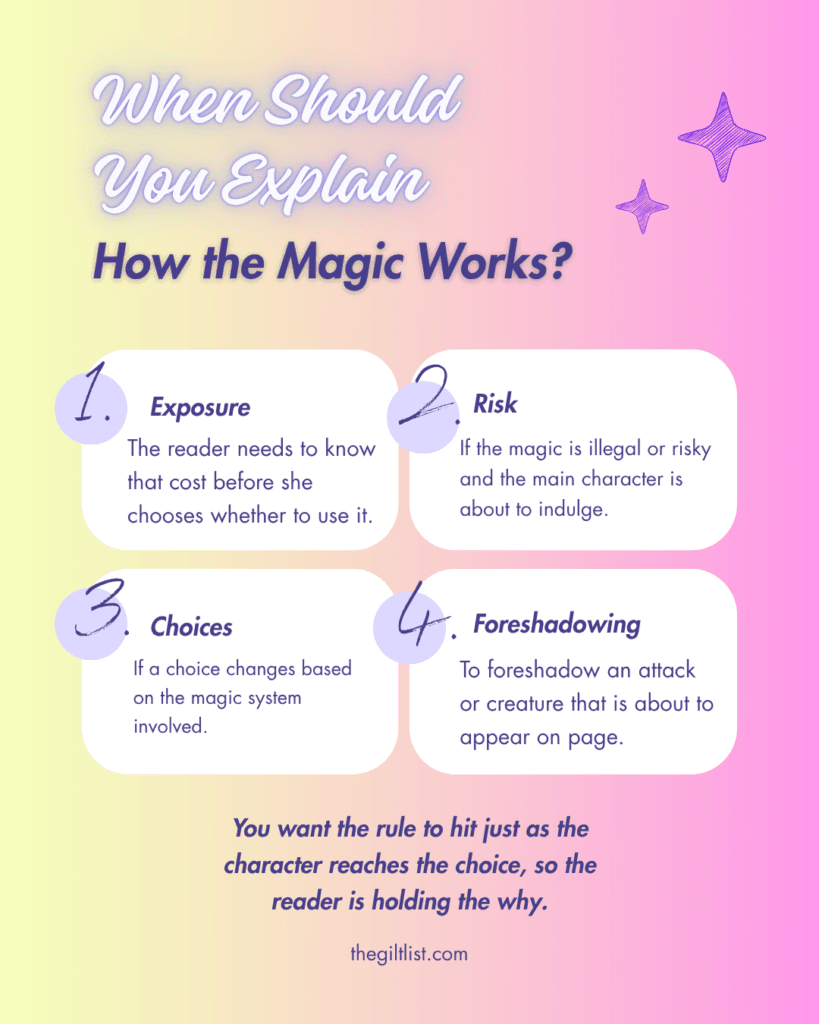
Explain a piece of your magic system at the moment it affects a decision. You want the rule to hit just as the character reaches the choice, so the reader is holding the why.
What it looks like in practice:
- If using magic will expose your protagonist as something forbidden, the reader needs to know that cost before she chooses whether to use it.
- If magic drains the user’s life, show or state that cost before the big risky cast.
- If a kind of magic is illegal, let that law sit on the scene while the character decides whether to break it. Now the rule creates pressure in the room.
- If the character has to make a choice as a consequence of a magic system that wouldn’t make sense without an explanation.
- If the character is about to be attacked by a certain kind of magic and you need to foreshadow the risk.
Do You Need the Whole System Up Front?
What tends to go wrong is the urge to be complete. Writers worry that if they do not explain the whole story behind the magic, the reader will feel lost. The opposite is usually true. The reader feels lost when you give them everything at once, because they have no idea which part matters. This looks like: you explain that fire magic only burns hot on the new moon, and right now it’s a full moon…so the reader is watching for the moment a problem is going to be solved or go wrong because of this magic rule…then it never comes…and still doesn’t come….but the main character does use ice powers. This leaves a reader feeling not only confused, but disappointed.
So in the early pages, leave out:
- Full category systems laid out before we have seen a single spell.
- A long history of how magic entered the world, delivered before we care about anyone in it.
- Glossary terms arriving before the thing they name has appeared.
- Exceptions introduced before the base rule they belong to.
- Characters lecturing each other about things they both already know, purely so the reader can listen in.
Should You Lead With the Power or the Cost?
Costs are almost always more interesting than abilities. “She can move objects with her mind” is a fact. “Every time she moves an object with her mind she loses an hour of memory, and she has been doing it a lot lately” is a story.
Costs that do double duty like this:
- Physical pain or injury that the character has to hide.
- Memory loss, which threatens everything they are trying to hold onto.
- Social danger, where using the power marks them in front of the wrong people.
- Religious shame, where the magic is real but the using of it damns them.
- Legal punishment that turns every cast into a gamble.
- A romantic consequence, where the power costs them the one person they want.
- Emotional exposure, where magic reveals what they feel before they are ready to feel it.
Pick the cost that hurts your specific character most, and let that be the first thing the reader understands about the system, this will stick in the readers mind the most.
How Many New Magic Terms Is Too Many?
Every invented word is a small loan you are asking the reader’s memory to take out. A few loans are fine. A dozen on the first page and the reader is doing memory work instead of reading. Worse? You will lose trust when that memory work doesn’t pay off. This is why theories inbetween book series are so popular. Reader’s scour these details, knowing they will pay off at some point, and try to put the puzzles together.
I wrote about the mechanics of this in why readers DNF fantasy novels, but the short version for terminology:
- Show the thing before you name it, wherever you can.
- Repeat the important terms.
- Do not introduce five magic terms in one page.
- Tie the word to a feeling. “The Brand” means very little on its own. “The Brand, the thing her brother died earning” means a bit more.
How Much Magic Belongs in Chapter One?
Chapter one only needs the magic that touches the opening situation.
If your protagonist is sneaking past a ward, you need the reader to understand that ward, what it does, and what happens if it catches her. You do not need the eight other types of ward. However, you can trust the reader to guess that there might be more wards, and once your character is past them, they’ll want to know more about it and feel satisfied when it pops up again later.
If you want a structured pass on magic systems in Chapter One, the Fantasy First Chapter Checklist walks through exactly what an opening needs to carry and what it can safely hold back, and the Fantasy First Chapter Guide goes deeper on the setup work underneath it.
Common Magic System Introduction Mistakes
The ones I see most often, in roughly the order they show up:
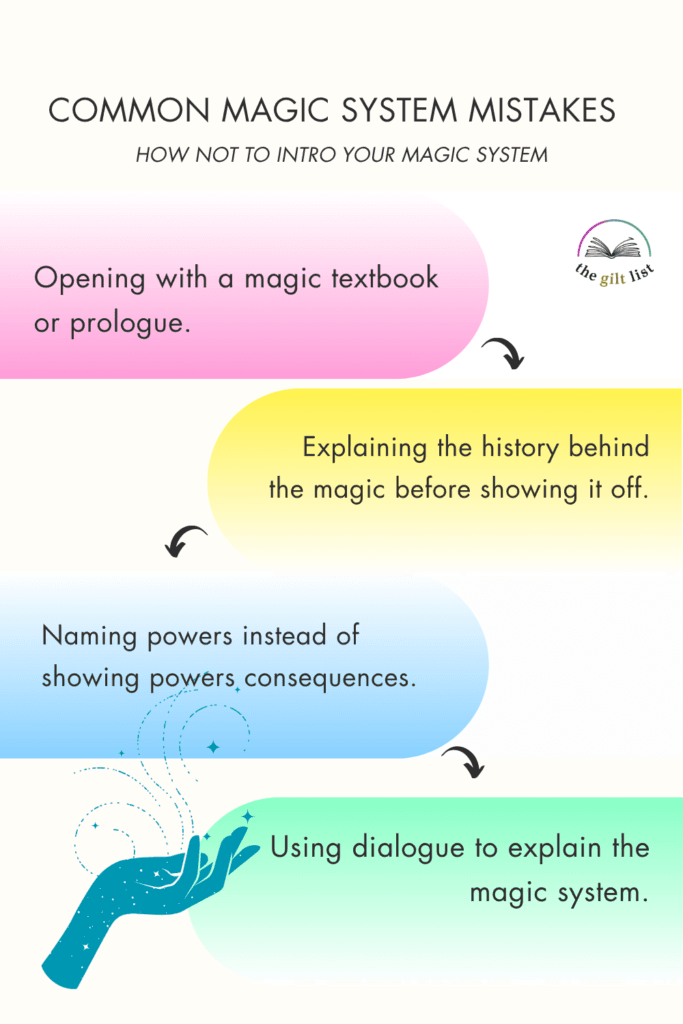
- Opening with a magic textbook. A chapter, or worse a prologue, that explains the system before anything happens. Save prologues for epic fantasy only.
- Explaining history before consequence. The reader gets the centuries of lore before they get a single moment where the magic does anything.
- Introducing categories too early. The four schools, the nine houses, the twelve disciplines, all named up front. Sometimes this can work in YA with a more simplistic voice, but for other subgenres it’s usually a no go.
- Naming powers before showing why they matter. A capitalized ability with no scene will lead to memory loss or betrayal.
- Using dialogue as obvious exposition. Two characters explaining the rules to each other for the reader’s benefit. “As you know, Seralt, the moonfire only burns at the solstice.” Seralt knows. Seralt is insulted and so are we.
- Explaining exceptions before the base rule. The reader cannot understand “except during an eclipse” until they understand what normally happens.
If two or three of these are in your opening, that is good news as they are some of the most fixable problems in fantasy, because the material is usually already there. It is just in the wrong order, or arriving too early.
A Quick Magic System Scene Test
Run this on any scene where you have stopped to explain how the magic works. Six questions:
- Does this rule affect the character’s choice in this scene?
- Does it affect the danger or the cost of what they are about to do?
- Does the reader actually need it right now, or am I explaining it because I find it interesting?
- Can part of this wait until later without confusing anyone?
- Is the terminology clear, or am I asking the reader to hold three new words at once?
- After the explanation, does the scene still move, or did it stall while I lectured?
Want Another Set of Eyes on Your Opening?
Your magic system is probably not too complicated. It is probably arriving too early, all at once, before the reader has a reason to want it. Teach it through use, tie it to a cost, and bring each rule in at the moment it changes a choice.
If this is the thing happening in your opening, start with the Fantasy First Chapter Checklist. And if you want another set of eyes on the actual pages, the first chapter critique is built for exactly this kind of problem, where the worldbuilding is good but the timing is fighting the story.
Frequently Asked Questions
Introduce it through use rather than explanation. Show a character doing something with the magic, attach a clear cost or consequence to it, and let the reader pick up the rules from the scene. You can deepen the system across the whole book. The opening only needs the part that matters to the opening.
Only the part of it that the first chapter actually leans on. If a rule affects a choice, a risk, or a cost in your opening scene, the reader needs it. Everything else can wait until the moment it becomes load-bearing, which is usually later than writers think.
Less than you want them to. A useful guideline is one clear rule, shown in action, before you add exceptions or extra categories. Readers can hold a small amount of new information at the start, so spend that budget on the rule that affects what happens next.
Tie every piece of explanation to a decision, a cost, or a consequence in the scene. If a paragraph of magic explanation is not feeding something the character is about to do, it is probably a dump.
Usually the reverse works better. Show the magic in action first so the reader has an image to attach the rule to, then name and explain it. The exception is when a rule changes the stakes of a choice. There, the reader needs the rule a beat before the character chooses.
Too many new terms at once, categories introduced before any single spell has been seen, exceptions explained before base rules, and explanation that arrives with no consequence attached. Confusion almost always comes from timing and quantity.
Yes, and it usually should. Soft magic keeps its workings vague to preserve wonder, but the reader still needs to sense its limits and costs so it cannot solve every problem for free. Even Gandalf has things he cannot do.