
Your first chapter makes promises whether you mean it to or not.
The reader cannot see your outline, your series plan, or the genius twist in chapter thirty. All they have is the opening, and from that opening, they build a set of expectations about the kind of book they are holding. How much romance. How dark. How fast. How much magic. Whether this is a cozy weekend read or a seven hundred page emotional demolition.
That set of expectations is your story promise. And I promise, you have a few floating in your first chapter (if you’ve written that far that is).
When the opening promises one book and the rest delivers another, readers feel cheated even if both books are good, because the one they signed up for is not the one they got. So let’s talk about what your opening is actually promising, where fantasy and romantasy complicate it, and how to check whether your first chapter is selling the right book.
If you want to see something similar in action in the dramasphere world of Booktok check out my piece on Innamorata.
What Is Story Promise in Writing: Takeaways
- Story promise is the expectation your opening creates about the kind of book this is.
- Openings promise genre, tone, pace, romance level, danger, and emotional payoff.
- A mismatch breaks reader trust, even when both books are good.
- Fantasy openings juggle several promises at once, which makes them easy to get wrong.
- Description and the character’s first want both make promises before any plot arrives.
- A first chapter critique can show you what your opening is actually promising.
What Does Story Promise Actually Mean?
Story promise is reader expectation, set early and mostly without words. By the end of your first chapter the reader has decided what kind of experience they are in for, and they will hold you to it.
This is more like the shape of the book…ie. genre, emotional theming, pace, the level of romance and danger, the kind of payoff that would satisfy you by the end. Readers read those signals fast and mostly unconsciously, then relax into the book or start to feel uneasy depending on whether the signals match what comes next. Keep the promise and you buy patience for slower stretches later. Break it and the reader starts to resist your book, or worse, DNF it. For more reasons on why readers DNF check out this guide.
What Does Your Opening Promise the Reader?
A first chapter is busy making promises about all of these at once:
- Genre and subgenre: epic, cozy, grimdark, romantasy?
- Tone: playful, earnest, bleak, warm.
- Pace: fast, or a slow build?
- World depth: light touch, or a dense system to study?
- Romance level: central love story, subplot, or none?
- Danger: how high can the stakes go, how dark will this get?
- Emotional experience: comfort, catharsis, dread, delight?
- Central conflict: what is the book about?
- Payoff: the kind of ending that satisfies this opening.
You do not have to address these on purpose because the opening addresses them anyway (and writers have a funny subconscious way about them, where they drop all sorts of clues without even realizing), the only real question is whether the promises match the book you want to write.
Ps. Another great thing about these little promises you don’t notice is they can often answer what a sequel should be about, or how to wrap up a loose storyline.
The Romantasy Promise Problem
Romantasy lives or dies on a specific promise, and it is the one writers most often get slightly wrong.
If the romance is central, the opening has to signal romantic energy early. These readers come for the relationship as much as the magic, and an opening with no romantic charge tells them this might not be their book, whatever chapter five holds.
If your book is fantasy first with a romantic subplot, that is valid, but the opening has to say so. An opening that reads as full romantasy and then delivers mostly politics will frustrate the exact readers it attracted. Decide which book you are writing, then make the opening tell the truth about it. I get into the mechanics of this in character desire is not enough in fantasy. But essentially, you need to show how love is missing in the main character’s life.
Common Story Promise Mismatches
The ones I see most, all of which read as a broken deal:
- A prologue promises epic, world-ending scale, then chapter one shrinks to a small domestic scene with no visible connection or wondering of the great wide world out there.
- The opening promises romance by narrowing in on a lonely character, and the book becomes mostly politics.
- The opening promises dark and dangerous, and the book settles into light banter in scene two.
- The opening promises court intrigue with a masked ball, and the book becomes a travel quest.
- The opening promises a magic school with a letter or journey, and the book becomes romance only without the classroom dynamics.
- The opening is an adventurer finding treasures, telling the history of them, and quickly jumps to a mystery that has nothing to do with the history told.
None of these are bad storytelling ideas, but they aren’t connecting the way they should. You should be closing the gap, subtly foreshadowing what is to come in every little detail.
How Description Makes a Promise
Readers read tone from objects long before they read it from plot, which is pretty cool really. Picture a long dining table of wood from the forbidden forest, a bowl of soup going cold, silver rings on careful fingers playing with a fourth spoon, a complaint about a magic law across the table, her gown laced too tight. Before anything happens, the reader has guessed the decade, the social world, the tone, probably the subgenre.
Everything you choose to describe is a signal: which details you linger on, how the voice feels about them. If your book is a brutal war story but your opening lingers over teacups and embroidery, the description has promised a gentler book than the one waiting in chapter four. Match the texture of your description to the texture of your story.
Advanced tip: If you want to go further, think about the rough time your story is set in. How can you tell the reader this period of history without stating it? What fabrics and objects would be in the room with us?
How a Character’s First Want Makes a Promise
A protagonist’s first visible want tells the reader what kind of journey to expect from the whole book.
- Wants freedom: an escape or liberation arc.
- Wants approval: a social or power story.
- Wants revenge: something darker.
- Wants safety: survival and emotional recovery.
- Wants a forbidden person: romance and temptation.
If the opening want points one direction and the book travels another, the reader feels the misdirection even if they cannot describe it to you during a beta read.
How Do You Check Your Story Promise?
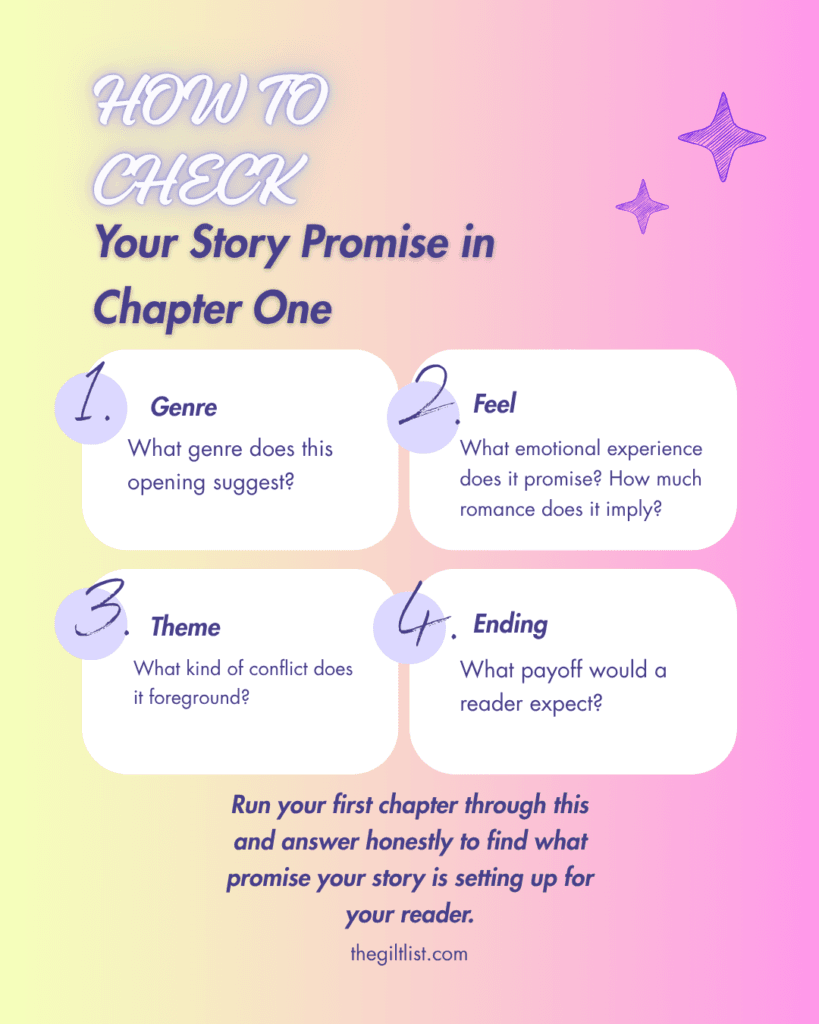
Run your first chapter through this and answer honestly:
- What genre does this opening suggest?
- What emotional experience does it promise?
- How much romance does it imply?
- What kind of conflict does it foreground?
- What payoff would a reader expect?
- Does the rest of the book deliver that?
When a First Chapter Critique Helps
It is hard to see your own story promise, because you already know what the book becomes, so you read your opening through the whole story. Your reader only has the page in front of them.
A first chapter critique is partly a read on exactly this: what your opening is promising, whether those promises match the book, and where a reader’s expectations are being set in a direction you did not intend.
Want to Know What Your Opening Is Promising?
Your first chapter is making a deal with the reader whether you meant to or not. It is telling them how much romance, how dark, how fast, and what kind of ending would feel right. The job is to make that deal match the book you wrote, so the reader who falls for your opening is the reader your book is for.
For a clear read on what your opening promises, the first chapter critique is built for it. To check it yourself first, the Fantasy First Chapter Checklist gives you a structured way to test the promise. If the promise is off across the whole book, developmental editing is the deeper version of this work. More craft breakdowns are in the writing guides hub.
Frequently Asked Questions
Story promise is the expectation your opening creates about the kind of book the reader is entering: genre, tone, pace, romance level, danger, and the type of payoff. Readers build it from the first chapter and hold the rest of the book to it.
Genre and subgenre, tone, pace, world depth, romance level, danger, the central conflict, and the kind of ending that would satisfy. It makes these promises through voice, description, and the character’s first want, usually without stating any of them.
Ask what genre, tone, and payoff your opening implies, then ask whether the rest of the book delivers that. If beta readers love your opening but feel let down later, it is probably promising a different book than the one you wrote.
The part of story promise that signals which genre and subgenre the reader is in. Romantasy readers expect romantic tension early, grimdark readers expect moral grit, cozy readers expect comfort. Breaking it is one of the fastest ways to lose the readers your opening attracted.
Fantasy openings juggle several promises at once: magic, politics, romance, lore, danger, tone. That makes them easy to get wrong, because the opening can flag a thread the book never develops or bury the one it is about.
It sets them. Readers relax into a book when the opening’s signals match what follows, which buys patience for slower stretches. When the signals mismatch, readers resist, because part of them is still waiting for the book the opening promised.
Yes, and it is one of the most common problems in otherwise strong manuscripts. A first chapter can be well written and still set the reader up for a different book than the one you deliver. The quality of the chapter does not fix the mismatch.