
Somewhere along the way writers were told that every chapter has to end on dramatics. Think… a gasp, a door bursting open, a knife at someone’s throat. So we get manuscripts where every chapter break is a fake emergency, and readers stop trusting any of them. Obviously.
A chapter ending has two jobs. It A) pays the reader for the chapter they just read, and B) it gives them a reason to start the next one. So, let’s take a look at how to do that.
For more guides like these check out the writers hub.
How to End a Chapter So Readers Keep Reading: Takeaways
- A chapter ending needs to pay off and continue, both at once.
- Not every ending needs a cliffhanger; unless you want the tension as high as possible, give yourself room to grow.
- End after something has changed.
- Decisions make strong endings, because they set the next chapter up before it starts.
- Emotional realizations work well, especially in romantasy.
- A chapter break cannot replace story advancement. It only marks it.
What Does a Chapter Ending Need to Do?
Give the reader something for the time they just spent, and open a reason to keep going. The payoff can be small: an answer, a decision, a moment of feeling. The continuation can be small too: a new question, a fresh conflict, a choice about to be made. Aim for satisfied enough to feel paid, unsatisfied enough to keep reading. Get both and the break works. Easy peasy.
Chapter Endings That Earn the Next Page
Seven that cover most of what you need, none of them a fake emergency.
The Answer Plus New Question Ending
The chapter resolves one thing and opens another. They find the letter, and the letter proves someone inside the court has been lying, but why did they betray the knight? The reader gets the answer and immediately needs to know what it means. This is the workhorse, and you can use it more than any other without the reader noticing.
The Decision Ending
The character chooses something that changes the next chapter before it even starts. She decides to take the bargain and give it all she has. He agrees to ride for the capital or die trying. The choice itself is the hook. Strong for fantasy quests, political turns, and the moment a romance crosses a line.
The Cost Ending
She wins the trial, and now she owes the prince a favor he will absolutely collect. She finds the hidden treasure but breaks the cursed vial, and now she will be cursed until the full moon. The reader feels the win and the dread at once.
The Emotional Shift Ending
Something changes between two people, and that change is the ending. Trust is a big one. Attraction gets harder to deny, and they almost kiss, but don’t. A lie starts to hurt more than it did, they thought they could live with it, but simply can’t. Romantasy runs on these, because the relationship is the story.
The Reframe Ending
The last beat changes how the reader understands everything they just read. It does not have to be a twist, it’s usually an internal thought that reframes what happened. Think… a single line that recasts the scene, or a detail that they realize means something different now. The reader re-reads the chapter in their head on the way to the next one.
The Conflict Increases Ending
The walls move in. A deadline is set. A secret brings one person closer to being found out. A choice narrows from three options to two. The stakes rose because of something that happens in the scene, and the final line notes it.
The Promise Fulfilled Ending
Sometimes a chapter earns the right to end on the payoff itself. The first display of power. The almost-kiss. The betrayal finally out in the open. The aftermath carries its own little tempting beckoning finger because the reader wants to see what the world looks like now that it has happened.
The Door Opens Ending
Our character moves into a new world. They walk into the castle, or find themselves entering a whimsical market. You have to actually make the door matter for this to work.
The No Going Back Ending
They say the forbidden name aloud. They use the magic in public. They kiss the person they are supposed to betray. They kill someone, spare someone, expose someone, marry someone, bind themselves to something, or tell the truth when silence would have kept them safe. The reader keeps going because the old version of the story is gone and they’re curious what will happen now.
It’s a Trap Ending
The council meeting was never a negotiation. The love interest did not arrive by accident. The safe house was watched. It’s a new piece of information within the scene itself, that can end it mid-way and open a new chapter with new MRUs (reaction vs reaction).
Most strong chapter endings are just combinations of these. A cost ending can also reframe the chapter. A relationship shift can also increase conflict. A decision can create a new question.
What Goes Wrong at Chapter Endings?
- A fake shock at every break, until the reader stops believing any of them.
- Cutting away before the emotional consequence, so the reader feels robbed.
- Ending on a vague mood instead of a change, so nothing resolves.
- Running past the natural end of the scene, so the chapter deflates after its real ending.
- Using the chapter break to make it look like the story is bigger than it is.
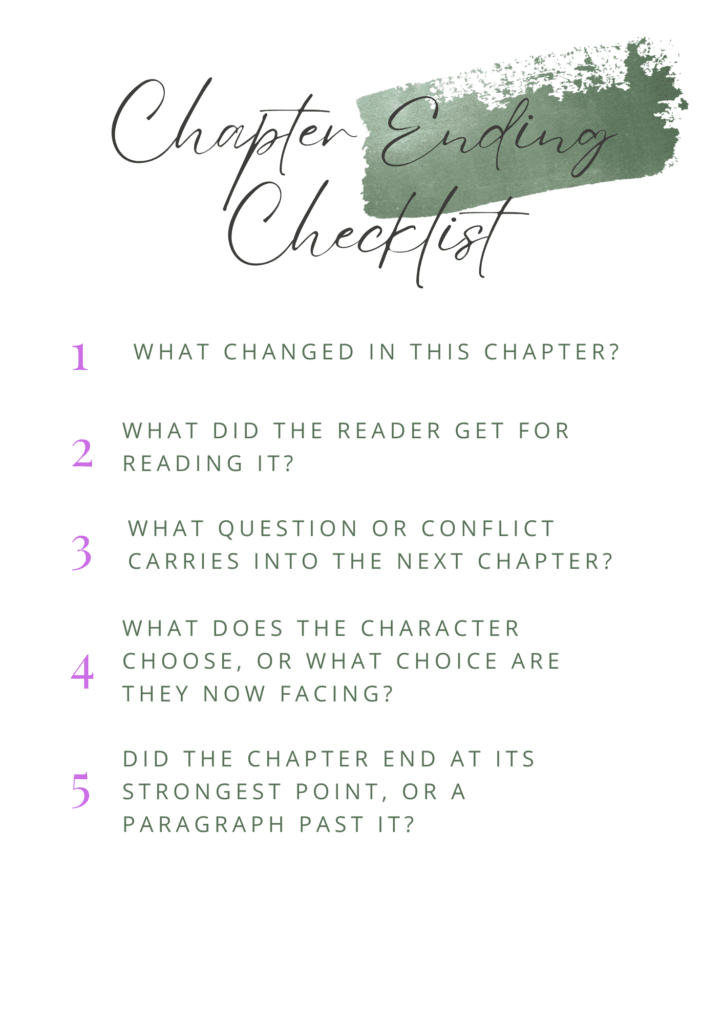
Chapter Ending Checklist
Run the last page of any chapter through this:
- What changed in this chapter?
- What did the reader get for reading it?
- What question or conflict carries into the next chapter?
- What does the character choose, or what choice are they now facing?
- Did the chapter end at its strongest point, or a paragraph past it?
Usually the fix is to cut to the strongest beat, or add the small turn that gives the reader something to chase.
Want to Know If Your Openings Earn the Next Page?
Chapter endings are not about gasps. Pay off the chapter, then point at what is coming, and let the kind of ending suit the scene rather than forcing a cliffhanger onto a calm moment.
If your early chapters are where readers drift, start with the Fantasy First Chapter Checklist. If you want another reader to tell you whether your opening chapters earn the turn of the page, the first chapter critique is built to find exactly that. For pacing problems past the opening, developmental editing covers the full draft. More craft breakdowns are in the writing guides hub.
Frequently Asked Questions
End it after something has changed, on a beat that rewards the reader and opens a reason to keep going. That can be an answer plus a new question, a decision, a cost, an emotional shift, or a rise in pressure.
No, and a manuscript full of them backfires. When every chapter ends on a fake emergency, readers stop trusting the breaks. A decision, a cost, or an emotional shift pulls readers forward just as well, often better.
A reason to need the next thing: an open question, a choice about to play out, a pressure that just rose, or a relationship that just moved.
Use an emotional shift, a decision, or a small rise in pressure. A calm chapter can end on trust cracking, a choice being made, or a deadline being set. None of those need action.
Yes, and in romantasy it often should. A shift in trust, attraction, or loyalty is a strong ending because the relationship is the engine of the book.
A fake shock with nothing behind it, an ending that cuts away before the payoff, a vague mood with no change, or a scene that runs past its natural end.
Find the strongest beat in the final pages, then see how much comes after it. If the chapter keeps going past the moment that resolves or turns the scene, it ends too late. Cut to the strong beat.