
Choosing the right editor for fiction means matching the type of editing you need to the stage your manuscript is actually at. A developmental editor cannot save a manuscript that hasn’t met the paper at all. A copy editor/line editor cannot fix structural issues. A proofreader cannot fix a magic system. And no editor, no matter how good, can substitute for understanding what your book actually needs before you hire one.
That’s the short answer. But if you’re here, you probably need the longer one.
If you’re looking for more writing guides for fantasy authors, check out my writing hub.
What Do Fiction Editors Actually Do?
Editing is not one job. It’s at least four different jobs, and confusing them is how writers waste hundreds of pounds/dollars on the wrong service at the wrong time. And that sort of mistake compounds. If you get a proofreader and go back and rewrite their work? Now you’re paying for them again. Ouch.
Here’s the breakdown:
| Edit Type | What It Does | When You Need It |
| Developmental editing | Big picture — structure, pacing, character arcs, plot holes | After your first or second draft |
| Structural/line editing | Scene-by-scene, sentence-level flow and clarity | After developmental work is done |
| Copy editing | Grammar, consistency, house style, continuity | Near-final draft only |
| Proofreading | Typos, formatting, final errors | After copy edit, before publishing |
A lot of writers — especially first-time novelists — go straight to a proofreader because it’s the cheapest option. And then they wonder why an agent won’t pick up their book, or they struggle to keep long-time readers. The proofreader caught the typos. Nobody caught the fact that Act 2 drowned in the messy middle, and Act 1 made a promise that genuinely upset the reader once they hit Act 3. And the characters all did the wrong thing at the wrong time. All of that is a structure issue first.
How Do You Find a Fiction Editor for Your Book?
Honestly, most advice on this is a bit useless. “Post in a writing group!” “Ask around!” Right. And then what — you get seventeen responses from people charging £50 for a full manuscript edit and you have no idea who any of them are. Very helpful.
Finding a fiction editor isn’t really about finding a list. It’s about finding the right reader for your specific book. It’s super, super important that your editor loves your work as much as you do, and no database is going to let you search by that criterion. A technically good editor who doesn’t understand what you are trying to do, or who your potential reader is, won’t help you very much.
So before you start searching, get clear on two things: your genre, and your goals. Are you querying traditional publishing, or going indie? Do you need someone who understands romantasy reader expectations, or dark fantasy, or upmarket women’s fiction? Who is your audience? What do you intend them to walk away with at the end of your work?
Once you know what you’re looking for in terms of editor fit, the most reliable route is word of mouth inside your genre community. Author acknowledgements pages are genuinely underrated; writers thank their editors by name, usually. If you really liked a book, you can track that name to the source.
Another underrated way is if you resonate with the editor’s online portfolio. Do you love the way they talk about books? About your genre? Do they specifically work with exactly what you do? Can you actually see yourself being friends? This is a person who will be talking you through your work, and if you get a bad vibe and don’t like them, you won’t take their edits seriously.
Beyond that, genre-specific Discord communities, author Facebook groups, and BookTok writer spaces often have recommendation threads from authors who’ve actually used someone.
Also, please note that a lower price is not a safer bet when you’re uncertain. A professional fiction editor working on an 80,000-word manuscript needs time — real time — to do that properly. That is probably a month or so. If you wouldn’t work on it for a month, for that price, if it were someone else’s work, then you need to question why they are charging so low. Sometimes it might be specials, filling up slots, discounts for certain genres they like, and so forth. But if they’re asking for 500$ for an entire manuscript, run.
What Should You Look for in a Fiction Editor?
Genre fluency is non-negotiable. A brilliant literary fiction editor is probably the wrong person for your dark romantasy with monster romance subplots. They might technically be a good editor, but they don’t understand what readers in your genre are expecting, and what breaks the implicit contract with them.
Beyond genre, you want:
- A sample edit or editorial letter. Most professional fiction editors will offer a paid sample edit on the first few pages or chapters. If someone won’t do this, that tells you something.
- Clear communication about turnaround and process. Editing is a relationship. You need someone who communicates clearly before you’ve even paid them, because that doesn’t get better after.
- Compatibility with your goals. Are you querying traditional publishing, or self-publishing? A developmental editor with a trad background will give you different advice than one who works primarily with indie authors. Neither is wrong — but they’re not interchangeable.
- Clear deliverables. Are they offering an editorial letter and in-line edits? Or just vibes on how it feels to read the book? Do you want an exact step-by-step fix, or for them to hone in on a specific issue?
- Social proof. Do they have any proof that they know what they are talking about? Have they edited books before? Manifestos on their editing process? Breakdowns you can actually look at as samples? I have a fun Hunger Games breakdown as a good example.
What’s the Difference Between a Fiction Editor and a Writing Coach?
A fiction editor is typically engaged on a completed (or near-completed) draft. They read what exists and respond to it. A writing coach works with you during the drafting process, helping you think through structure, accountability, craft development, and sometimes the psychological part of actually finishing a manuscript.
If you haven’t finished your book yet, a writing coach or critique partner might serve you better than an editor. An editor cannot do their best work on a half-finished draft, and most professional ones won’t take it on at that stage anyway.
Should You Get a First Chapter Edit Before You Pay for a Full Manuscript Edit?
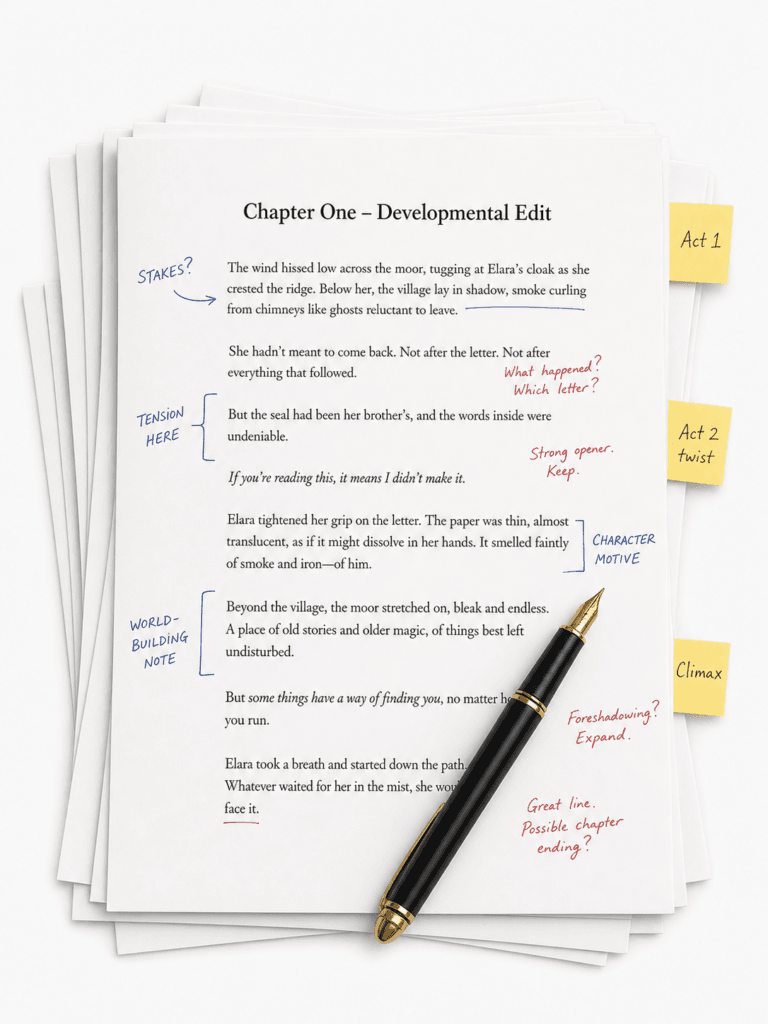
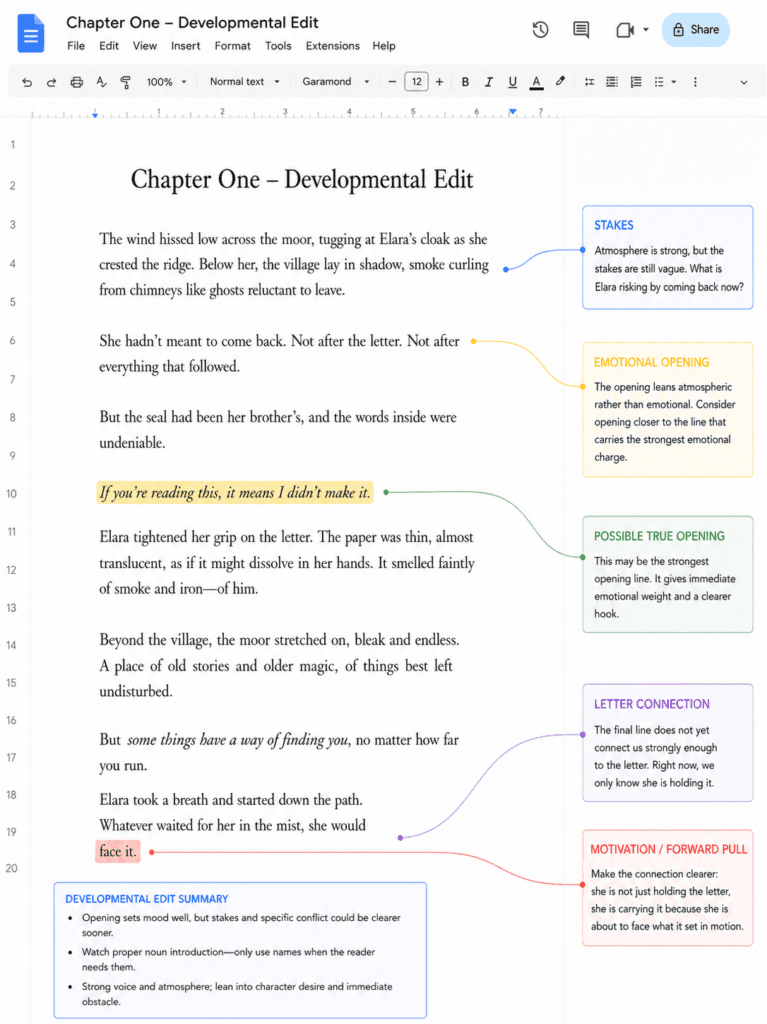
Your first chapter is load-bearing in a way the rest of your book isn’t; it has to hook a reader, establish voice, set up stakes, and signal genre, all at the same time. If it’s not working, the rest of the manuscript is working much harder than it should be, and there’s no point in querying or publishing it. If you’re querying agents, your first chapter (sometimes your first page) is all they’re going to read before they decide if your book is worth it.
If you do nothing else, get this kind of edit.
Getting your first chapter assessed before you invest in a full developmental edit is not just smart economically; it tells you whether you have a structural problem from the very beginning. I offer a First Chapter Audit service here at The Gilt List specifically for this reason.
I’ve also built an Act 1 analysis tool for writers who want to stress-test their opening act before it reaches any editorial eyes. But if you’re interested in a more in-depth developmental edit I offer that too. For those worried about budget, I have an alternative critique editing service that may help you.
Do I need a Whole Draft Finished Before Getting an Editor?
This depends on the editor personally. I don’t mind looking at work where someone got mostly to the end, and wrote a rushed, unfinished Act 3 because they weren’t sure, or they got lost or confused. I don’t mind some of the messy middle missing because you just couldn’t figure out how to branch it together. A developmental editor should be able to see what strings tie together. But not every editor works that way, and that’s completely valid. Some do their best work with a complete draft. Some are brilliant at characterisation problems but less interested in structural chaos. Some don’t mind if the dialogue’s still rough.
The only way to know is to ask. You would be surprised how many editors are quietly delighted by a specific kind of challenge.
One of the best things I took from an advanced editing class I did was this: not every writer is ready for every level of feedback, and it’s the editor’s job to figure out what will actually make them better right now, not just what’s technically wrong, but what this writer needs next in their craft development. The feedback that helps a debut novelist finish a readable first book is not the same feedback you’d give someone three books deep who’s ready to level up their prose.
Silly illustration, but: if Jane Austen had worked with a developmental editor — she didn’t, because back then communities just communitied — you wouldn’t give her the same notes as someone writing their first Kindle Unlimited novella. Different stages, different needs, different goals. An editor worth hiring understands that process, and is ready to work with you.
Fiction Editing Checklist: What to Check Before You Hire Anyone
Before you approach a fiction editor, run through this yourself:
- Have you finished a complete draft or at least, know where you want to go, and it’s mostly put together? It’s ok to be stuck in the messy middle and need a way out.
- Have you done at least one self-revision pass?
- Do you know what type of editing you need, and why?
- Have you identified editors who work in your genre specifically?
- Do you have a realistic budget, and do you know the going rates?
- Have you read the editor’s sample work, testimonials, or client list?
- Have you requested a sample edit or editorial letter before committing?
- Do you know what your publishing goals are — trad, hybrid, indie?
If you can’t answer most of those, you’re not ready to hire yet — and that’s fine. Rushing into an editing contract before your manuscript or your goals are clear is how you end up paying twice.
Working With Me Directly
I am selective. That’s not a marketing line, it’s just true. I only take on manuscripts I genuinely think I can serve well, in a very specific genre, fantasy (like YA, dystopian, romantasy, usually with a twist). This means there are books I’ll say no to. Like, I wouldn’t edit a Jane Austen novel, sorry Jane.
Not because they’re bad, but because I’m not the right person. I know what I’m good at. I once edited a novel in science fiction fantasy that I adored, when usually I’m not a fan of major sci-fi. I loved it because I thought “if we can make these characters shine, and move the story, this could be killer.” Every review for that book raved about the characters. If I can see something like that in the work, and the writer agrees that’s also their aim, I’m excited and want to work on it.
If you think we might be a good fit — particularly if you’re writing in fantasy, YA, romantasy, fantasy romance, or dark fiction — you’re welcome to reach out at melissa@thegiltlist.com. Tell me about your manuscript, where you are in the process, and what you’re hoping to get from editorial feedback. I’ll be honest with you about whether I think I can help. And I will be very excited to hear from you.
FAQ
Start with genre. Search Reedsy filtered by your genre, ask in author communities where writers share direct recommendations, and check acknowledgements pages in books that felt well-edited to you. A referral from an author in your genre is worth more than any directory listing.
Fiction editing is a four-figure line item, not a £200 “nice to have,” if you’re working with someone experienced. For a standard 80,000-word novel, most professional developmental editors now sit somewhere in the ballpark of low four figures — often between roughly £1,800 and £4,000+ depending on genre complexity, how broken the draft is, and whether you’re getting one pass or a more intensive package.
I took a break from developmental editing for a while to work on marketing endeavors. I really want to offer this to writers one day. So I’m currently offering steep discounts just to start working with authors again.
A developmental editor works on big-picture problems — structure, pacing, character arcs, plot logic. A copy editor works on sentence-level issues — grammar, consistency, style. They are not interchangeable. Most manuscripts need both, in that order.
Usually yes — check the acknowledgements section. Authors almost always thank their editor by name. If a book has a strong, distinctive editorial feel, this is genuinely useful research before hiring someone.
Not necessarily a professional one, but your manuscript should be in as strong a shape as possible. Many debut authors query with only critique partner feedback. That said, a developmental edit or first chapter audit before querying can sharpen your opening significantly — which is what agents are reading first.
At a minimum: chapter-by-chapter pacing review, character arc consistency, plot hole identification, POV stability, opening chapter strength, dialogue authenticity, and stakes clarity. For genre fiction specifically, genre convention awareness matters too — a romantasy without a satisfying romantic arc is going to have a reader problem regardless of how clean the prose is.
No — the First Chapter Audit is focused specifically on your opening chapter: what it’s doing, what it’s not doing, and whether it’s doing its job for your genre and audience. It’s not a substitute for a full developmental edit on a complete manuscript, but it’s a very useful starting point, especially if you’re mid-draft or preparing to query.