
Writing the first chapter of a novel is a tiny bit brutal. It has to sell the book, set up the story, and somehow not read like a prologue you regret later. It’s the gateway to your story, and it alone decides whether readers stay or wander off to something else.
A strong opening can captivate readers and pull them straight into your world. It establishes tone, mood, and genre in a handful of pages, giving readers an honest taste of what’s coming next instead of bait-and-switching them three chapters in. That first chapter also introduces your protagonist, hints at their goals, and brushes up against the conflicts they’ll spend the rest of the book untangling. It sets the scene, offers just enough background and world-building to orient us, and then gets out of its own way. At least it does all of that, in theory.
Through all of this, you’re aiming to create intrigue and raise questions, that means balancing action, exposition, and dialogue so the chapter feels like a story….not a thesis.
Luckily (or not so) there are common pitfalls that can sink an opening before it’s even really begun. Avoiding those and deliberately building in the right elements, gives your first chapter a genuine chance to leave a lasting impression and do what it’s supposed to do. This guide is here to help you get that opening working as hard as the rest of your book.
If you’re looking for more guides on fantasy writing techniques, check out the writers’ hub. Otherwise, you can contact me to start working together.
Why the First Chapter Matters
The first chapter holds all the power. It’s the bit readers, agents, and publishers all quietly judge you on, long before they meet your shocking twist in chapter twenty-two. So a clever opening can hook your audience and make them weirdly loyal, fast. If it’s perfect, they may even order the next book in the series right then and there or even convince them to overlook some flaws. The Shadows Between Us was one of those for me.
A well-crafted beginning also sets expectations. It introduces key elements—like, characters, tone, genre signals—and tells the reader what kind of experience they’ve just signed up for.
The first chapter often has to:
- Introduce the main theme and conflict.
- Establish the protagonist’s world and desires.
- Set the mood and tone from the outset.
And it’s very true that many literary agents and publishers will decide whether to keep reading based solely on your opening. So, if you’re better at characterisation, or plot twists, or theme, it’s a little unfair, but it’s the nature of the beast.
Crafting a Powerful Opening Line
An opening line doesn’t have to be “the best sentence you’ve ever written in your life,” but it does need to do make the reader curious, and capture the theme. Some clever writers even give away the series twists in their first line. Hunger Games is a fantastic example of this; see the guide for more.
A gripping opener can captivate immediately, or it can bore someone to tears. But it sets the stage for the story, whether you intend it or not. You can craft that line to evoke curiosity, unease, amusement, or straight-up drama but the point is that it nudges the reader to keep going because there’s clearly a larger story unfolding.
Techniques that often work well:
- Use vivid imagery to drop the reader straight into a moment.
- Pose an intriguing question or present an unexpected fact.
- Start with a strong, memorable statement that feels like only this character could think or say it.
- States the story twist before the story begins.
- Drops a confusing world-building element.
- Starts conflict immediately.
Establishing Tone, Mood, and Genre
Readers are unconsciously scanning for tone, mood, and genre signals from the first paragraph. You want to establish those early so the right audience finds you. Is this dark and tense? Cozy and character-focused? Fast-paced and snarky? The atmosphere you set here will colour everything that follows.
Descriptive language is one of your best tools. The same scene can feel melancholic, whimsical, or ominous depending on the details you pick and the words you use. Dialogue helps here too; how people speak tells us a lot about the world they live in.
Useful pointers:
- Use descriptive imagery or metaphors that match your overall tone.
- Let dialogue carry some of the mood, whether it’s sharp, funny, formal, or understated.
- Keep the tone consistent throughout the chapter, even if the emotions shift.
Introducing Your Protagonist and Their Goal
The first chapter is your readers’ first date with the protagonist. They don’t need the entire life story, but they do need a reason to want to spend a few hundred pages with this person. Make their presence deliberate and memorable. A single well-chosen action, line of dialogue, or internal reaction can do a lot more work than three paragraphs of description.
You also want to reveal your protagonist’s primary goal or point of friction early on. It doesn’t have to be the final-book-boss objective yet, but it should give readers a clear sense of what’s driving them right now.
When you’re introducing them, consider:
- What makes this character distinct from every other protagonist in their genre lane?
- What is their immediate objective or conflict in this chapter?
- How does their presence change the space they’re in or the people around them?
A balanced introduction gives us traits, motivations, and at least one challenge to latch onto. Plant a clear goal, even if it evolves later, and make sure it threads into your broader narrative rather than feeling bolted on. For a more comprehensive in-depth guide on how to create character desire, check this out.
Setting the Scene: World-Building and Background
Setting is part of the story. In your first chapter, you’re giving readers the coordinates for where and when this is all happening, and why it matters. In some WIPs the setting can be tracked as a character of its own.
Your world should feel vivid and lived-in, even if we’re only seeing a corner of it. Instead of unloading your entire lore bible, focus on a few sensory details that make the place feel real. Use sights, sounds, smells, textures, and temperature to ground the reader:
- Location: Where does the story actually take place in this opening?
- Time period: When are we, and how can the reader tell without you shouting the date?
- Culture and society: What norms, customs, or unspoken rules are already shaping your characters’ choices?
Background information is important, but it works best when woven into action and interaction. Info-dumps in chapter one are where a lot of otherwise promising manuscripts lose readers. For an in-depth, higher-level guide on worldbuilding without info dumping, I’ve got you here.
Creating Intrigue and Raising Questions
If readers know everything by the end of chapter one, why would they keep going? Intrigue is what keeps them turning pages at midnight when they definitely meant to stop. You want to begin with something that doesn’t fully add up yet, think an event, a line, a reaction that suggests a deeper story. Not in a confusing, “I have no idea what’s happening” way, but in a “I need to know why that happened” way.
You can:
- Introduce an unexplained event that clearly has consequences.
- Reveal a secret, but not its full context.
- Show a character behaving in a way that doesn’t match what we’ve been told about them.
The trick is to hint at a larger web without tangling the reader in it immediately. If you plant the right questions, they’ll happily follow you into chapter two to chase the answers.
Balancing Action, Exposition, and Dialogue
A strong first chapter usually has all three: something happens, something is explained, and people actually speak to each other. The art is in the ratio.
Action moves the story forward and shows us what your characters do under pressure. Exposition gives us enough context that we’re not lost. Dialogue reveals relationships, attitude, and conflict.
To keep things balanced:
- Fold action into your narrative arcs so it changes something, not just “stuff happening.”
- Use exposition sparingly and strategically—answer the questions the reader actually has right now, not all the questions they might have later.
- Let dialogue pull double duty: reveal character and move the plot, rather than just existing as witty banter or pure information.
Building Tension and Stakes Early
Your first chapter doesn’t need to blow up the world, but it does need to make us feel that something is at risk. Tension is what makes a reader care. It can be as big as a looming disaster or as intimate as an awkward conversation your protagonist desperately doesn’t want to have. Stakes are what they stand to lose or gain.
Helpful strategies:
- Introduce time constraints or deadlines, even small ones.
- Unveil secrets that have the potential to hurt or reshape relationships.
- Present challenges that feel genuinely difficult for this specific character.
You don’t want the tension to feel forced or melodramatic for the sake of it. Instead, let it grow naturally out of your character’s goals and the situation they’re in. When the stakes are clear, readers will care what happens next and they will keep turning the page.
Introducing Conflict and Antagonistic Forces
Stories run on conflict. If everything in your protagonist’s life is fine in chapter one, there’s not much reason to keep reading. You don’t have to fully unveil your Big Bad yet, but the shape of your opposition should start to appear, and probably thematically link. That might be a person, a system, an internal struggle, or all three if you’re feeling ambitious.
You can:
- Present a dilemma where your protagonist can’t have everything they want.
- Introduce an antagonist or opposing force, even in a small way.
- Show internal conflict through clashing desires, fears, or values.
These early conflicts give readers something to root for and against. Balancing internal and external tension from the start makes your character feel more layered and your story more grounded.
Making Your Setting Vivid and Immersive
A vivid setting turns reading into a sensory experience.
Specificity is your friend:
- Visuals: Colours, shapes, movement, what they actually see.
- Sounds: Background noise, conversations, machines, weather.
- Smells: Food, smoke, damp stone, perfume, these are powerful shortcuts to emotion.
- Textures: Rough stone, slick pavement, scratchy uniforms.
- Temperature: The prickling heat, the bone-deep chill, the heavy, humid air.
You don’t need to use all five senses in every paragraph, but sprinkling them in gives your setting weight. The goal is for readers to feel like they’ve stepped into a real place, even if it only exists in your head.
Avoiding Common First Chapter Pitfalls
There are a few classic ways to accidentally flush your first chapter down the drain. The good news: once you know them, they’re easier to spot in your own work.
Watch out for:
- Info-dumping: Giving us the entire history of the kingdom, war, family, or magic system before anyone actually does anything.
- Clichés: Opening scenes we’ve all seen a thousand times, like waking from a dream, staring into a mirror, “it was all a normal day until…”
- Weak hooks: A first line or first page that could belong to any book in your genre.
- Overloaded introductions: Dumping the whole cast in at once so we remember no one.
The First Chapter Checklist to End All Checklists
The first chapter can absolutely make or break how readers feel about your book. A checklist is not about turning creativity into homework; it’s about making sure you haven’t accidentally skipped something crucial.
As you draft or revise, ask yourself whether you have:
- Crafted a compelling opening line.
- Established tone, mood, and genre early.
- Introduced your protagonist and their main goal.
- Set the scene with vivid, specific description.
- Created intrigue and raised at least one good question.
- Balanced action, exposition, and dialogue.
- Built tension and stakes quickly and clearly.
- Introduced conflict and antagonistic forces in some form.
- Made the setting feel vivid and immersive.
- Avoided clichés, info-dumps, and overloaded introductions.
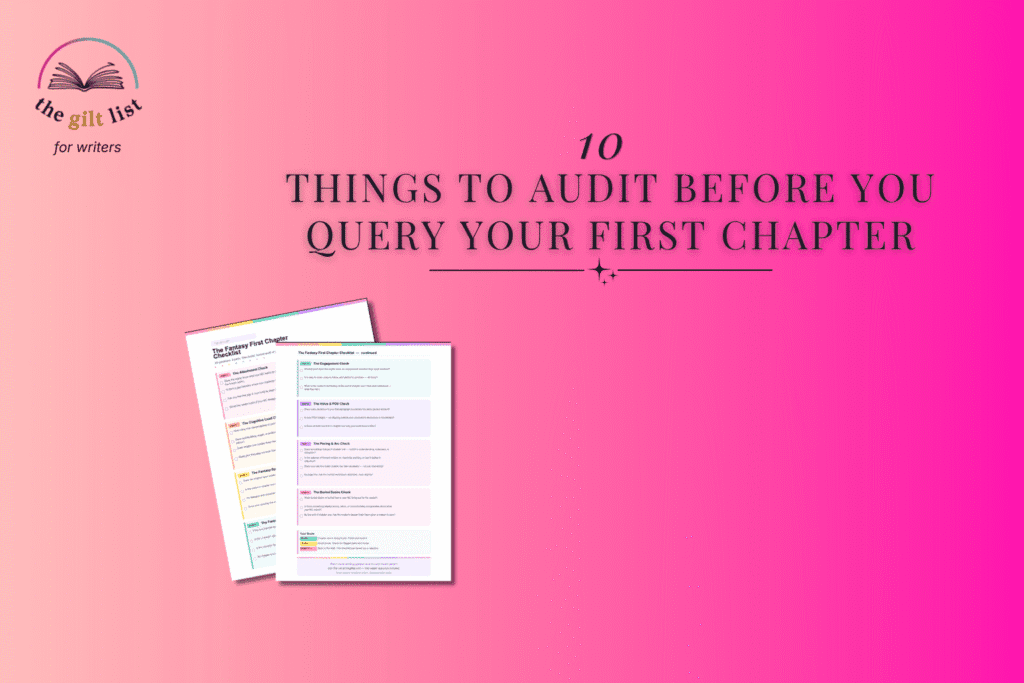
I have a full fantasy chapter one checklist breakdown here if you’d like to go through everything one by one or check out my no-AI Act 1 Tool to help you improve your story.
Revising, Polishing, and Getting Feedback
The first version of your first chapter is allowed to be messy. Give yourself a short break after drafting so you can come back with slightly less emotional attachment. You’ll see what’s really there and not what you think is there. Then read through and look for clunky sentences, saggy sections, and places where you’re bored even though you know what happens.
Polishing is about impact. Do you find yourself skimming? Drifting? Fully engaged? Are you confused? Did you wish you had more of something? Also, tighten sentences, cut filler, and tidy dialogue so conversations sound like people, not exposition machines. Keep asking: is this the cleanest way to say what I mean? But don’t look at lines until the developmental editing is clean.
Share it with trusted peers, critique partners, or a writing group and pay attention to patterns in their reactions:
- Are the characters engaging?
- Is the pace dragging or racing ahead?
- Does the opening hook actually make them want to read on?
Then ship it off to your friendly developmental editor (like me!) who can tell you what all of that means, and how to fix it.
Final Thoughts: Leaving Readers Wanting More
A great first chapter makes it impossible to put the book down. By the end of that chapter, readers should trust you and curious enough to keep going. You’ve set the tone, introduced main elements, sparked questions, set up the promises, and shown them just enough of your world and cast to make them care.
Ending with a compelling hook at the end of this chapter, like an unresolved question, a new complication, a foreshadowing line, nudges them straight into chapter two. Your job is to make turning the page feel inevitable. My job is to help you do it.