
A book can be well written and still hard to stay inside; you have probably felt it as a reader: the prose is fine, the world is clearly clever, and somehow you keep sliding off the page and reaching for your phone. The problem here is usually cognitive load.
Cognitive load is the mental work the page asks of the reader. Names to hold, rules to track, relationships to keep straight, invented terms to file. Each one is a small withdrawal from working memory, which is famously small. Nelson Cowan’s research on memory limits suggests we can comfortably juggle only about four chunks of new information at once.
Fantasy spends that budget faster than any other genre, which is why a beautifully written fantasy opening can lose a reader who would have stayed for a clumsier contemporary one.
Cognitive Load in Fiction: Takeaways
- Cognitive load is the mental work the page asks the reader to do.
- Fantasy creates more of it early, through names, rules, and invented terms.
- Good prose does not cancel out overload. A clear sentence can still ask too much.
- Proper nouns are the heaviest cost.
- Readers strain when they cannot tell what matters and what can be skimmed.
- Reduce load by tying information to goal, emotion, and consequence.
What Is Cognitive Load in Fiction?
It is how much the reader’s brain has to carry to follow the page. Some of that work is the good kind like tracking a mystery, holding a question, feeling a relationship build.
The kind that costs you readers in a bad way are things such as, holding six names before any of them matter, tracking a magic system before it does anything, keeping straight a web of houses and titles from a single paragraph. The reader is spending effort and getting nothing back yet, and that is what makes a page feel heavy even when the writing is good.
Why Does Fantasy Create More Cognitive Load?
Fantasy asks the reader to learn a world and follow a story at the same time. A contemporary novel opens on a kitchen and a bad phone call, and the reader already knows how kitchens and phones work, pretty easy to get into. Fantasy has to teach as it goes:
- Invented names for people and places.
- A magic system with its own rules.
- World history with no prior reference.
- Politics, factions, shifting alliances.
- Unfamiliar geography.
- Titles, ranks, forms of address.
- Species, gods, social rules.
- Sometimes multiple points of view.
The skill is the writer needs to learn is how to release them at a rate the reader can absorb.
If you are still developing those systems rather than revising how they appear on the page, the free worldbuilding tool for fantasy writers gives you somewhere to build the geography, politics, magic, factions and terminology first. Its World Reveal Plan then helps you decide what the reader needs now and what can stay in the World Bible until later.
Can Good Writing Still Be Hard to Read?
Yes. No matter how beautifully something is written, it still requires brain power. A lyrical paragraph stuffed with three new names, a piece of history, and an unexplained term is still three names, a history, and a term, however elegant the syntax. Readers who put down a well-written book often reach for “it just didn’t grab me.” Frequently the opening pages had asked for more memory than they were ready to spend. I broke down the wider pattern in why readers DNF fantasy novels.
Why Proper Nouns Cost the Reader So Much
A proper noun is a promise that this name will matter, and a request that the reader remember it, so each one is a fresh withdrawal from working memory. You have to fulfill the promise, so the reader keeps trusting you.
A quick way to help the reader remember the name, if it’s not going to pay off for a while, is to tie it to a threat, desire, or a vivid action that is easy to remember. Introduce a character through a single moment of wanting or fearing something and the reader keeps the name, and everyone wins.
For instance, imagine a scene where a main character reads off the names of titles: Prince Eric of Kindledom, Prince John of Sillyverse, Princess Mary of Arionville, and The Count of Juniper, all listed as guests to the next ball. The reader is going to forget all of that by the time you get to the ball scene. Now tell a story with the names; maybe Eric and the MC had a falling out one time, maybe The Count is especially evil and did something terrible that affected the MC, and so forth. And with all that in mind, we have a goal of avoiding those characters in the ball scene. Now the reader might not specifically remember the exact names the first time, but they will remember what those names mean, reducing cognitive load.
Why Readers Lose Track of What Matters
A lot of reader confusion is not about the facts, but the priority of those facts. The reader cannot tell what to keep in mind and what to let wash over them, so they either try to hold everything and exhaust themselves, or hold nothing and miss the line that mattered.
A common version of this is a paragraph of elaborate world history followed by one key line about the character’s situation. The history is vivid and long, so the reader spends their attention there, and the line that actually matters slips past. Later that situation comes into play and it feels out of nowhere for the reader, unsatisfying. And nothing happens with the world-building information they held tightly too. Now they’re on page 77 and still wondering when it will matter. This sort of thing breaks trust between you and the reader.
How Overload Breaks Reader Trust
When a reader works hard to hold something and it never pays off, they learn to stop working so hard. The next time the page asks them to remember a name or track a rule, some part of them declines, because last time the effort was wasted. They don’t get that satisfying feeling of being a part of the story, and put it down to “bad writing”.
I wish this could be tattooed in terms of world building into every writer’s mind: Every piece of information you make the reader carry is a small loan, and readers keep lending only if you keep paying them back.
How to Reduce Cognitive Load Without Dumbing Down the Book
I know all of this feels like you are simplifying the world when you don’t add all of that information in. Actually, you can keep a lot of it if you do it the right way, and make everything rich, layered, and fun for the reader:
- Introduce fewer names in the opening, and give each one a moment that makes it stick.
- Repeat important terms instead of assuming one mention will be enough.
- Attach new information to a goal, an emotion, or a back story that is biting.
- Delay categories and history until the reader needs them to follow a choice. (Do they need to climb a wall? Now is a great time to drop lore about how materials are shipped in and who does the carpentry).
- Explain rules at the moment they affect a decision, not before.
- Use consequences to teach, so the reader learns the world by watching it cost someone something.
- Keep the point of view steady early to avoid confusion.
Cognitive Load in Your First Chapter
The opening is where overload does the most damage, because the reader has not decided to trust you yet, so they have the least patience for unpaid effort. A first chapter with a dozen names, two magic rules, and four factions is asking for investment the reader has no reason to make.
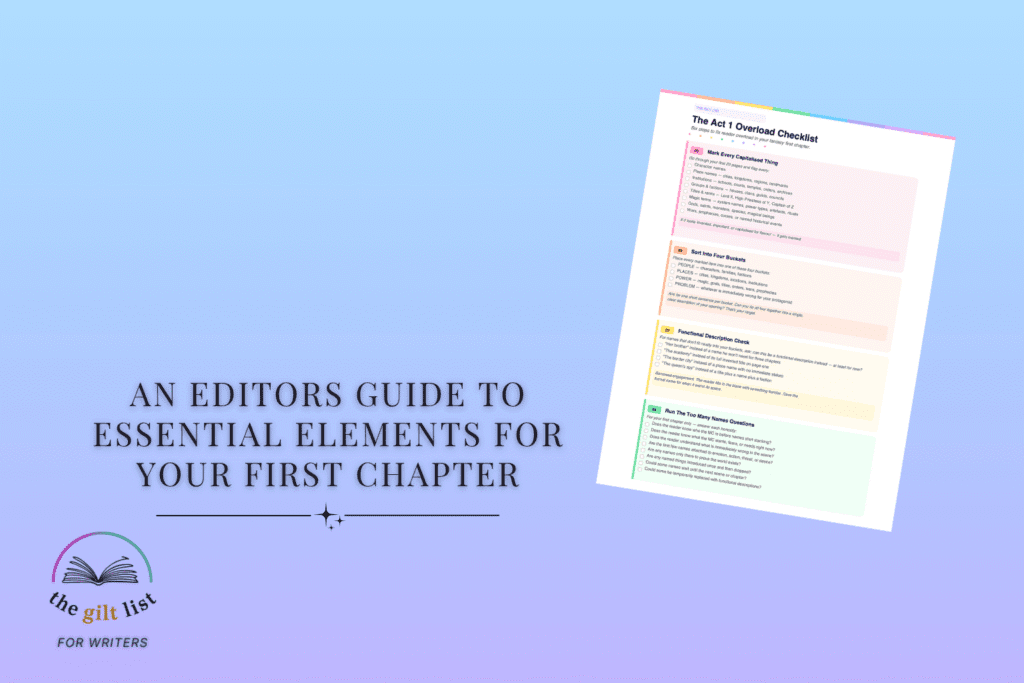
This is what the Fantasy First Chapter Checklist is built to help you discover. It will help take you through everything step-by-step.
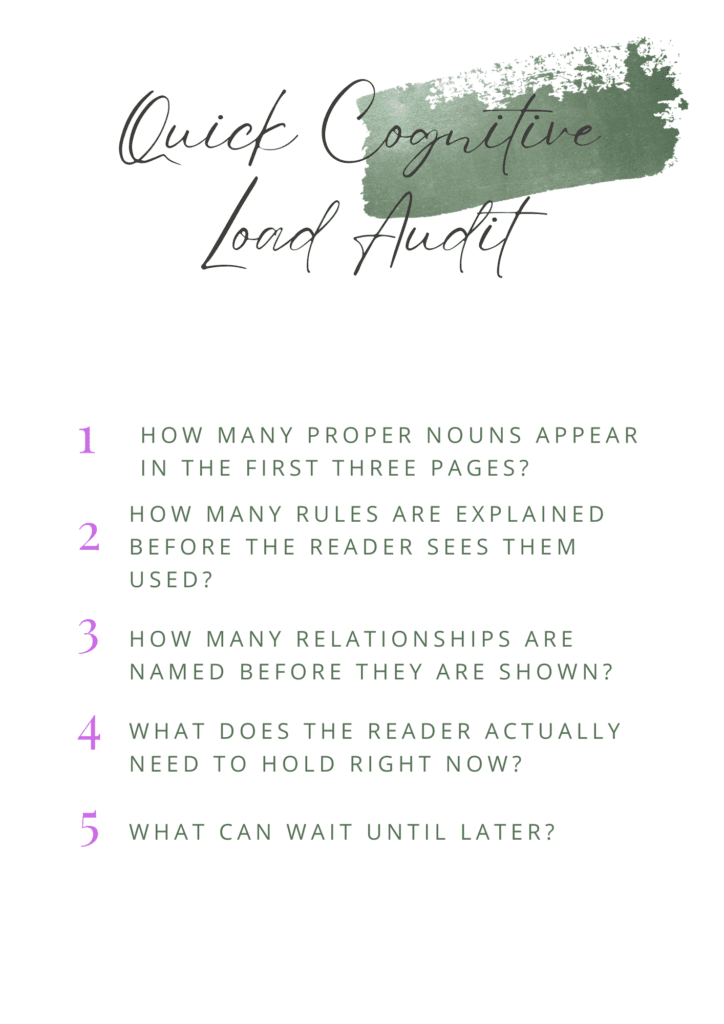
Quick Cognitive Load Audit
A fast pass on your opening pages:
- How many proper nouns appear in the first three pages?
- How many rules are explained before the reader sees them used?
- How many relationships are named before they are shown?
- What does the reader actually need to hold right now?
- What can wait until later?
If the counts are high and the “needs to hold it now” list is short, you have found your overload; you can now choose to tie it to an action or emotion if that works, or remove it.
Want to Know If Your Opening Asks Too Much?
A reader quitting a good book is often not a verdict on your writing; it is a sign the page asked for more memory than the reader was ready to spend. Introduce fewer things at once, tie each one to a goal or a feeling, and pay back every piece of information you ask the reader to carry.
If you suspect your opening is overloaded, start with the Fantasy First Chapter Checklist. If you want a reader to tell you exactly where the page gets too heavy, the first chapter critique is built for it. For overload that runs past the opening, a fantasy developmental edit covers the whole draft. More craft breakdowns are in the writing guides hub.
Frequently Asked Questions
The amount of mental work the page asks the reader to do: names to hold, rules to track, relationships to follow, terms to remember. Some of that work is the pleasure of reading but the kind that loses readers is effort that does not pay off, especially early.
Fantasy asks the reader to learn a world and follow a story at the same time. Invented names, magic systems, history, politics, and geography all add memory work that contemporary fiction gets for free.
Yes. Beautiful prose does not reduce cognitive load. A lyrical paragraph packed with new names, history, and unexplained terms still asks the reader to hold all of it.
There is no hard number, but working memory holds only a few new chunks at once, so a first chapter that introduces a dozen names is asking too much. Introduce a small number early, each attached to a memorable moment, and trickle the rest in.
Make importance visible, so the reader can tell what to hold and what to skim. Attach information to goals and emotions, repeat key terms, and explain rules when they affect a decision.
It can, when it arrives faster than the reader can absorb it or before it matters to the story. Worldbuilding tied to a goal or a consequence is easy to carry. Background delivered ahead of any reason to care piles up as unpaid memory work.
Count the proper nouns, rules, and relationships in your first three pages, then ask how many the reader truly needs to hold right now. If the counts are high and the genuine need is low, it is overloaded.