
Most debut romantasy writers are not struggling because they cannot write but because a lot of craft books are written for literary fiction or epic fantasy. The structural rules for fast-paced fantasy with a romantic backbone are different, and if nobody tells you that, you can spend three years writing a stunning manuscript that will not survive a slush pile.
I see this all the time. A writer comes to me with a manuscript that has a wonderful opening, a magic system you could fall into, a love interest who any reader would die for, and a midpoint where the whole thing…collapses. If you find yourself flailing at the midpoint, this is probably your major issue, and if you don’t, it might be there without you even realizing. The actual fix though is easy and involves braiding romance and fantasy so tightly you cannot separate them, and using both arcs to support the story the whole way through.
Here is, hopefully, the last guide you will ever need on writing your first romantasy or urban fantasy novel, and the many offshoot guides that will help you get from start to finish.
If you want guides for so many things romantasy/fantasy so you can actually write with confidence my guides are broken down on the writers hub by type. This is the overall guide, but I have lots of nitty gritty things you can check out, too.
How to Write Your First Romantasy Novel: Takeaways
- Romantasy runs on a dual arc, and the dual arc must be braided, not parallel.
- Your first chapter has one job: sign the genre contract so the right reader stays.
- The five Gwen Hayes romance beats sit inside Act 1 and have to land by 25 percent.
- Magic has to do emotional work. If the magic is decorative, the romance carries the whole book.
- The midpoint is where most debuts collapse, because the romance arc resolves before the external plot does.
- Kindle Unlimited is its own publishing economy. The decision to publish there or not shapes the structure of your book.
- A developmental editor is for after revision two to three, when you can no longer see the shape of your own draft.
Why Generic Craft Advice Fails Romantasy
The craft books that taught most of us how to write a novel were written before romantasy was a category, and most of them treat romance as something that happens inside a plot. In romantasy, romance is the plot. Or, more accurately, one of two co-equal plots running on the same set of pages. Generic craft advice tells you to make sure your protagonist has a clear external goal. Fine. But it does not tell you that the external goal has to be the thing that prevents the romantic resolution, and the romantic obstacle has to be the thing that prevents the external resolution, and both arcs have to keep colliding until the very end.
This is why the best thing you can do as a debut writer in this genre is stop reading craft advice that does not mention romance arcs, hidden worlds, dual protagonists, or fated mates, and start treating your manuscript as the hybrid it actually is. Also, read, read, read! For the love of holy. Read Quicksilver for worldbuilding that is carefully placed, read The Hunger Games for mirroring and foreshadowing, read ACOTAR to learn how we can weave trope, and fun into fantasy and debase ourselves a little. Read One Dark Window for style vs. substance, or Divine Rivals. I have a secret favorite for chapter endings and it’s Darren Shan, which I know, wild one. Read, read, read, and decide for yourself what each author does best, how, and why. Take notes. Absorb.
What Counts as Romantasy?
Romantasy is a romance built inside a fantasy world, where the romance arc carries equal or greater structural weight to the external plot, and the HEA or HFN is non-negotiable. Romantasy readers will tolerate a long book, a slow burn, a complicated magic system, and a morally grey love interest, but lord help you if you make the romance flat as a pancake. They will not tolerate an ambiguous ending where the love fizzles to a maybe.
If you are writing something that ends with the couple parted, you are not writing romantasy. You are writing fantasy with a romantic subplot, which sells to a different reader, with a different blurb, on a different shelf. Do yourself a favor and don’t try to convince an agent or a reader that the breakup ending still makes it a romance; you will not sell them on it.
For a real-world example. Fourth Wing is romantasy. The bonded dragon is the adhesion beat, the romantic arc with Xaden is co-equal with the survival plot, and the HEA is the reader’s promised destination. ACOTAR is also romantasy. From Blood and Ash is again romantasy. The Cruel Prince is…you guessed it, romantasy. Strange the Dreamer is fantasy with a romantic subplot.
Premise: Building the Romantic Problem First
A romantasy is when the external goal and the romantic obstacle create each other. If you can describe your book without mentioning the love interest, your premise is not a romantasy premise yet and needs to be reworked. This can be a lot easier than you think, and is one of the great reasons for hiring editors who specialize in structure. You may already have this going for you, and simply don’t have the language for it, or one small change could get you there. So, if you think you haven’t managed to write what you wanted to, don’t fret yet.
The test I run on every premise that comes across my desk is this: can you state the external goal, the romantic obstacle, and the way they create each other in one sentence? Violet has to survive the dragon riders’ academy, but the boy assigned to kill her is also the boy bonded to her dragon’s mate. That is a romantasy premise, because it’s all the things in one.
Spend an extra week on the premise. It will save you six months on the manuscript.
What Is The First Chapter’s Job?
Your first chapter has one job. Nope. It is not to hook the reader, although that helps. It is not to establish voice, although that also helps. It is to sign the genre contract with your reader. By the end of your first chapter, the reader should know whether they are in romantasy, fantasy romance, paranormal romance, or fantasy with romantic elements.
In romantasy that means the romantic stakes are visible by the end of chapter one. If you’re asking how you can possibly show the romantic lead that early, that’s not really how it’s done. Instead, there is a piece missing for our heroine that is love-shaped. Loneliness, or a feeling of not belonging, is a big trope off the top of my head. Feyre kills the wolf in the first chapter of ACOTAR, and the reader knows something supernatural is coming for her, which sets up the bargain with Tamlin. At the same time, she does not fit in with her family and spends most of the book and the next one trying to find her “family”, her “people”. Fourth Wing opens with Violet on the morning of conscription, and the romantic and survival stakes are there right away. Again, she does not fit in; she is looking for something missing; everyone thinks she will fail, except, of course, for him. The genre contract is signed in the opening pages.
Your first chapter is also where you lose readers to cognitive load. Romantasy first chapters drown when they introduce too many invented names too fast without emotional stakes, stories, action, or immediate consequence attached. If you want to see a master class of worldbuilding in romantasy openings in action, pick up Quicksilver. Callie Hart is able to create a vast world, with a lot of lore drops, in a way not seen in many traditional romantasy’s. She does this by weaving action, emotion, backstory, and consequence together with each drop. If you haven’t read it from this angle, you absolutely must.
Check out this for the full guide with a bunch of in-depth guides:
Act 1 Structure: The 5 Gwen Hayes Beats
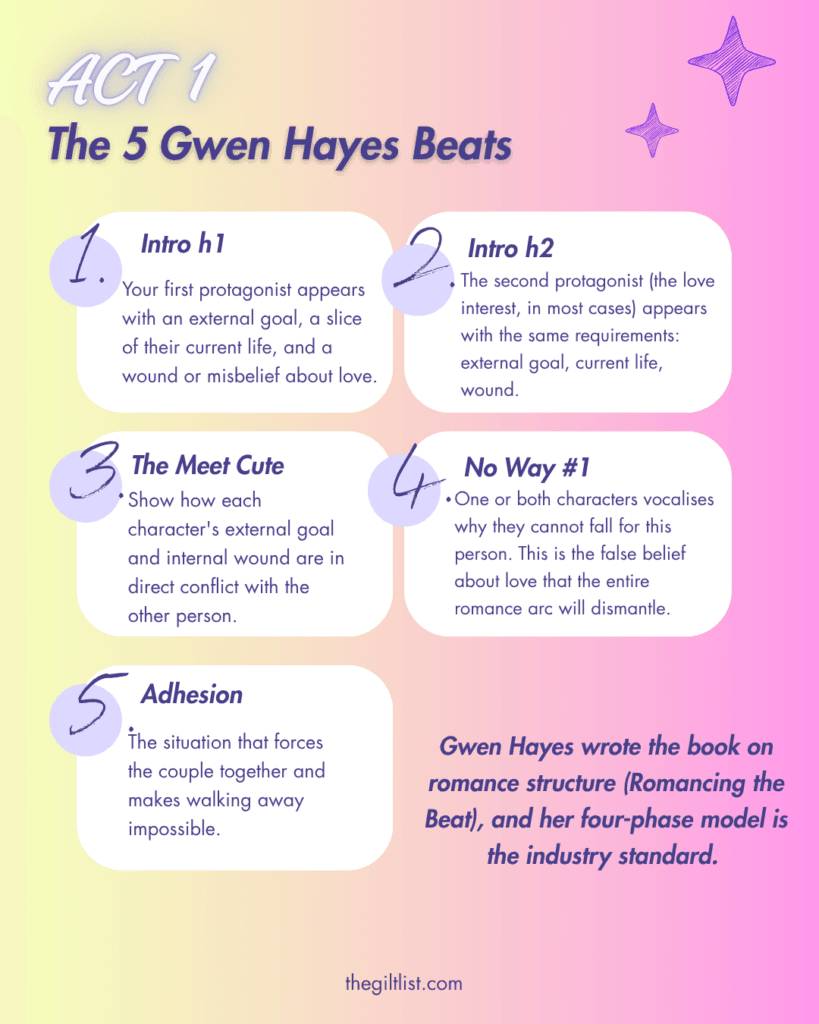
Gwen Hayes wrote the book on romance structure (Romancing the Beat), and her four-phase model is the industry standard. Phase One, which maps to Act 1 of your novel and runs to roughly the 20 to 25 percent mark, contains five specific beats. If any of them are missing, your Act 1 will feel structurally off in a way readers can sense but not name. If you want to be walked through this process step by step with your personal ideas that’s what the Novel Outline Tool does, I’ve embedded it below on this page. If you don’t have an ideas? Boom. I also have a story idea generator for Romantasy using beloved tropes.
Introduce H1
Chapter one. Your first protagonist appears with an external goal, a slice of their current life, and a wound or misbelief about love that the romance arc will eventually dismantle. The wound does not need to be named on the page but visible in their choices.
Introduce H2
The second protagonist (the love interest, in most cases) appears with the same requirements: external goal, current life, wound. This can happen in the meet-cute scene or separately, but it has to happen inside Act 1. If you are writing dual POV, H2 gets their own opening that establishes them as a person with their own life, not as the love interest waiting for the heroine to arrive.
The Meet Cute
Their first meeting. The job of this scene is not to be cute, but it sure is fine to try it that way. It is to show how each character’s external goal and internal wound are in direct conflict with the other person. A well-written meet-cute makes the reader understand instantly why these two people are going to be a problem for each other. This usually lands between 5 and 15 percent of the manuscript.
No Way #1
Internal resistance. One or both characters vocalises why they cannot fall for this person. This is the false belief about love that the entire romance arc will dismantle. It cannot be circumstantial (I am busy). It has to be a belief about love itself, rooted in the wound. I cannot be loved while I am still this. I cannot trust anyone after what happened. I will not survive losing someone again. And so on.
Adhesion
The situation that forces the couple together and makes walking away impossible. Marriage of convenience, bonded dragons, fae bargain, shared quest, prophecy, blood debt. This is the Act 1 to Act 2 transition and lands at 20 to 25 percent. Without an adhesion beat, your romance arc has no structural reason to exist past the meet-cute, and your story will stall because the reader cannot see why these two are stuck together.
How to Make Magic Do The Emotional Work
The single biggest difference between a competent romantasy draft and a great one is whether the magic does emotional work within the plot itself. In a competent draft, the magic system is interesting, internally consistent, and is decorative. In a great one, the magic is the thing that creates the romantic obstacle, reveals the wound, or forces the choice that resolves the arc, and ultimately, says something about the world and says something about the characters as people.
Look at how Fourth Wing uses the dragon bonds. The bond is the adhesion beat. The bond is the danger. The bond is the way intimacy is made literal. They are literally bound; it’s quite on the nose. ACOTAR uses the bargain mark for the same reason. The fae mate bond does the same job in countless other books. Your magic system needs at least one element that is structurally entangled with the romantic arc.
If you are still building those systems, the free romantasy worldbuilding tool includes prompts for ways magic, politics, class, law and culture can press directly on the relationship arc. It is built to help you work out those connections before you start trying to force them into individual scenes.
The Middle: Where Most Debuts Die
If you have read beta feedback that says it lost me around chapter eight, the structural cause is almost always one of four things.
The first is that the romance arc resolved too early. The couple kissed, slept together, or admitted feelings, and now there is nothing to root for. The second is that the dual arcs drifted apart. The romance and the plot are running in parallel rather than creating each other. The third is that neither are saying no to the romance to create that tension. The fourth is that the romance is working, but there are too many scenes not doing structural work.
The fix is almost always structural which is good news, because you can always move things around, like put the kiss scene later, put the climax of the story in the same beat as the romance crumbling, and remove scenes that are not doing any work to tighten the whole story.
What is Voice?
Voice is the only part of writing you genuinely cannot fix in revision, it really is a thing that happens when you have been writing for a while, and you cannot fake it. You can fix structure. You can fix pacing. You can fix character. You cannot retrofit voice onto a draft that does not have it. Which is why I tell every debut romantasy writer to spend the first month of drafting not worrying about plot at all, and just write scenes that sound like the book they want to write. Then go back and structure.
This is also a big reason why so many editors will tell you not to edit period. To write, write, write, first. Your natural voice…is voice. It is the thing agents, and readers and publishers alike are looking for. If you edit things partway through your writing process, you won’t be in a flow state; voice won’t happen. Now, if you’ve been writing for a long time, you might get away with it, due to habit, but that’s another thing.
Romantasy voice in particular tends to be close third or first person, with high interiority. The reader is inside the protagonist’s head, hearing their thoughts about every scene, and that intimacy is part of the genre contract. Distant narration kills romantasy stone dead. If your reader cannot hear your protagonist’s voice on every page, you have written the wrong genre. So combine your voice and your characters voice, with first person/close third, and you will have that unique thing everyone says they’re looking for.
A first chapter critique is the next step if you want a cold reader to tell you whether the voice is landing.
Should You Go Kindle Unlimited?
Whether you publish in Kindle Unlimited is not a marketing decision you make after the book is finished because it is a structural decision that shapes the book. You may get lucky and naturally fit it (if you consider that lucky for you) but it’s best not to hope if you’re aiming for KU.
KU readers are voracious, fast, and tropey, and they expect a different kind of book than trad-pub readers do. Shorter chapters. Faster pacing. Cliffhangers between books. Series of three to seven books rather than standalones. Higher trope density. Earlier romantic on-page commitment. A lot of things flying at once. Phew.
If you are writing for KU, plan the series from book one. Plant season-arc questions early. Build the world so it can sustain multiple POV books or connected standalones. Write to genre conventions hard, not lightly. If you are writing for trad pub and debuting, you need the opposite. Write to market but you want something that is standalone with series potential.
Neither path is better by the way; it’s completely down to who you are as a writer and what you aspire to, it doesn’t mean anything about you as a storyteller.
Do You Actually Need an Editor?
Honestly? Not always. Some writers can self-edit a debut into shape, especially if they have strong critique partners. Some writers can publish a clean draft straight to KU and find their audience. I am not going to pretend every writer needs to spend money they do not have.
But most writers, especially first-time writers, hit a wall around revision three. This is after you read the whole thing, fixed missing gaps and changed a couple of things that didn’t work, then started on some tone/line edits. Now you’ve read it so many times you’re not sure.
After beta readers, it probably looks like you rewriting everything you understood from the feedback, and it’s still not quite “there”. Or worse, you’re so overwhelmed you no longer know what to start.
That is the moment a developmental editor pays for themselves. The job of a developmental editor is to hand-hold the structural edit and help you even figure out every step you need to take and in what order.
If you are at revision two and stuck, working with a romantasy developmental editor is built for that stage. If you are pre-query and want to know whether the opening lands, the first chapter critique is the entry point most writers start with.
What Is The Single Most Important Thing to Note?
If you take one thing from this post, take this. Romantasy is a dual-arc novel, and the dual arc must be braided. Every scene should be doing two jobs. Every chapter should be advancing both arcs. Every obstacle in the external plot should be making the romantic obstacle harder, and every obstacle in the romance should be making the external plot harder.
If you can keep that one principle in your head while you draft, you will avoid the single most common reason debut romantasy manuscripts fail. Everything else, the beats, the magic, the voice, the KU decision, the editor question, follows from that one structural commitment.
Get that braid right dear reader and the rest will hold.
How to | Structural Editing for Romantasy
If you’re sitting on a finished draft and your first chapter is keeping you up at night and you would like help, the first chapter critique is the entry point most romantasy writers start with. You send the opening, you get back a structural feedback document, you know what to fix before you query. Win, win, win.
If your whole manuscript might need work and you are completely overwhelmed and want to get it right you need developmental editing on the full draft. I even offer a critique version which is a lighter pass, and nicer to your pocketbook.
If you want more guides writing guides hub is where the craft posts live.
Or start plotting out your story right now with my beat, plot, & optional chapter tool
Fantasy first chapter resources
Start here but also consider the writer hub which breaks down advice by type:
If you want professional feedback:
Frequently Asked Questions
Romantasy and fantasy romance are often used interchangeably, but romantasy increasingly refers to the post-2020 wave of fast-paced, tropey, romance-forward fantasy aimed at the BookTok audience. Fantasy romance can refer to older, more traditionally structured fantasy with strong romantic arcs. Both have HEA or HFN endings. The structural conventions are similar.
Most published romantasy first chapters run between 3,000 and 5,000 words. A short chapter can work if it makes the genre promise and gives us a reason to keep reading. The job is to sign the genre contract, introduce the protagonist with a visible want, plant the romantic spine, and end with a hook that pulls the reader into chapter two.
The opening should make the romantic promise visible, even if the love interest isn’t there yet. If they arrive later, the earlier chapters need to give us a reason to expect, and frankly want, that relationship.
Yes, but it does not have to be elaborate. What it has to do is interact structurally with the romantic arc. A magic system that is purely decorative will leave the romance carrying the whole book, and most debut romances are not strong enough to do that alone. The magic and the romance should be entangled, ideally through a bond, a bargain, a mate mark, or a shared power source.
KU is its own publishing economy with its own structural conventions. If you choose KU, plan the series from book one, write to trope conventions hard, and pace faster. If you choose trad pub, you have more room for standalone work and quieter craft. Make the decision before you start drafting, not after.
Most writers are ready for a developmental editor after revision two, when they have addressed all the feedback they understand and the manuscript still feels wrong but they cannot see why. The first chapter critique is the entry point for pre-query writers who want to know whether the opening is landing.
Running the romance arc and the external plot in parallel rather than braiding them. Every scene should be doing both jobs. Get the braid right and the rest of the structure tends to fall into place.