
You finish the book then revise it four times. You know every character’s childhood, every rule of the magic system, what happened at the bridge two hundred years ago and why the northern kingdom has never forgiven it. Then you open a blank document and try to fit all of that into 300 words for a stranger who will decide in about thirty seconds if this story is actually good.
It’s a horrible job for everyone involved really, especially as at the end of the day we all got into this line of work because we adore story and want more voices in the world and more books. But, it has to be done and if you’re going to do something might as well do it right. So let’s dive in and help make the perfect query together.
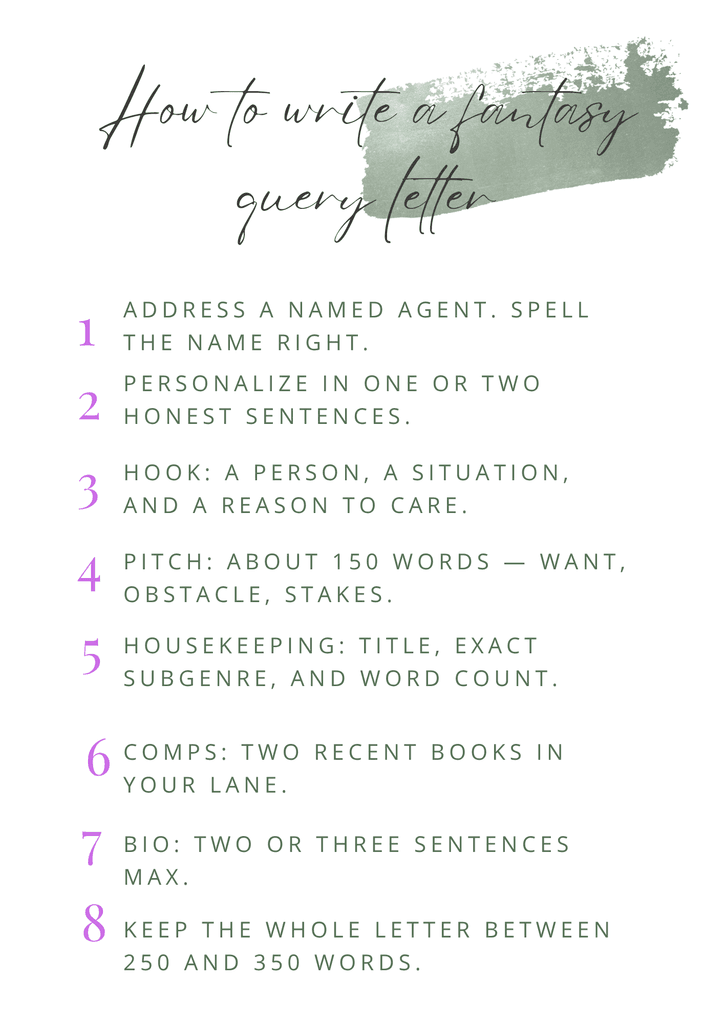
Ahem so. A query letter needs seven pieces…a greeting, brief personalization, a hook, a pitch of about 150 words covering your protagonist and what’s at stake, housekeeping (title, genre, and word count), comps, and a short bio. You need to keep the whole thing between 250 and 350 words. Anything past 400 and you should already be cutting ruthlessly. If you deal in emails you would know that people rarely read them carefully, brief is always better.
Takeaways
- Keep it to 250 to 350 words. Agents read 50 to 200 queries a week and give each one about thirty seconds.
- Your hook is two or three sentences and it does more work than anything else in the letter.
- The pitch is not a synopsis…the synopsis is.
- Fantasy’s own trap is worldbuilding eating the space your character needed to take up.
- Personal stakes beat cosmic ones. If you gotta cut stakes cut the plot ones.
- Name your subgenre exactly. “Fantasy” isn’t enough. A good critique editor can tell you what you’re writing or help you write what you should have written.
What is a query letter actually for?
A query letter is a one-page sales pitch with one job and that is to make an agent want the pages from you. So you have to give them the protagonist, the problem, the stakes, and enough market information to see where the book belongs in the sales process so the agent knows if they can make you and the publisher happy.
Writers get this wrong in a very understandable direction because you’ve spent years on this book and you want the agent to understand it and love it just as well as you do. So you way over explain. By which I mean you give context, you set up the world, you mention what the story is really about underneath it all, why you chose that theme, and so on like we’re in a literary class. And the agent, who is thirty seconds into your email with another ninety to read before lunch, still doesn’t know what they need to but they do know they don’t have time for this ish.
Once you have finished or if you have a copy of a query you wrote try reading it and answering the following questions. Who is this book about? What does she want badly enough to do something stupid for? Who or what is stopping her? And if she fails, what does she personally lose? If you can’t answer all four from your own letter, an agent has no chance of answering that either and it’s all for naught.
In summary, a query answers four questions fast…who is this about, what do they want, what’s in the way, and what happens if they fail? Everything else in the letter is there if you have space.
What should a fantasy query letter include?
Use the standard template that most agents will be looking for. An agent scanning her inbox knows where to look for each piece (Yey), and making her hunt for anything at all costs you attention you do not have to spare if you want to stand out.
1. The greeting
Address a named agent. Dear Ms. Whoever. Spell it right. Please lord spell it right. Double check.
Misspell the agent’s name or open with “Dear Agent” …ew…and the letter immediately looks like a mass blast from some scammer in a far away land, and not the fantasy kind. Your email may be going to a lot of people but you don’t want the agent knowing that.
2. Personalization
Add one or two sentences on why you picked this agent. Like a book she represents that is like yours, something from her wishlist, a talk she gave, what ever. You can find this on her or his socials (I often use her to be quick but I swear I know agents can be male and all the other genders too).
One honest sentence about why you like them beats a paragraph of flattery you added to suck up. If you skip it entirely and the letter reads as a blast and not like you care. But dear writer, overdo it and it reads as padding covering a weak hook you’re hoping they will ignore because you would make great irl friends. If you can’t find a real reason, a plain “I’m querying you because you represent romantasy and are open to submissions” does the job and at least shows you checked.
3. The hook
Your hook has to give an agent a person, a situation, and a reason to care, in the space of a tweet, essentially.
The fantasy writer’s instinct is to open with the world, because the world is what makes your book different and cool. Resist it like the plague. An agent can’t care about a kingdom that probably already exists somewhere else anyway but she can care about someone in trouble.
Loewenstein’s information-gap theory of curiosity is a decent way to think about what a hook is doing. Curiosity appears when we can see a gap between what we know and what we want to know. A hook opens one clear gap and leaves it open for the agent. Don’t be vague.
Genoveva Dimova’s query for what became her debut is a good example. She set up her protagonist as a witch who handles monsters for a living, then finished the opening with the line that there is only one monster she cannot defeat, and it is her ex. One sentence gives you her job, the world’s rules, her competence, the tone of the book, and a personal problem. You know within seconds whether you want to read this because you like those tropes right? That’s the aim.
4. The pitch
The pitch should be about 150 words. Your protagonist, what she wants, what stands in the way, and what it costs her if she fails. Easy.
The most common failure here is writing a synopsis instead of a pitch. This happens, then this happens, then this other thing happens, and they all live happily ever after…or don’t. That is a plot summary, and it tells an agent what occurs without giving the story any conflicts to care about quickly. A pitch needs conflict, pressure, and a choice your character cannot escape.
End on the stakes rather than the resolution. Don’t tell her how it ends. That’s what the synopsis is for, and yes, that’s a separate document you also have to write and I have a whole guide for that to.
5. Housekeeping
Add your title, your genre, your word count, and your comps. One or two sentences, on all of that.
Name the subgenre exactly, not just vague fantasy. Think epic, romantasy, cozy, dark academia, gaslamp, urban fantasy, la la la. You want the agent to picture the exact publisher they could sell this to. Agent wishlists are usually subgenre-level now, so this is also how you prove you’ve read the requests and website.
Also, please get the word count into range for your subgenre and round it to the nearest thousand. In fantasy, word count is one of the fastest viability checks an agent can make and it’s usually spot on (one of the first things I also studied in editing classes), which is worth knowing before you decide 158,000 is fine because your book is complicated and has layers…it isn’t fine.
6. Comps
Two recent books in your lane that share your tone, your heat level, and your readership.
The trap in fantasy is reaching for the giants like Maas or Sanderson. Comping your debut to the biggest three books in the genre usually reads as optimism or like you don’t actually read in your genre and just said the first author you thought of. Recent mid-list titles do far more work because they tell an agent which readers your book is for and which editor might want it…and that you know your stuff.
Claiming your book has no comparison can make it look as though you have not read widely enough in your own genre to position it and isn’t a good look. Almost every story has elements of others.
7. Bio
Two or three sentences at most. At most. Think publishing credits, relevant expertise, anything that makes you the right person for this book and for writing in general. If you’re a bus driver by day no need to mention your day job. But you’re a copywriter? Go ahead and say so.
If you have no credits, say almost nothing don’t say you have nothing to offer….clearly you can write or you wouldn’t be here. Don’t tell an agent the book is destined to be a bestseller or perfect for film everyone says that, they won’t believe you even if it’s true. Don’t write your bio in your protagonist’s voice, which is a thing people do and which agents remember for years, and not fondly. It’s unprofessional.
Use the bio to turn relevant real-life experience into authority and show you can meet a deadline. Somebody who works with maps and writes about cartographers has an obvious connection the agent will appreciate. If you have something like that, use it.
Why does worldbuilding weaken so many fantasy query letters?
Fantasy queries have a predictable failure point you can avoid… worldbuilding takes over. It happens because the thing you are proudest of is also the thing that doesn’t matter….sorry. Unless you have a quick easy magic system that hasn’t been done before like tearing pages from a book. Agents like quirky magic.
Make every invented proper noun earn its place and fight for it if you’re going to use them….yes to the death. You probably have room for two or three at most think character names, one place, maybe one term if the whole book needs it.
Working memory research has been narrowing the estimate for decades in terms of what someone can remember for new terms. Miller’s famous 1956 paper put the number of items we can hold at once at around seven, and Cowan’s later work revised that down considerably, closer to four chunks when rehearsal and grouping are stripped away. If your name is one of those, don’t lose out to the name of your story’s city.
Processing fluency adds another problem. Work by Reber, Schwarz and Winkielman found that harder-to-process material can be judged less positively, even when the difficulty is not the same thing as quality. So if you stuff a query with lore the friction can start to feel like clumsy prose. Green and Brock’s work on narrative transportation points in a similar direction… confusion makes absorption harder to sustain. This is all a fancy way of saying always simplify.
I’ve unpacked this more in cognitive load in fiction and processing fluency for fiction writers, because the same problem shows up in first chapters.
Dimova’s query is a good counterexample. She deliberately put three folkloric monster names in her opening line, against advice she had been given, because those creatures were real Bulgarian folklore and each carried something a plain English equivalent would lose…she made a thoughtful choice and so should you.
Why do personal stakes work better than cosmic stakes?
If your query says the fate of the kingdom hangs in the balance, you’ve told the agent nothing, because roughly every fantasy query she reads this week says a version of that. I mean think of every fantasy book you know…there’s always someone about to die or something about to fail.
Saving the world is background noise in a slush pile that they hear forty times a day. Give the agent the personal loss instead.
If this is hard to pin down, the problem might not be the query. Sometimes you cannot name what the protagonist stands to lose because the manuscript has not decided either. What Is Story Promise? is the next place to look if this is you.
What makes a query easy to reject?
Some of these are craft problems. Some are just bad query skills. Give it a gander and check it isn’t you.
- Opening with a rhetorical question. “Have you ever wondered what you’d do if you woke up with magic?” No. Next.
- No word count, or one wildly out of range. Both make the query look as though you do not know the market.
- Comping to the mega-bestsellers, or claiming your book is like nothing else on the shelf.
- A 600-word plot summary that includes the ending and every subplot.
- A grandiose bio. Destined to be a bestseller, already imagining the film, my writing group loved it.
- Themes essays. What your book is really about is not the pitch. What happens in it is what we want to know.
- Typos. The query is your first sample of how carefully you handle the work, so obvious errors show you can’t write (I mean not really but people make assumptions).
- Querying before the book is finished. Fiction has to be complete and revised, no exceptions.
What does a stronger fantasy query pitch look like?
The version that gets skimmed. “In the realm of bobville, the eight Great Houses have maintained an uneasy peace since the Shattering three centuries ago, when the Raven Court fractured and blood-magic was outlawed. Bob Vaudran, born to House Judd but raised in exile after her mother’s disgrace, has spent her life concealing the mark on her wrist that identifies her as a blood-worker. When the Convocation summons all houses to the capital for the first time in a generation, Bob must navigate the treacherous politics of a court that would execute her on sight, while uncovering a conspiracy that threatens the fate of the realm itself.”
Nine proper nouns. Nine. Three centuries of history eesh. And the agent still doesn’t know what Bob wants. The stakes at the end are the fate of the realm, which is the phrase in half the queries that week. This isn’t good.
See these real examples instead.
Genoveva Dimova — FOUL DAYS: the query that got her an agent, with her own breakdown of what worked.
Wren Lennox — MARIOTA: the query package that led to six offers of representation.
Livia Blackburne — MIDNIGHT THIEF: a successful YA fantasy query with agent commentary.
Mike Martinez — THE DAEDALUS INCIDENT: a successful fantasy/steampunk query with agent commentary.
How long should a query letter be?
Between 250 and 350 words for the whole thing, including the greeting and the sign-off.
I know. That feels impossibly short when you have written 110,000 words. It is meant to because that constraint forces you to decide what the book is actually selling, and that is usually a healthy test of whether you understand the story clearly enough to pitch it and make sales off of it.
Query Letter Builder Tool
How should you format and send a query letter?
Follow the agent’s submission guidelines to the letter, every time, even when they contradict the last agent’s. Some want the first five pages pasted below the query. Some want ten. Some want fifty. Some want a synopsis attached.
For email submissions, paste everything into the body unless the agent asks for attachments. Subject lines usually follow QUERY: Title by Your Name, but submission guidelines win every time. If hers says something different, do that. For all that’s holy. Research the agent first.
And remember that most agents read your sample pages right there under the letter. So the query gets her to keep scrolling, and then your opening pages have to sell. That’s where a lot of writers with strong queries still lose the request, which I’ve written about in why am I not getting requests from agents.
What should you check before sending a query?
Test the letter on someone who hasn’t read your book and ask them to tell you back what the story is about, who it’s about, and what that person wants.
If their answer is vague, or wrong, or they say something like “it sounds like there’s a war,” the query isn’t working yet. This is a great litmus test.
Thennn check the rest of the package. The manuscript has to be finished and revised; Is My Fantasy Manuscript Ready to Query? walks through that. Your agent list also needs people who actually represent your subgenre, so use How to Find Literary Agents for Fantasy.
Frequently asked questions
250 to 350 words total. Over 400 words and you’re cutting into the agent’s patience. That word count includes your greeting, personalization, hook, pitch, housekeeping, and bio.
No. End the pitch on the stakes, not the resolution. Your synopsis includes the ending. Your query is a pitch designed to make someone want to find out.
Two or three proper nouns is a safe ceiling, and every one should be understandable from the sentence around it. The number is less important than whether a stranger can read the sentence without stopping to work out what a word means.
Yes, and two recent ones in your subgenre work better than three vague ones. Comps tell the agent which shelf your book belongs on and which readers will buy it. Avoid comping to the biggest bestsellers in the genre.
Then keep the bio to a sentence, or leave it out. No bio beats a defensive one. If your day job or background connects to the book, that is usually the best thing to put there.
Pitch book one as a standalone with series potential. An agent is deciding whether she can sell this book, and a debut that only works as part of a planned seven-book arc is a harder sell than one that stands on its own.
Check the agency’s guidelines. Many run a no-from-one-is-a-no-from-all policy, so querying two agents at the same agency can cost you both. Some allow it. Read the page before you send.