
Every November, thousands of writers decide that it’s time to start writing that book idea accumulating dust somewhere in the back of their writerly brain…or that other idea that keeps trying to mosey on in when you should be working on your current WIP. And inevitably, every November, a good number of writers discover that the idea seemed perfectly rational in their daydreams, but not quite as practical on paper.
And that actually writing 50,000 words or more is a lot harder than it looks.
That’s right, National Novel Writing Month is back in 2026, although things look rather different following the closure of the original NaNoWriMo organisation. These days, independent challenges are keeping the November tradition alive, including NaNo 2.0, ProWritingAid’s Novel November and Heart Breathings’ Rough Draft Challenge.
So, if you’re planning to spend November writing a fantasy novel, romantasy, urban fantasy, or that experimental book-to-musical you’ve been considering, here’s a look at how to prepare.
You can find more November writing help in our writer hub, including craft guides and free planning tools. Or check out the giant guide How to Write Your First Fantasy/Romantasy.
If you’re starting a fantasy novel and still have little more than a Pinterest board, start with seven decisions to make before you write. Already got the idea but need a plot? Try my quick guide to outlining a novel before NaNoWriMo.
Quick answer: To prepare for NaNoWriMo 2026, choose your November writing challenge and a realistic word-count goal, then plan your protagonist’s goal, main conflict, first act and major story beats. Fantasy and romantasy writers should also establish the magic rules and romantic tensions that affect those choices.
Jump to:
- November 2026 writing challenges
- How to prepare your novel
- Fantasy worldbuilding
- Planning a romantasy
- Daily word-count goals
- Preparation checklist
Is NaNoWriMo Happening in 2026?
Yes siree, but it’s no longer the original nonprofit that used to happen, thanks to the drama-lama explosion on the internet….let’s just say, it’s a good thing it’s shut down, even though I sorely miss the community and haven’t quite been able to write the same way in November since.
The original challenge called for writers to hack out 50,000 words all through November in order to get coupons off tools, and other fun things. Now it’s up to the independent groups who are trying to champion the tradition, but with their own quirks.
NaNo 2.0
NaNo 2.0 is a volunteer-led effort involving longtime participants, including original founder Chris Baty. It supports a wider range of project goals than the classic 50,000-word target. You can find the current activities and signup details on the NaNo 2.0 website.
ProWritingAid
ProWritingAid’s Novel November is another option, with scheduled writing events, resources and a community programme. See ProWritingAid’s Novel November page for the 2026 challenge details.
Heart Breathings
This is my personal favorite. You will adore the chill live sprints and community if you sign up. This challenge gives the sort of vibe NaNo did and would be my top choice for any fantasy/sci-fi writers. Sarra Cannon needs to be sponsored by bigger companies, stat. You can find the Rough Draft Challenge at Heart Breathings, and the community lives in the Heart Breathings Facebook group.
You can also ignore the organised events entirely! That’s completely a thing. Lots of writers set their own November target, and hang out on the socials. Our NaNoWriMo alternatives guide compares the options in more detail.
How Do You Prepare for NaNoWriMo 2026?
Well that depends on your process, doesn’t it? But I recommend plots, worldbuilding, characters, themes, and if you’re like me, a complete step-by-step, beat-by-beat breakdown to work from. Want to do that quickly before the challenge begins?
The idea is to make this as smooth as possible, so all you have to do is sit down and write.
1. Know What Your Protagonist Wants
1. Before you begin writing, identify what your main character wants and why they want it, what they believe about the world and themselves…then know, as the writer, why this is wrong.
This is the beginning of goal, motivation, and conflict (GMC), which is one of the best ways to determine whether a character can actually carry a novel to completion, instead of just being a fun character to have conversations in your head with. Ideally, they would come with both benefits, of course.
2. Once you have a goal, and a reason why it will matter if that goal fails; preferably, it should trigger fear in your MC. Now set up another character who wants the opposite of that goal – the love interest is great for a romantasy – and watch the sparks fly.
Two characters and a goal now done, look how easy that was?
3. Next, set up a setting that will make that goal very hard to get, or morph the setting you have in mind until it achieves this.
These three main blocks will get you far. If you only plan a little, this is what I would include. If you want to dive in deeper, read our guide to character desire in fantasy.
2. Understand Your Novel’s Central Conflict
The central conflict is the problem that drives your story to the end. You want your character to go after their goal, but every time they win a little, something worse should come from their actions. This creates a cycle of small victories and increasingly difficult consequences, raising the stakes until your character reaches the “dark night of the soul,” when all seems lost.
What is that you ask? That is where your character must confront the possibility that the goal they’ve been chasing isn’t what they actually need, or that the belief driving their decisions has been wrong all along. They now have to make a choice, change their approach, or accept something they weren’t willing to face at the beginning of the story.
To do this, ask what your protagonist will attempt first, why that attempt won’t solve everything, and how the situation might actually become worse.
3. Decide What Happens in Your First Act
If you want to plan a little further than just a character, with a goal and belief, and ideas on how these might coalesce, then you’ll want to plan the first act. Or really, the inciting incident.
Where does your character begin, and what is the one big thing that must happen to set them on a new path?
Whatever the thing that must happen, your character should debate “answering its call”. For example, a character may work in the fields with dreams of leaving; one day they are called to the court to marry the villain. They could run away, or they could face what comes next.
In Harry Potter, that’s the You’re a Wizard, Harry, moment; for ACOTAR it’s the wolf moment.
It’s so important to have this fairly early in modern literature, as readers are less inclined to wait and wade through pages of politics, magic, or meeting characters.
For more structure help, see our fantasy novel plot structures guide and the free Novel Plot and Beat Planner.
4. Prepare the Main Story Beats
Alright, so you have the character, the setting, and the inciting incident, but still want more structure? It’s time to prepare the 4 beats you most need.
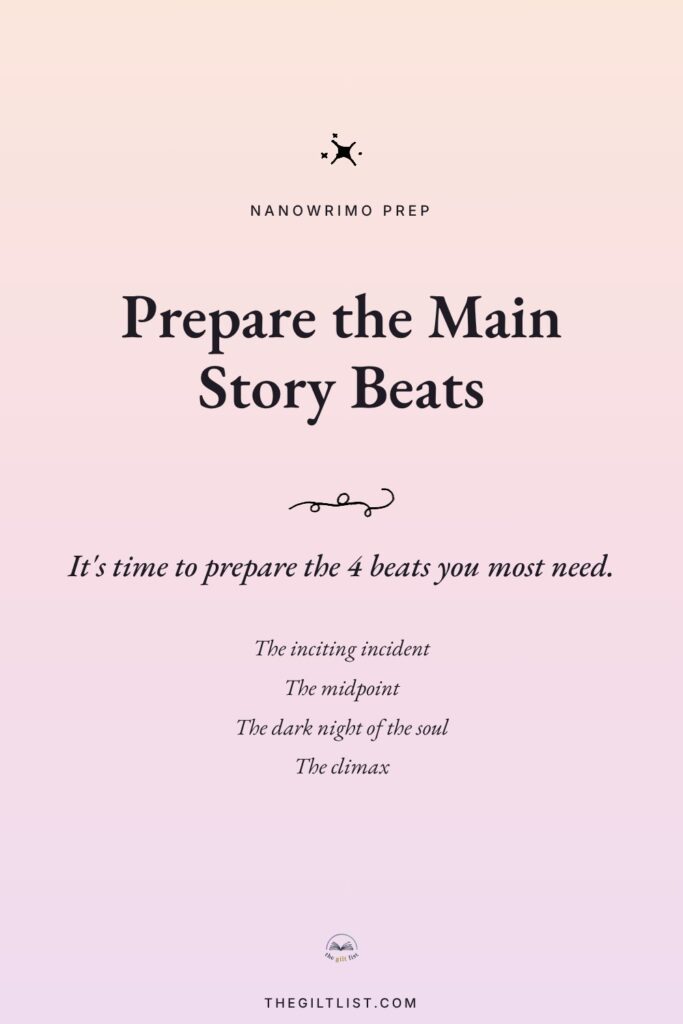
The first big moment is your inciting incident, which we’ve already covered. This is what disrupts your character’s normal life and sets the story in motion.
Next, your character starts working toward their goal. They’ll face problems, make decisions, and hopefully win a few small victories along the way. But around the middle of your novel, something important should happen that changes how they understand the situation. This is called the midpoint.
For example, perhaps your character has spent the first half of the novel trying to rescue someone, only to discover that the person they’re rescuing is actually working with the villain. Suddenly, the original plan doesn’t make sense anymore.
This is why the two halves of Act Two should feel different. Before the midpoint, your character is pursuing their original goal with the information they have. After the midpoint, they’re responding to what they’ve discovered, usually with higher stakes and a much bigger problem to solve.
After the midpoint, let the character try the new approach and watch that go wrong too. Ideally, the problems they are facing should now come from the choices they’ve made in the first half of the book, not random new bad things dropping from the sky.
Build this toward the dark night of the soul, when they seem to have lost everything they were after…..and their original belief about themselves or the chaos unfolding is finally impossible to ignore.
Then you have the climax, where they make the big choice differently than they would have at the beginning. That choice should resolve the central conflict, even if it costs them something.
And then you can wrap up!
5. Prepare a List of Scenes You Want to Write
Hate outlining all of the scenes and beats and acts? One really cool idea is to draft out ten scenes you know will be in this book. Pick the ones that really excite you, and lay them out in the order they will probably, maybe, happen.
It could be the kiss, the worst moment in the book, the victory…you probably have a couple of ideas already that are just jumping right out at you.
From here you know exactly where the story will need to go. For example, if two characters kiss, how do they get there? If there is a big argument about a betrayal, how does a character find out about it?
The best thing about this plan is that if you sit down with writer’s block, you can at least smash out these scenes the way you imagine, and edit them if things don’t quite line up later. You can also keep adding to this running list of fun scenes so you don’t run out of ideas to write.
How Should Fantasy Writers Prepare Their Worldbuilding Before NaNoWriMo?
Fantasy writers should prepare enough worldbuilding to understand the rules, conflicts and consequences that affect the opening chapters and maybe the big twist or ending, to avoid plot holes.
Worldbuilding is one of those things that feel really productive to do, but it won’t get words onto the page. So it’s best imagined outside of sitting at your desk.
If you want a worldbuilding process that asks you questions you probably haven’t even imagined to ask yourself, that’s what the worldbuilding tool is for.
What Magic Rules Do You Need Before Writing?
Start with what magic can do, what it cannot do, and what it costs. Write a running list of what magic you know, and think about how that would make people act in certain situations, be it love, violence, or even childbirth.
Would they stop fearing certain things? Start fearing others? The worldbuilding tool also considers magic.
It’s also good to think about magic a few steps deeper than basic levels.
For example, if a character can shoot flames, how exactly does that work? What does it cost them to do it? What is the limitation? This will set up parameters for you as you write scenes, and deepen the emotional world behind the magic.
How Much Worldbuilding Should You Include in the First Chapter?
Only as much as readers need to understand the opening situation.
I know it’s tempting to write several pages in the opening so people understand your world, but trust me when I say…no one needs it.
Readers can infer a lot. Go follow a fan account for something like Hunger Games or Fourth Wing sometime, and you will discover how fast readers are at spotting even the tiniest of clues and making 50 connections. All they need is one moment, when it’s needed.
If the magic doesn’t matter for several chapters, write it in another document. Can that count towards your word count? You make the rules. I say yes. It’s still writing.
For more detail, see our guide to worldbuilding in your first chapter.
How Should You Prepare a Romantasy Novel for NaNoWriMo?
Romantasy writers need to plan both the fantasy conflict and the development of the romantic relationship, if you’re going to plan anything. These are two separate storylines, although ideally they should affect one another throughout the book, especially if you’re planning on publishing.
Start by giving both characters their own goals, then find a way to make those goals work against each other. For example, perhaps your heroine wants to overthrow the king, while your love interest is determined to protect him. Now, every time one character gets closer to achieving their goal, they create a problem for the other.
This gives you a natural way to build conflict as the story progresses. The characters are falling in love, but their goals are pulling them in opposite directions. Eventually, something has to give, and one or both characters will have to make a difficult choice.
Ideally, that choice should come at a cost. Perhaps your love interest has to betray the king he’s sworn to protect, or your heroine has to sacrifice her chance at revenge to save him. Either way, you have a potentially heroic moment that resolves some of the conflict between them and gives readers something to swoon over.
Win, win.
What Romantic Beats Should You Plan?
Romantic beats depend on how spicy your book is. In a high-spice, fast-paced novel, you might want to bring physical intimacy into the relationship earlier, depending on the pace and the promise you’ve made to readers. There’s no set number of scenes you need for that, but the math is about four for popular KU/K+ works out there. If it’s closed door, or clean, you can really draw out that first kiss, as long as you dial up the banter and flirting.
Other beats to plan for usually revolve around the secret one character is keeping from the other, or they’re both keeping. This looks like: The moment they decide not to tell it, the moment it would have been quite important to tell it but they can’t, the moment the other character finds out, and the moment of forgiveness.
The same could be true of a misunderstanding. Which looks like: The moment it is set up, the moment they should have figured it out, the moment the character is hurt by it, and the moment it is resolved.
You could also plan their first moment of real trust, a moment of vulnerability, or when one makes a choice that costs them something because of the other. Then there’s the relationship’s lowest point and the choice to come back together.
For more on planning both plotlines, read our guide to writing your first romantasy novel.
How Many Words Do You Need to Write Each Day for NaNoWriMo?
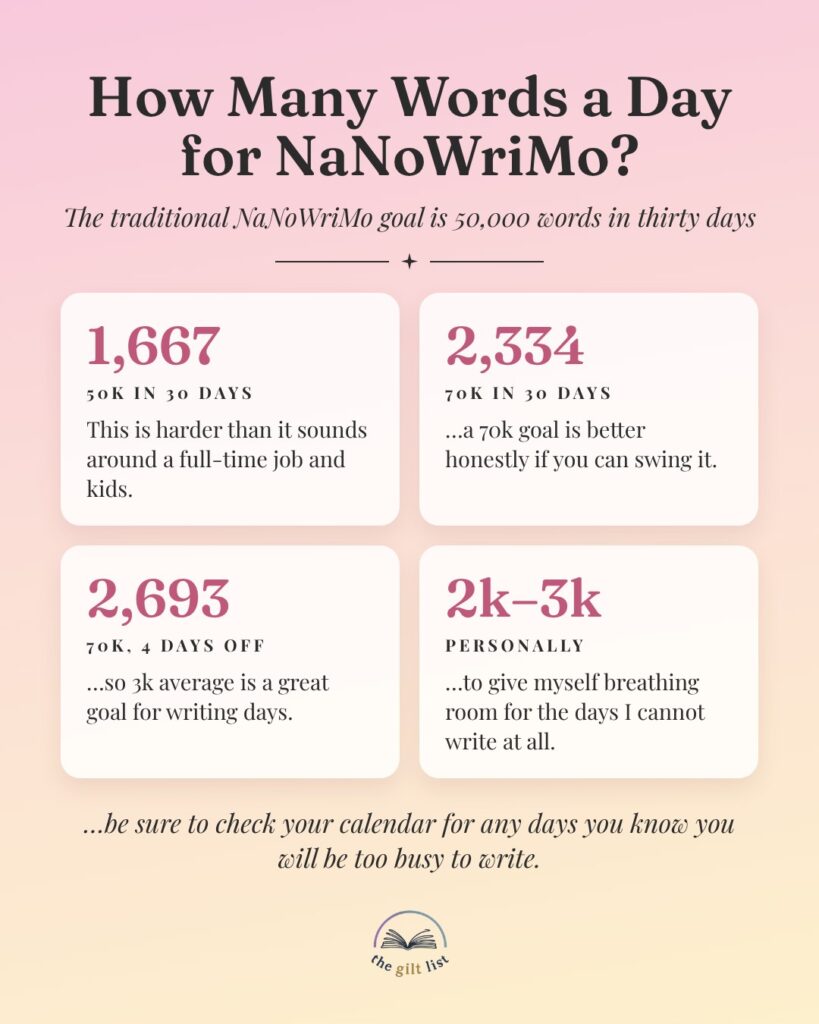
The traditional NaNoWriMo goal is 50,000 words in thirty days, which works out to approximately 1,667 words per day. This is harder than it sounds around a full-time job and kids. Personally, I like to slam out 2k-3k a day to give myself breathing room for the days I cannot write at all.
Before setting off on this adventure, be sure to check your calendar for any days you know you will be too busy to write, and add those words to this 2-3k marker as well.
Tip: To keep up with this absurd number of words, begin typing furiously in your phone’s notepad, or in an email to yourself (so you can add it to your WIP later) in the pickup lane, in the bath, on a train, etc., etc. Then profit.
Remember too that 50,000 words isn’t necessarily a finished adult fantasy or romantasy manuscript; actually, it’s probably half, which is why I think a 70k goal is better honestly if you can swing it. After edits in December, adding on a few thousand more isn’t hard, and the draft will then be complete.
70k is about 2,334 words a day, or about 2,693 if you want four days off, so 3k average is a great goal for writing days.
To see which word count your genre needs, and why, check out our fantasy novel word count guide.
Should You Edit Your Novel While Writing It in November?
For most writers chasing a substantial November word count, detailed editing is better left for later.
Why? Because you will go back, read a bit of it, and on bad days hate it. You’ll want to scrap the whole thing and give up your entire career. This will happen for EVERY novel you ever write, if you’re any good at the craft.
Now, if a structural issue happens that is BIG, leave inline notes or use coloured text to remind yourself what should have happened. You could even put strikethrough on passages that aren’t working rather than deleting them, then keep writing. That way, you can still see the material when you come back to edit and might salvage some of it.
I also recommend keeping two documents going: one for the novel and one for notes. If those notes count towards your personal word count, that’s your call, although an organised challenge may have its own rules.
What Should You Do When You Fall Behind During NaNoWriMo?
First, work out why you’ve fallen behind to see if you can make that stop. If you’re too busy or tired, set a smaller goal. No book was written overnight, and your health matters. Also, let’s be honest: no one’s going to know when you’re a New York Times bestselling author that you failed NaNoWriMo, and no one will ask either.
If the problem is writer’s block or simply not getting words down quickly enough, there are a few things you can try.
Try speech-to-text if typing is slowing you down.
For writer’s block: Daydream the scene before you sit down, note the main elements you need to include, and plan tomorrow’s scene before ending today’s writing session. When you sit back down, reread the last page to get into the flow. You can even stop halfway through a scene during your writing session, so there’s an easy place to start tomorrow.
Also, writing out of order isn’t a crime, despite what your colour-coded outline may suggest. If a scene is calling your name, go for it; sometimes getting the words flowing is enough to build momentum again.
What Should You Do Before November 1?
If you’ve got a week, use it to make the important decisions. If you’ve only got a day, concentrate on the essentials:
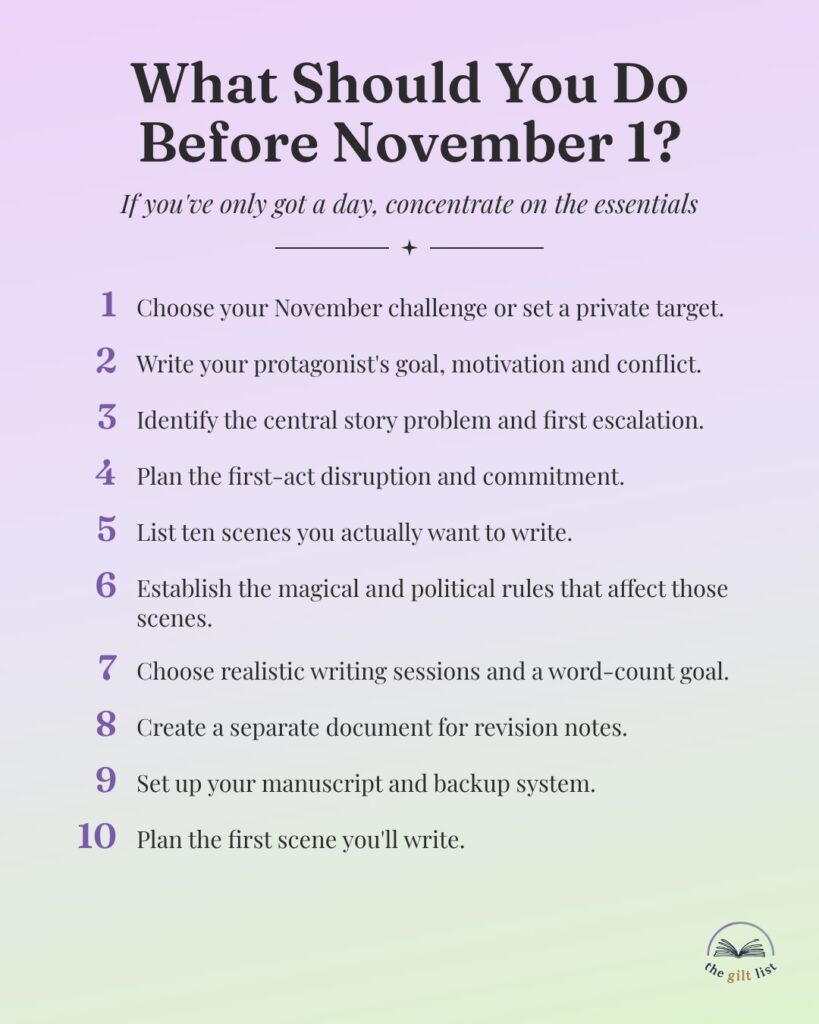
1. Choose your November challenge or set a private target.
2. Write your protagonist’s goal, motivation and conflict.
3. Identify the central story problem and first escalation.
4. Plan the first-act disruption and commitment.
5. List ten scenes you actually want to write.
6. Establish the magical and political rules that affect those scenes.
7. Choose realistic writing sessions and a word-count goal.
8. Create a separate document for revision notes.
9. Set up your manuscript and backup system.
10. Plan the first scene you’ll write.
And then, when November arrives, actually write. And remember, you will hit a wall, pushing through said wall will reward you with a love for your story again….eventually.
What Happens After NaNoWriMo?
Hopefully, you’ll finish November with a substantial draft, a better understanding of your characters and a big long list of what to fix next. Whether you reach 50,000 words or not, you’ll have material to work with, and that’s what really matters at the end of the day.
If the novel isn’t finished, keep drafting before committing to detailed revisions. Work off the momentum you’ve created and get to the end of the draft. If it is finished, give yourself some distance, then evaluate the structure. Does the plot develop logically? Do the characters still have clear goals? Does the opening establish the story you’ve actually written? Is everything in the story that you wanted there? Sometimes we think we’ve written something but it doesn’t quite materialise.
When you’re ready for feedback, I offer First Chapter Critiques, Fantasy Manuscript Critiques and Developmental Editing for fantasy and romantasy. You can also use our fantasy first chapter checklist to take another look at your opening before sending it to anyone.
Frequently Asked Questions About NaNoWriMo 2026
Yes. Independent organisers are continuing November novel-writing events, though the original nonprofit closed in 2025.
The tradition runs November 1–30. Check the dates for your chosen independent event.
The classic goal is 50,000 words in thirty days, averaging about 1,667 words per day. Other independent challenges can have more flexible targets.
Yes. You don’t need previous publishing experience; begin with a manageable goal and a story problem you want to explore.
No. But a clear protagonist goal, central conflict and some idea of the first act can make November drafting easier.
Keep writing after November. Missing a word-count target doesn’t invalidate what you’ve written.