
If you’re starting a fantasy novel for NaNoWriMo, please, I’m begging you, don’t spend the last few days of October inventing the fourth dynasty’s family tree.
I know. It’s fun. I’m a bore. But you have to trust me.
When November 1st rolls around, none of that family tree will help you write chapter one. What you actually need is seven little things. Come and I’ll show you.
Want the bigger picture? My NaNoWriMo 2026 prep guide covers the whole month, and how to outline a novel before NaNoWriMo goes deeper on structure. Everything else lives in the writer hub.
Quick answer: Before starting a fantasy novel, decide seven things: what your main character wants, what breaks their normal life, the central conflict, two or three magic rules and their costs, what the reader needs to know on page one, which relationship will change the plot, and what your first scene is about in one sentence. Everything else can wait until you’re drafting.
Jump to:
- The seven decisions
- What you can leave for later
- Should you write a prologue?
- The seven decisions checklist
- After chapter one
What Do You Need to Decide Before Starting a Fantasy Novel?
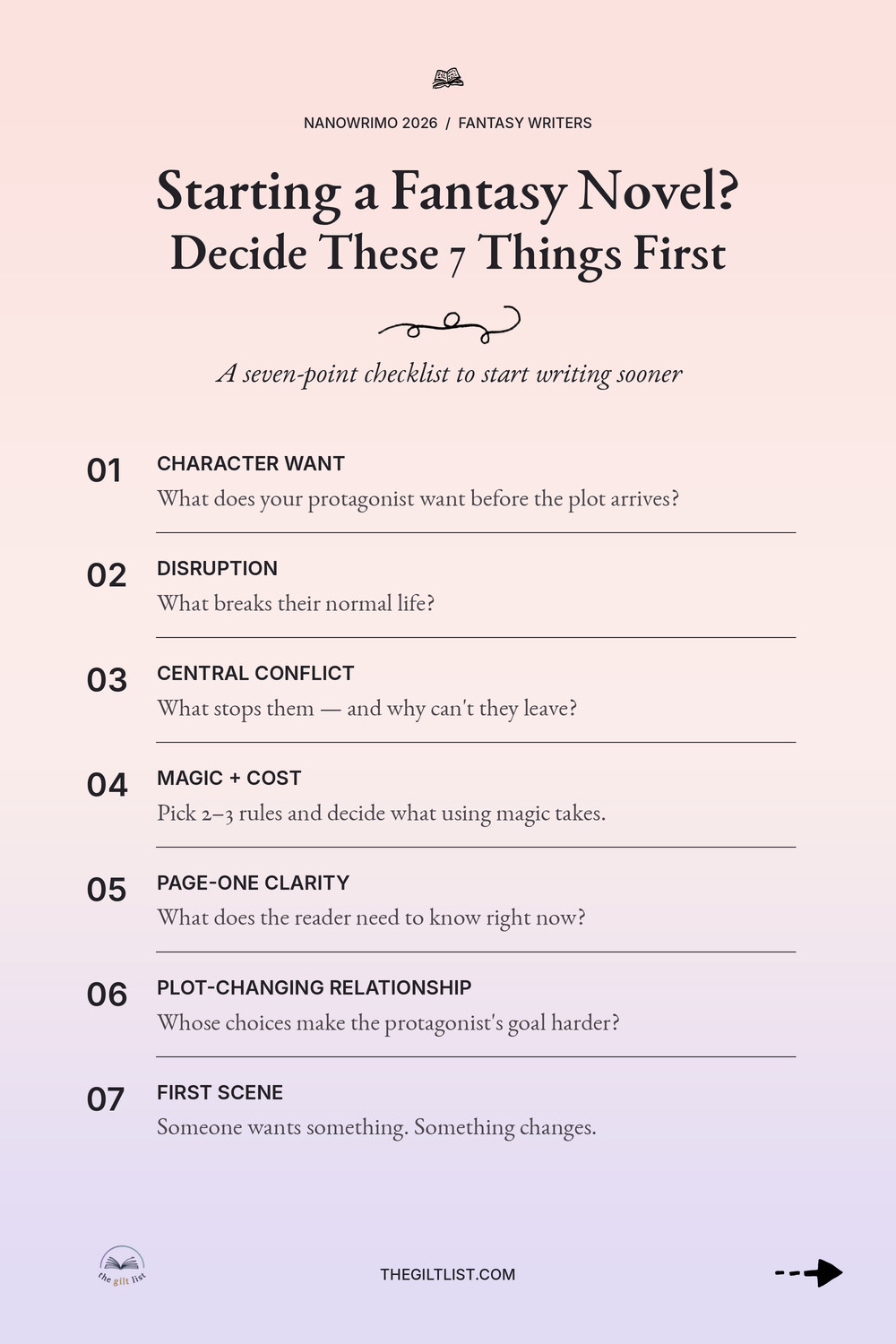
Here are the seven. I’ll use one example all the way through so you can see how they work. It’ll be about Georgina, a debt collector paying off her family’s debt to a guild by collecting other people’s debts.
1. What Does Your Main Character Want Before the Story Starts?
Your main character needs to want a thing before the big bad comes. This could be a sense of safety, belonging, a promotion, revenge, freedom, and so forth. Write it down, then decide what they’d risk to get it, or what they wouldn’t risk, to get extra spicy.
For example: Georgina wants to buy her family’s debt back from the guild, and she’ll do pretty much anything to make that happen, including things she’s not proud of.
If that want feels a bit thin, my guide to character desire in fantasy will help you dig into it.
2. What Breaks Their Normal?
Something has to make their current plan stop working in its tracks, even if that current plan is to stay in their bed, warm and snuggly, and never leave the house again. It could be basically anything: a public accusation, an invasion of their home, and so on. This interruption only counts if your character HAS to respond to it. If they get to stay under the bedsheets, it won’t work.
When you have the thing that will happen, you’ll know what to do to get to that point.
For example: Georgina’s next collection is a dead man, and the guild says his debt now belongs to her.
3. What’s the Central Conflict?
Three things here. First, name what your character wants, then what’s stopping them, and why walking away would be even worse for them. That thing that’s in the way could be external or internal. As long as the reader understands what it is and believes in it, it will work.
The important tip here, though, is that it needs to cause more than one problem. It needs to be BIG. If you can punch someone in the nose and resolve it, it’s more of a hiccup than a central conflict.
For example: If Georgina can’t pay, the guild takes her little brother as an apprentice for a very dangerous role.
4. What Can the Magic Do, and What Does It Cost?
Listen. I know you want to branch out all the magic ideas and make them really mean something, but I promise for a quick outline all you need is what the magic is and what it takes. It’s not the magic system itself that makes your book interesting, but the catch for that magic system. Think Harry Potter and you can name a million catches. Star Wars too.
For example: Debts in this world are magically binding; you can’t just run from them. If you don’t pay, the guild can take your sense of self, a piece at a time.
When you’re ready to build a magic system that really intertwines with your world and works well, the free fantasy worldbuilding tool will help.
5. What Does the Reader Need to Know on Page One?
Readers just need to know what your character is trying to do and why, to start caring about your story. The politics are fun later, but every good book starts with a reader who loves the characters. And every good writer should start there too. As you’re adding worldbuilding pieces, ensure they only show up because they have to, through action, through consequence, through dialogue and setting.
Read why readers DNF fantasy novels to see more on this thought.
6. Which Relationship Changes the Plot?
In romantasy, that’s obviously the love interest, and you need to know how they make the external plot harder for the main character. What do they want or do that conflicts with your MC’s goals? In other fantasy, you can pick a friend, rival, sibling or ally whose choices will force your character to rethink something about the world, their goal, or themselves.
For example: The dead man has a son, and the guild has told him to make sure Georgina pays.
Writing a romance-forward book? The big guide to writing your first romantasy novel is your next read.
7. What’s Your First Scene Actually About?
Here, try to fill out this sentence for your own story.
Someone wants something, something gets in the way, and the attempt changes the situation.
For example: Georgina goes to the guild to beg for freedom, she’s sick of this ish. She leaves with even more debt.
If you want help opening strong, the fantasy first chapter guide has you covered.
What Can You Leave for Later?
Honestly? Most of it. Here’s what can wait until you’re drafting, or even until December:
- The full map.
- The family tree of every royal house.
- The religions, calendars and seven moons.
- The made-up languages.
- The names of side characters. Type CHARACTERA, CHARACTERB and keep going. Then CTRL/CMD + F to change them later.
- The exact ending. A rough direction is plenty to work from.
Should You Write a Prologue for NaNoWriMo?
Usually, no. I hiss at prologues and often wonder if a prologue is ever needed. It’s a lazy way to info dump to the reader so you don’t have to do the work of figuring out how to add the world around the action. Sorry not sorry. Write chapter one instead, trust me. If the book genuinely needs a prologue, you’ll know when you’re revising, and several beta readers will agree with you if you’re right.
A prologue is only worth it if it sets up a promise or conflict that chapter one can’t deliver as well. It should never, ever be used to explain your magic system, or act like a bible of what happened in the world before now. Put the keyboard down.
The Seven Decisions Checklist
Write one line for each and you’re ready to start.
- My main character wants…
- Their normal life breaks when…
- They can’t walk away because…
- The magic can…but it costs…
- On page one, the reader needs to know…
- The relationship that changes the plot is…
- My first scene, in one sentence, is…
Done? Brilliant. Now go have a look at the guide to writing 50,000 words in 30 days without burning out, because you’re going to need it.
What Should You Do After Writing Chapter One?
Keep going! Don’t polish it yet; wait until the end of the draft. When the draft’s done and you come back to it, run your opening through the first chapter checklist to see how you can at least strengthen the start and attract beta readers. And when you want a real editor’s eyes on it, I’ll be here.
Frequently Asked Questions About Starting a Fantasy Novel
Decide what your main character wants, what breaks their normal life, the central conflict, a few magic rules and their costs, what the reader needs on page one, which relationship changes the plot, and what your first scene is about.
No. Start with the two or three rules that shape your characters’ choices and keep track of the rest as you draft.
Usually not at the start. Write chapter one first. Only add a prologue if it sets up something the first chapter can’t.
Only what affects your opening chapters: the rules, places and politics your character has to deal with right away. The rest can wait.
It should give readers a reason to care and something to follow. That doesn’t have to be a fight or a chase.
That’s fine. A rough direction is enough to start. Many writers figure out the ending while drafting.