
If you’re anything like me, you have a folder called QUERIES and a tracking spreadsheet with a column you stopped filling in around week three. Forty sent in total and what came back was form noes and silence. Of course, the silence is somehow worse, because at least a rejection is is a closed door.
And if you’re really like me, at around 2am you did the math and decided…the math meant you can’t write.
Thankfully, dear writer, this is not true.
What it actually means is one of two things. Either your query isn’t earning the read, or your pages lose the agent about eleven lines in.
And FYI I read opening pages for a living, from writers who were nowhere near ready and writers who were about three sentences away from a request, and the rejection count has never once told me which was which.
For the ultimate query guide with lots of bits and pieces to read that should help you on this journey check out How to Query. If you suspect the letter itself is the problem, rebuild it with the query letter builder for fantasy writers before changing the manuscript. Or head to the writer hub for all the guides in one place.
Takeaways
- A stack of noes with no requests is the most common outcome in querying, and on its own it tells you almost nothing about your book. So breath.
- Per-agent request rates run somewhere between 0.03% and 1.1%, and that number is a bit off, because wins are often flagged more.
- In science fiction and fantasy specifically, one dataset of agents put average rejection rates around 87%, with a range of 70% to 98%.
- Most agents read your sample pages inside the query email, so it could be either.
- Watch requests, not rejections. Zero requests across twenty-five well-matched agents probably means your query letter needs work. Requests with silence after? Probably opening pages. I love this idea, keep working on it? Deff open pages.
- Romantasy has an extra hurdle right now, because agents are drowning in it.
Why am I not getting requests from agents?
You’re not getting requests because your query hook isn’t selling the book, or because the sample pages underneath it lose the reader before page two. Those are the only two things most agents ever see, so those are the only two things that can be going wrong, obviously.
Query letters almost always need a unique “hook”. Something that hasn’t been done before, that is unique to you. Think, magic is made by sewing pieces of fabric together, or dragons are more intelligent than humans are are the ones pushing the war. A twist on a trope, something that stands out, etc. And that query must be character driven to boot.
Here’s the bit most writers miss though. The query letter feels like the thing on trial, obviously, because it’s the thing you rewrote eleven times and read aloud to your partner who said it sounded great, love that for you. But most agents want your opening pages pasted straight into the submission, and plenty of them read the pages first and the letter after. Yeah, I was shocked by that too.
A perfect hook still dies if the pages under it open with a map, a prophecy, and four invented nouns before anybody wants anything. Or a prologue. Yeesh.
What is a normal request rate when querying?
The best available public numbers we have put the average manuscript request rate per agent somewhere between 0.03% and 1.1%. At the generous end of that you’d query about a hundred agents to earn one request. At the other end, over three hundred, which is more agents than most subgenres even have.
And that data comes from writers reporting into query databases themselves, which pollutes things because they stop once they get an acceptance. So the real rate is probably worse than the reported one, which I find weirdly comforting rather than depressing, because it means the pile of noes on your screen is arithmetic and not a review on you as a writer.
For fantasy the picture is the same. One analysis of science fiction and fantasy agents pulled from query-tracking data found average rejection rates around 87%, ranging from 70% to 98% depending on the agent. And the agents who’ve published their own annual figures tell the same story. One reported taking roughly four thousand first-novel queries in a year, reading about 150 of them in full, and signing eight writers. Another agency published a year where 6,152 queries produced 26 requests and two new clients.
Never stop writing based on queries, as you can see, it doesn’t mean much to be rejected.
How many queries do agents actually receive?
One widely shared estimate puts the average agent’s annual slush at around 11,000 submissions. Agents who went and looked at their own query-database records push back hard on that, saying the realistic figure for most of them is closer to 1,500 to 5,000 a year.
Fine, so let’s take the conservative end. Three thousand queries a year, read by one person who also has a client list to sell, contracts to negotiate, editors to chase, and presumably a family who’d like to see her (or him, or they). That’s about sixty openings a week arriving on top of the actual job. Nobody reads sixty openings a week generously. They read looking for the moment they’re allowed to stop, because stopping is the only way through the pile.
Is it my query or my pages?
Obviously, we can’t really know, but probably something like:
- No requests at all. It’s your query hook or your opening pages, because that’s all anyone saw.
- Page requests that turn into passes. The query works. The opening did its job for a few pages and then didn’t.
- Full requests that turn into passes. The opening works and the manuscript loses agents somewhere deeper in, usually in the middle. A lot of agents report being really disappointed by the messy middle trope. Usually, if you can make the middle as tight as the start, you have a good shot.
Most of you reading this are in the first bucket. And most people in the first bucket go and rewrite the query. Nine times, usually (ok I didn’t really count). But the query feels the most fixable, so it’s what we keep tweaking. But if you haven’t had your opening reviewed by an experienced beta or a professional editor, now might be the time.
Why do fantasy openings lose agents faster than other genres?
Every invented name, faction, magic term, and city is something a reader has to carry in working memory while also trying to care about a person. Research on processing fluency by Reber, Schwarz and Winkielman found that when text is harder to process, readers don’t experience it as more sophisticated. They experience it as worse. The friction gets blamed on the writing, every time. Work on narrative transportation by Green and Brock comes at it from the other side, showing that the feeling of being lost in a book snaps the instant a reader hits confusion, and once it snaps they stop being immersed and start being suspicious.
So an opening that front-loads lore is manufacturing friction on the exact page an agent uses to decide. And nobody writes “your cognitive load is too high” in a rejection letter. They write “not quite right for my list,” or they write nothing at all.
I’ve written about this mechanism a lot, because it sits underneath nearly every rejection in this genre. Start with cognitive load in fiction for why a well-written book can still be exhausting, then processing fluency for fiction writers for what it does sentence by sentence, and why readers DNF fantasy novels. The rest of the guides live in the Writing Craft Guides hub.
1. The world turns up before a person does
This is the signature one. Geography, history, magic rules, three ruling houses and their grievances, all before anyone on the page wants anything at all. The reader is being asked to memorize before they’ve been given a reason to care, and attachment never gets a chance to form, so the reader really doesn’t care. And if they don’t care, they’re not emailing you back.
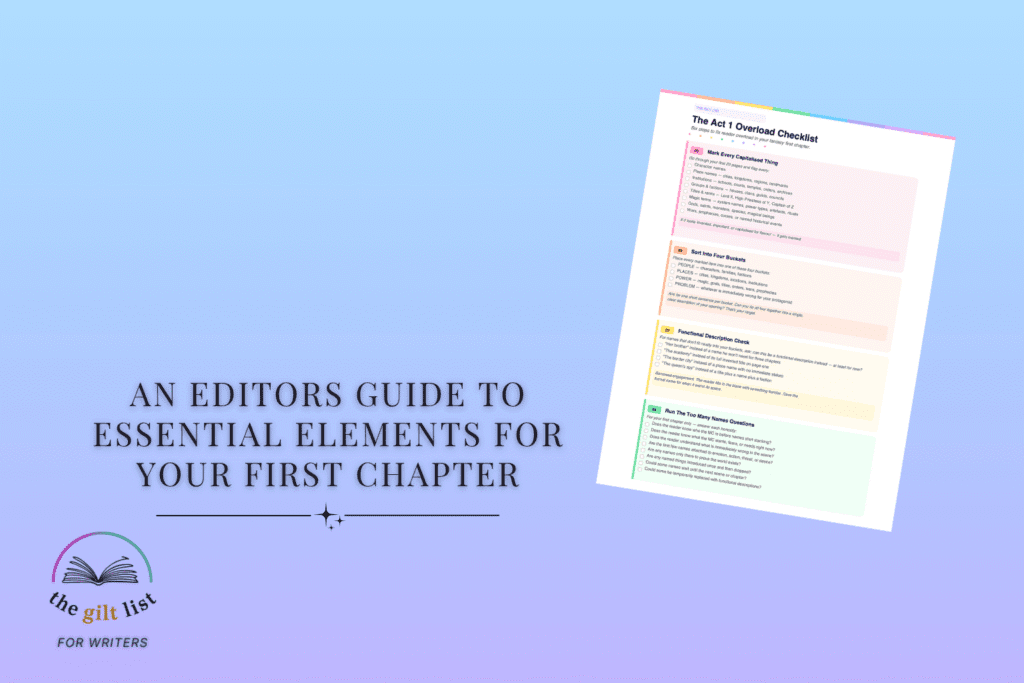
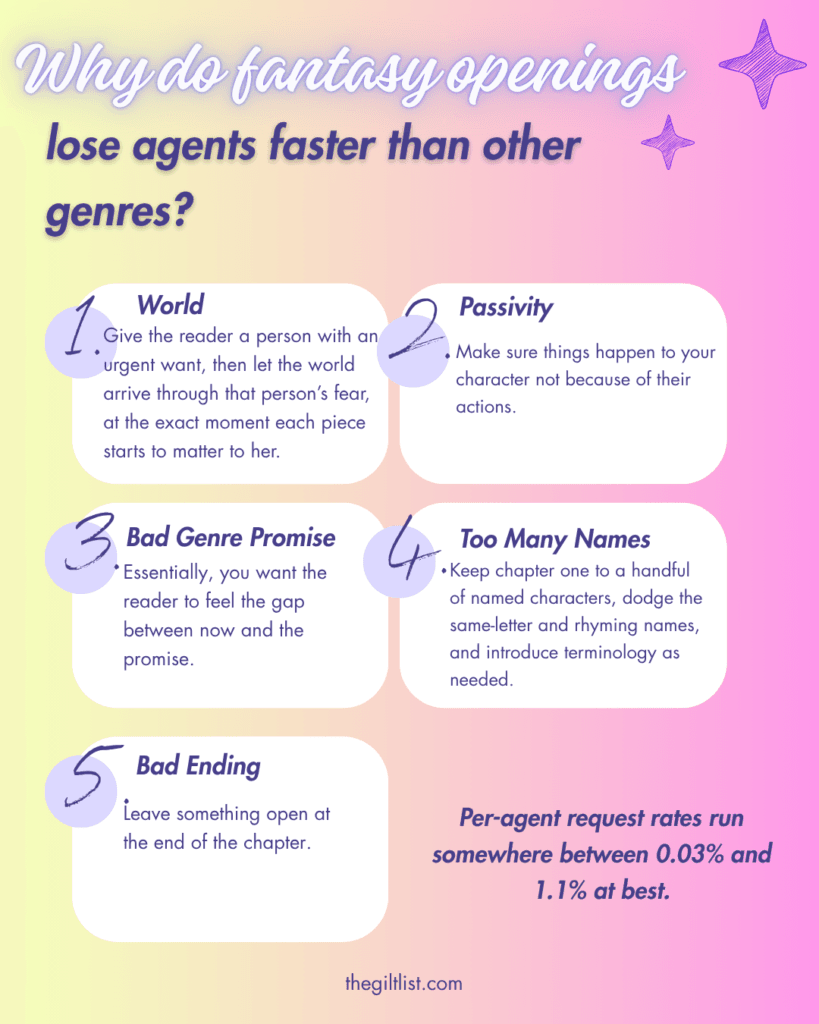
The fix is ordering better. Give the reader a person with an urgent want, then let the world arrive through that person’s fear, at the exact moment each piece starts to matter to her. You can see more about this in worldbuilding in your first chapter or pick up the opening to Quicksilver because the author do this so well.
2. The protagonist is passive
Things happen to her. She observes, she gets escorted from room to room, she reacts to news. Readers will forgive a flawed protagonist and follow a monstrous one quite cheerfully, but they won’t follow an inert one, and an agent reads passivity as a character who isn’t the hero of her own book yet, and a writer who wanted to write a premise, not create a story.
If the want is the part you can’t pin down, how to create character desire in fantasy goes further than “give her a goal.”
3. The genre promise doesn’t match the pitch
Your query says romantasy with a morally grey love interest. Your first chapter is a war council and a map, without a whiff of angst or want. An agent who represents romantasy knows precisely what her readers expect and how fast they expect it, so a mismatch between the letter and the pages reads as a writer who hasn’t clocked her own genre.
Romantasy readers want relational charge in chapter one, bot necessarily the love interest on the page, just the hunger for one, the sense that this is a book where love is coming and it’s going to cost somebody something enormous. What is story promise covers how to signal that without staging a meet cute, but essentially, you want the reader to feel the gap between now and the promise.
4. Too many names, far too fast
Twelve proper nouns on page one, three characters whose names start with the same letter, one of whom is a bloody horse, or even invented terms dropped in with no context, so your reader is translating instead of reading. Keep chapter one to a handful of named characters, dodge the same-letter and rhyming names, and introduce terminology at the moment the scene needs it, only. More on the cast problem in too many characters in your fantasy first chapter.
5. The chapter ends and nothing pulls
The scene closes, nothing is left open, and the reader is free to go and load the dishwasher. You don’t need a cliffhanger, necessarily, but you need continuation energy, which is a different thing. A choice just made, a question that needs an answer, a situation that has changed. How to end a chapter has lots of ideas for this.
If you want a structural read on your own opening before you spend another agent, the Act 1 Revision Tool walks you through the first 25% and flags which of these gaps you’ve got. It’s free, it takes about ten minutes, and it doesn’t ask you to upload a word of your manuscript.
Is romantasy harder to query right now?
Yes, and pretending otherwise helps nobody. Agents are open to romantasy because romantasy sells. They’re also seeing a volume of it that makes standing out much harder than it was three years ago.
An agent at one of the major agencies said it plainly in 2026. There’s real genre fatigue around romantasy, though it keeps selling, and a lot of that fatigue comes from writers chasing a lucrative trend without deep knowledge of the space. Her point was that in a genre like this one, knowing what’s working, which tropes readers are starving for, and what the conventions actually promise, is the entire job.
Which is fixable, thankfully. It’s also a reading problem before it’s a writing problem. If your comps are the three biggest books in the genre and your last romantasy read was two years ago, an agent will feel that in your first chapter long before she feels it in your query letter. How to write your first romantasy novel is the structural version of what those conventions are really asking you for.
When should I stop querying and fix something?
Stop when you’ve queried around twenty-five well-matched agents with the same materials and got back zero requests of any kind. Well-matched being the keyword here.
Your agent list is finite and single-use. You don’t get to re-query the same agent with the same book once she’s passed, so every name you burn on a version that wasn’t ready is a name you can’t spend on the version that is, which is a problem. So you need to be both conservative, and do just enough to tell.
How do I fix it if I’m getting no requests?
Stop querying, work out which layer is failing, fix that layer, then send a fresh batch of five to ten. Firing the same package at more agents just spends your list faster.
- Pause the list.
- Pressure-test the hook. Can you say your book in one sentence with a character, a want, and a problem in it? If you can’t, neither can the agent. And are your comps recent and in your actual lane, or are you comping to the untouchable megasellers like everyone else in the pile?
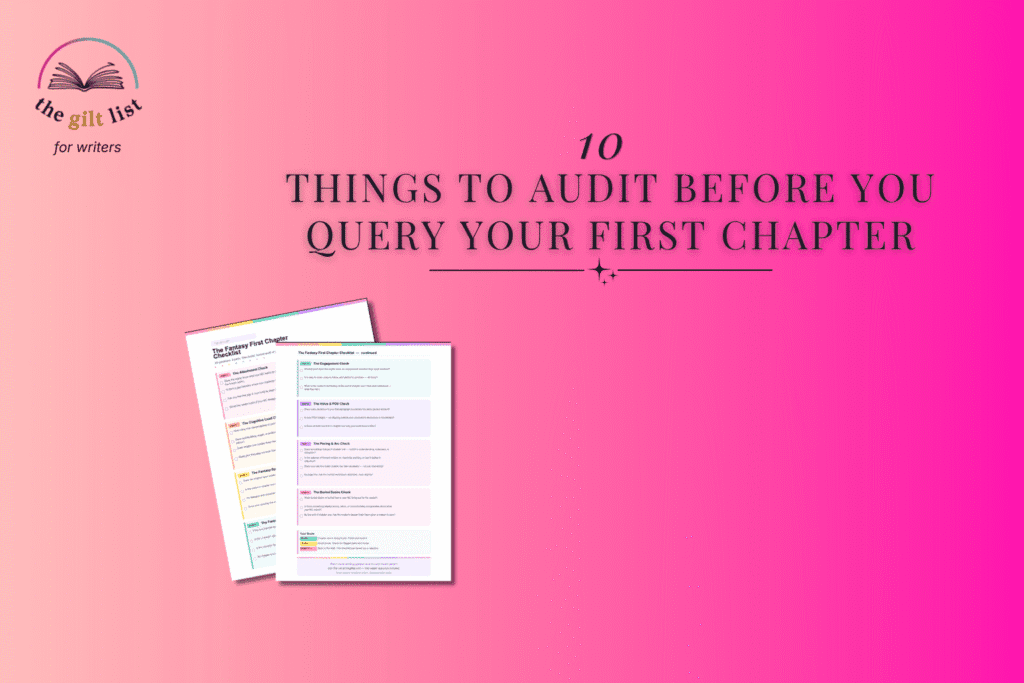
- Read your first five pages the way an agent will. Person before world? A want by the bottom of page one? A real choice in the first scene? Romantic charge on the page if you’re pitching romantasy? The fantasy first chapter checklist and 10 things to audit before you query are both built for exactly this pass.
- Get outside eyes on the opening. You can’t read your own first chapter cold.
- Re-query in small batches. Five to ten at a time.
Help With My Pages
For the outside eyes, that’s my job. A first chapter critique reads your opening the way an agent reads it, with none of your context, and tells you where she’d have stopped and why. If your fulls are being requested and then passed on, the trouble is deeper than the opening and a manuscript critique reads the whole book to find where the story loses people. If you already know the structure needs rebuilding rather than diagnosing, that’s developmental editing.
Frequently asked questions
Around twenty-five, to well-matched agents, with the same materials. Zero requests across that many good-fit agents is your signal to stop and revise.
Most agents ask for sample pages pasted into the submission and read them alongside the query, and some read the pages first.
Anything above zero across a well-matched list means your package works and you’re in the fit lottery. Public data puts the average per-agent request rate under two percent, so even strong books collect a lot of noes.
Increasingly, yes. Plenty of agents work on a no-response-means-no basis, so silence past their stated window is a pass. Log it as a rejection in your tracker past this deadline.
Yes, and the reverse is just as true. The query has to earn the read and the pages have to keep it. If either one fails the request doesn’t come.
Yes. Inboxes are fuller, more writers are querying, and the request rates that looked normal five or six years ago are out of date. Advice built on those older numbers is one of the reasons writers who are performing perfectly normally feel like they’re failing.