
Writers spend an astonishing amount of time polishing the first sentence of a fantasy novel, as though one sufficiently beautiful line will carry three royal houses, an extinct god, a blood oath, and the protagonist’s dead mother safely onto page two.
It won’t.
The first sentence matters, obviously, but most fantasy openings lose readers when the chapter asks for attention before giving them a character, question, or problem to attach it to.
This is particularly easy to do in fantasy and romantasy. You have a world to establish, magic to explain, politics humming in the background, and probably at least one person with silver eyes whose intentions are going to become inconvenient later. The writer knows why all of it matters. The agent only has the pages.
So when an agent rejects a fantasy first chapter, ask what reading experience those pages created. That answer will tell you far more than worrying over whether the writing was “good enough.”
For more information check out the writerly hub for all the guides or the major guide on How to Query for all you need to know, or even Why Am I Not Getting Requests.
Takeaways
- Before polishing the prose again, test the scene underneath it…who wants what, what stands in the way, what choice is made, and what changes?
- Fantasy openings usually fail because they ask the reader to process the world before giving them a character, problem, or question to care about.
- Worldbuilding works best when it appears through the protagonist’s immediate fear, goal, conflict, or consequence.
- A protagonist can be active on the page and still feel passive if they are not making choices that affect the scene.
- The opening should promise the same genre, tone, pace, and emotional experience that the query promises.
- Too many names and invented terms create cognitive work before the reader knows which information matters.
- Mystery gives the reader a clear question. Confusion removes the context needed to form one.
- A prologue should create dread, pressure, mystery, or story promise.
- If the book becomes compelling on page thirty, the real beginning may be buried later.
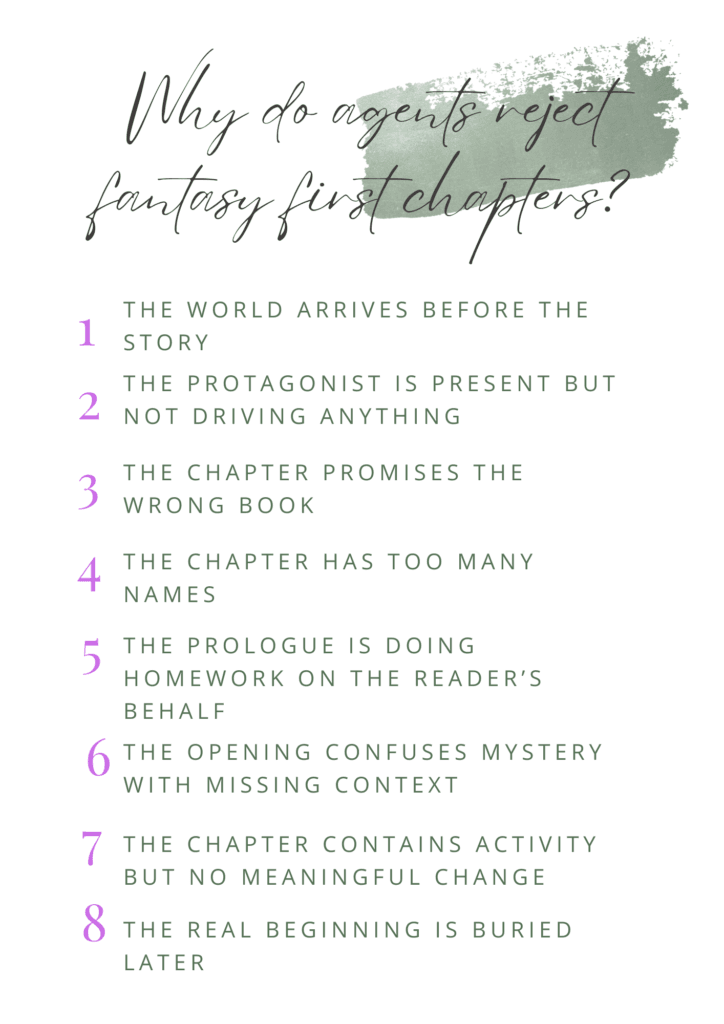
Why do agents reject fantasy first chapters?
Agents reject fantasy first chapters for any number of reasons, including taste, market fit, timing, and the needs of their list. No editor can inspect a rejection email and announce the exact cause.
But first chapters do develop repeatable craft problems. Like, they introduce information before desire. They promise one kind of book in the query and another on the page. They give the protagonist a great deal to observe and very little to do. And more and more and more. So let’s break them all down.
For the guide that covers most of this check out How to write your first romantasy novel. And if you’re looking for a checklist to help walk you through it the Fantasy First Chapter Checklist can help.
1. The world arrives before the story
The chapter opens with the old war, the ruling families, the structure of magic, or a ceremonial journey through the capital. The information may be beautifully written, but probably way before the reader knows how to use it.
Fantasy writers sometimes treat understanding the world as the entry price for caring about the scene. Usually the reverse works better. Give the reader a person with an immediate concern, then let the world complicate it, and even confuse the reader at times.
A girl hiding an illegal mark before a public ceremony can carry a surprising amount of worldbuilding. We learn what the mark means because she is frightened of it being seen. We learn who has power because those people can expose her. We learn the rule of magic at the moment it limits her choice. And not once did you have to go into the history of magical marks, or ceremonies.
2. The protagonist is present but not driving anything
A passive opening does not necessarily contain a passive person. The protagonist may walk, argue, dress, train, attend a council meeting, and survive an assassination attempt with wit, sass, and plenty of drive. But do they have a goal? And when they tried to move toward that goal did they make something worse? Or is everything happening to them because the world calls for it?
Readers attach faster when they can track desire and choice, and go along for the ride. The desire can be small, think avoid being recognised, steal back a letter, keep a younger brother out of the guard, get through a betrothal dinner without agreeing to anything. But it must set up issue, after issue and have actual choices and wants and dreams.
3. The chapter promises the wrong book
Story promise is the set of expectations an opening creates about genre, tone, scale, pace, emotional focus, and the kind of payoff waiting later.
A query can pitch enemies-to-lovers romantasy, but if the opening contains no relational tension, romantic hunger, threat of intimacy, or even a sense that love will matter, the pages may currently promise fantasy first and romance…eventually. This is a positioning problem, and reader will put it down before they trudge through to what they really wanted.
The love interest does not have to stride onto page one with dark hair and smoldering eyes. But the opening should signal the emotional experience the book intends to sell you. Court intrigue needs social danger. Cozy fantasy needs safety and community. Grimdark needs consequence, and darkness from the get. Think about mirroring what is to come in the opening scenes, and make your descriptors, and locations echo the genre.
4. The chapter has too many names
There is no sacred maximum number of fantasy names allowed in chapter one, the issue is whether the reader knows which names matter now. Like, right now.
A protagonist, her sister, the king she intends to betray, the city, the magical order, and three historical figures can all be introduced quickly, but each proper noun creates a small demand on the reader. It says…remember this. When the scene has not shown why the information matters, those demands pile up, and readers toss out bits and pieces they needed to keep.
Keep the important names active and also attach them to emotion, conflict, action, or consequence. Remember to borrow attachment if you can, aka, brother over Fred my brother.
5. The prologue is doing homework on the reader’s behalf
Fantasy prologues are not inherently bad. Some are excellent. The trouble begins, dear writer, when the prologue exists because the writer believes the reader must understand the mythology before meeting the person whose life it destroys. If you love your worldbuilding more than your characters story, you are probably falling into this trap.
A prologue earns its place by creating pressure, dread, mystery, or a promise the main narrative will fulfil. It does not earn its place by reciting the ancient agreement between six kingdoms while a nameless priest lights symbolic candles. This is great and all, and maybe it really did happen, but why should I care? If you insist on a prologue, give it dread, give it foreshadowing, divert expectations with it, or use it as a story telling device; think The Knight and The Moth, which uses all of these tricks.
The other common problem is tonal whiplash…a violent, high-stakes prologue from a fascinating viewpoint, followed by chapter one in which the actual protagonist spends twelve pages completing chores…well, the reader who opened the book and loved it, won’t love they were lied to.
6. The opening confuses mystery with missing context
Mystery gives the reader enough information to form a clear question. Confusion withholds the information required to know what question to ask. We should leave curious, not confused.
A masked stranger leaving a warning on the protagonist’s bed creates mystery when we understand the warning and why discovery would be dangerous through internal or external dialogue, or a sign on the door of the house with rules and regulations, or well, something to match the two, but not fill in all the pieces. The same scene becomes confusion when we do not know where the protagonist is, what the warning refers to, who is speaking, or why anyone is upset.
Writers often remove context to make an opening intriguing, then discover they have also removed the handrail. Let readers understand the immediate situation, and make it interesting enough to ask what the heck?
7. The chapter contains activity but no meaningful change
A sword fight can feel slow. Two people drinking tea can feel tangible. Pace comes from change and pressure, not simply action packed scenes.
By the end of the chapter, something should be different… the character’s options have narrowed, a relationship has shifted, a risk has become visible, a question has sharpened, or a decision has created consequences. If the chapter ends with everyone in roughly the same emotional and narrative position, the reader has been busy without moving. They don’t know why they’re bored…but they are.
8. The real beginning is buried later
Many fantasy first chapters are written before the author fully knows the book. They begin with arrival, routine, explanation, or a pleasant tour of the setting because the writer is finding their way in.
Then the manuscript discovers its real energy on page thirty, when the protagonist makes the first irreversible choice, meets the person who destabilises them, or learns the fact that changes the story.
That does not always mean cutting the first thirty pages and calling it a day, I wish it was that easy. But it does mean asking whether the current opening creates the same promise and pressure as the book once it wakes up. A fun way to do this is to look at your final scenes, climax scenes, and opening scenes to see if they mirror each other. Could you guess the thread by reading just those three?
What does a rejected fantasy opening look like?
Imagine chapter one opens with Aelith entering the Riven Court for a blood ceremony. On the way in, the narrator explains the three houses, the war between them, the origin of the ceremony, and the rule that only legitimate heirs may use blood-magic. Aelith greets several relatives, notices the room, remembers her mother, and worries that something may go wrong, somewhere, out there.
The sentences can be lovely, I mean drenched in style, and beauty. The chapter still has a problem. The reader has been given a setting, history, and event, but Aelith? What does she even want? What is she even afraid of?
Now begin with Aelith hiding an illegal blood-mark beneath her glove while the person inspecting entrants moves closer. She needs to enter the ceremony without being exposed because her younger brother is already inside and cannot leave without her. The houses, war, ceremony, and magic rules can still appear, maybe in panicked thoughts as the threat looms closer. Now every piece of information presses against a want. We want to know. She needs to know. We all want the story to continue.
Is the problem my prose or my first-chapter structure?
Sometimes the prose is the problem…sometimes. Sentences can be unclear, overwritten, repetitive, or so determined to sound fantastical that nobody is quite sure where the character is standing. But if you’re the kind of writer who has this in their blood, dreams of writing, breathes it, I can almost guarantee it is never your prose. Prose is where the talent usually lies.
More often, writers keep polishing prose because it is easier to adjust a sentence than question the scene underneath it, the scenes underneath take years of study. You can get there intuitively, but diagnosing it once it’s gone wrong is a whole other ball game. Which is why professional help really is so huge for many.
If you’re trying to really fix the opening of your story try this. Summarize the chapter without the prose. Who wants what? What makes it difficult? What choice do they make? What changes? What kind of book does the chapter promise? Does the final chapter of the story match the opening? Vague answers usually point to a structural problem, and can help you dig your way out. Weak answers to, like a boring want.
What should a fantasy first chapter establish?
A first chapter does not need to explain the whole world, reveal the central villain, introduce every major character, or stage a small explosion to prove the book has pace.
It should give the reader enough to enter the story with confidence. Usually that means:
- a viewpoint character with a clear immediate concern;
- a desire or intention that gives the scene direction;
- pressure, opposition, or consequence;
- worldbuilding attached to the current problem rather than delivered in advance;
- an honest signal of genre, tone, and emotional focus;
- a meaningful shift by the end of the chapter;
- a reason the next chapter matters.
Related reading: Why Readers DNF Fantasy Novels | How Can I Get Professional Editing Help With My First Chapter? | Browse the Fantasy and Romantasy Writing Guides
What to do before you send another batch
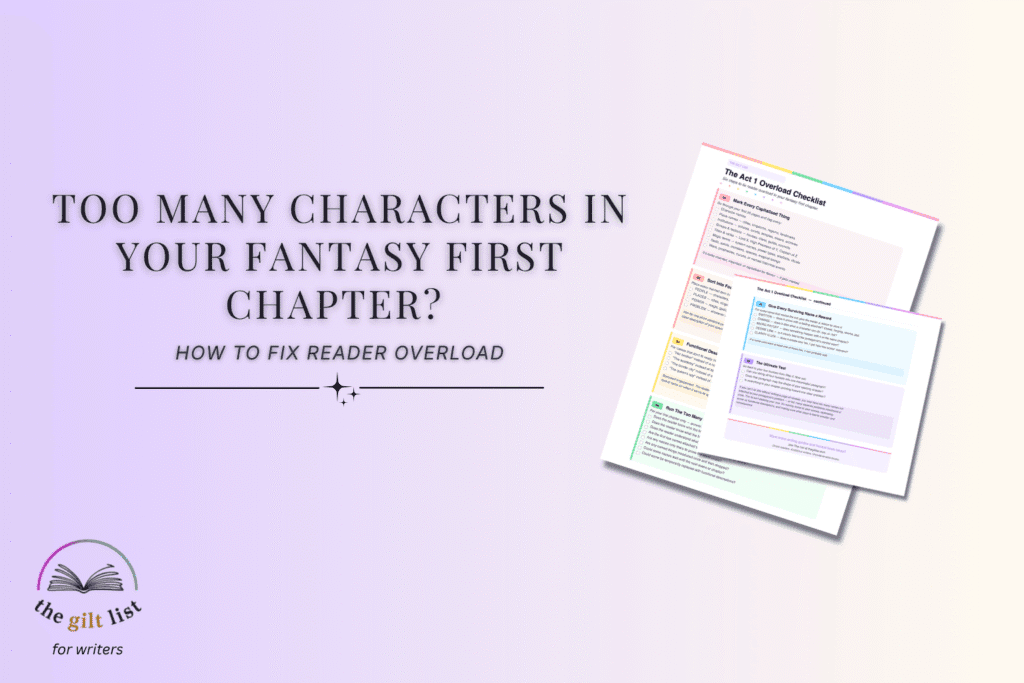
Run the opening through the Fantasy First Chapter Checklist or the free Act 1 Checklist Tool. They will help you separate a chapter-one problem from an Act 1 problem before you start cutting scenes at random.
If you can see that something is wrong but cannot tell whether the issue is story promise, pacing, character desire, worldbuilding load, or where the book begins, book a First Chapter Critique for fantasy and romantasy. I read the opening as an editor and as the sort of reader you are trying to keep, then give you an ordered revision plan instead of a list of disconnected problems.
Writers who are still shaping the story can use the Fantasy and Romantasy Novel Plot Planner to test the book’s main beats and chapter direction. The writing craft guide hub has the deeper posts on reader attachment, worldbuilding, pacing, and story promise.
Why the critique is worth doing before you query harder
A weak opening can use up a very good agent list before the writer has enough information to revise well. A First Chapter Critique gives you feedback on the pages agents are actually seeing: the hook, the opening sequence, the fantasy or romantasy promise, and the point where confidence starts to slip.
You receive specific notes on what is already working, what is creating friction, and what to revise first. Your manuscript is read by me and is never run through AI. You can also read how professional fantasy chapter editing works before deciding which level of support makes sense.
Frequently asked questions
Agents differ, but a strong fantasy opening usually offers a clear viewpoint, character desire, controlled worldbuilding, a legible genre promise, and forward pressure. The chapter needs to make the reader want more, not explain everything at once.
Include the worldbuilding the reader needs to understand the character’s immediate choices, risks, and reactions. Delay information that has no current story function. The issue is not the amount alone, but the order and relevance.
There is no universal chapter deadline. The opening should, however, signal that romance is central to the reading experience. That signal may come through the love interest, another relationship, romantic desire, or a clear relational promise.
Some submissions are declined very quickly, while others are read further. Writers cannot control the exact stopping point. They can make sure the first page is clear, specific, and connected to a scene with desire and pressure.
Start with a character in a meaningful situation. Action only helps when the reader understands who is involved, what they want, and why the outcome matters.
No. A prologue works when it creates a necessary promise, pressure, or question that the main narrative will carry forward. It becomes a problem when it mainly teaches background or promises a more compelling book than chapter one delivers.