
You’ve reached the middle of your novel and discovered that the ending you planned no longer makes sense. Or you know how the book ends, but you have absolutely no idea how to get your characters there. Meanwhile, chapter three is looking more and more tempting to rewrite. Again.
If you’re wondering how to finish writing a novel when the middle has become a mess, well, I’m going to show you. But the main point is Finish it messy.
You can change the ending later. You can even change the beginning to suit the ending you eventually write, to be honest with you. And I’ll tell you what, it’s much easier to make those decisions when you can see the whole story at once somewhere, rather than spending weeks polishing chapters that might get the axe.
To finish writing a novel when you’re stuck in the middle, choose a possible ending, work backwards through the major decisions, and write the scenes you can already picture. Skip difficult passages with placeholders and keep a list of changes to make later. Finish the first draft before tackling major structural rewrites.
Writing a book? Find more craft guides, writing tools and editorial advice in The Gilt List Writer Hub.
Jump to:
- Why are you stuck in the middle of writing your novel?
- Should you edit your novel before you’ve finished the first draft?
- How do you work out the ending of your novel?
- What should happen in the second half of your novel?
- How can you keep writing when you don’t know what happens next?
- What if you’re writing a romantasy?
- How can you finish your first draft faster?
Why are you stuck in the middle of writing your novel?
The middle is where all those stunning ideas from the beginning start demanding you do something with them that works. Like, your protagonist has made choices, your characters know things they didn’t before, and the plot you planned may no longer fit the people you’ve written and how they sound coming from your mind.
Before you rewrite anything, work out which problem you have:
- You know what happens next but can’t get the scene to work. Summarise it in brackets and skip ahead.
- You know where you want to go but not how to get there. Write the later scene, then work backwards.
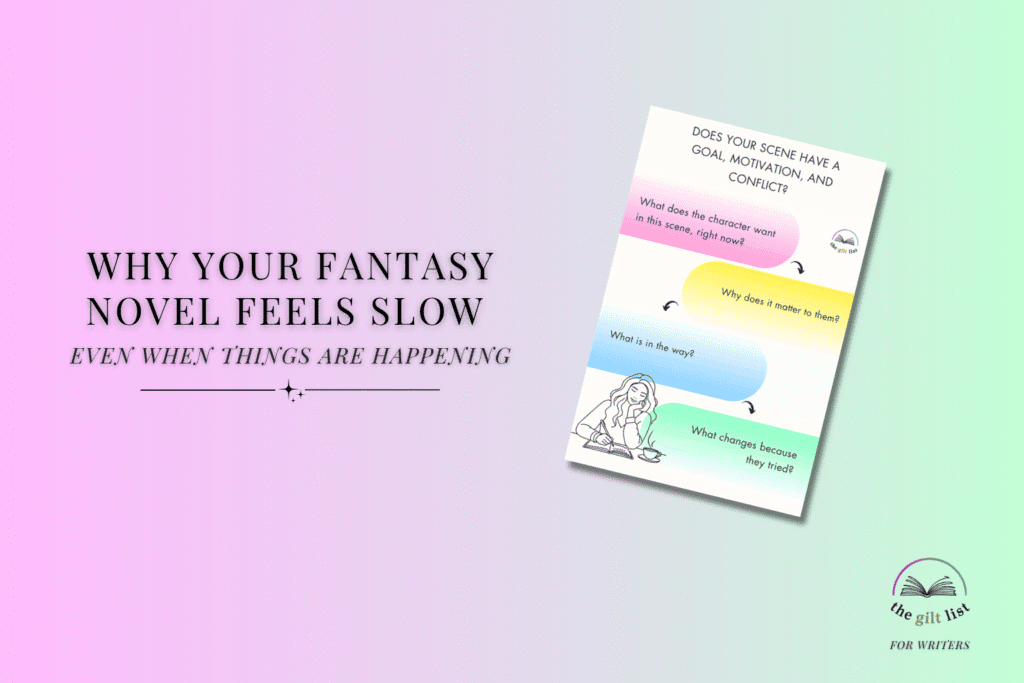
- Your character has no reason to make the next move. Check what they want now, why they want it, and what’s stopping them.
- You don’t know what the antagonist is doing. Pick a move they could make that puts pressure on the protagonist’s goal. Basically, make them want the opposite.
- You can’t see an ending at all. Start with the final choice your protagonist might have to make.
If you know what happens next but dread writing it, the issue might be energy or enthusiasm. My guide to losing interest in writing your novel can help you tell the difference.
Should you edit your novel before you’ve finished the first draft?
For a fast first draft, put major rewrites aside until you’ve reached the ending. You can correct a mistake or reread a few pages if you need to find your place, but don’t spend a fortnight rebuilding the opening while the rest of the book is still changing because trust me when I say this: you will have to rewrite it again at the very end.
Let’s say your protagonist believes the prince killed her sister. About halfway through, you decide he didn’t do it, but he is protecting the person who did. Well, that changes his motivation and probably a few earlier conversations. It might also change the romance, depending on how long he keeps that secret.
Here, write a note at the top of your document or in a separate file: Prince protects the killer. Check his motivation and dialogue in earlier chapters. Then continue as though you’ve already made the change.
Once you reach the ending, you can decide exactly where the truth needs hinting at or what slight things to change in earlier scenes, without having to make massive rewrites, and cut too much because you were overwhelmed. You may even discover that the new version doesn’t work either and have to start again. And at least this way, you don’t have 10 versions you’ve rewritten and wasted time on.
You can revise while drafting if that’s how you work best; that’s fine — you do you. BUT if your goal is to finish quickly, save the bigger elective surgery for later, so you don’t spend years on the same WIP.
How do you work out the ending of your novel?
If you don’t know it, choose a possible final decision and outcome, then work backwards from it, and see where it lines up with what you have….basically, go ahead and write the final scene, have the character wax poetic about all the things they’ve lost and gained…Now you know what to lose and gain, what to make painful to lose, what to make hard to gain, and how to tie up the book.
Don’t know the ending? Flip to the beginning. What is your character’s weakness, and what would it take to turn it into a strength? What are they missing in their life that they NEED not want, and how can the ending give them that? What goal are they after overall, like get the crown, etc., and how would getting it or not getting it improve how they feel about themselves? You want your ending to soothe the real issue internally for the character, not what they think the issue is. If these are opposites, even better.
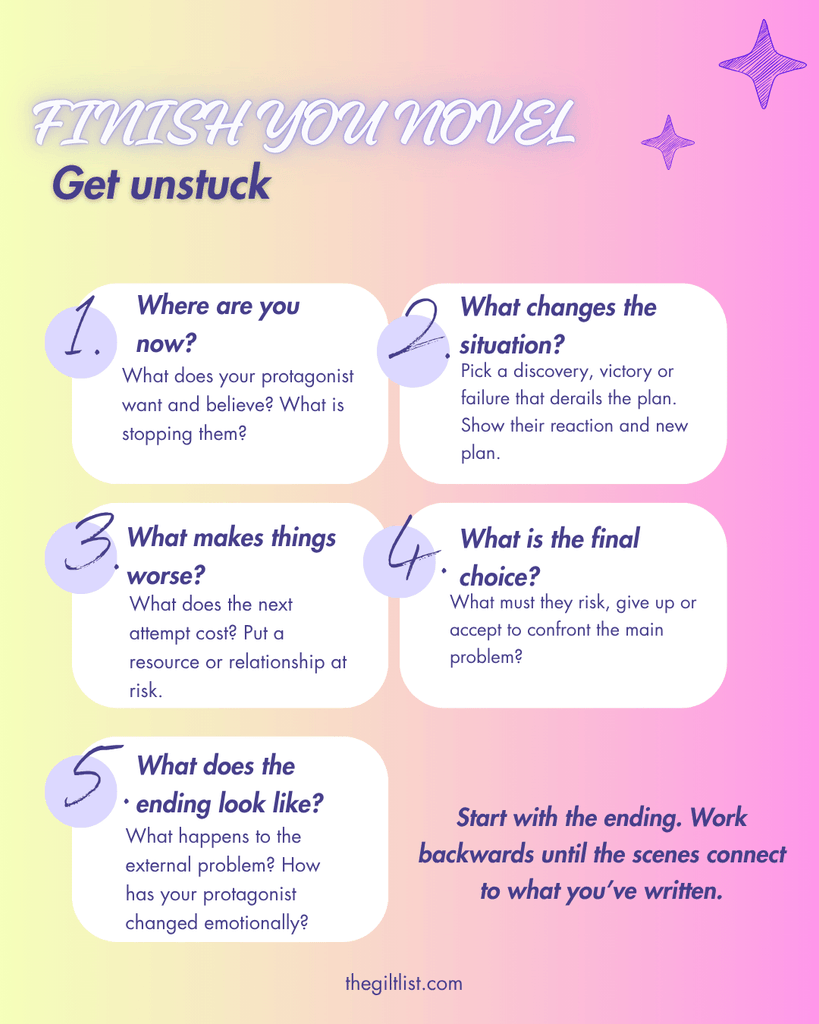
Write a short finish map using these five points:
- Where are you now? What does your protagonist want, what do they believe, and what is stopping them?
- What changes the situation? Choose a discovery, victory or failure that makes their current plan harder or impossible. That’ll be one scene. Then you have them react and think of a new plan.
- What makes things worse? What does their next attempt cost them? What resource or relationship is now at risk? Make it happen or almost happen. If it doesn’t happen, what does it cost instead?
- What is the final choice? What must they risk, give up, or accept to confront the main problem?
- What does the ending look like? What happens to the external problem, and what has changed for the character emotionally?
For example, imagine your protagonist is trying to break a curse and believes a spell will do it. Halfway through, she discovers the spell transfers the curse to someone else, but her ally uses it anyway. At the climax, she must decide whether to repeat that harm to save someone else she loves.
If she refuses and finds another way to contain the curse, what does that other way cost? What has to happen before she knows it exists? Who could help her, and why would they agree? Add those answers to your map as scenes for solving this problem. Combine them where it makes sense.
Now work backwards again. If she needs the ally’s help in the climax, what must happen before the ally will trust her? What would make that happen? Keep asking what, why, and how, until you reach a situation you’ve already written. This is your map moving forward.
You don’t have to solve the whole book in one sitting, if there is still gaps that’s ok, that’s what a dev editor is for. You just need to fill in as much as you can. Besides, walking away from a problem will often give you the solution. If you want more help organising the larger beats, use this guide to outlining a novel or try my Novel Plot & Beat Planner, which walks you through the process step by step.
What should happen in the second half of your novel?
The second half needs to carry your protagonist from their current problem toward a decision that changes it. A revelation can make their original plan impossible; their response can then create the trouble that leads to the climax.
Look at the major developments you’ve already written. What has your protagonist tried? What have they learned? If their plan is still exactly the same as it was near the beginning, give them a reason to reconsider it. For more ways to organise those turning points, see my guide to plot structures for fantasy novels.
Here are some places to start. Pick whichever makes you want to write, as the more words you have on the page the more clues you will give yourself.
Around the middle: Let the protagonist get something they want, but then discover it isn’t what they expected. Or go ahead and reveal that someone they trust has been lying about the goal. How does that change their next move?
As the consequences build: Let their new plan work, but at a cost. Perhaps someone else is put in danger, or the protagonist loses the one resource they were relying on. What do they try now that the easy answer is gone?
Near the end: Put two things they value into conflict and watch it play out. If they can save the person or complete the mission, which do they choose? What has happened earlier that makes this choice painful? How can you make it hurt the reader the most?
After the climax: Show the result. What has the protagonist gained or lost? How do they feel about what they did, and what does that mean for the people closest to them?
How can you keep writing when you don’t know what happens next?
Skip to a scene you can picture and leave a clear note for the gap, something like, I don’t know what happens here but I know it has to get to X.
I promise, you can write out of order, summarise a difficult passage or draft the ending before you’ve connected it to the middle. Other things to try:
Skip the difficult scene
If you know the characters need to escape a castle but can’t work out how, jump to the scene after the escape and worry about it later. Maybe something about what happens after the escape will give you a clue about it. Maybe a character makes a joke and you’re like YES BRILLIANT that should be the escape. This is why we keep writing forward no matter what. Because it helps you to ask: Where are they? Who is hurt? What did they lose? What problem are they dealing with now? And make those things as painful as possible earlier.
If you’re stuck because a character doesn’t care and doesn’t want to do the “heist” or what ever it is, do a little more thinking before you skip. Start putting people she loves in danger one by one in your mind. Start throwing everything she likes out of the window in a daydream. Cause her as much pain as possible and poke at her. Which thing makes her move the fastest? That’s your choice for scenes, we need to make THAT happen. If that motivation still isn’t clicking, have a look at creating character desire in fantasy.
Use placeholders that tell you what changes
A placeholder is a note in the manuscript marking something you’ll write or check later. It can be as small as [CITY NAME] or as large as a missing scene.
For a scene, write down what happens, why it matters and what is different afterwards. For example:
[ESCAPE SCENE: They get out, but she uses forbidden magic. The queen now knows who she is and can send someone after her.]
That gives you a consequence to work with without having to write it. You can make up the consequence; it doesn’t even matter, as long as it keeps you moving. The idea here is to play. [Something exciting happens here] isn’t the best note. Say three things maybe, and pick one later. Maybe someone gets physically hurt here; say X character gets hurt, and write what happens next. Why or how is not your problem; the next scene is. We can always change these things later, but we can’t work with anything if it isn’t on the page.
Use brackets for research and emotional transitions too: [CHECK HOW LONG THE JOURNEY TAKES] or [SCENE WHERE SHE STARTS TRUSTING HIM AFTER HE TELLS THE TRUTH]. If you don’t yet know how a scene works, write what it needs to achieve and move on.
Keep a fix-later document
When you change something substantial, record the new version and where you think the old version appears. Then draft from that point using the new version. For a deeper check once your draft is finished, use my guide to finding plot holes in your novel.
| Where you changed it | New version | Check later |
|---|---|---|
| Chapter 14 | The queen is the villain | Her conversations in chapters 2, 5 and 9 |
| Chapter 18 | The love interest already knows about the curse | Their first meeting and chapter 11 |
| Chapter 21 | Magic cannot bring back the dead | The healing scene in chapter 4 |
Want to see an example?
Here’s a preview of my plot-hole tracking spreadsheet. Open the editable version to use it as a starting point for your own manuscript.
Preview not showing? Open the PDF example.
Write the scenes you’re excited about
If you can picture something you love and you’re super stuck, write it now. Find out what your characters say when they get there. You might learn something that helps you build the scenes leading up to it.
A fantasy dialogue prompt can also give you convo ideas that inspire you to add a twist or something funny to help pick up the scene a bit energy-wise.
What if you’re writing a romantasy?
Ok so with romantasy, the relationship copies the story beats. For every inciting incident (the big thing that changes the character’s life at the start), there is a romance one and a plot one. For every dark night of the soul (it all goes wrong near the end), there is a plot one and a romance one. You get the picture. The more the romance one is wound with the plot one? The more you weave the story, the more you win at storytelling. Does the main character have to choose between losing her love or saving the day? That’s huge stakes, and huge winnings. But obviously, it’s quite overdone, so the idea is to make it emotionally relevant to this character. If you’re working out how those two arcs fit together, my guide to writing your first romantasy novel goes into the structure.
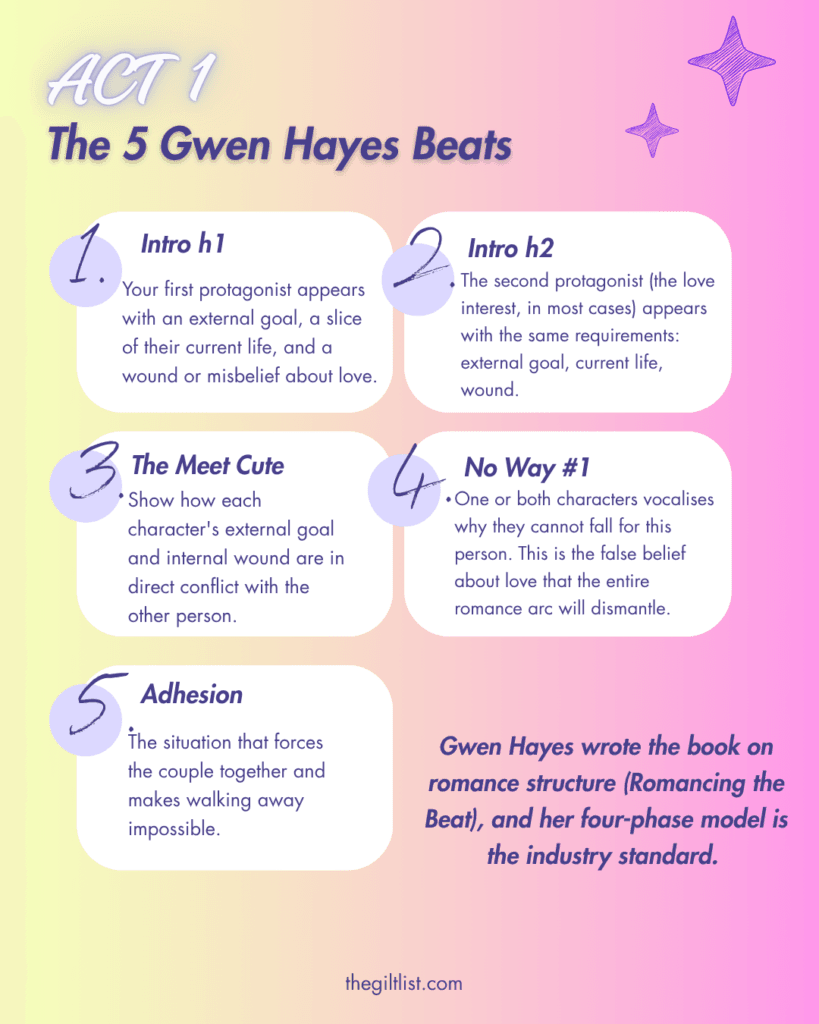
Say your ending requires the heroine to trust the love interest with a dangerous secret. If she distrusts him in the middle, what could he do to earn that trust after? What situation would give him the opportunity to make her like him more? What needs to happen before she is willing to accept his help at all, let alone trust him? Work backwards until you reach a scene you’ve already written, and note the missing steps.
Don’t know the plot, but kind of know the relationship beats? Write the end of the relationship, then work back like the above example. Then ask, what does the plot need to do to make all of that so much worse so that the love and plot line feel like a win/loss, loss/win, win/win, loss/loss?
For e.g. If she needs his help to pursue the curse, that attempt can force them together. If he hides what he knows about the curse, her discovery can damage the trust they’ve built that he NEEDS her to have for the ending. A villain comes along after that and threatens her sibling because of the curse they want. He saves the day. She slightly trusts him more. And so on.
How can you finish your first draft faster?
Make a plan based on the time you actually have. It could be, I will write act 1 by this date, or it could be, I’ll write 2 scenes a day.
If you work better with a word target, estimate how much you have left and divide it by the words you can reasonably write in a session. For example:
- 30,000 words ÷ 500 words per session = 60 sessions
- 30,000 words ÷ 750 words per session = 40 sessions
- 30,000 words ÷ 1,000 words per session = 30 sessions
It could even be time limits to be honest. I will write one hour a day even if I get three words out.
My biggest tip: At the end of a session, leave yourself one sentence about what happens next OR stop the scene half way. Future You gets to open the document and find an instruction or know exactly where to jump off from. This tricks your brain into “keep going mode”.
Once you’ve finished, read through the draft and make a list of the bigger story problems you want to tackle. If you can’t work out what to fix first, my Fantasy Manuscript Critique is for looking at a mostly finished draft and working out what needs attention. You don’t need every sentence polished first.
Frequently asked questions about finishing a novel
Yes. Write or summarise the events needed to connect your current draft to the ending, even if some scenes are rough or out of order. The aim is to have the main story on the page so you can see what needs rebuilding.
Choose a possible final decision for your protagonist and write a version of the ending around it. What do they choose, what happens because of it, and how do they feel afterwards? You can change that version when you know more.
Yes. Leave a note explaining what the scene needs to do, then continue with the next part you can write. Come back before you consider the draft complete enough to assess if the missing scene contains a major decision or event the story depends on.
Work out whether you’re bored with the scene, unsure what happens next, or no longer interested in the story itself. If it’s a scene problem, skip ahead. If you don’t know where the plot is going, choose a possible ending and work backwards. You can fix the earlier chapters once you have a complete draft.
Check what your protagonist wants, what they’ve already tried, and why their current plan is failing. Add a discovery, consequence or difficult choice that forces them to change direction. You don’t need to rewrite the entire middle before moving forward.
Usually, yes, especially if your goal is to complete the manuscript quickly. Keep a list of suspected plot holes and continue drafting with your intended changes in mind. Once the draft is finished, you can check how each change affects the whole story.