
A fantasy first chapter has one hell of a job.
It has to introduce a character, open a world, suggest a genre, create a question, manage reader confusion, hint at the emotional promise, and somehow do all of that without turning into a glossary wearing a cloak.
No wonder writers keep rewriting chapter one until the file name becomes something deeply normal like chapter-one-final-FINAL-real-this-time-v7.docx. (Ask me how I know.)
This fantasy first chapter guide is for writers who know their opening matters, but are tired of advice that says things like “start with action” as if the answer to every story problem is someone falling through a window.
The real question is simpler and much more poignant… has your first chapter given the reader a reason to stay?
Fantasy first chapter guide: quick takeaways
A strong fantasy first chapter usually does four things well:
- gives the reader a person to follow
- creates a clear enough problem, desire, pressure, or question
- introduces worldbuilding only when it matters to the scene
- ends with some kind of continuation energy
What should a fantasy first chapter actually do?
A fantasy first chapter should orient the reader, create emotional or narrative pull, and make a promise about the kind of story they are entering.
Your first chapter is a doorway. It tells the reader:
- whose story this is
- what kind of world they are entering
- what kind of emotional experience the book is offering
- what question, pressure, or problem they should track
- whether the book is likely to reward their attention
That last one matters a lot more than advice often dictates. Readers are not being lazy when they put a book down. Usually, they are making a calculation about whether this story is worth their attention.
Fantasy asks for more effort than many genres because the reader is learning unfamiliar names, rules, places, politics, species, magic, history, and often a romantic dynamic at the same time. That can be glorious when it works. When it doesn’t, it feels like homework. Don’t be a readers homework.
Why fantasy first chapters are harder than normal openings
Fantasy writers have to create immersion and comprehension at the same time. Too much explanation, and the chapter goes flat and reads like a textbook. Too little, and well the reader is frankly lost.
This is the bit where generic writing advice starts to wobble. “Drop the reader into the action” can work beautifully in a contemporary thriller because the reader already understands cars, phones, hospitals, houses, police stations, offices, family dinners, and why it is bad when someone breaks into your kitchen.
In fantasy, “drop the reader into the action” can become:
Vaelreth unsheathed the moonblade as the seventh bell of Arkaeth rang across the ruins of Tharn.
Which might sounds very fancy, but means absolutely nothing.
Who is Vaelreth? What is a moonblade? Is Arkaeth a city, a god, a school, a cursed shopping centre? Why are we in ruins? Is the seventh bell bad? Is Tharn a place, a person, a battle, a breakfast pastry?
The reader can handle a little uncertainty, in fact, you want it (confusing I know). But not at this level. Uncertainty should feel mysterious, ominous, fun, not like a headache. In fantasy opening chapters you are handling load, more than you’re handling suspense. Suspense feels like a cake walk in comparison.
The 4 jobs of a fantasy first chapter
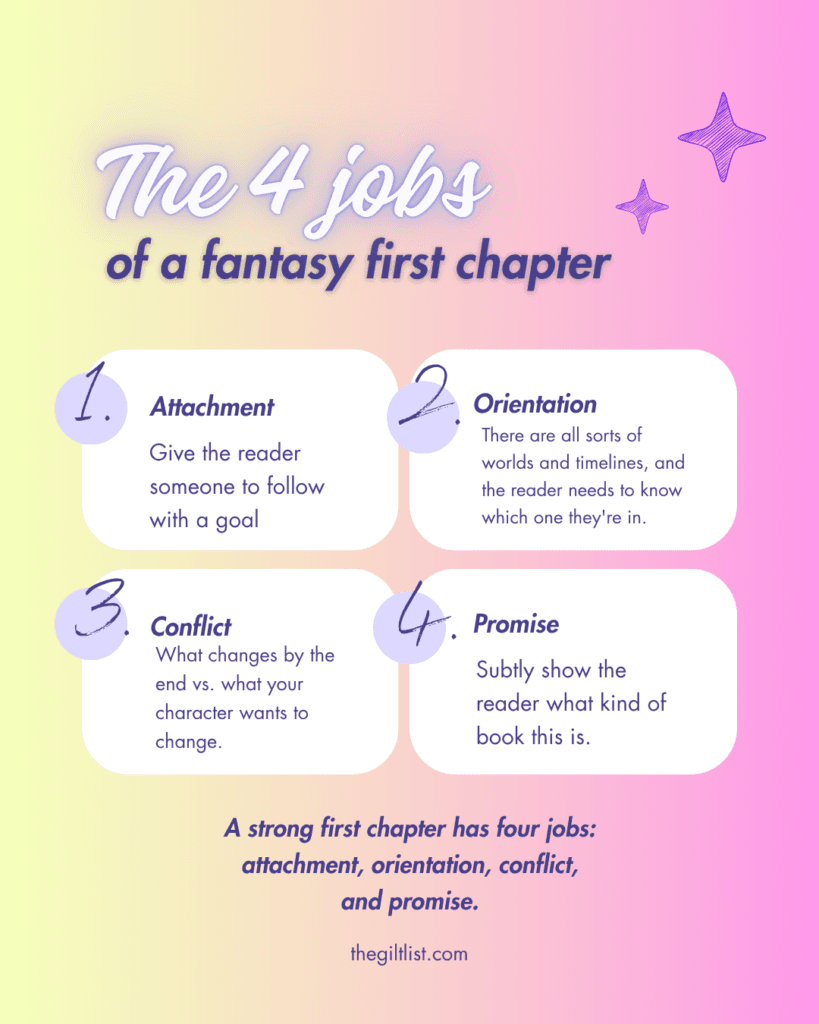
A strong first chapter usually has four jobs: attachment, orientation, conflict, and promise.
You do not need to nail them all with equal force, this will depend on your voice and what is unique to your storytelling. You might find you lean atmospheric (orientation, promise) You may lean into character voice (promise, attachment). Or perhaps you add a dash of revenge talk, or romantic dreaming (promise, conflict). You could be the kind of writer who runs with theme on theme and weaves them together like a ninja with a writing pen for ninja stars (conflict, promise). You doing you helps make a chapter strong. But sometimes, you doing you means you’re more likely to go light on one of the other. Finding what you’re going light on can help bring the writing together.
1. Attachment: give the reader someone to follow
The reader needs a reason to follow this character before they fully understand the world. And I don’t mean likeability. Likeability is wildly over-discussed, often by people who would apparently only read about protagonists who make good group project partners.
Readers can attach to all kinds of characters:
- a competent disaster
- a furious girl with a point
- a scholar who knows too much
- a prince who is clearly one bad day away from becoming a public relations incident
- a lonely person trying very hard not to need anyone
- a liar whose lie is already cracking
The reader needs a human signal. A want. A fear. A contradiction. A wound.
If your first chapter opens with a character walking through a beautifully described city but the reader cannot tell what that character wants, fears, hides, avoids, needs, or misunderstands. That character might save a cat (do a good deed that makes them likeable), but without humanity, a want, a fear, they aren’t sticky. A big issue I see in drafts is a character with a want or fear that’s planted far too late on the page or in some cases, the writer clearly knows what the character wants but forgot to let the reader in on the bit.
2. Orientation: let the reader stand somewhere
Orientation means giving the reader enough ground to continue. In fantasy, there are all sorts of worlds and timelines, and the reader needs to know which one they’re in from the jump. That’s not about blood lines, or magic systems, that’s about…what fabrics are available, are we in space or in a cave? Timeline is such a big one here, you’d be surprised by how many first drafts forget to make what “time” it is very clear.
The reader also needs to know who everyone is…conversation with no explanation is a lesser issue, but happens every so often.
And a step up from that. A lot of confusing fantasy openings are not confusing because the ideas are too complex. They are confusing because the reader cannot sort the information by usefulness. You’re giving the reader history, for example, so the reader starts filing it away for a conflict that must be upcoming….then it never comes. This is tied to promise, but fits orientation too. There is such a thing as false foreshadowing, and it isn’t good.
So if you introduce:
- the protagonist
- the dead queen
- the current king
- the capital city
- the old empire
- three gods
- two political factions
- a magic order
- the protagonist’s mother
- the protagonist’s missing brother
- and the horse
…All before the reader knows what the scene is doing, and frankly, the horse may be the only one they emotionally trust.
GMC: make the chapter change
A first chapter needs pressure, a goal, a motivation, and a conflict.
A character might be trying to get something, avoid something, hide something, survive something, prove something, deny something, or choose between two bad options.
Pressure can come from:
- a deadline
- a secret
- a social risk
- a rule
- a forbidden desire
- a magical cost
- a relationship shift
- a threat
- a public failure
- a private fear
A slow scene can actually work if the conflict is clear.
That is why adding action does not always fix a slow opening. A fight scene with no emotional or narrative change can feel flat if the main character had no end goal, no reason to care, and no fight about it. Ask what changes by the end of chapter one and what your character wants to change. These will almost never be the same, that’s what helps conflict.
4. Promise: show the reader what kind of book this is
Chapter one teaches the reader what kind of book they are entering. By the way you describe things, the way the internal monologue sings, the fears the characters have, the little tropey worldbuilding details. Sometimes you can accidentally give the wrong promise. I see this most with “time” as discussed earlier.
Try this: You’re sat at the dining table in the opening scene eating soup, and griping about a magic system gone wrong, wearing a dress, and fiddling with silver rings….what decade are you in? You can’t tell. It’s a common issue.
The same issue pops up for all sorts of genre promises, too. Eg. Your character might complain of lonliness on the job, hunting vampires…yet there is no romantic subplot later…you just made a false promise to the reader. It’s subtle, and a massive issue for first chapters.
The opening is often managing several promises at once:
- the fantasy promise
- the romance promise
- the emotional promise
- the worldbuilding promise
- the plot promise
- the tone promise
Some ways certain genre do this are:
- A court-intrigue opening promises secrets, status, power, and social danger.
- A cosy village opening promises a softer emotional register, even if the book later develops higher stakes.
- A romantasy opening with immediate relational tension promises that romance, attraction, distrust, longing, or chemistry will matter to the reader experience.
- A prologue about ancient war promises scale and history. That can work well if chapter one carries the same emotional weight in a more immediate form.
How much worldbuilding should be in chapter one?
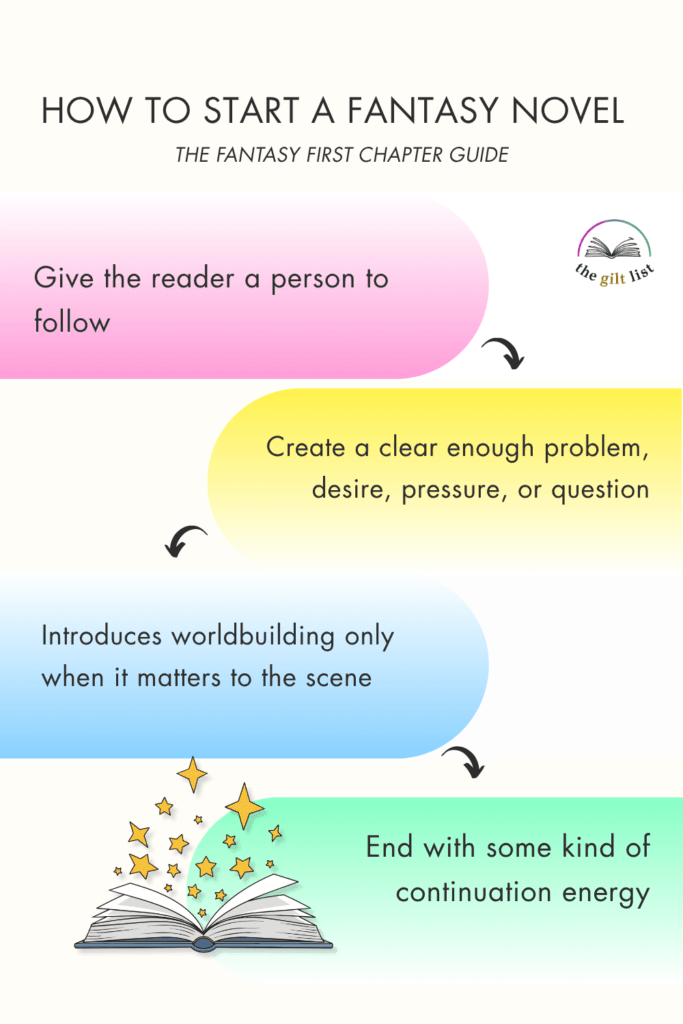
Chapter one should include the worldbuilding the reader needs to understand the current scene.
Worldbuilding earns its place if it explains:
- what the character can do
- what the character cannot do
- what the character risks
- what the character wants
- who has power
- what a choice costs
- why the scene matters
- what is about to happen
Some quick examples:
- A magic law matters if someone is about to break it.
- A court custom matters if one wrong gesture could humiliate the protagonist.
- A kingdom’s history matters if the conflict nods to it.
- A religious rule matters if the character’s desire puts them against it.
It’s best to strip the worldbuilding first, and re-read the chapter to see if it still makes sense. You can do this with a beta reader or friend.
If the problem is that the world itself is still half-built, use the free worldbuilding tool for fantasy writers before you keep forcing answers into Chapter One. The World Bible Builder helps you develop the systems underneath the story first, then its World Reveal Plan helps you decide which pieces the opening actually needs.
Should you explain the magic system in the first chapter?
Explain the magic system in chapter one when the reader needs the rule to understand a choice, risk, cost, or consequence.
A first-chapter magic explanation might show:
- what the magic can do in this scene
- what it costs
- what happens if someone sees it
- why the protagonist uses it or refuses to use it
- how it changes the character’s options
A full system explanation can wait. Please don’t go into a tangent on the page, or have a character say it all out loud. Choose one or two one liners, like internal monologue, or costly choices, to give the reader the gist.
A simple test that helps:
- Can the reader understand the scene without this explanation?
- Would the scene lose meaning without this explanation?
Should a fantasy novel start with a prologue?
A fantasy novel can start with a prologue if the prologue creates the right expectation for the book. Most of the time though, the answer is a big, fat, no. Save it for your author email list, or social media.
Now if you write epic, heavy, fantasy, go for it. Some quick tricks authors of lighter fantasy may also use are poems at the top of chapters, pictures of maps with hidden details, and family trees.
A prologue is weak because it usually explains history without creating conflict, introduces characters who vanish without purpose for the reader, or makes chapter one feel smaller in a disappointing way after an epic backstory. I found Divine Rivals caused the prologue let down, the story felt more contained than its prologue. Of course, the author can get away with it with her success and incredible skill.
The question to ask is simple:
- Does the prologue make chapter one more compelling?
- If not, it may be doing work of a bonus book or chapter near the end.
Common fantasy first chapter mistakes
These are the issues I would check first.
Opening with history before a character
History becomes more interesting when the reader can see who is living with its consequences.
Ancient wars, curses, royal betrayals, dead queens, old gods, and fallen empires can all matter deeply. They hit faster when they press on someone in the present scene.
Start with the effect. Bring in the cause much later.
Introducing too many names too soon
Proper nouns create memory work.
A named character, place, object, title, god, kingdom, faction, language, and magical discipline all ask the reader to store something. If too many pop up before the story gives them weight, the opening starts to feel too much.
Explaining the world before the scene needs it
The first chapter should not feel like the reader has to pass a quiz before the story begins.
Worldbuilding is strongest when it works inside the scene. If a detail does not affect what is happening now, it may belong later. Or almost certainly does.
This is especially true for political systems, magical categories, geography, and history.
Starting with atmosphere that has no conflict
Atmosphere is part of fantasy’s appeal. A strong sensory opening can do real work. It still needs conflict underneath it. A forest becomes more interesting when entering it has a cost. A court becomes scarier when one mistake matters. A village becomes spookier when the protagonist is trying to keep something hidden inside it.
Atmosphere works best when the reader can feel why the place matters.
Waiting too long to reveal character desire
The protagonist does not need to want something enormous in chapter one. They can want to get through a ceremony, avoid a conversation, hide a power, reach a locked room, protect a sibling, leave town, win a trial, or keep a secret for one more day.
Making the opening promise the wrong book
Sometimes the first chapter works on its own and still sets up the wrong expectation.
- A romance-forward opening creates a different expectation from a political fantasy opening.
- A dark prologue creates a different expectation from a comic chapter one.
- A slow, lyrical opening creates a different expectation from a high-tension adventure opening.
The problem may not be the quality of the chapter. It may be the match between the opening and the book that follows.
How to know if your fantasy first chapter is working
A fantasy first chapter is probably working if the reader can answer these questions:
- Who am I following?
- What does this character want, fear, hide, or need right now?
- Was the reader told what the MC wants once the scene stakes changed?
- What changed by the end of the chapter?
- What kind of world am I entering?
- What kind of emotional experience is being promised?
- What question or pressure makes chapter two feel necessary?
- What information mattered most?
Beta reader feedback can help, but only if you know how to read it. “I liked the writing but struggled to get into it” often points to weak conflict or delayed attachment. “I was confused” often points to orientation problems. “It gets better later” usually means chapter one is not yet doing enough.
What should happen by the end of chapter one?
By the end of chapter one, something should change.
That change might be external:
- a secret is exposed
- a rule is broken
- a threat appears
- a choice is made
- a power is revealed
- an invitation arrives
- a relationship changes
- a door closes
It might be internal:
- the protagonist admits a fear
- shame becomes action
- desire becomes harder to deny
- trust weakens
- grief worsens
- a belief cracks
The ending does not need a cliffhanger as much as it needs a goal for the reader to follow.
Find Your Story Idea
If you’re ready to get started but can’t decide on a story idea, you can take a spin on my story spark tool that helps you find story ideas.
Do you need a first chapter critique?
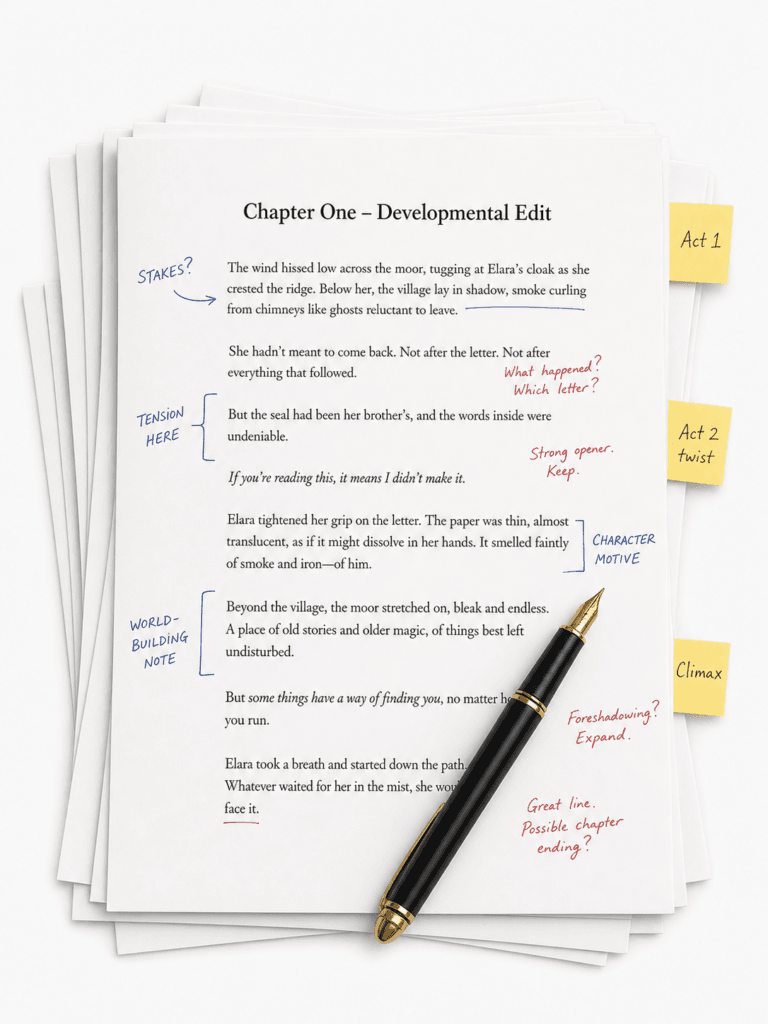
A first chapter critique is great for when you cannot tell whether your opening is creating the right reader experience.
It can help if:
- beta readers say the chapter is confusing
- readers like the writing but do not feel hooked
- the book gets stronger after chapter two or three
- you keep rewriting the opening without knowing what changed
- you are preparing to query
- you are preparing for beta readers
- you are self-publishing and want the opening to work harder
- you need to know whether the chapter is promising the right book
A good critique should tell you what the opening is doing, where the reader may stumble, and what to revise first.
It should also separate line-level issues from structural issues. A sentence polish will not fix a chapter that has no pressure, unclear desire, or too much worldbuilding in the wrong place.
[Book a First Chapter Critique] or [Book a Manuscript Critique]
Fantasy first chapter resources
Start here:
If you want professional feedback:
Final thoughts
A fantasy first chapter should open the door and beckon you inside.
Give the reader a character to follow, enough world to stand in, enough conflict to feel a current, and a clear promise about the story ahead. Once those pieces are working, the prose has something stronger to sit on and you can look at line level issues.
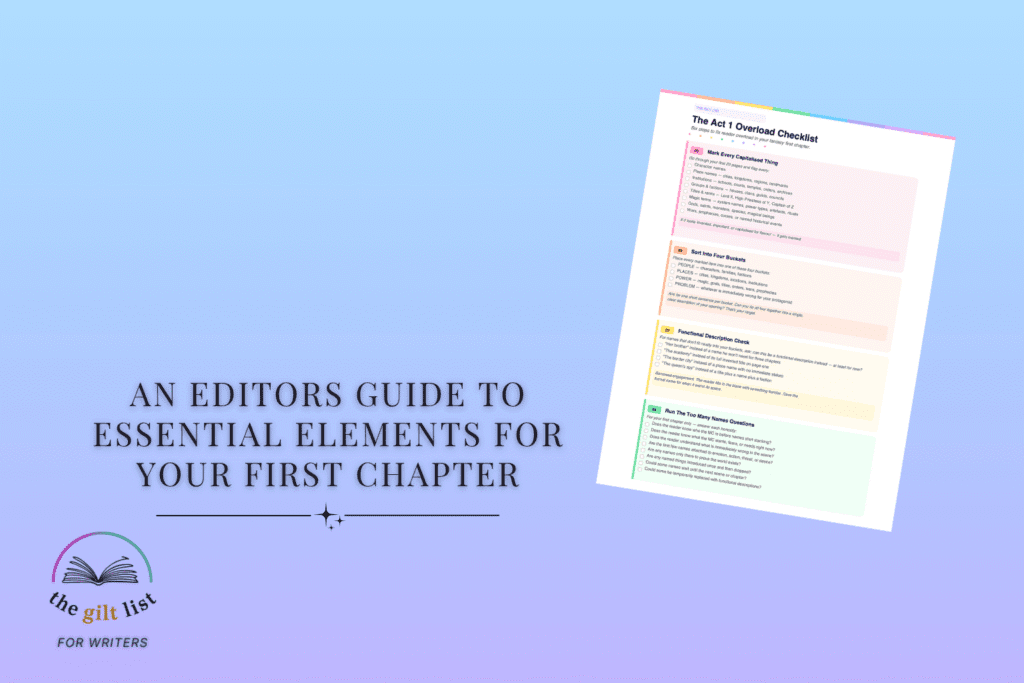
If your opening still feels slow, unclear, or hard to connect to, start with the checklist. If you want another set of eyes on the pages, the first chapter critique is built for exactly this stage.
FAQ: Fantasy First Chapters
The first chapter of a fantasy novel should introduce the reader to a character, a situation, and a reason to keep reading. It should also signal the tone and genre of the book. The reader does not need every piece of worldbuilding yet, but they should understand enough to follow the scene.
Chapter one should include the worldbuilding needed to understand the scene, the character’s choices, and the pressure of the moment. Extra history, terminology, politics, or magic-system explanation can usually wait until the reader has a stronger reason to care.
A fantasy novel can start with action, but the action needs context and consequence. A fast opening works best when the reader understands who is involved, what is at risk, and what changes because of the scene.
There is no fixed number, but fewer important names are usually easier for the reader to hold. Introduce the characters who matter to the immediate scene first. Names attached to emotion, danger, action, or desire are easier to remember than names attached only to background information.
Use a prologue if it creates the right expectation for the book and makes chapter one more compelling. A prologue is weaker when it only explains history or promises a more intense story than the main opening delivers.
Readers often DNF fantasy openings because they feel overloaded, unanchored, or unsure what they are meant to care about. The writing can be strong and still lose readers if the chapter delays character attachment, pressure, or clarity for too long.
A first chapter critique is focused editorial feedback on the opening pages of a manuscript. For fantasy and romantasy, it usually looks at hook, clarity, story promise, worldbuilding load, character desire, pacing, genre signal, and whether the chapter creates enough reason to continue.